

ガイド(2024年最新)実際のDatabricks Databricks-Certified-Data-Engineer-Associate試験問題
Databricks-Certified-Data-Engineer-Associate試験問題集合格させるのは更新されたのは2024年年最新の認証済み試験問題
GAQMのDatabricks-Certified-Data-Engineer-Associate(Databricks認定データエンジニアアソシエイト)試験は、Databricksを使用してビッグデータソリューションを設計および実装する専門知識を証明したい個人を対象とした認定プログラムです。この試験は、Databricksを使用して大規模なデータ処理システムを構築および管理するスキルを検証したいデータエンジニア、データアナリスト、ビッグデータアーキテクトを対象としています。
認定試験は、データビックに関する候補者の知識と、プラットフォームを使用してデータパイプラインを構築および管理する能力をテストするように設計されています。試験は多肢選択式の質問で構成され、タイミングがあり、最大時間制限は120分です。試験に合格するには、候補者は70%の最小スコアを達成する必要があります。この試験はオンラインで入手でき、世界中のどこからでも撮影でき、あらゆるバックグラウンドや場所のデータエンジニアがアクセスできるようにします。
質問 # 59
Which of the following SQL keywords can be used to convert a table from a long format to a wide format?
- A. CONVERT
- B. TRANSFORM
- C. SUM
- D. WHERE
- E. PIVOT
正解:E
解説:
The SQL keyword that can be used to convert a table from a long format to a wide format is PIVOT. The PIVOT clause is used to rotate the rows of a table into columns of a new table1. The PIVOT clause can aggregate the values of a column based on the distinct values of another column, and use those values as the column names of the new table1. The PIVOT clause can be useful for transforming data from a long format, where each row represents an observation with multiple attributes, to a wide format, where each row represents an observation with a single attribute and multiple values2. For example, the PIVOT clause can be used to convert a table that contains the sales of different products by different regions into a table that contains the sales of each product by each region as separate columns1.
The other options are not suitable for converting a table from a long format to a wide format. CONVERT is a function that can be used to change the data type of an expression3. WHERE is a clause that can be used to filter the rows of a table based on a condition4. TRANSFORM is a keyword that can be used to apply a user-defined function to a group of rows in a table5. SUM is a function that can be used to calculate the total of a numeric column.
References:
* 1: PIVOT | Databricks on AWS
* 2: Reshaping Data - Long vs Wide Format | Databricks on AWS
* 3: CONVERT | Databricks on AWS
* 4: WHERE | Databricks on AWS
* 5: TRANSFORM | Databricks on AWS
* : [SUM | Databricks on AWS]
質問 # 60
A new data engineering team team. has been assigned to an ELT project. The new data engineering team will need full privileges on the database customers to fully manage the project.
Which of the following commands can be used to grant full permissions on the database to the new data engineering team?
- A. GRANT ALL PRIVILEGES ON DATABASE customers TO team;
- B. GRANT SELECT PRIVILEGES ON DATABASE customers TO teams;
- C. GRANT SELECT CREATE MODIFY USAGE PRIVILEGES ON DATABASE customers TO team;
- D. GRANT USAGE ON DATABASE customers TO team;
- E. GRANT ALL PRIVILEGES ON DATABASE team TO customers;
正解:A
解説:
Explanation
To grant full privileges on the database "customers" to the new data engineering team, you can use the GRANT ALL PRIVILEGES command as shown in option E. This command provides the team with all possible privileges on the specified database, allowing them to fully manage it.
質問 # 61
An engineering manager wants to monitor the performance of a recent project using a Databricks SQL query.
For the first week following the project's release, the managerwants the query results to be updated every minute. However, the manager is concerned that the compute resources used for the query will be left running and cost the organization a lot of money beyond the first week of the project's release.
Which of the following approaches can the engineering team use to ensure the query does not cost the organization any money beyond the first week of the project's release?
- A. They can set the query's refresh schedule to end on a certain date in the query scheduler.
- B. They can set the query's refresh schedule to end after a certain number of refreshes.
- C. They can set a limit to the number of individuals that are able to manage the query's refresh schedule.
- D. They can set a limit to the number of DBUs that are consumed by the SQL Endpoint.
- E. They cannot ensure the query does not cost the organization money beyond the first week of the project's release.
正解:A
質問 # 62
A data engineer has realized that they made a mistake when making a daily update to a table. They need to use Delta time travel to restore the table to a version that is 3 days old. However, when the data engineer attempts to time travel to the older version, they are unable to restore the data because the data files have been deleted.
Which of the following explains why the data files are no longer present?
- A. The TIME TRAVEL command was run on the table
- B. The OPTIMIZE command was nun on the table
- C. The HISTORY command was run on the table
- D. The DELETE HISTORY command was run on the table
- E. The VACUUM command was run on the table
正解:D
質問 # 63
A data engineer has joined an existing project and they see the following query in the project repository:
CREATE STREAMING LIVE TABLE loyal_customers AS
SELECT customer_id -
FROM STREAM(LIVE.customers)
WHERE loyalty_level = 'high';
Which of the following describes why the STREAM function is included in the query?
- A. The data in the customers table has been updated since its last run.
- B. The STREAM function is not needed and will cause an error.
- C. The table being created is a live table.
- D. The customers table is a reference to a Structured Streaming query on a PySpark DataFrame.
- E. The customers table is a streaming live table.
正解:E
解説:
The STREAM function is used to process data from a streaming live table or view, which is a table or view that contains data that has been added only since the last pipeline update. Streaming live tables and views are stateful, meaning that they retain the state of the previous pipeline run and only process new data based on the current query. This is useful for incremental processing of streaming or batch data sources. The customers table in the query is a streaming live table, which means that it contains the latest data from the source. The STREAM function enables the query to read the data from the customers table incrementally and create another streaming live table named loyal_customers, which contains the customer IDs of the customers with high loyalty level. Reference: Difference between LIVE TABLE and STREAMING LIVE TABLE, CREATE STREAMING TABLE, Load data using streaming tables in Databricks SQL.
質問 # 64
A data analyst has developed a query that runs against Delta table. They want help from the data engineering team to implement a series of tests to ensure the data returned by the query is clean. However, the data engineering team uses Python for its tests rather than SQL.
Which of the following operations could the data engineering team use to run the query and operate with the results in PySpark?
- A. SELECT * FROM sales
- B. There is no way to share data between PySpark and SQL.
- C. spark.table
- D. spark.delta.table
- E. spark.sql
正解:E
解説:
Explanation
from pyspark.sql import SparkSession
spark = SparkSession.builder.getOrCreate()
df = spark.sql("SELECT * FROM sales")
print(df.count())
質問 # 65
Which of the following benefits of using the Databricks Lakehouse Platform is provided by Delta Lake?
- A. The ability to distribute complex data operations
- B. The ability to collaborate in real time on a single notebook
- C. The ability to support batch and streaming workloads
- D. The ability to manipulate the same data using a variety of languages
- E. The ability to set up alerts for query failures
正解:C
解説:
Delta Lake is the optimized storage layer that provides the foundation for storing data and tables in the Databricks lakehouse. Delta Lake is fully compatible with Apache Spark APIs, and was developed for tight integration with Structured Streaming, allowing you to easily use a single copy of data for both batch and streaming operations and providing incremental processing at scale1. Delta Lake supports upserts using the merge operation, which enables you to efficiently update existing data or insert new data into your Delta tables2. Delta Lake also provides time travel capabilities, which allow you to query previous versions of your data or roll back to a specific point in time3. References: 1: What is Delta Lake? | Databricks on AWS 2: Upsert into a table using merge | Databricks on AWS 3: [Query an older snapshot of a table (time travel) | Databricks on AWS] Learn more
1blob:https://www.bing.com/a746b4b4-48d0-4f44-9736-44d1ce0c4228
learn.microsoft.com2blob:https://www.bing.com/525fbb0f-e02f-4a70-8085-22c065fe0ca0 medium.com3blob:https://www.bing.com/5cb5bd07-1008-4cf7-9fa3-42a5a689c7d5 slideshare.net4blob:https://www.bing.com/9a7e8352-30c1-4356-a73f-a7253b607ef7 docs.databricks.com5blob:https://www.bing.com/3f65cc27-d573-4810-b272-01238a431c03 github.com6blob:https://www.bing.com/334f6880-dfeb-4e61-bd9a-76efae0a2d01 key2consulting.com
質問 # 66
Which of the following Git operations must be performed outside of Databricks Repos?
- A. Merge
- B. Push
- C. Pull
- D. Clone
- E. Commit
正解:D
質問 # 67
A data engineer has been given a new record of data:
id STRING = 'a1'
rank INTEGER = 6
rating FLOAT = 9.4
Which of the following SQL commands can be used to append the new record to an existing Delta table my_table?
- A. UPDATE my_table VALUES ('a1', 6, 9.4)
- B. my_table UNION VALUES ('a1', 6, 9.4)
- C. UPDATE VALUES ('a1', 6, 9.4) my_table
- D. INSERT INTO my_table VALUES ('a1', 6, 9.4)
- E. INSERT VALUES ( 'a1' , 6, 9.4) INTO my_table
正解:D
質問 # 68
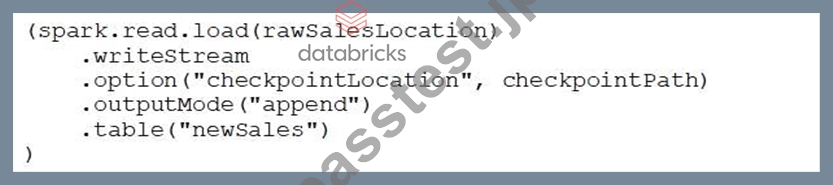
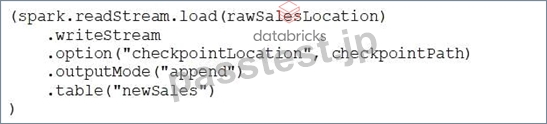
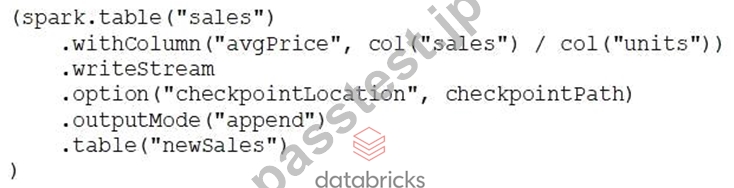
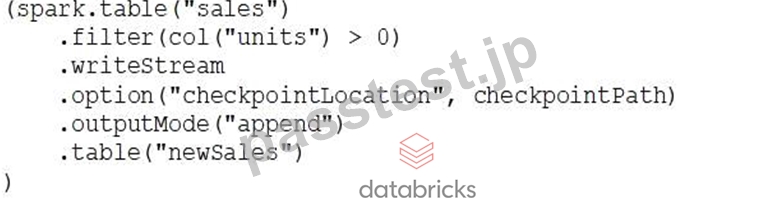
Which of the following Structured Streaming queries is performing a hop from a Silver table to a Gold table?
- A.
- B.

- C.
- D.
- E.
正解:B
質問 # 69
A data engineer has three tables in a Delta Live Tables (DLT) pipeline. They have configured the pipeline to drop invalid records at each table. They notice that some data is being dropped due to quality concerns at some point in the DLT pipeline. They would like to determine at which table in their pipeline the data is being dropped.
Which of the following approaches can the data engineer take to identify the table that is dropping the records?
- A. They can navigate to the DLT pipeline page, click on each table, and view the data quality statistics.
- B. They can navigate to the DLT pipeline page, click on the "Error" button, and review the present errors.
- C. They can set up separate expectations for each table when developing their DLT pipeline.
- D. They can set up DLT to notify them via email when records are dropped.
- E. They cannot determine which table is dropping the records.
正解:A
解説:
Explanation
To identify the table in a Delta Live Tables (DLT) pipeline where data is being dropped due to quality concerns, the data engineer can navigate to the DLT pipeline page, click on each table in the pipeline, and view the data quality statistics. These statistics often include information about records dropped, violations of expectations, and other data quality metrics. By examining the data quality statistics for each table in the pipeline, the data engineer can determine at which table the data is being dropped.
質問 # 70
A dataset has been defined using Delta Live Tables and includes an expectations clause:
CONSTRAINT valid_timestamp EXPECT (timestamp > '2020-01-01') ON VIOLATION FAIL UPDATE What is the expected behavior when a batch of data containing data that violates these constraints is processed?
- A. Records that violate the expectation are added to the target dataset and recorded as invalid in the event log.
- B. Records that violate the expectation are dropped from the target dataset and recorded as invalid in the event log.
- C. Records that violate the expectation are added to the target dataset and flagged as invalid in a field added to the target dataset.
- D. Records that violate the expectation are dropped from the target dataset and loaded into a quarantine table.
- E. Records that violate the expectation cause the job to fail.
正解:E
解説:
The expected behavior when a batch of data containing data that violates the expectation is processed is that the job will fail. This is because the expectation clause has the ON VIOLATION FAIL UPDATE option, which means that if any record in the batch does not meet the expectation, the entire batch will be rejected and the job will fail. This option is useful for enforcing strict data quality rules and preventing invalid data from entering the target dataset.
Option A is not correct, as the ON VIOLATION FAIL UPDATE option does not drop the records that violate the expectation, but fails the entire batch. To drop the records that violate the expectation and record them as invalid in the event log, the ON VIOLATION DROP RECORD option should be used.
Option C is not correct, as the ON VIOLATION FAIL UPDATE option does not drop the records that violate the expectation, but fails the entire batch. To drop the records that violate the expectation and load them into a quarantine table, the ON VIOLATION QUARANTINE RECORD option should be used.
Option D is not correct, as the ON VIOLATION FAIL UPDATE option does not add the records that violate the expectation, but fails the entire batch. To add the records that violate the expectation and record them as invalid in the event log, the ON VIOLATION LOG RECORD option should be used.
Option E is not correct, as the ON VIOLATION FAIL UPDATE option does not add the records that violate the expectation, but fails the entire batch. To add the records that violate the expectation and flag them as invalid in a field added to the target dataset, the ON VIOLATION FLAG RECORD option should be used.
References:
* Delta Live Tables Expectations
* [Databricks Data Engineer Professional Exam Guide]
質問 # 71
A data engineer has been using a Databricks SQL dashboard to monitor the cleanliness of the input data to an ELT job. The ELT job has its Databricks SQL query that returns the number of input records containing unexpected NULL values. The data engineer wants their entire team to be notified via a messaging webhook whenever this value reaches 100.
Which of the following approaches can the data engineer use to notify their entire team via a messaging webhook whenever the number of NULL values reaches 100?
- A. They can set up an Alert with one-time notifications.
- B. They can set up an Alert with a new webhook alert destination.
- C. They can set up an Alert without notifications.
- D. They can set up an Alert with a custom template.
- E. They can set up an Alert with a new email alert destination.
正解:B
解説:
A webhook alert destination is a way to send notifications to external applications or services via HTTP requests. A data engineer can use a webhook alert destination to notify their entire team via a messaging webhook, such as Slack or Microsoft Teams, whenever the number of NULL values in the input data reaches 100. To set up a webhook alert destination, the data engineer needs to do the following steps:
In the Databricks SQL workspace, navigate to the Settings gear icon and select SQL Admin Console.
Click Alert Destinations and click Add New Alert Destination.
Select Webhook and enter the webhook URL and the optional custom template for the notification message.
Click Create to save the webhook alert destination.
In the Databricks SQL editor, create or open the query that returns the number of input records containing unexpected NULL values.
Click the Create Alert icon above the editor window and configure the alert criteria, such as the value column, the condition, and the threshold.
In the Notification section, select the webhook alert destination that was created earlier and click Create Alert. Reference: What are Databricks SQL alerts?, Monitor alerts, Monitoring Your Business with Alerts, Using Automation Runbook Webhooks To Alert on Databricks Status Updates.
質問 # 72
Which of the following describes a scenario in which a data team will want to utilize cluster pools?
- A. An automated report needs to be runnable by all stakeholders.
- B. An automated report needs to be made reproducible.
- C. An automated report needs to be version-controlled across multiple collaborators.
- D. An automated report needs to be refreshed as quickly as possible.
- E. An automated report needs to be tested to identify errors.
正解:D
解説:
Explanation
Cluster pools are typically used in distributed computing environments, such as cloud-based data platforms like Databricks. They allow you to pre-allocate a set of compute resources (a cluster) for specific tasks or workloads. In this case, if an automated report needs to be refreshed as quickly as possible, you can allocate a cluster pool with sufficient resources to ensure fast data processing and report generation. This helps ensure that the report is generated with minimal latency and can be delivered to stakeholders in a timely manner.
Cluster pools allow you to optimize resource allocation for high-demand, time-sensitive tasks like real-time report generation.
質問 # 73
Which of the following must be specified when creating a new Delta Live Tables pipeline?
- A. A location of a target database for the written data
- B. A path to cloud storage location for the written data
- C. The preferred DBU/hour cost
- D. At least one notebook library to be executed
- E. A key-value pair configuration
正解:D
解説:
Option E is the correct answer because it is the only mandatory requirement when creating a new Delta Live Tables pipeline. A pipeline is a data processing workflow that contains materialized views and streaming tables declared in Python or SQL source files. Delta Live Tables infers the dependencies between these tables and ensures updates occur in the correct order. To create a pipeline, you need to specify at least one notebook library to be executed, which contains the Delta Live Tables syntax. You can also specify multiple libraries of different languages within your pipeline. The other options are optional or not applicable for creating a pipeline. Option A is not required, but you can optionally provide a key-value pair configuration to customize the pipeline settings, such as the storage location, the target schema, the notifications, and the pipeline mode. Option B is not applicable, as the DBU/hour cost is determined by the cluster configuration, not the pipeline creation. Option C is not required, but you can optionally specify a storage location for the output data from the pipeline. If you leave it empty, the system uses a default location. Option D is not required, but you can optionally specify a location of a target database for the written data, either in the Hive metastore or the Unity Catalog.
質問 # 74
A data engineer only wants to execute the final block of a Python program if the Python variable day_of_week is equal to 1 and the Python variable review_period is True.
Which of the following control flow statements should the data engineer use to begin this conditionally executed code block?
- A. if day_of_week = 1 and review_period:
- B. if day_of_week == 1 and review_period:
- C. if day_of_week == 1 and review_period == "True":
- D. if day_of_week = 1 and review_period = "True":
- E. if day_of_week = 1 & review_period: = "True":
正解:B
解説:
In Python, the == operator is used to compare the values of two variables, while the = operator is used to assign a value to a variable. Therefore, option A and E are incorrect, as they use the = operator for comparison.
Option B and C are also incorrect, as they compare the review_period variable to a string value "True", which is different from the boolean value True. Option D is the correct answer, as it uses the == operator to compare the day_of_week variable to the integer value 1, and the and operator to check if both conditions are true. If both conditions are true, then the final block of the Python program will be executed. References: [Python Operators], [Python If ... Else]
質問 # 75
A data engineer needs access to a table new_table, but they do not have the correct permissions. They can ask the table owner for permission, but they do not know who the table owner is.
Which of the following approaches can be used to identify the owner of new_table?
- A. Review the Owner field in the table's page in the cloud storage solution
- B. Review the Owner field in the table's page in Data Explorer
- C. All of these options can be used to identify the owner of the table
- D. There is no way to identify the owner of the table
- E. Review the Permissions tab in the table's page in Data Explorer
正解:B
解説:
he approach that can be used to identify the owner of new_table is to review the Owner field in the table's page in Data Explorer. Data Explorer is a web-based interface that allows users to browse, create, and manage data objects such as tables, views, and functions in Databricks1. The table's page in Data Explorer provides various information about the table, such as its schema, partitions, statistics, history, and permissions2. The Owner field shows the name and email address of the user who created or owns the table3. The data engineer can use this information to contact the table owner and request for permission to access the table.
The other options are not correct or reliable for identifying the owner of new_table. Reviewing the Permissions tab in the table's page in Data Explorer can show the users and groups who have access to the table, but not necessarily the owner4. Reviewing the Owner field in the table's page in the cloud storage solution can be misleading, as the owner of the data files may not be the same as the owner of the table5. There is a way to identify the owner of the table, as explained above, so option E is false.
Reference:
1: Data Explorer | Databricks on AWS
2: Table details | Databricks on AWS
3: Set owner when creating a view in databricks sql - Databricks - 9978
4: Table access control | Databricks on AWS
5: External tables | Databricks on AWS
質問 # 76
A data engineer needs to create a table in Databricks using data from a CSV file at location /path/to/csv.
They run the following command: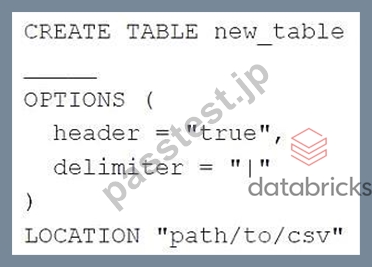
Which of the following lines of code fills in the above blank to successfully complete the task?
- A. USING DELTA
- B. None of these lines of code are needed to successfully complete the task
- C. USING CSV
- D. FROM "path/to/csv"
- E. FROM CSV
正解:C
質問 # 77
A Delta Live Table pipeline includes two datasets defined using STREAMING LIVE TABLE. Three datasets are defined against Delta Lake table sources using LIVE TABLE.
The table is configured to run in Development mode using the Continuous Pipeline Mode.
Assuming previously unprocessed data exists and all definitions are valid, what is the expected outcome after clicking Start to update the pipeline?
- A. All datasets will be updated once and the pipeline will persist without any processing. The compute resources will persist but go unused.
- B. All datasets will be updated once and the pipeline will shut down. The compute resources will be terminated.
- C. All datasets will be updated at set intervals until the pipeline is shut down. The compute resources will persist until the pipeline is shut down.
- D. All datasets will be updated once and the pipeline will shut down. The compute resources will persist to allow for additional testing.
- E. All datasets will be updated at set intervals until the pipeline is shut down. The compute resources will persist to allow for additional testing.
正解:E
解説:
Explanation
You can optimize pipeline execution by switching between development and production modes. Use the Delta Live Tables Environment Toggle Icon buttons in the Pipelines UI to switch between these two modes. By default, pipelines run in development mode.
When you run your pipeline in development mode, the Delta Live Tables system does the following:
Reuses a cluster to avoid the overhead of restarts. By default, clusters run for two hours when development mode is enabled. You can change this with the pipelines.clusterShutdown.delay setting in the Configure your compute settings.
Disables pipeline retries so you can immediately detect and fix errors.
In production mode, the Delta Live Tables system does the following:
Restarts the cluster for specific recoverable errors, including memory leaks and stale credentials.
Retries execution in the event of specific errors, for example, a failure to start a cluster.
https://docs.databricks.com/en/delta-live-tables/updates.html#optimize-execution
質問 # 78
Which of the following describes the storage organization of a Delta table?
- A. Delta tables are stored in a single file that contains data, history, metadata, and other attributes.
- B. Delta tables are stored in a single file that contains only the data stored within the table.
- C. Delta tables store their data in a single file and all metadata in a collection of files in a separate location.
- D. Delta tables are stored in a collection of files that contain data, history, metadata, and other attributes.
- E. Delta tables are stored in a collection of files that contain only the data stored within the table.
正解:D
解説:
Delta Lake is the optimized storage layer that provides the foundation for storing data and tables in the Databricks lakehouse. Delta Lake is open source software that extends Parquet data files with a file-based transaction log for ACID transactions and scalable metadata handling1. Delta Lake stores its data and metadata in a collection of files in a directory on a cloud storage system, such as AWS S3 or Azure Data Lake Storage2. Each Delta table has a transaction log that records the history of operations performed on the table, such as insert, update, delete, merge, etc. The transaction log also stores the schema and partitioning information of the table2. The transaction log enables Delta Lake to provide ACID guarantees, time travel, schema enforcement, and other features1. References:
* What is Delta Lake? | Databricks on AWS
* Quickstart - Delta Lake Documentation
質問 # 79
A data engineer wants to create a relational object by pulling data from two tables. The relational object does not need to be used by other data engineers in other sessions. In order to save on storage costs, the data engineer wants to avoid copying and storing physical data.
Which of the following relational objects should the data engineer create?
- A. Database
- B. Temporary view
- C. View
- D. Delta Table
- E. Spark SQL Table
正解:B
解説:
Explanation
Temp view : session based Create temp view view_name as query All these are termed as session ended:
Opening a new notebook Detaching and reattaching a cluster Installing a python package Restarting a cluster
質問 # 80
......
合格させる保証付き無料クイズ2024年最新の実際に出ると確認されたDatabricks:https://www.passtest.jp/Databricks/Databricks-Certified-Data-Engineer-Associate-shiken.html
Databricks-Certified-Data-Engineer-Associate試験問題でリアルに更新された問題PDF:https://drive.google.com/open?id=1_ZwFX4dhREJUbQXZ0xekUqonc8A0KFCs