

無料で使えるCSC2サンプル問題で100%カバー率のリアル試験問題(更新された187問あります)
今すぐダウンロード!リアルCSI CSC2試験問題集テストエンジン試験問題
質問 # 66
What event would trigger an amendment of the account application while monitoring a portfolio?
- A. The annual client meeting.
- B. When a new market cycle is formed.
- C. When a client's job situation has changed.
- D. When the advisor's views are influenced by a recent news headline.
正解:C
質問 # 67
How does beta help assess the risk of a mutual fund?
- A. Monitors trading volumes.
- B. Compares management expense ratios.
- C. Relates its returns to the underlying markets.
- D. Measures comparative performance.
正解:C
質問 # 68
What is the main responsibility of the trustees of a mutual fund trust?
- A. Ensuring investments are in line with the fund's investment objectives.
- B. Portfolio trading and implementation of investment strategy.
- C. Day-to-day supervision of the investment portfolio.
- D. Arranging cash distributions through dividend payments.
正解:A
質問 # 69
What action must an investment advisor take when submitting a trade ticket for a short sale?
- A. Mark it as a margin order
- B. Obtain minimum margin amount from client
- C. Verify the client can borrow the shares.
- D. Mark the sell-order ticket as a short sate
正解:D
解説:
When submitting a trade ticket for a short sale, an investment advisor mustmark the sell-order ticket as a short sale. This ensures compliance with regulatory requirements and informs the broker and exchange that the sale involves borrowed shares. Marking the order appropriately helps maintain transparency and enables monitoring for potential market manipulation.
* A. Verify the client can borrow the shares: The responsibility for ensuring share availability lies with the broker, not the advisor.
* C. Obtain minimum margin amount from client: This is done separately as part of the account setup and transaction process, not when submitting the trade ticket.
* D. Mark it as a margin order: Short sales involve margin, but the ticket must specifically indicate "short sale" rather than just "margin."
質問 # 70
What do technical analysis and fundamental analysis have in common?
- A. They are used to predict changes in security prices.
- B. They compare the intrinsic value against a security's current price.
- C. They are nullifiedaaccording to the random walk theory.
- D. They study the causes of security' s price movements.
正解:A
解説:
Bothtechnical analysisandfundamental analysisare tools used to predict changes in security prices, but they differ significantly in their approaches.
* Fundamental Analysisevaluates the intrinsic value of a security by analyzing factors such as a company's financial statements, industry conditions, and macroeconomic trends. It assumes that market prices will eventually reflect a security's true value.
* Technical Analysisexamines historical price and volume data to predict future price movements. It focuses on identifying patterns, trends, and market sentiment without regard to the underlying fundamentals.
Option A is incorrect because it only describes fundamental analysis. Option B erroneously connects both methodologies to the random walk theory, which discounts their effectiveness. Option D misstates their purpose, as technical analysis focuses on price trends, not the causes of price movements.
References:
* Volume 2, Chapter 13: Fundamental and Technical Analysis, Overview of Fundamental and Technical Analysis,Canadian Securities Course.
質問 # 71
An advisor to explain the benefits of labour sponsored funds (LSVCC) to some of his clients.
With which client should the advisor have this discussion?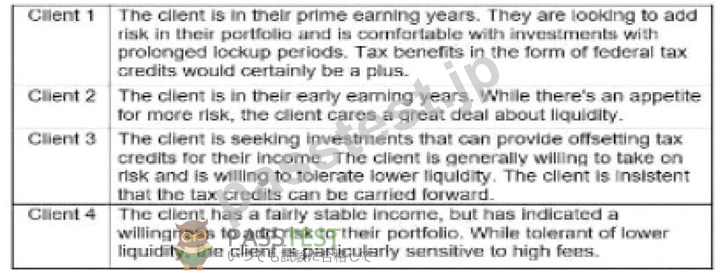
- A. Client 4
- B. Client 2
- C. Client 1
- D. Client 3
正解:C
解説:
Labour Sponsored Venture Capital Corporations (LSVCCs), or labour-sponsored funds, are high-risk investments designed to stimulate job creation and economic growth. They provide tax benefits in the form of federal and, in some cases, provincial tax credits, making them attractive to investors in higher income brackets who are comfortable with the following:
* Increased portfolio risk
* Reduced liquidity due to long lockup periods
* High potential tax incentives
Analysis of Clients:
* Client 1:
* In theirprime earning yearsand comfortable withhigher riskandlong lockup periods.
* Interested intax benefits in the form of federal tax credits.
* Matches the profile of an ideal candidate for LSVCCs.
* Correct answer: C
* Client 2:
* In early earning years and prioritizesliquidityover other factors.
* LSVCCs are unsuitable due to theirlack of liquidity(e.g., lockup periods).
* Incorrect
* Client 3:
* Focused on investments withoffsetting tax creditsbut insists on tax credits being carried forward.
* LSVCC tax credits cannot typically be carried forward, making them unsuitable.
* Incorrect
* Client 4:
* Stable income but sensitive tohigh fees.
* LSVCCs generally havehigh management fees,making them unsuitable.
* Incorrect
References to Canadian Securities Course Exam 2 Study Materials:
* Volume 2, Chapter 22 - Labour Sponsored Venture Capital Corporations
* Discusses LSVCCs, their tax advantages, high-risk nature, and reduced liquidity.
* Volume 2, Chapter 24 - Canadian Taxation
* Explains federal and provincial tax credits applicable to LSVCCs and their suitability for higher- income clients.
質問 # 72
Why are inverse exchange-traded funds effective in declining markets?
- A. They use active management.
- B. They use physical commodities.
- C. They use borrowed capital.
- D. They use derivatives.
正解:D
質問 # 73
What is unique to responsible investment?
- A. It bases investment decisions exclusively on environmental factors.
- B. It is unavailable with certain asset classes like segregated fundi
- C. A combination of a values and valuation-based approach to investing
- D. ESG factors are standardized across the investment no industry.
正解:C
解説:
Responsible investing (RI) incorporates environmental, social, and governance (ESG) factors into investment decisions. This approach combines values-based investing (aligning investments with personal or institutional ethics) and valuation-based investing (analyzing ESG factors to assess potential risks and returns).
* A. It is unavailable with certain asset classes like segregated funds: RI is increasingly available across various asset classes, including segregated funds.
* B. ESG factors are standardized across the investment industry: ESG standards vary and are not uniformly applied.
* D. It bases investment decisions exclusively on environmental factors: RI considers environmental, social, and governance factors, not just environmental concerns.
Reference:CSC Volume 1, Chapter 8, "Responsible Investment - ESG Factors" explains the dual focus of RI on values and valuation.
質問 # 74
Which regulatory body is responsible for the surveillance of trading and market-related activities of participants on Canadian equity marketplaces?
- A. OSFI
- B. OBSI
- C. CSA
- D. CIRO
正解:D
解説:
TheCanadian Investment Regulatory Organization (CIRO)is responsible for overseeing trading and market-related activities of participants on Canadian equity marketplaces. CIRO conducts surveillance to ensure compliance with rules, regulations, and fair market practices.
Other options:
* OBSI (Ombudsman for Banking Services and Investments): Handles disputes between financial institutions and their clients but does not conduct trading surveillance.
* OSFI (Office of the Superintendent of Financial Institutions): Regulates and supervises federally regulated financial institutions, focusing on their solvency.
* CSA (Canadian Securities Administrators): Coordinates securities regulation across Canada but does not directly monitor trading activities.
References:
* Volume 1, Chapter 3:The Canadian Regulatory Environment, section on "Market Surveillance and Trading Oversight" explains CIRO's role.
質問 # 75
Who generally executes portfolio strategy within a buy-side firm?
- A. Investment advisor.
- B. Head of fixed income
- C. Trader
- D. Portfolio manager.
正解:D
解説:
Within a buy-side firm, theportfolio manageris responsible for executing the portfolio strategy. They oversee investment decisions, asset allocation, and security selection based on the investment mandate and client objectives. Other roles:
* Head of fixed income(B) specializes in fixed-income securities rather than overall strategy.
* Investment advisor(C) interacts with clients, focusing on advice rather than execution.
* Trader(D) carries out transactions but does not set the portfolio strategy.
References
* CSC Volume 2, Chapter 27:Working with the Institutional Client - The Buy-Side Portfolio Manager, p.
27-8.
質問 # 76
When acting as a principal, how do investment dealers generate revenue?
- A. Through brokerage changes.
- B. Thrown tracers.
- C. Through spreads on buy/sell prices.
- D. Through commissions
正解:C
解説:
When acting as a principal, investment dealers buy and sell securities for their own account. They generate revenue by earning a spread, which is the difference between the price at which they buy securities (bid price) and the price at which they sell them (ask price). This is distinct from their role as an agent, where revenue is earned through commissions on trades executed on behalf of clients.
* A. Through commissions: Commissions are earned when acting as an agent, not as a principal.
* B. Through tracers: This term does not apply to revenue generation.
* C. Through brokerage charges: Brokerage charges relate to fees imposed on client accounts, not principal trading spreads.
Reference:CSC Volume 1, Chapter 1, "The Principal and Agency Functions of Investment Dealers" explains how spreads generate revenue in principal trades.
質問 # 77
In March of this year, a client buys 1,000 PIL inc, common shares at $16 per share and pays a commission of
$25 on the purchase. Several months later in the same year, the client sell the shares at $12 per share and pays commission of $50 on the sale. What is the client's allowable capital loss on the transaction?
- A. $2,013
- B. $1,925
- C. $2,038
- D. $2,025
正解:C
解説:
To calculate the allowable capital loss, we must first determine the adjusted cost base (ACB) and the proceeds of disposition (POD), then subtract the latter from the former. Commissions on both the purchase and sale are included in the calculation.
Step-by-Step Explanation:
* Purchase Details:
* Number of shares purchased: 1,000
* Purchase price per share: $16
* Total purchase cost before commission: $16 × 1,000 = $16,000
* Add purchase commission: $25
* Adjusted cost base (ACB): $16,000 + $25 = $16,025
* Sale Details:
* Number of shares sold: 1,000
* Sale price per share: $12
* Total sale proceeds before commission: $12 × 1,000 = $12,000
* Deduct sale commission: $50
* Proceeds of Disposition (POD): $12,000 - $50 = $11,950
* Capital Loss Calculation:
* Capital loss = ACB - POD
* Capital loss = $16,025 - $11,950 = $4,075
* Allowable Capital Loss:
* In Canada, 50% of the capital loss is allowable for tax purposes.
* Allowable capital loss = 50% × $4,075 = $2,038
* Option A ($2,038): Correct.
* Option B ($2,025): Incorrect; likely excludes commissions or contains a minor calculation error.
* Option C ($1,925): Incorrect; this does not account for the full adjusted cost base or allowable percentage.
* Option D ($2,013): Incorrect; this likely contains a rounding error or miscalculation.
References to Canadian Securities Course Exam 2 Study Materials:
* Volume 2, Chapter 24 - Canadian Taxation
* Discusses the calculation of adjusted cost base (ACB), proceeds of disposition (POD), and allowable capital losses.
* Volume 1, Chapter 11 - Corporations and Their Financial Statements
* Details financial concepts like capital gains, losses, and the treatment of commissions in securities transactions.
* Volume 2, Chapter 26 - Working with the Retail Client
* Covers tax implications and planning for securities transactions.
質問 # 78
Which derivatives transaction has the greatest default risk?
- A. Individual investor entering future contract with an institutional investor.
- B. Exchange-traded equity option contract between an individual investor and a dealer.
- C. Individual investor buying shares on an exchange during the ex-rights period.
- D. Interest rate forward agreement between an investment dealer and a corporation.
正解:D
解説:
Aninterest rate forward agreement (FRA)is anover-the-counter (OTC)derivative contract. Unlike exchange- traded derivatives, OTC contracts are not centrally cleared, meaning there is nointermediary to guarantee performance. This increases counterparty (default) risk, making FRAs inherently riskier than exchange-traded contracts.
* A. Individual investor buying shares on an exchange during the ex-rights period: This is a standard transaction involving equity securities, not derivatives, and carries no default risk.
* C. Exchange-traded equity option contract between an individual investor and a dealer: Exchange- traded derivatives are backed by a clearinghouse, which mitigates default risk.
* D. Individual investor entering a futures contract with an institutional investor: Futures contracts are also exchange-traded and centrally cleared, reducing default risk.
質問 # 79
What item compares the expected return of the market portfolio to the riskless rate?
- A. Beta
- B. Alpha
- C. Risk premium
- D. Variance
正解:C
質問 # 80
How are investment dealers unique participants in the institutional market?
- A. They manage a firm's financial assets in support of a company's business activities.
- B. They manage pools of assets on behalf of beneficiaries.
- C. They produce research reports.
- D. They act on both they buy side and sell side.
正解:D
解説:
Investment dealers play a unique role in the institutional market due to their dual capability of operating on both thebuy sideand thesell side:
* The Buy SideInvestment dealers assist institutional investors like pension funds, mutual funds, and hedge funds in acquiring securities to meet their investment objectives. These clients aim to optimize returns on their invested assets, and the dealers provide them with access to securities markets, investment advice, and execution services.
* The Sell SideOn the sell side, investment dealers facilitate the issuance of new securities. They underwrite and distribute these securities, providing liquidity to the market. They also produce research reports and provide trade execution services to institutional and retail clients. This dual operation is critical for maintaining market efficiency and ensuring the smooth functioning of capital markets.
This dual-role capacity makes investment dealers pivotal in bridging gaps between the needs of securities issuers and institutional investors. They enhance market liquidity, efficiency, and transparency through their intermediary functions.
References:
* Canadian Securities Course, Volume 1, Chapter 1:The Investment Dealer's Role as a Financial Intermediary
* Canadian Securities Course, Volume 2, Chapter 27:Working with the Institutional Client.
質問 # 81
Which type of market participant is generally regulated as an alternative trading system?
- A. Pink sheets
- B. Dark pool
- C. Venture exchange
- D. Over-the-counter bulletin board.
正解:B
解説:
Analternative trading system (ATS)is a trading platform that is not a formal stock exchange but allows for the buying and selling of securities. Adark poolis a type of ATS where trade details are not displayed until after execution, providing anonymity to large institutional trades. Other options like venture exchanges, pink sheets, and OTC bulletin boards are not considered ATSs.
References:
* Volume 1, Chapter 9, "Alternative Trading Systems".
質問 # 82
After reviewing a client's risk tolerance, time horizon and financial objectives. Andy recommends that a long- term asset mix of 55% equities, 40 bonds and 5% cash would be most appropriate for the client.
Which approach has Andy taken in his recommendation?
- A. Tactical asset allocation
- B. Dynamic asset allocation
- C. Strategic asset allocation
- D. Ongoing asset allocation
正解:C
解説:
Strategic asset allocationis a long-term approach to portfolio management where a target allocation among asset classes (e.g., equities, bonds, cash) is established based on the client's risk tolerance, time horizon, and financial objectives. This allocation remains relatively constant over time, with periodic rebalancing to maintain the original proportions.
* Details of Andy's Recommendation:Andy recommends a fixed asset mix of 55% equities, 40% bonds, and 5% cash, which aligns with the principles of strategic asset allocation. The focus is on maintaining this allocation to meet long-term goals, without frequent shifts based on short-term market movements.
* Why Other Options Are Incorrect:
* A. Dynamic asset allocation: This involves frequent changes to asset allocation in response to market trends, which is not evident in Andy's recommendation.
* B. Tactical asset allocation: This is a short-term, active approach where adjustments are made based on market conditions to capitalize on opportunities.
* D. Ongoing asset allocation: While this involves periodic rebalancing, it is not a defined approach like strategic allocation.
References:
* CSC Volume 2, Chapter 16: Asset allocation strategies.
質問 # 83
After reviewing a client's risk tolerance, time horizon and financial objectives. Andy recommends that a long- term asset mix of 55% equities, 40 bonds and 5% cash would be most appropriate for the client.
Which approach has Andy taken in his recommendation?
- A. Tactical asset allocation
- B. Dynamic asset allocation
- C. Strategic asset allocation
- D. Ongoing asset allocation
正解:C
解説:
Strategic asset allocation is a long-term approach to portfolio management where a target allocation among asset classes (e.g., equities, bonds, cash) is established based on the client's risk tolerance, time horizon, and financial objectives. This allocation remains relatively constant over time, with periodic rebalancing to maintain the original proportions.
* Details of Andy's Recommendation:Andy recommends a fixed asset mix of 55% equities, 40% bonds, and 5% cash, which aligns with the principles of strategic asset allocation. The focus is on maintaining this allocation to meet long-term goals, without frequent shifts based on short-term market movements.
* Why Other Options Are Incorrect:
* A. Dynamic asset allocation: This involves frequent changes to asset allocation in response to market trends, which is not evident in Andy's recommendation.
* B. Tactical asset allocation: This is a short-term, active approach where adjustments are made based on market conditions to capitalize on opportunities.
* D. Ongoing asset allocation: While this involves periodic rebalancing, it is not a defined approach like strategic allocation.
:
CSC Volume 2, Chapter 16: Asset allocation strategies.
質問 # 84
......
最新CSC2テスト問題集を試そう!更新されたCSI試験が合格できます:https://www.passtest.jp/CSI/CSC2-shiken.html
検証済み!CSC2問題集と解答でCSC2テストエンジン正確解答付き:https://drive.google.com/open?id=1vBLam7ga-VAPMp1yJ5wsRn-G3N1nUth8