

CPHQ問題集でリアル試験問題でテストエンジン問題集でトレーニング
NAHQ CPHQテスト問題集とオンライン試験エンジン
CPHQ認定試験は、医療品質と患者安全の向上に献身している医療専門家にとって、必要不可欠な資格です。これは、卓越性へのコミットメントと、医療品質管理の追求において超越する意欲を示します。CPHQ認定を取得することで、医療専門家はキャリアを向上させ、収益性を高め、医療業界に意義ある影響を与えることができます。
CPHQ試験は紙ベースおよびコンピュータベースのフォーマットで提供され、世界中のテストセンターで年間を通じて利用可能です。試験料には、候補者ハンドブック、オンラインリソース、練習問題などの学習資料へのアクセスが含まれます。NAHQは、試験の準備を支援するワークショップやウェビナーも提供しています。
質問 # 336
An organization Is Implementing a new electronic medical record and has employed a project manager.
At the first meeting, the project manager observes the following:
* The team estimates It Is one-fourth finished with Identifying benchmark organizations.
* Team members have not yet begun to identify the current state.
- They are halfway through collecting public data, which puts them slightly behind schedule for that task.
Which of the following tools should the quality Improvement project manager recommend?
- A. Ishlkawa diagram
- B. Model for Improvement
- C. Design of Experiments
- D. Gantt chart
正解:D
解説:
A Gantt chart is a type of bar chart that illustrates a project schedule1. This tool is used in project management, and it's particularly useful in the scenario described because it can help the team visualize their progress on different tasks1.
In this case, the team is at different stages with various tasks: they're one-fourth finished with identifying benchmark organizations, they haven't started identifying the current state, and they're halfway through collecting public data1. A Gantt chart can help them see all these tasks and their progress in one place, making it easier to manage their work and stay on schedule1.
While the other tools mentioned (Model for Improvement, Design of Experiments, Ishikawa diagram) can be useful in certain scenarios, they don't specifically address the need to visualize and manage progress on multiple tasks23. Therefore, the Gantt chart is the most appropriate tool to recommend in this situation1.
質問 # 337
A healthcare organization has decided that the healthcare quality professional will provide performance improvement training to all supervisors. The first step is to
- A. assess the past performance of the group.
- B. provide a pretraining reading list.
- C. determine current knowledge of the supervisors.
- D. develop the content outline.
正解:C
解説:
The first step in providing performance improvement training to supervisors is to assess their current knowledge. Understanding the existing knowledge level allows the healthcare quality professional to tailor the training content to address gaps, reinforce existing knowledge, and ensure that the training is relevant to the audience's needs. Without this initial assessment, there is a risk that the training might be too basic or too advanced, leading to ineffective learning outcomes.
Develop the content outline (B): While important, developing the content outline should come after assessing the supervisors' current knowledge to ensure the training is appropriately targeted. Assess the past performance of the group (C): Assessing past performance can be helpful, but it is secondary to understanding current knowledge, as the latter directly informs the content and structure of the training.
Provide a pretraining reading list (D): This is a preparatory step that would be more effective after determining what knowledge needs to be covered during the training. Reference NAHQ Body of Knowledge: Education and Training in Quality Improvement NAHQ CPHQ Exam Preparation Materials: Training Program Development and Implementation
質問 # 338
Which of the following best describes the purpose of the nominal group technique?
- A. eliminates redundant Ideas generated by team members
- B. ensures effective communication among team members
- C. diffuses potential conflict between team members
- D. encourages equal participation from all team members
正解:D
解説:
The Nominal Group Technique (NGT) is a structured method for group brainstorming that encourages contributions from everyone12. It is designed to facilitate quick agreement on the relative importance of issues, problems, or solutions2. The process involves participants identifying and contributing ideas toward a topic or question specified by the facilitator1. Participants then discuss and individually prioritize the ideas1. This method ensures that the opinions of all group members are taken into account and prevents the discussion and process from being dominated by an individual participant1. Therefore, it encourages equal participation from all team members.
References:
https://asq.org/quality-resources/nominal-group-technique
質問 # 339
There is an increased incidence of type 2 diabetes among patients living near a healthcare organization as compared to the state.
Considering social determinants of health, which of the following strategies can be used to address this problem?
- A. Collaborate with local farmers' markets to make fresh produce more widely available.
- B. Review evidence-based diabetes management protocols with primary care providers.
- C. Set up a community-based education program about blood glucose monitoring.
- D. Educate newly diagnosed patients on diabetes disease management.
正解:A
解説:
Addressing the increased incidence of type 2 diabetes through the lens of social determinants of health involves addressing broader factors that impact health. Collaborating with local farmers' markets to make fresh produce more widely available is a strategy that addresses the social determinants of health by improving access to healthy food options. This approach can help reduce the risk of diabetes by making it easier for community members to make healthy dietary choices, thereby addressing one of the root causes of the increased diabetes incidence.
Educate newly diagnosed patients on diabetes disease management (A): While important, this strategy focuses on managing diabetes after it occurs rather than addressing the social determinants that contribute to its onset.
Set up a community-based education program about blood glucose monitoring (B): This is also important for management but does not directly address the social determinants that lead to the higher incidence.
Review evidence-based diabetes management protocols with primary care providers (C): This improves care quality but does not address the social factors contributing to the disease.
Reference
NAHQ Body of Knowledge: Addressing Social Determinants of Health in Quality Improvement NAHQ CPHQ Exam Preparation Materials: Strategies for Managing Social Determinants of Health
質問 # 340
Universities often evaluate applicants for admission on the basis of, among other things, the applicants' scores on standardized tests. The scores are thus one of the criteria by which program judge the Quality of their applicants. However, although two programs may use the same criterion - scores on a specific standardized examination-to evaluate applicants, the programs may differ markedly on standards: One program may consider applicants acceptable if they have scores above the 50th percentile, whereas the score above the 90th percentile may be the standard of acceptability for the other program.
This example clearly defines the difference between:
- A. Processes and outcomes
- B. Sources and structure
- C. Criteria and standards
- D. Efficacy and equity
正解:C
質問 # 341
An improvement project was implemented to expand utilization of primary care services in a rural area where only 5% of residents sought primary care. The team established a goal of 20% of residents using primary care.
The table below shows the results for the four months following implementation of the improvement:
% Residents Using Primary Care
Time | %
Baseline | 5%
Month 1 | 15%
Month 2 | 20%
Month 3 | 21%
Month 4 | 22%
Which of the following should the quality professional recommend to the organization?
- A. Implement another improvement cycle.
- B. Assess patient satisfaction with providers.
- C. Disband the improvement team.
- D. Monitor for sustainment.
正解:D
解説:
The improvement project successfully increased the utilization of primary care services from a baseline of 5% to 22% by the fourth month, surpassing the initial goal of 20%. At this point, the quality professional should focus on ensuring that this improvement is sustained over time. Monitoring for sustainment involves tracking the ongoing performance to confirm that the increased utilization is maintained and identifying any potential declines or issues early. Continuous monitoring helps to determine if the implemented changes have become fully integrated into routine practices and are producing the desired outcomes consistently.
* Implement another improvement cycle (A): This is unnecessary at this stage, as the goal has been met and even exceeded. Further improvement cycles should only be considered if the current gains are not sustained or if new goals are established.
* Assess patient satisfaction with providers (C): While assessing patient satisfaction is important, it is not the immediate priority after meeting the primary utilization goal. Satisfaction assessments could be part of a broader quality strategy but do not address the current need for ensuring the sustainability of improvements.
* Disband the improvement team (D): Disbanding the team could be premature, as their role in monitoring sustainment is crucial. The team may still be needed to support ongoing improvements or address any emerging issues.
References
* NAHQ Body of Knowledge: Quality Improvement Processes
* NAHQ CPHQ Exam Preparation Materials: Sustaining Improvements
* NAHQ Guide to Measuring Healthcare Outcomes
=========
質問 # 342
Reviewing organizational priorities, addressing regulatory requirements, and identifying goals for the next year are important components in the development of which of the following?
- A. incentive bonus plans
- B. quality improvement plan
- C. survey readiness teams
- D. annual competency checklist
正解:B
解説:
Explanation: Reviewing priorities, regulatory requirements, and goals is key to developing a quality improvement plan (D), guiding quality efforts. Competency checklists (A), survey teams (B), and bonus plans (C) are unrelated. NAHQ emphasizes these components for quality planning.
NAHQ CPHQ Study Guide, Organizational Leadership Section, "Quality Improvement Planning"; NAHQ CPHQ Practice Questions, Strategic Quality Management.
質問 # 343
Following a procedure, a patient is returned to the operating room for removal of a sponge. If no incident report is completed, which of the following will most reliably identify the occurrence?
- A. Surgeon disclosure
- B. Patient complaint
- C. Claims data
- D. Peer review
正解:C
解説:
Claims data is often the most reliable source to detect adverse events like retained surgical items, especially if incident reports are missing due to underreporting. Claims submitted for reimbursement contain diagnostic and procedure codes that flag such events (The Joint Commission, Sentinel Event Reporting, 2024; AHRQ, Patient Safety Indicators, 2023).
* Patient complaints and surgeon disclosure may occur but are less consistent.
* Peer review relies on voluntary disclosure and may not capture all events.
References:
The Joint Commission, Sentinel Event Reporting, 2024
AHRQ, Patient Safety Indicators, 2023
質問 # 344
Amenities may cover areas as mentioned below EXCEPT:
- A. Good directional signs
- B. Ample and convenient parking
- C. Vast and facilitated food providing area
- D. Comfortable waiting rooms
正解:C
質問 # 345
An organization Is tracking Infection rates to determine the benchmarks for the next fiscal year. The team Is analyzing the data for Infection rates. Which key variables are missing to interpret the graph?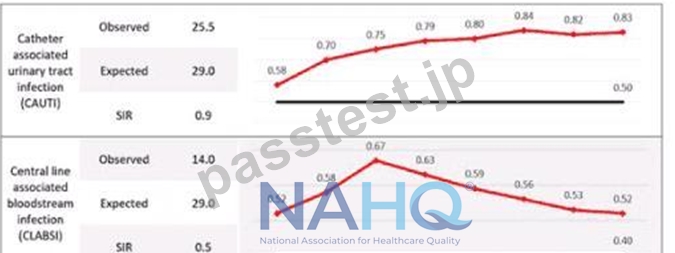
- A. the timeframe for each data point andthe source (or the target line
- B. the mode of the data points and expected rate for external hospitals
- C. the standardized infection ratio for the previous year and denominator for each measure
- D. the quality of patients and hospital compliance with handwashing
正解:A
解説:
The question pertains to key variables missing in a graph that tracks infection rates for benchmarking purposes. The options provided suggest various combinations of data that could potentially be missing, impacting the interpretation of the graph.
Option A suggests a need for historical data and specific denominators, but it doesn't address immediate contextual needs like timeframe or source/target lines.
Option C introduces external hospital expected rates and modes of data points, which might not be directly relevant to interpreting a specific organization's infection rate trends.
Option D focuses on qualitative aspects like patient quality and compliance with handwashing protocols, which are essential but not directly related to interpreting graphical data.
Option B is verified as correct because it highlights two critical elements: "the timeframe for each data point" and "the source (or target line)." These elements are fundamental to understanding any graph as they provide context regarding when the data was collected and what benchmarks or standards are being compared against.
The timeframe is essential to identify trends over time, seasonal variations, or impacts of specific interventions or changes in practice.
The source or target line provides a benchmark indicating expected performance levels or goals that the organization aims to achieve.
Without these two pieces of information, it would be challenging to derive meaningful insights from the graph about infection rate trends and their implications for future benchmarks.
References:
HQ Solutions: Resource for the Healthcare Quality Professional, Fifth Edition, Chapter 5: Quality Review and Accountability, p. 133-134 Learning Lab: Survey Readiness - A Team Approach to Success, Slide 8: Data Display Learning Lab: The Role of the Healthcare Quality Professional in Population Health Management, Slide 10:
Data Visualization
質問 # 346
A recent analysis reveals that reimbursement projection Is being negatively Impacted by post- surgical respiratory failure rates.
What Is the first step to address this issue?
- A. Conduct a focus group with the anesthesiologists and nurse anesthetists.
- B. Conduct focused professional practice evaluation (FPPE) on the surgeons in the organization.
- C. Obtain a list of the patients Identified by this code and conduct a retrospective review.
- D. identify a team leader and facilitator to Implement a quality Improvement project.
正解:C
解説:
When a healthcare organization identifies a problem that is impacting its performance, such as post- surgical respiratory failure rates negatively impacting reimbursement projections, the first step is typically to gather more information about the issue123.
In this case, the best way to do that would be to obtain a list of the patients identified by this code and conduct a retrospective review (Option D)123. This would allow the organization to look back at the medical records of these patients to understand more about their cases, including potential risk factors, the course of their treatment, and the outcomes they experienced123.
This information can then be used to identify patterns or trends that might be contributing to the high rates of post-surgical respiratory failure123. For example, the review might reveal that certain surgical procedures, patient characteristics, or care practices are associated with a higher risk of respiratory failure123.
Once this information has been gathered and analyzed, the organization can then move on to the next steps in the quality improvement process, such as identifying potential interventions, implementing changes, and monitoring their impact123.
Reference: 123
質問 # 347
Which of the following measures would best evaluate the health of a metropolitan area?
- A. Quality-adjusted life year
- B. Life expectancy
- C. Average birth weight
- D. Maternal mortality rate
正解:B
解説:
Evaluating the health of a metropolitan area requires comprehensive measures that reflect the overall well- being of its population. Among the options provided, life expectancy is the most encompassing indicator.
Life Expectancy: This measure indicates the average number of years a person can expect to live, based on current mortality rates. It reflects the overall mortality level of a population and is influenced by a widerange of factors, including healthcare quality, socioeconomic conditions, and public health initiatives.
While the other measures provide valuable insights, they are more specific:
Average Birth Weight: This metric focuses on newborn health and can indicate maternal health and prenatal care quality but does not encompass the broader population.
Quality-Adjusted Life Year (QALY): QALY measures the value of health outcomes by combining quantity and quality of life. It's often used in health economics to assess the value of medical interventions but is less commonly applied to assess the overall health of a metropolitan area.
Maternal Mortality Rate: This rate measures the number of maternal deaths per 100,000 live births. While it is a critical indicator of women's health and healthcare quality, it does not provide a comprehensive view of the entire population's health.
Therefore, life expectancy serves as the most comprehensive measure among the options listed for evaluating the health of a metropolitan area.
References:
City Health Dashboard - "Metrics Background"
National Center for Biotechnology Information (NCBI) - "Measuring, Monitoring, and Evaluating the Health of a Population"
質問 # 348
TQC is excellence driven rather than defect driven-a system that integrates:
- A. Quality development, quality improvement and quality maintenance
- B. Quality improvement and quality maintenance
- C. Quality development, quality improvement and quality assessment
- D. Quality improvement and quality maintenance
正解:A
質問 # 349
The quality director would like to prepare the team for the upcoming accreditation survey. Which of the following would ensure continuous team survey readiness?
- A. Annual mock survey
- B. Routine internal evaluations
- C. Gap analysis of any new standards
- D. Just-in-time assessments
正解:B
解説:
Continuous survey readiness requires ongoing processes to maintain compliance with accreditation standards, ensuring the organization is always prepared.
Option A (Routine internal evaluations): This is the correct answer. The NAHQ CPHQ study guide states,
"Routine internal evaluations, such as regular audits and tracers, ensure continuous readiness by identifying and addressing compliance gaps proactively" (Domain 4). This fosters a culture of preparedness.
Option B (Gap analysis of any new standards): Gap analysis is useful for specific updates but is not a continuous process for overall readiness.
Option C (Annual mock survey): Annual mock surveys are helpful but not continuous, as they occur infrequently.
Option D (Just-in-time assessments): Just-in-time assessments are reactive, conducted close to surveys, not ensuring ongoing readiness.
CPHQ Objective Reference: Domain 4: Performance and Process Improvement, Objective 4.7, "Maintain continuous accreditation readiness," emphasizes routine evaluations. The NAHQ study guide notes, "Ongoing internal evaluations ensure sustained compliance with standards" (Domain 4).
Rationale: Routine evaluations maintain continuous readiness by embedding compliance into daily operations, as per CPHQ's accreditation principles.
Reference: NAHQ CPHQ Study Guide, Domain 4: Performance and Process Improvement, Objective 4.7.
質問 # 350
Many assume they understand how to fix the problem and do not probe beneath the surface of complaints and use
survey responses. Organizations should not be surprised by negative reports. Complaints about unhelpful office staff
could stem from many sources. For instance:
- A. All of these
- B. Employees did not provide clear directions to patients on how to get the practice
- C. Patients were not able to get an appointment when they needed one
- D. Employees put patients on hold in the middle of medical emergencies
正解:A
質問 # 351
He used his understanding of statistics to design tools to respond to variation. Following his arrival at Western Electric Co. in 1924, Shewhart introduced the concepts of common cause, special cause variation and statistical control. He designed these concepts to assist Bell Telephone of repairs within its transmission systems.
Who is he?
- A. Armand Shewhart
- B. Joseph M Juran
- C. W Edwards Deming
- D. Walter Shewhart
正解:D
質問 # 352
During analysis of patient falls, a quality professional notes that there has been an increase in the fall rate over the last 3 months. What other data should be analyzed first to determine potential causes?
- A. nurse to staff ratio
- B. average daily patient census
- C. fall assessment protocol compliance
- D. utilization of chemical restraints
正解:C
解説:
Analyzing fall assessment protocol compliance (C) is the first step to determine causes of increased fall rates, as it evaluates whether risk assessments and interventions are implemented correctly. Census (A), chemical restraints (B), and staffing ratios (D) are secondary factors. NAHQ emphasizes process-related data for safety analysis.
NAHQ CPHQ Study Guide, Patient Safety Section, "Fall Prevention and Data Analysis"; NAHQ CPHQ Practice Questions, Patient Safety Metrics.
質問 # 353
Based on the data below, which unit should the quality Improvement coordinator focus on?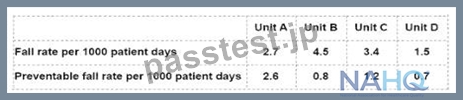
- A. Unit D
- B. Unit A
- C. Unit B
- D. Unit C
正解:C
解説:
* Based on the data below, which shows the percentage of patients who acquired a hospital-associated infection (HAI) in each unit, the quality improvement coordinator should focus on Unit C, which has the highest rate of HAI among the four units.
* A hospital-associated infection (HAI) is an infection that patients get during or after receiving health care in a hospital or other health care facility. HAIs can cause serious complications, increase morbidity and mortality, prolong hospital stays, and increase health care costs. Therefore, preventing and reducing HAIs is a key quality and safety goal for health care organizations.
* A quality improvement coordinator is a professional who develops and implements quality improvement initiatives, monitors and evaluates quality performance, and provides education and support to staff and leaders on quality methods and tools. One of their responsibilities is to identify and prioritize areas for improvement based on data analysis and evidence-based practices.
* To determine which unit should be the focus of quality improvement efforts, the quality improvement coordinator can use a data analysis tool such as a Pareto chart, which shows the frequency or impact of different factors or causes in descending order, along with a cumulative line that indicates the percentage of the total. A Pareto chart can help identify the most significant issues or opportunities for improvement, based on the 80/20 rule, which states that 80% of the effects come from 20% of the causes.
* Using the data below, a Pareto chart can be created as follows:
Table
Unit
HAI Rate (%)
A
5
B
7
C
12
D
4
* The Pareto chart shows that Unit C has the highest HAI rate (12%), followed by Unit B (7%), Unit A (5%), and Unit D (4%). Thecumulative line shows that Unit C alone accounts for 40% of the total HAI rate, and Units C and B together account for 63.3% of the total HAI rate. Therefore, according to the Pareto principle, the quality improvement coordinator should focus on Unit C, as it represents the most significant problem area and the greatest opportunity for improvement.
* The quality improvement coordinator can then conduct a root cause analysis to identify the possible factors or causes that contribute to the high HAI rate in Unit C, such as staff compliance, infection control practices, patient characteristics, environmental factors, etc. A root cause analysis can be facilitated by using a visual tool such as a fishbone diagram, which organizes possible factors into categories, such as people, process, equipment, environment, etc. The quality improvement coordinator can also collect and compare data from other units or sources to identify gaps and best practices.
* Based on the root cause analysis, the quality improvement coordinator can then develop and implement an action plan to address the identified causes and improve the HAI rate in Unit C. The action plan should include specific, measurable, achievable, relevant, and time-bound (SMART) goals, interventions, and indicators. The quality improvement coordinator can also involve the staff and leaders of Unit C in the planning and implementation process, to ensure their engagement and ownership of the improvement efforts.
* The quality improvement coordinator should also monitor and evaluate the progress and outcomes of the action plan, using data collection and analysis tools such as run charts, control charts, or statistical process control (SPC), which can show the variation and trends in the HAI rate over time. The quality improvement coordinator should also provide feedback and recognition to the staff and leaders of Unit C, and make adjustments to the action plan as needed, based on the data and evidence.
References:
NAHQ HQ Principles, Module 2: Data Management, Lesson 2.3: Data Analysis Tools, Topic 2.3.1: Pareto Chart, Topic 2.3.2: Fishbone Diagram NAHQ Learning Lab: The Role of the Healthcare Quality Professional in Population Health Management, Module 3: Data Collection and Analysis, Slide 16: Pareto Chart, Slide 18: Fishbone Diagram NAHQ Journal for Healthcare Quality, Volume 42, Issue 5, September/October 2020, Article: Utilization of Improvement Methodologies by Healthcare Quality Professionals During the COVID-19 Pandemic, Page
283: Figure 1. Pareto Chart of COVID-19 Cases by State as of June 30, 2020 NAHQ News and Media, News: Shaping the Future of the Healthcare Quality Profession, Paragraph 5: The Role of the Quality Improvement Coordinator NAHQ Resources, Healthcare Quality Solutions: Ready Your Workforce for Quality, Page 5: The Role of the Quality Improvement Coordinator
質問 # 354
Several leaders in a healthcare facility have differing opinions regarding the pursuit of alternative certifications and recognitions. The Chief Quality Officer (CQO) has opted to retain an external quality consultant to determine relevance, appropriateness, and readiness for an alternative certification. The most appropriate role for an external consultant is to
- A. determine the final certification selection.
- B. support the CQO's choice for alternative certification.
- C. evaluate the facility's needs, goals, and stakeholder input.
- D. uncover other opportunities for improvement within the facility.
正解:C
解説:
Explanation: An external quality consultant provides objective, expert analysis to guide decision-making in organizational leadership initiatives. The most appropriate role is to evaluate the facility's needs, goals, and stakeholder input (A), ensuring alignment with strategic priorities and readiness. Determining the final certification (B), uncovering other opportunities (C), or supporting the CQO's choice (D) are not the consultant's primary roles. NAHQ emphasizes objective assessment in leadership decisions.
NAHQ CPHQ Study Guide, Organizational Leadership Section, "Role of External Consultants in Quality Initiatives"; NAHQ Code of Practice, Principle 2: Strategic Leadership.
質問 # 355
A random sampling also can be drawn by placing equally sized pieces of paper with a range of numbers on them (e.g., 1 to 100) in a bowl and picking a predetermined number to be the sample.
The problem with simple random samples is that:
- A. They may under represent segments of population
- B. They cannot truly depict the samples
- C. They may over represent segments of population
- D. They may over or under-represent segments of population
正解:D
質問 # 356
Which of the following quality Improvement Tools Is best for risk assessment of a new or modified process?
- A. SWOT analysis
- B. force field analysis
- C. failure mode and effects analysis (FMEA)
- D. 5 whys
正解:C
解説:
Failure Mode and Effects Analysis (FMEA) is a systematic method for evaluating a process to identify where and how it might fail, to assess the relative impact of different failures, and to identify the parts of the process that are most in need of change. FMEA includes review of the following: Steps in the process: Identify what could go wrong during each step.
Failure modes: Identify potential failure modes for each step.
Failure effects: For each failure mode, identify potential effects.
Severity: Assign a severity rating for each effect of failure.
Occurrence: Assign an occurrence rating for each failure mode.
Detection: Assign a detection rating for each failure mode and effect.
Risk Priority Number (RPN): Calculate the RPN for each effect.
FMEA is particularly useful in healthcare for risk assessment of a new or modified process because it not only identifies potential failures, but also prioritizes them based on their impact, frequency of occurrence, and detectability, allowing for targeted and efficient process improvement.
Reference: Quality improvement tools are standalone strategies or processes that can help you better understand, analyze, or communicate your QI efforts1. The 7 Basic Quality Tools for Process Improvement2.
A guide to quality improvement tools3.
質問 # 357
A multidisciplinary team has been convened to review delays in laboratory turnaround time between the medicine clinic and the laboratory. The team's first step in evaluating the issue is to
- A. conduct a failure mode and effects analysis (FMEA).
- B. observe how the medical assistants prepare the specimens.
- C. see if the surgery clinic is also experiencing delays.
- D. create a flow chart to study the process.
正解:D
解説:
The first step for a multidisciplinary team tasked with evaluating delays in laboratory turnaround time is to create a flow chart to study the process. A flow chart visually maps out the steps involved in the current process, allowing the team to understand each stage, identify bottlenecks, and pinpoint where delays might be occurring. This provides a clear, shared understanding of the process among all team members, which is essential before diving into more detailed analysis or improvements.
* Conduct a failure mode and effects analysis (FMEA) (B): FMEA is a valuable tool for identifying potential failures, but it is typically used after understanding the process in detail.
* See if the surgery clinic is also experiencing delays (C): While this could be useful information, the primary focus should be on the specific process under review.
* Observe how the medical assistants prepare the specimens (D): Observation is important, but understanding the entire process flow is the first step.
References
* NAHQ Body of Knowledge: Process Mapping and Flowcharting in Quality Improvement
* NAHQ CPHQ Exam Preparation Materials: Initial Steps in Process Improvement
=========
質問 # 358
Based on this matrix, which of the following ideas should the team address first?
- A. 6 and 8
- B. 2 and 5
- C. 1 and 7
- D. 3 and 4
正解:B
解説:
Based on the matrix provided, ideas 2 and 5 should be addressed first because they are in the quadrant that represents both high impact and high feasibility. Prioritizing ideas that are both highly feasible and likely to have a significant impact ensures that the organization can quickly and effectively implement changes that will yield the most benefit.
* High Impact and High Feasibility: Ideas in this quadrant are typically the most promising because they are not only achievable (high feasibility) but also expected to produce meaningful improvements (high impact).
* Strategic Prioritization: Addressing these ideas first allows the team to generate quick wins, which can build momentum and support for further quality improvement efforts.
* Comparison to Other Options:
* A. 1 and 7: High impact but low feasibility-these ideas might be more challenging to implement and could require more resources or time.
* B. 3 and 4: Low impact and low feasibility-these ideas are neither easy to implement nor likely to have a significant effect, making them lower priorities.
* D. 6 and 8: High feasibility but low impact-while these ideas are easier to implement, their impact might be minimal, so they should not be the primary focus initially.
References: NAHQ materials on prioritization in quality improvement emphasize the importance of focusing on initiatives that combine high impact with high feasibility to optimize resource use and maximize outcomes.
=========
質問 # 359
......
CPHQ認定は、ヘルスケア業界で高く評価されており、世界的に認識されています。それは卓越性のマークであり、医療の質における知識とスキルを向上させるという候補者のコミットメントを示しています。 CPHQ認定は、質の高いマネージャー、リスクマネージャー、患者安全専門家、医療幹部など、さまざまな役割の医療専門家に最適です。 CPHQ認定を取得することにより、候補者は医療の質に関する専門知識を示し、キャリアの見通しを高めることができます。この試験はコンピューターベースであり、世界中のさまざまなテストセンターで撮影できます。
NAHQ CPHQ問題を提供していますCPHQ Certification問題集と完璧な解答付き:https://www.passtest.jp/NAHQ/CPHQ-shiken.html
信頼され続けるCPHQ試験のコツとPDF試験材料:https://drive.google.com/open?id=1wYJmmFqmockv0Xcpt70HRYrXCoSDkYSx