

無料でゲット!2025年最新のに更新されたSAP C-THR81-2405試験問題と解答
C-THR81-2405問題集PDFとテストエンジン試験問題
質問 # 34
What field of the country-specific Corporate Address element is required in the Corporate Data Model?
- A. City
- B. Location
- C. Address1
- D. Country
正解:D
質問 # 35
A business rule triggers a transfer event reason when an employee's location is changed. Which base object would you use for this business rule?
- A. Employee Information Model
- B. Employee Information
- C. Job Information Model
- D. Job Information
正解:C
解説:
When creating a business rule to trigger a transfer event reason upon a location change, theJob Information Modelis the correct base object. This is because location is a field within theJob Informationentity, and changes to fields within this entity are best handled using theJob Information Modelbase object for related rules.
* C: Job Information Model
質問 # 36
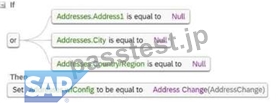
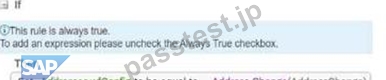
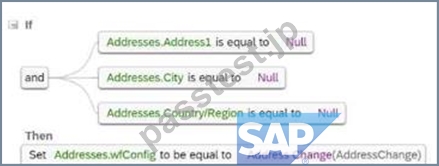
Which clause meets the WFD_Address rule requirement?
- A.

- B.
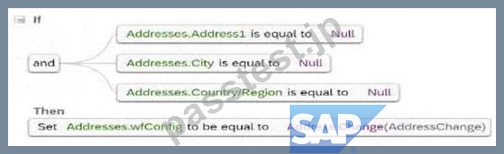
- C.
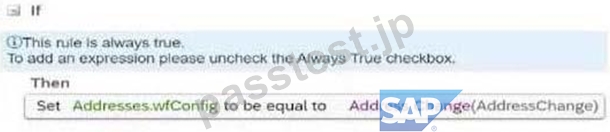
- D.
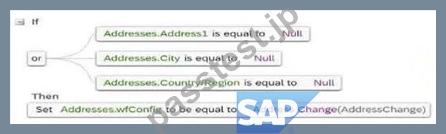
正解:A
質問 # 37
How should you build the IF condition to identity the user when the employee is updating their own Personal Information?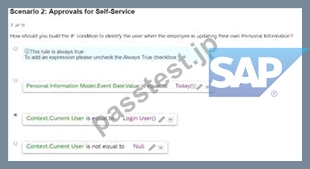
- A. Option B
- B. Option D
- C. Option A
- D. Option C
正解:D
解説:
To identify the user when the employee is updating their own personal information, theIF conditioninOption Cis correct. This configuration:
* Checks if theContext.Current Useris equal to theLogin User.
* Ensures that the rule applies only when the employee is making changes to their own personal data.
This approach is aligned with SAP SuccessFactors logic for self-service scenarios, enabling accurate identification of the user in such workflows.
Scenario 2: Approvals for Self-Service
質問 # 38
What are some SAP recommended guiding principles to achieve clean core operations? Note: There are 3 correct answers to this question.
- A. Define roles and responsibilities as part of a process transformation office.
- B. Establish an organizational structure, technical foundation, and transformation methodology for clean core.
- C. Establish regular housekeeping tasks and procedures.
- D. Establish release management.
- E. Integrate clean core practices in the end-to-end value process chain.
正解:A、B、E
解説:
SAP recommends the following guiding principles to maintain clean core operations:
* Integrate Clean Core Practices in End-to-End Processes: Embed clean core strategies throughout the value chain for consistency.
* Define Roles and Responsibilities: Establish clear accountability for clean core implementation via a process transformation office.
* Organizational and Technical Foundation: Develop a robust framework, including technical structures and methodologies, to drive clean core adherence.
* Other activities like release management and regular housekeeping are operational best practices but not core guiding principles.
Scenario 1: HR Transaction Rules
質問 # 39
What properties are available when using model base objects in business rules? Note: There are 3 correct answers to this question.
- A. PII
- B. Visibility
- C. Previous Value
- D. Max-length
- E. Required
正解:B、C、E
解説:
When working with model base objects in SAP SuccessFactors Employee Central business rules, the following properties are available:
* B. Visibility
* Visibility determines whether a field is displayed or hidden based on business rules. This is critical for maintaining data confidentiality or streamlining user interfaces.
* C. Previous Value
* This property allows rules to compare the current value of a field with its previous value, enabling conditional logic for actions such as triggering notifications or workflows.
* E. Required
* Required indicates whether a field must be populated before a record can be saved. Business rules can enforce data completeness using this property.
A: PII (Personally Identifiable Information)andD. Max-lengthare not applicable properties for business rules in the context of model base objects.
質問 # 40
A customer has scheduled an HRIS sync job, which includes mapping of job titles, to run every Friday. On Tuesday, an employee's job title is changed via Manager Self-Service (MSS) to become effective on Thursday.
When will the synchronization happen?
- A. Saturday, the day after the sync job completes
- B. Tuesday, the day the transaction is entered
- C. Thursday, when the change becomes effective
- D. Friday, when the sync job completes
正解:A
質問 # 41
The HR admin has to change the salary of an employee, which will trigger a workflow for the employee's manager. The employee's manager should be able to edit the transaction if the propo amount is NOT correct. Where in the workflow do you need to define this?
Refer to the screenshot to answer the question.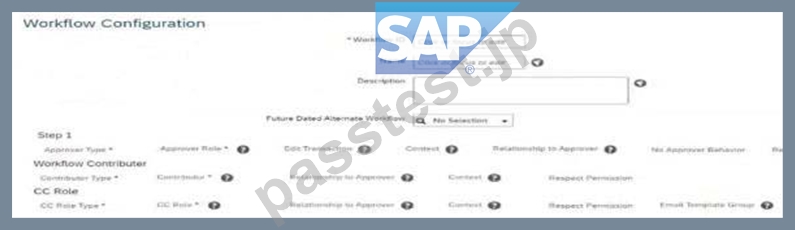
- A. Edit Transaction
- B. No Approver Behavior
- C. Respect Permission
- D. Context
正解:A
質問 # 42
Which rule supports the Default_JobClass requirement?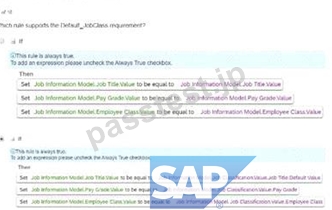
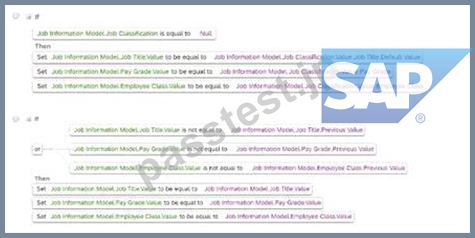
- A. Option B
- B. Option D
- C. Option A
- D. Option C
正解:A
解説:
The rule inOption Bsupports theDefault_JobClassrequirement by setting default values for fields such as Job Title, Pay Grade, and Employee Class when the Job Classification field is NULL. This ensures that appropriate default data is applied to job information records when certain fields are not explicitly filled.
Scenario 1: HR Transaction Rules
質問 # 43
How do you set the Event Reason Derivation rule to ensure event reasons are NOT overwritten?
- A. Set the IF statement to check if the event reason value is blank and set the THEN statement to NULL.
- B. Set the IF statement to Always True and set the THEN statement as blank.
- C. Set the IF statement to check if the event reason value is NOT NULL and set the THEN statement as blank.
- D. Set the IF statement to check if the event reason value is NULL and set the THEN statement as blank.
正解:B
解説:
To ensure that event reasons arenot overwritten, the business rule should be configured as follows:
* Set the IF statement to Always True: This ensures the rule is triggered every time.
* Set the THEN statement as blank: This ensures that no new event reason value overwrites the existing one.
By following this configuration, the system avoids unnecessary overwriting of existing event reason values while processing changes.
質問 # 44
You have updated several position departments using Import and Export data, but the incumbent's data still shows the previous information for the department hris-field. What are some possible causes for this data inconsistency? Note: There are 2 correct answers to this question.
- A. The business rule to sync data changes sets the position department to be equal to job information department
- B. The technicalParameters value has NOT been set to SYNC in the position record.
- C. The technicalParameters column with a value of SYNC has NOT been included in the import file.
- D. The business rule to sync data changes sets the Job Information.Department to be equal to Job Information. Position.Department.
正解:B、C
質問 # 45
Where do you enable the Incumbent of Parent Position option to filter positions in Hire, MSS Job Information and History?
- A. In Position Management Settings > Hierarchy Adaptation
- B. In Position Management Settings > UI Customizing
- C. In Manage Business Configuration > jobInfo
- D. In Configure Object Definitions > Position
正解:B
解説:
TheIncumbent of Parent Positionoption, used to filter positions in Hire, MSS Job Information, and History, is enabled inPosition Management Settings > UI Customizing. This configuration allows users to define filtering options for selecting positions, improving usability and ensuring data relevance during employee management processes.
質問 # 46
Which mathematical formula must be set in the THEN condition to meet the Jobinfo_FTE_Comp rule requirement?
- A. (Previous FTE Value - Current FTE Value) X Base Salary
- B. (Base Salary/Current FTE Value) X Previous FTE Value
- C. (Current FTE Value-Previous FTE Value)/Base Salary
- D. (Base Salary/Previous FTE Value) X Current FTE Value
正解:D
解説:
The formula(Base Salary / Previous FTE Value) X Current FTE Valueensures that the base salary is adjusted correctly when there is a change in the Full-Time Equivalent (FTE) value. This formula maintains salary proportionality by recalculating the base salary based on the ratio of the new FTE value to the previous FTE value. It is critical in cases where FTE adjustments impact an employee's compensation.
Scenario 1: HR Transaction Rules
質問 # 47
Which action will trigger a system validation for an in-progress workflow?
- A. Adding a new employee
- B. Rehiring an inactive employee
- C. Updating Job Information with the same effective date
- D. Terminating an employee
正解:C
質問 # 48
What are some of the position management application-specific rule scenarios? Note: There are 3 correct answers to this question.
- A. Trigger Rules to Calculate Full-Time Equivalent
- B. Trigger Rules for Off Cycle Event Batch
- C. Derive Job Requisition Template in Recruiting Integration
- D. Create Right to Return for Incumbent
- E. Update Rule for Mass Change Run
正解:A、D、E
解説:
Application-specific rule scenarios in Position Management include:
* A. Create Right to Return for Incumbent:
* This rule supports the creation of a right-to-return record for an incumbent when a position- related action occurs, such as a temporary assignment.
* B. Update Rule for Mass Change Run:
* This rule automates updates during mass position changes, ensuring consistent application of business logic across multiple positions.
* C. Trigger Rules to Calculate Full-Time Equivalent:
* This rule calculates the FTE value based on position or job information attributes, ensuring accurate reporting and compliance.
These rules enhance the flexibility and functionality of position management processes.
質問 # 49
Your customer would like to automate its company's HR transactions. This includes auto-populating fields to reduce data entry errors and automating approvals during self-service transactions.
You are asked to create the following rules based on your customer's requirements:
* Three event reason derivation rules (ERD1, ERD2, ERD3)
* A separate catch-all event reason derivation rule (ERD-Catch)
* A workflow derivation rule based on event reasons (WFD)
* A rule to auto-populate the Job Title. Pay Grade, and Employee Class field values in the Job Information whenever the job code is changed (Defauit_JobClass)
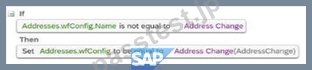
* A rule to use AddressChange workflow for any address change requests (WFD_Address)
* A cross-entity rule to auto-calculate the Base_Salary amount based on ) changes to the FTE value for any event other than Hire or Rehire (Joblnfo_FTE_Comp) Answer the questions to ensure the event reasons and workflow rules adhere to SAP SuccessFactors recommended practices.
Which clause meets the WFD_Address rule requirement?
- A.
- B.
- C.
- D.
正解:C
質問 # 50
Which objects are supported in cross-entity business rules? Note: There are 2 correct answers to this question.
- A. Job Information
- B. Pay Component Recurring
- C. Work Permit Information
- D. Personal Information
正解:A、B
質問 # 51
How do you create country/region-specific fields (CSF) for a country that does NOT have pre- delivered Legal Entity CSF fields? Note: There are 3 correct answers to this question.
- A. Update the condition and condition values of the association.
- B. Create a composite association to the new generic object on Legal Entity.
- C. Create a composite association on the new generic object to Legal Entity.
- D. Update the field criteria of the association.
- E. Create a new generic object.
正解:B、D、E
解説:
To create country/region-specific fields (CSF) for a country that does not have pre-delivered Legal Entity CSF fields, follow these steps:
* Create a New Generic Object: Develop a new generic object to define the specific fields required for the country/region. This object will store the additional data fields pertinent to the Legal Entity.
* Create a Composite Association to the New Generic Object on Legal Entity: Establish a composite association from the Legal Entity to the newly created generic object. This association links the Legal Entity to the country/region-specific fields, enabling the system to recognize and utilize these fields appropriately.
* Update the Field Criteria of the Association: Modify the field criteria within the association to ensure that the new fields are correctly associated with the Legal Entity. This step involves setting conditions that determine when the new fields are applicable, based on factors such as country/region.
These steps align with the standard procedures for extending the data model in SAP SuccessFactors Employee Central to accommodate country/region-specific requirements.
質問 # 52
Which rule can effectively catch all unspecified events in a transaction?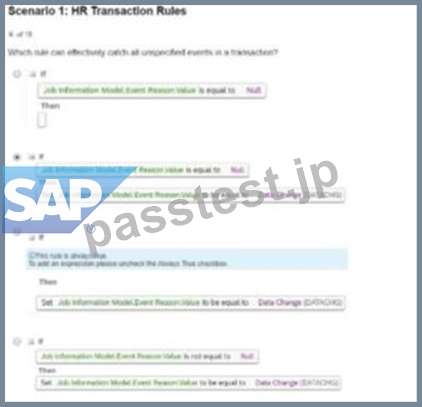
- A. Option B
- B. Option D
- C. Option A
- D. Option C
正解:A
質問 # 53
The employee is changing their marital status. Once the workflow is approved, the manager gets a notification via e-mail that this change has been processed. The manager then goes into the system and checks the workflow, but notices that they can see more fields than the ones for which they should receive a notification (Name, Marital Status, and Nationality). Why is that?
- A. There is a rule that sets up the visibility for the fields in Personal Information and this applies when checking the workflow.
- B. In the workflow, Respect Permissions was set to No for the notification line to the manager.
- C. The manager has transactions pending approval permission for Personal Information.
- D. The manager's approver context is set to Source.
正解:A
質問 # 54
......
検証済みのC-THR81-2405テスト問題集と解答で正確な86問題と解答あります:https://www.passtest.jp/SAP/C-THR81-2405-shiken.html
最新をゲットせよ!C-THR81-2405認定有効な試験問題集解答:https://drive.google.com/open?id=1rdUZOS7NUC239rrzUzMGx20gGFBxR9KZ