

[2025年04月05日]Salesforce-MuleSoft-Developer-I問題集PDFとテストエンジン 試験問題
検証済みのSalesforce-MuleSoft-Developer-Iテスト問題集と解答で正確な237問題解答あります
Salesforce Salesforce-MuleSoft-Developer-I 認定試験の出題範囲:
| トピック | 出題範囲 |
|---|---|
| トピック 1 |
|
| トピック 2 |
|
| トピック 3 |
|
| トピック 4 |
|
| トピック 5 |
|
| トピック 6 |
|
| トピック 7 |
|
| トピック 8 |
|
| トピック 9 |
|
| トピック 10 |
|
| トピック 11 |
|
質問 # 11
Refer to the exhibits.

The Batch job processes an array of strings.
What information is logged by the logger component after the batch job scope completes processing of the input payload?
- A. Total Records Processed: 3
Successful Records: 3
Failed Records: 0
payload: ["A","B","C"] - B. ["A","B","C"]
- C. Total Records Processed: 3
Successful Records: 3
Failed Records: 0
payload: ["a", "b", "c"] - D. Total Records Processed: 3
Successful Records: 3
Failed Records: 0
正解:D
解説:
Correct answer is as below. On complete phase only has access to batch job result statistics and payload is not available.
Total Records Processed: 3
Successful Records: 3
Failed Records: 0
On Complete
During this phase, you can optionally configure the runtime to create a report or summary of the records it processed for the particular batch job instance. This phase exists to give system administrators and developers some insight into which records failed to address any issues that might exist with the input data.
Sample output is as below
Mule Ref Doc : https://docs.mulesoft.com/mule-runtime/4.3/batch-processing-concept#on-complete
質問 # 12
Mule application contains ActiveMQ JMS dependency. Mule application was compiled and run successfully in Anypoint Studio. The mule application must now be exported from Anypoint Studio and shared with other developer. What export options should be selected to create the smallest JAR file that can be imported into other developer's Anypoint Studio and run successfully?
- A. Select the Include project modules and dependencies option only
- B. Select both Attach Project Sources and Include project modules and dependencies option
- C. Select only Attach Project Sources only
- D. De-select both Attach Project Sources and Include project modules and dependencies option
正解:C
解説:
Correct answer is Select only Attach Project Sources only
You must keep the Attach Project Sources option selected to be able to import the packaged JAR file back into a Studio workspace.
Deselect the Include project modules and dependencies option.
This option skips bundling the actual modules and external dependencies required to run the Mule application in a Mule runtime engine, creating a lightweight JAR file package that does not include any dependencies specified in the Mule application's pom.xml file.
The generated JAR file is not a functional deployable archive and cannot be deployed to a Mule runtime engine, but instead offers a way to archive only the source files that make up the Mule application. This is the same as using the -lightWeightPackage flag when packaging using the Mule Maven Plugin and is useful if you want to distribute your project to other Studio installations because it only keeps a reference to all its dependencies. When you import a lightweight package into Studio, all your dependencies are automatically downloaded MuleSoft Doc Ref : https://docs.mulesoft.com/studio/7.8/import-export-packages
質問 # 13
Refer to the exhibit.
What Database expression transforms the input to the output?
- A.

- B.

- C.

- D.

正解:B
解説:
This kind of questions are best solved with filtering technique. Key thing to note here is XML attributes are always access by @ notation. So in this example orderId can be accessed as @OrderId which makes option 3 and option 4 false. Now difference in optin and option 2 is in mapping of lineItemPrice. Correct syntax to format a String in Numbse is value.price as Number. Hence option 2 is correct
質問 # 14
A Scatter-Gather processes three separate HTTP requests. Each request returns a Mule event with a JSON payload. What is the final output of the Scatter-Gather?
- A. An Object containing all three JSON payload Objects
- B. An Array of the three Mule event Objects
- C. An Object containing all three Mule event Objects
- D. An Array of the three JSON payload Objects
正解:C
解説:
Correct answer is An Object containing all three Mule event Objects
The Scatter-Gather component is a routing event processor that processes a Mule event through different parallel processing routes that contain different event processors. Each route receives a reference to the Mule event and executes a sequence of one or more event processors. Each of these routes uses a separate thread to execute the event processors, and the resulting Mule event can be either the same Mule event without modifications or a new Mule event with its own payload, attributes, and variables. The Scatter-Gather component then combines the Mule events returned by each processing route into a new Mule event that is passed to the next event processor only after every route completes successfully.
The Scatter-Gather component executes each route in parallel, not sequentially. Parallel execution of routes can greatly increase the efficiency of your Mule application and may provide more information than sequential processing.
Sample output is as below
MuleSoft Documentation reference : https://docs.mulesoft.com/mule-runtime/4.3/scatter-gather-concept
質問 # 15
Refer to the exhibits.
The web client sends a POST request to the ACME Order API with an XML payload. An error is returned.
What should be changed in the request so that a success response code is returned to the web client?
- A. Set a request header with the name Content-Type to a value of application/xml
- B. Set a response header with the name Content-Type to a value of application/octet-stream
- C. Set a request header with the name Content-Type to a value of applicatron/octet-stream
- D. Set a response header with the name Content-Type to a value of applkation/xml
正解:A
解説:
The HTTP 415 Unsupported Media Type client error response code indicates that the server refuses to accept the request because the payload format is in an unsupported format. The format problem might be due to the request's indicated Content-Type or Content-Encoding , or as a result of inspecting the data directly. As per RAML input is expected in application/xml.
Hence correct answer is Set a request header with the name Content-Type to a
質問 # 16
Refer to the exhibits.

The my-app xml file contains an Error Handier scope named "global-error-handler" The Error Handler scope needs to be set to be the default error handler for every flow in the Mule application Where and how should the value "global-error-handler" be added in the Mule project so that the Error Handler scope is the default error handler of the Mule application?
- A. In the my-app.xml file, as an attribute of a configuration element
- B. In the pom.xml file, as the value of a global element
- C. In the Validation folder as the value of a global element in the error-handling yaml file
- D. In the mule-artifact json file, as the value of a key-value pair
正解:A
質問 # 17
Refer to the exhibit.
The Mule application's connectors are configured with property placeholders whose values are set in the config.yaml file What must be added to the Mule application to link the config.yaml file's values with the property placeholders?
- A. A dependency element in the pom xml file
- B. A propertiesFile key/value pair in the mule-artifact json file
- C. A configuration-properties element in the acme-app xml file
- D. A file-config element in the acrne-app xml file
正解:C
質問 # 18
Refer to the exhibits.
What is written to the records.csv file when the flow executes?
- A. Nothing
- B. The payload convert to CVS
- C. The JSON payload
- D. An error message
正解:C
解説:
Transform Message Add write_date is coverting payload in JSON format and same JSON payload is avaialble to file write processor. However, if the payload is a different format (for example, not CSV) , you can place the transformation inside the Write operation to generate content that will be written without producing a side effect on the message in transit. This is not done in this case. By default, the connector writes whatever is in the message payload. Hence JSON payload will be written to file.
質問 # 19
Refer to the exhibits.
The input array of strings is processed by the batch job that processes, filters, and aggregates the values. What is the last message logged by the Logger component after the batch job completes processing?
- A. [ "A", "C, "D", "E" ]
- B. [''E'']
- C. [''D", "E"]
- D. [ ["A", "C", "D" ], ["E"] ]
正解:B
解説:
Logs would look like:
INFO 2021-06-09 19:14:56,039 [[MuleRuntime].uber.06: [validationtest].batch-job-validationtestBatch_Job-work-manager @6de10f3e] [processor: validationtestFlow/processors/1/route/0/route/0/aggregator/processors/0; event: bfb751e1-9939-11eb-9f69-02053763653a] org.mule.runtime.core.internal.processor.LoggerMessageProcessor:
[
"\"A\"",
"\"C\"",
"\"D\""
]
--
INFO 2021-06-09 19:15:02,486 [[MuleRuntime].uber.06: [validationtest].batch-job-validationtestBatch_Job-work-manager @6de10f3e] [processor: validationtestFlow/processors/1/route/0/route/0/aggregator/processors/0; event: bfb751e1-9939-11eb-9f69-02053763653a] org.mule.runtime.core.internal.processor.LoggerMessageProcessor: [
"\"E\""
]
Batch aggregator value is 3. Hence in first time it will print ["A", "C", "D"] and in next iteration it will print [ "E" ]
-------------------------------------------------------------------------------------------------------------------------------------------------- Correct answer is [ "E" ]
質問 # 20
Following Mulesoft's recommended API-led connectivity approach , an organization has created an application network. The organization now needs to create API's to transform , orchestrate and aggregate the data provided by the other API's in the application network. This API should be flexible enought ot handle the data from additional API's in future.
According to Mulesoft's recommended API-led connectivity approach , what is the best layer for this new API?
- A. Process layer
- B. System layer
- C. Data layer
- D. Experience layer
正解:A
解説:
Correct answer is process layer as all the orchestration and transformation logic should be in process layer as per Mulesoft's recommended approach for API led connectivity.
API-led connectivity is a methodical way to connect data to applications through reusable and purposeful APIs. These APIs are developed to play a specific role - unlocking data from systems, composing data into processes, or delivering an experience.
What are the APIs that enable API-led connectivity?
API-led connectivity provides an approach for connecting and exposing assets. With this approach, rather than connecting things point-to-point, every asset becomes a managed API - a modern API, which makes it discoverable through self-service without losing control.
The APIs used in an API-led approach to connectivity fall into three categories:
System APIs - these usually access the core systems of record and provide a means of insulating the user from the complexity or any changes to the underlying systems. Once built, many users, can access data without any need to learn the underlying systems and can reuse these APIs in multiple projects.
Process APIs - These APIs interact with and shape data within a single system or across systems (breaking down data silos) and are created here without a dependence on the source systems from which that data originates, as well as the target channels through which that data is delivered.
Experience APIs - Experience APIs are the means by which data can be reconfigured so that it is most easily consumed by its intended audience, all from a common data source, rather than setting up separate point-to-point integrations for each channel. An Experience API is usually created with API-first design principles where the API is designed for the specific user experience in mind.
質問 # 21
Refer to the exhibit.
What is the output payload in the On Complete phase
- A. summary statistics with NO record data
- B. The original payload: [1,2,31
- C. The records processed by the last batch step: [StepTwol, StepTwo2, StepTwo3]
- D. The records processed by all batch steps: [StepTwostepOnel, stepTwostepOne2, StepTwoStepOne3]
正解:A
解説:
This is a trcik question. On complete phase pyalod consists of summary of records processed which gives insight on which records failed or passed. Hence option 4 is correct answer MuleSoft Documentation Reference : https://docs.mulesoft.com/mule-runtime/4.3/batch-processing-concept#on-complete
質問 # 22
Which of the below is used by Mule application to manage dependencies which make sharing the projects lightweight and easier?
- A. POM.xml
- B. Global element
- C. Cloudhub
- D. Configuration file
正解:A
解説:
POM.xml contains info about the project and configurationn details used by Maven to build the project
質問 # 23
Refer to the exhibits.
Larger image
Larger image
Larger image
The Mule application configures and uses two HTTP Listener global configuration elements.
Mule application is run in Anypoint Studio.
If the mule application starts correctly, what URI and port numbers can receive web client requests? If the mule applications fails to start , what is the reason for the failure?
- A. The mule application start successfully
Web client requests can be received at URI on port 2222 and on port 3333. - B. The mule application start successfully
Web client requests can only be received at URI on port 2222 but not on port 3333 - C. The mule application fails to start
There is URL path conflict because both HTTP Listeners are configured with same path - D. The mule application fails to start because of the port binding conflict as HTTP request also use same port i.e. 3333
正解:A
解説:
In this case both the flows can start without any error and requests can be received on both ports. Flow names httpListener1 can call other flow using HTTP request without any issues.
Hence correct answer is
The mule application start successfully
Web client requests can be received at URI on port 2222 and on port 3333.
Lets check why other options are incorrect
1) The mule application fails to start. There is URL path conflict because both HTTP Listeners are configured with same path ---- This is incorrect as port value is different in both listeners
2) The mule application start successfully. Web client requests can only be received at URI on port 2222 but not on port 3333 --- This is incorrect as there is no reason for not receiving requests on port 3333
3) The mule application fails to start because of the port binding conflict as HTTP request also use same port i.e. 3333 --- Port binding conflict will not happen in this case. It would have if both listener configurations would have been on same port . But that is not the case here.
Mule Ref Doc : HTTP Listener Reference - Mule 4 | MuleSoft Documentation
質問 # 24
An HTTP Request operation sends an HTTP request with a non-empty JSON object payload to an external HTTP endpoint. The response from the external HTTP endpoint returns an XML body. The result is stored in a target named the Result.
What is the payload at the event processor after the HTTP Request?
- A. A non-empty Java object
- B. The XML response body
- C. The original JSON request body
- D. null
正解:C
質問 # 25
Refer to the exhibits.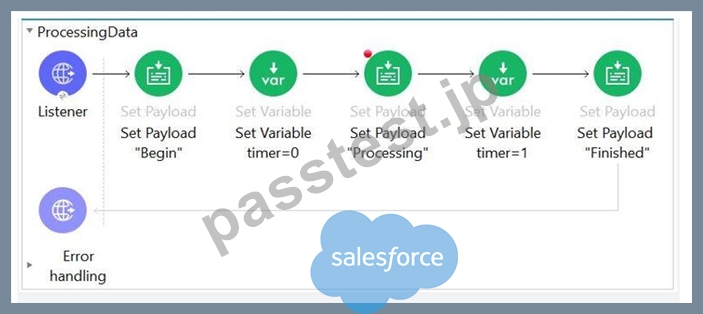
The Mule Application is being debugged in Anypoint Studio and stops at breakpoint. What is the value of payload displayed in debugger at this breakpoint?
- A. Begin
- B. Finished
- C. Processing
正解:A
質問 # 26
Refer to the exhibit.
How many private flows does APIKIT generate from the RAML specification?
- A. 0
- B. 1
- C. 2
- D. 3
正解:C
質問 # 27
By default, what happens to a file after it is read using an FTP connector Read operation?
- A. The file is renamed in the same folder
- B. The file is deleted from the folder
- C. The file stays in the same folder unchanged
- D. The file is moved to a different folder
正解:C
解説:
File is not updated when FTP read operations is performed.
MuleSoft Doc Ref : https://docs.mulesoft.com/file-connector/1.3/file-read
質問 # 28
What asset cannot be created using Design Center?
- A. API specifications
- B. API portals
- C. Mule Applications
- D. API fragments
正解:B
解説:
API portal are created by API Exchange and cannot be created by Design Center
質問 # 29
What is output of Dataweave flatten function?
- A. Object
- B. LInkedHashMap
- C. Map
- D. Array
正解:D
解説:
Correct answer is Array.
Flatten turns a set of subarrays (such as [ [1,2,3], [4,5,[6]], [], [null] ]) into a single, flattened array (such as [ 1, 2, 3, 4, 5, [6], null ]).
This example defines three arrays of numbers, creates another array containing those three arrays, and then uses the flatten function to convert the array of arrays into a single array with all values.
Source
%dw 2.0
output application/json
var array1 = [1,2,3]
var array2 = [4,5,6]
var array3 = [7,8,9]
var arrayOfArrays = [array1, array2, array3]
---
flatten(arrayOfArrays)
Output
[ 1,2,3,4,5,6,7,8,9 ]
質問 # 30
A Utility.dwl file is located in a Mule project at src/main/resources/modules. The Utility.dwl hie defines a function named pascalize that reformats strings to pascal case.
What is the correct DataWeave to call the pascalize function in a Transform Message component?
- A.

- B.

- C.

- D.

正解:A
質問 # 31
Refer to the exhibits.

Set paylaod transformer is set the firstName and lastName of the customer as shown in below images.
What is the correct Dataweave expression which can be added in message attribute of a Logger activity to access firstName (which in this case is Madhav) from the incoming event?
- A. vars."customer.firstName"
- B. customer.firstName
- C. vars."customer"."firstName"
- D. firstName
正解:C
解説:
Correct answer is vars."customer"."firstName"
Please note that you can also access firstName using this syntax vars.customer.firstName.
Mule Ref Doc : Variables in Mule Apps | MuleSoft Documentation
質問 # 32
How does APIkit determine the number of flows to generate from a RAML specification?
- A. Creates a separate flow for each resource
- B. Creates a separate flow for each HTTP method
- C. Creates a separate flow for each resource that contains child resources
- D. Creates a separate flow for each response status code
正解:B
解説:
APIKIt Creates a separate flow for each HTTP method
質問 # 33
What is the trait name you would use for specifying client credentials in RAML?
- A. client-id
- B. cannot be specified in RAML
- C. client-id-required
- D. headers
正解:C
解説:
client-id-required enforces clients to add client_id and client_secret.
Please refer to below steps.
Add a section called traits: at the root level to define query parameters:
traits:
- client-id-required:
queryParameters:
client_id:
type: string
client_secret:
type: string
2) Reference the trait in each of the methods to specify that each of the methods require these query parameters. After each method in the RAML file, add is: [client-id-required]. For example:
/users:
get:
is: [client-id-required]
description: Gets a list of JSONPlaceholder users.
質問 # 34
Refer to the exhibits The Mule application does NOT define any global error handlers.
A web client sends a POST request to the Multi application with this input payload The File Write operation throws a FILECONNECTIVITY error What response message is returned to the web client?

- A. "OTHER ERROR"
- B. "ORDER NOT_CREATED"
- C. "FILECONNECTIVITY"
- D. "File written"
正解:B
質問 # 35
......
Salesforce Salesforce-MuleSoft-Developer-IテストエンジンPDFで完全版無料問題集:https://www.passtest.jp/Salesforce/Salesforce-MuleSoft-Developer-I-shiken.html
最新をゲットせよ!Salesforce-MuleSoft-Developer-I認定有効な試験問題集解答:https://drive.google.com/open?id=1gkMELLs27HVCIQgCHODS7jbO0bjSNRSc