

2025年11月実際に出る1Z0-1067-25試験問題集には正確で更新された問題
1Z0-1067-25試験問題集でPDF問題とテストエンジン
Oracle 1Z0-1067-25 認定試験の出題範囲:
| トピック | 出題範囲 |
|---|---|
| トピック 1 |
|
| トピック 2 |
|
| トピック 3 |
|
| トピック 4 |
|
質問 # 29
Which technique does NOT help you get the optimal performance out of the Oracle Cloud Infrastructure (OCI) File Storage service? (Choose the best answer.)
- A. Increase concurrency by using multiple threads, multiple clients, and multiple mount targets.
- B. Right size compute instances from where file system is accessed based on their network capacity.
- C. Limit access to the same Availability Domain (AD) as the File Storage service where possible.
- D. Serialize operations to the file system to access consecutive blocks as much as possible.
正解:D
質問 # 30
SIMULATION
Scenario: 2 (Oracle Cloud-init and AutoScaling: Use cloud-init to Configure Apache on Instances in an Autoscaling Instance Pool) Scenario Description: (Hands-On Performance Exam Certification) You're deploying an Apache-based web application on OCI that requires horizontal autoscaling.
To configure instances upon provisioning, write a cloud-init script for Oracle Linux 8 that installs and enables Apache (httpd), and opens the firewall for HTTP on TCP port 80. Create an instance configuration and include the cloud-init script in it. Use this instance configuration to create an instance pool and autoscaling configuration.
Pre-Configuration:
To fulfill this requirement, you are provided with the following:
Access to an OCI tenancy, an assigned compartment, and OCI credentials
A VCN Cloud-Init Challenge VCN with an Internet gateway and a public subnet. The security list for the subnet allows ingress via TCP ports 22 and 80 (SSH and HTTP). The route table forwards all egress to the Internet gateway.
Access to the OCI Console
Required IAM policies
An SSH key pair for the compute instance
Public Key https://objectstorage.us-ashburn-1.oraclecloud.com/n/tenancyname/b/PBT_Storage/o/PublicKey.pub Private Key https://objectstorage.us-ashburn-1.oraclecloud.com/n/tenancyname/b/PBT_Storage/o/PKey.key Note: Throughout your exam, ensure to use assigned Compartment , User Name , and Region.
Complete the following tasks in the provisioned OCI environment:
Task 1(a): Develop the cloud-init Script:
Task 1(b): Use cloud-init to Configure Apache on Instances in an Autoscaling Instance Pool:
正解:
解説:
See the solution below with Step by Step Explanation
Explanation:
Task 1(a): Develop the cloud-init Script:
Create a compute instance pbt_cloud_init_vm_01 with the following properties:
Shape: VM.Standard.A1.Flex instance with 1 OCPU and 6 GB memory
Image: Oracle Linux 8
Placement: Use any of the availability domains
Network:
Place in the public subnet Cloud-Init Challenge SNT
Assign a public IPv4
Use the SSH public key
Add a cloud-init script and perform the following:
Use yum or dnf to install httpd.
Use systemctl to enable and start httpd
Open the firewall to http:
sudo firewall-offline-cmd --add-service=http
systemctl restart firewalld
Mark Complete
Task 1(b): Use cloud-init to Configure Apache on Instances in an Autoscaling Instance Pool:
You're deploying an Apache-based web application on OCI that requires horizontal autoscaling.
To configure instances upon provisioning, write a cloud-init script for Oracle Linux 8 that installs and enables Apache (httpd), and opens the firewall for HTTP on TCP port 80. Create an instance configuration and include the cloud-init script in it. Use this instance configuration to create an instance pool and autoscaling configuration.
Task 2: Create an Autoscaling Instance Pool Including the cloud-init Script:
Create an instance configuration named pbt_cloud_init_config_01 with the following properties:
Shape: VM.Standard.A1.Flex instance with 1 OCPU and 6 GB memory
Image: Oracle Linux 8
Placement: Use any of the availability domains
Network:
Place in the public subnet Cloud-Init Challenge SNT
Assign a public IPv4
Use the SSH public key
Attach the cloud-init script created in Task 1
Create an instance pool named pbt_cloud_init_pool_01 with one instance by using the instance configuration pbt_cloud_init_config_01 Create and attach an autoscaling configuration named pbt_cloud_autoscaling_config_01 with the following settings:
Metric-based autoscaling
Cooldown: 300 second
Performance metric: CPU utilization
Scale-out rule:
Operator: Greater than (>)
Threshold: 75%
Number of instances to add: 1
Scale-in rule:
Operator: Less than (<)
Threshold: 25%
Number of instances to remove: 1
Scaling limits:
Minimum number of instances: 1
Maximum number of instances: 2
Initial number of instances: 1
Task 1: Develop the cloud-init script
In the main menu, go to Compute > Instances and click Create an Instance In the instance creation menu, enter the following details a. Name: Provide name given in the instructions b. Compartment: Use the assigned compartment c. Placement: Use any of the availability domains d. Image: Oracle Linux 8 e. Shape: VM.Standard.A1.Flex instance with 1 OCPU and 6 GB memory f. Network:
i. Place in the public subnet
ii. Assign a public IPv4
g. SSH keys: Upload or paste the provided SSH public key
h. Boot volume: Leave as default
i. Under advanced options, add the following cloud-init script:
#!/bin/shsudo dnf install httpd --assumeyes --quietsudo systemctl enable httpdsudo systemctl start httpdsudo firewall-offline-cmd --add-service=httpsystemctl restart firewalld j. Create the instance.
Task 2: Create an autoscaling instance pool including the cloud-init script
1. In the main menu, go to Compute > Instance Configurations. Click Create instance configuration.
a. In the instance configuration creation menu, enter the same details as before:
b. Name: Provide name given in the instruction/if not specified provide any name c. Compartment: Assigned compartment d. Placement: Use any of the availability domains e. Image: Oracle Linux 8 f. Shape: VM.Standard.A1.Flex instance with 1 OCPU and 6 GB memory g. Network:
i. Place in the public subnet
ii. Assign a public IPv4
h. SSH keys: Upload or paste the provided SSH public key
i. Boot volume: Leave as default
j. Under advanced options, add the following cloud-init script:
#!/bin/shsudo dnf install httpd --assumeyes --quietsudo systemctl enable httpdsudo systemctl start httpdsudo firewall-offline-cmd --add-service=httpsystemctl restart firewalld k. Create the instance configuration.
Task 2: In the main menu, go to Compute > Instance Pools. Click Create instance pool.
Enter the following details:
a. Name: Provide name given in the instruction/if not specified provide any name b. Compartment: Assigned compartment c. Instance configuration: Created in last step d. Number of instances: 1 e. Select any availability domain f. Leave fault domain unselected g. Primary VNIC: Provided VCN in the instructions h. Subnet: Public subnet i. Do not attach a load balancer j. Create the instance pool Task 3: In the main menu, go to Compute > Autoscaling Configurations. Click Create autoscaling configuration and enter the following details:
a. Name: Provide name given in the instruction/if not specified provide any name b. Compartment: Assigned compartment c. Instance Pool: Created in last step d. Select Metric-based autoscaling e. Autoscaling policy name: Does not matter f. Cooldown: 300 seconds g. Performance metric: CPU utilization h. Scale-out rule:
i. Operator: Greater than (>)
ii. Threshold: 75%
iii. Number of instances to add: 1
i. Scale-in rule:
i. Operator: Less than (<)
ii. Threshold: 25%
iii. Number of instances to remove: 1
j. Scaling limits:
i. Minimum number of instances: 1
ii. Maximum number of instances: 2
iii. Initial number of instances: 1
k. Create the autoscaling configuration.
質問 # 31
Your customer is running a set of compute instances inside a private subnet to manage their workloads on Oracle Cloud Infrastructure (OCI) tenancy. You have set up auto scaling feature to provide consistent performance to their end users during period of high demand. Which step should be met for auto scaling to work? (Choose the best answer.)
- A. Service gateway should be setup to allow instances to send metrics to monitoring ser-vice.
- B. Monitoring for the instances should not be enabled.
- C. OS Management Service agent (osms) must be installed on the instances.
- D. Audit logs for the instances should be enabled.
正解:A
質問 # 32
Which TWO components are optional while creating the MQL expressions in the Oracle Cloud Infrastructure (OCI) Monitoring service? (Choose two.)
- A. Statistic
- B. Interval
- C. Dimensions
- D. Metric
- E. Grouping Function
正解:C、E
質問 # 33
You are using the Oracle Cloud Infrastructure Command Line Interface to launch a Linux virtual machine. You enter the following command (with correct values for all parameters):
The command fails. Which is NOT a valid parameter in this command? (Choose the best answer.)
- A. "--shape <shape_name>"
- B. "-t <tenancy_id>"
- C. "--image-id <image_id>"
- D. "-c <compartment_id>"
- E. "--subnet-id <subnet_id>"
正解:B
質問 # 34
You are asked to implement the disaster recovery (DR) and business continuity requirements for Oracle Cloud Infrastructure (OCI) Block Volumes. Two OCI regions being used: a primary/source region and a DR/destination region. The requirements are: There should be a copy of data in the destination region to use if a region-wide disaster occurs in the source region * Minimize costs Which design will help you meet these requirements? (Choose the best answer.)
- A. Clone block volumes. Use Object Storage lifecycle management to automatically move clone objects to Archive Storage. Copy Archive Storage buckets from source region to destination at regular intervals.
- B. Back up block volumes. Use Object Storage lifecycle management to automatically move backup objects to Archive Storage. Copy Archive Storage buckets from source region to destination at regular intervals.
- C. Back up block volumes. Copy block volume backups from source region to destination region at regular intervals.
- D. Clone block volumes. Copy block volume clones from source region to destination region at regular intervals.
正解:B
質問 # 35
In your root compartment, you have two subcompartments, A and B.
You have three in-stances in each compartment, including the root (for a total of nine). What does the following metric query return if you use the console to run it in the root compartment? CpuUtiliza-tion[1m].mean()
- A. One time series: the average CPU utilization over the three instances in the root compartment per minute
- B. One time series: the average CPU utilization over all nine instances per minute
- C. Three different time series: each time series represents the average CPU utilization of one of the three instances in the root compartment per minute.
- D. One number: the average CPU utilization over all nine instances over the last minute
正解:A
質問 # 36
The general syntax for an IAM policy is: Allow <identity_domain_name>/<subject> to <verb> <resource-type> in <location> where <conditions> Which two are valid values for <lo-cation>?
- A. compartment MyCompartment
- B. security-zone MyZone
- C. tenancy
- D. region us-phoenix-1
- E. availability-domain aBCD:us-phoenix-1
正解:A、C
質問 # 37
To upload a file from a compute instance into Object Storage, you SSH into the compute instance and run the following OCI CLI command: oci os object put -ns mynamespace -bn mybucket --name myfile.txt --file /Users/me/myfile.txt --auth instance_principal Which statement must be true for this command to succeed?
- A. The bucket has a pre-authenticated request (PAR) that specifies the compute instance that will upload to it.
- B. Your OCI API key has been placed on the compute instance.
- C. The instance matches a matching rule for a dynamic group with the permission to up-load to the bucket.
- D. Your OCI user has the permission to upload to the bucket.
正解:C
質問 # 38
SIMULATION
Scenario: 3 (Use the OCI CLI to Work with Object Storage from a Compute Instance) Scenario Description: (Hands-On Performance Exam Certification) Your company runs a web application in OCI that generates log files. You want to upload these files to OCI Object Storage to meet data retention requirements. Some files need to be retained indefinitely, whereas others can be deleted after 30 days. Use the OCI CLI to create bucket and upload the log directory and create a lifecycle policy rule to delete temporary files after 30 days.
Pre-Configuration:
To fulfill this requirement, you are provided with the following:
Access to an OCI tenancy, an assigned compartment, and OCI credentials
A compute instance with OCI CLI installed and a set of files in ~/dir_to_upload to use Access to the OCI Console Required IAM policies Assumptions:
Perform the tasks by using the OCI CLI on the compute instance.
Use instance principal authentication for all CLI commands; the instance has been given the policies necessary.
Connect to the compute instance using Cloud Shell's private networking and the provided SSH key.
An SSH key pair has been provided to you for the compute instance.
Private Key https://objectstorage.us-ashburn-1.oraclecloud.com/n/tenancyname/b/PBT_Storage/o/PKey.key Note: Throughout your exam, ensure to use assigned Compartment , User Name and Region.
Complete the following tasks in the provisioned OCI environment:
Task 1: Create a Bucket in Object Storage
Task 2: Upload a Directory's Contents to Object Storage
Task 3: Add a Lifecycle Policy to the Bucket
正解:
解説:
See the solution below with Step by Step Explanation
Explanation:
Task 1: Create a Bucket in Object Storage
Create a bucket named CloudOpsBucket_<user id> with the following properties:
Storage tier: Standard
Auto-tiering: Disabled
Object versioning: Enabled
Emit events: Disabled
Keys: Oracle-managed
Visibility: Private
Task 2: Upload a Directory's Contents to Object Storage
Upload the contents of the directory ~/dir_to_upload and its subdirectories to the bucket CloudOpsBucket Task 3: Add a Lifecycle Policy to the Bucket Create a lifecycle policy rule that deletes all files from ~/dir_to_upload/temp after 30 days Task 1: Create a bucket in Object Storage
1. Open Cloud Shell in the console. Under Network along the top, select Ephemeral Private Network Setup.
2. Select the subnet of the compute instance.
3. SSH into the compute instance using the provided SSH key:
ssh -i /path/to/key opc@<private_ip>
4. In the compute instance, create the bucket with the following command (note that it's one long line):
oci os bucket create -c "<compartment_id>" --name "CloudOpsBucket" --auth instance_principal --versioning 'Enabled' Task 2: Upload a directory's contents to Object Storage
1. Upload the contents of the specified directory and subdirectories with the following command (note that it's one long line):
oci os object bulk-upload -bn "CloudOpsBucket" --src-dir "~/dir_to_upload" --auth instance_principal Task 3: Add a lifecycle policy to the bucket
1. Create a file named rule.json
2. Add the following content to rule.json:
{"items": [{"action": "DELETE","is-enabled": true,"name": "Delete-Rule","object-name-filter": {"exclusion-patterns": null,"inclusion-patterns": null,"inclusion-prefixes": ["temp/"]},"target": "objects","time-amount": 30,"time-unit": "DAYS"}]}
3. Add the lifecycle policy rule with the following command:
oci os object-lifecycle-policy put -bn "CloudOpsBucket" --from-json file://rule.json --auth instance_principal Top of Form
質問 # 39
You have been contracted by a local e-commerce company to assist with enhancing their online shopping application. The application is currently deployed in a single Oracle Cloud Infrastructure (OCI) region. The application utilizes a public load balancer, application servers in a private subnet, and a database in a separate, private subnet. The company would like to deploy another set of similar infrastructure in a different OCI region that will act as standby site. In the event of a failure at the primary site, all customers should be routed to the failover site automatically. After deploying the additional infrastructure within the second region, how should you configure automated failover requirements? (Choose the best answer.)
- A. Create a failover policy in the Traffic Management service. Set the IP address of the public load balancer for the primary site in answer pool 1. Set the IP address of the public load balancer for the secondary site in answer pool 2. Define a health check to monitor both sites.
- B. Create a new A record in DNS that points to the public load balancer at the secondary site. Create a CNAME for the sub-domain failover that will resolve to the new A rec-ord. Inform customers to prepend the website URL with failover if the primary site is unavailable.
- C. Deploy a new load balancer in the primary region. Create one backend set for the primary application servers and a second backend set for the standby application servers. Create a listener for the primary backend set with a timeout of 3 minutes. Create a listener for the secondary backend set with a timeout of 10 minutes.
- D. Create a load balancer policy in the Traffic Management service. Configure one answer for each site. Set the answer for the primary site with a weight of 10 and the answer for the secondary site with a weight of 100.
正解:A
質問 # 40
A developer has created a file system in the Oracle Cloud Infrastructure (OCI) File Storage service. She then launches an Oracle Linux compute instance and mounts the file system successfully on this instance. The next day, she tries writing to the file system from the compute instance using the following command: touch /mnt/yourmountpoint/helloworld.txt But receives an error message: touch: cannot touch '/mnt/yourmountpoint/helloworld.txt': Permission denied What might be the reason for this error?
- A. The touch command is not available in Oracle Linux, by default.
- B. Service limits or quota for file system writes have been breached.
- C. User is connecting as the default Oracle Linux user opc instead of the root user.
- D. User is not part of any OCI Identity and Access Management (IAM) group with write permissions to the File Storage service.
正解:C
質問 # 41
Your company hosts a web application on OCI using compute instances and block volumes. To minimize your recovery point objective (RPO), you enable cross-region block volume replication for the block volumes. Which option is true regarding cross-region volume replication?
- A. The replica cannot be directly mounted on a compute instance. Instead, it must be activated, creating a clone that will be available for mounting.
- B. Replication replaces the need for block volume backups.
- C. Replication is synchronous, so it may slightly degrade block volume performance.
- D. The cost of the replica matches the cost of the source volume; for example, the replica of a high-performance volume will be billed at the high-performance rate.
正解:A
質問 # 42
You are running an old version of PostgreSQL on several compute instances and want to update to the latest version. Which tool must you use to update the PostgreSQL packages on the existing machines?
- A. OCI CLI
- B. Terraform
- C. Ansible
- D. OCI Package Manager
正解:C
質問 # 43
You are using Oracle Cloud Infrastructure (OCI) services across several regions: us-phoenix-1, us-ashburn-1, uk-london-1 and ap-tokyo-1. You have creates a separate administrator group for each region: PHX-Admins, ASH-Admins, LHR-Admins and NRT-Admins, respectively. You want to restrict admin access to a specific region. E.g., PHX-Admins should be able to manage all resources in the us phoenix-1 region only and not any other OCI regions. What IAM policy syntax is required to restrict PHX-Admins to manage OCI resources in the us-phoenix-1 region only? (Choose the best answer.)
- A. Allow group PHX-Admins to manage all-resources in tenancy where re-guest.target='us-phoenix-1'
- B. Allow group PHX-Admins to manage all-resources in tenancy where re-guest.location='us-phoenix-1'
- C. Allow group PHX-Admins to manage all-resources in tenancy where re-guest.permission= 'us-phoenix-1'
- D. Allow group PHX-Admins to manage all-resources in tenancy where re-guest.region='us-phoenix-1'
正解:D
質問 # 44
Your team implemented a SaaS application that requires a whole system deployment for each new customer. The infrastructure provisioning is already automated via Terraform, and now you have been asked to develop an Ansible playbook to centralize configuration file management and deployment. What is the most effective way to ensure your playbooks are utilizing up-to-date and accurate inventory? (Choose the best answer.)
- A. Export an inventory list using Terraform apply command.
- B. Implement a Command Line Interface script to list all the resources and run it within Ansible to generate a dynamic inventory list.
- C. Export an inventory list from the Oracle Cloud Infrastructure Web console.
- D. Download the dynamic inventory script provided by Oracle Cloud Infrastructure and include it in the playbook invocation command.
正解:D
質問 # 45
You have a Terraform configuration that includes a VCN and three compute instances in the VCN. The configuration also includes a cloud-init script for each compute instance. You upload the configuration to OCI Resource Manager and run an apply job. Which option correctly describes the order of execution, assuming the configuration does not model explicit dependencies?
- A. Resource Manager provisions the VCN, then the compute instances one at a time. Terraform does not wait for the cloud-init script of each instance to complete before proceeding to the next instance.
- B. Resource Manager provisions the VCN, then all compute instances in parallel.
- C. Resource Manager provisions the VCN, then the compute instances one at a time. Terraform waits for the cloud-init script of each instance to complete before proceeding to the next instance.
- D. Resource Manager provisions the resources from top to bottom in the configuration file.
正解:B
質問 # 46
You have created several block volumes in the us-phoenix-1 region in a specific compart-ment. The compartment can be identified by the following Oracle Cloud Infrastructure (OCI) unique identifier, or ocid1.compartment.oc1.phx..exampleuniquelD Your manager has asked you to leverage the OCI monitoring service and write a metric query showing all read IOPS at a one-minute interval, filtered to this compartment and aggregated for the maximum. Which metric query will you create?
- A. IopsRead[lm]{compartmentId='ocldl.compartment.ocl.phx..exampleuniquelD'}.max()
- B. Iop-sWrite[lm]{compartmentId=Hocidl.compartment.ocl.phx..exampleuniquelD'}.mean()
- C. IopsRead[lm]{compartmentId = 'odd1.compartment.ocl.phx..exampleuniquelD'}.grouping().mean()
- D. Iop-sRead[lm{compartmentId='ocidl.compartment.ocl.phx..exampleuniquelD'}.grouplng().max()
正解:D
質問 # 47
Which statement about the Oracle Cloud Infrastructure (OCI) instance console connection is TRUE?
- A. It does not let you edit the configuration files needed to recover the instance
- B. It does not let you reset the SSH key
- C. It does not let you execute the sized-limit script.
- D. It does not let you use the boot menu during the reboot process
正解:D
質問 # 48
You have been asked to set up connectivity between a client on-premises network and Oracle Cloud Infrastructure (OCI). The requirements are:
* Low latency: The applications are financial and require low latency connectivity into OCI. * Consistency: The application is not tolerant of performance variation.
* Performance: The communications link needs to support up to 1.25 Gbps.
* Encryption: The communications link needs to encrypt any data in transit between the on-premises network and OCI Virtual Cloud Network (VCN). The client wants to implement the above with as low a cost as possible, while meeting all of the requirements. What should you suggest? (Choose the best answer.)
- A. Provision a site-to-site IPsec VPN between your on-premises network and your virtual cloud network (VCN) using VPN Connect.
- B. Provision FastConnect with a single private virtual circuit, and run an IPsec VPN tunnel over the top of this virtual circuit.
- C. Provision FastConnect with a single private virtual circuit.
- D. Provision FastConnect with a single public virtual circuit.
- E. Provision FastConnect with a single public virtual circuit, and run an IPsec VPN tunnel over the top of this virtual circuit.
正解:E
質問 # 49
You have created an Autonomous Data Warehouse (ADW) service in your company Oracle Cloud Infrastructure (OCI) tenancy and you now have to load historical data into it. You have already extracted this historical data from multiple data marts and data warehouses. This data is stored in multiple CSV text files and these files are ranging in size from 25 MB to 20 GB. Which is the most efficient and error tolerant method for loading data into ADW? (Choose the best answer.)
- A. Create Auth token, use it to create an object storage credential by executing DBMS_CLOUD.CREATE_CREDENTIAL, using the web console upload the CSV files to an OCI object storage bucket, create the tables in the ADW database and then execute DBMS_CLOUD.COPY_DATA for each CSV file to copy the contents into the corresponding ADW database table.
- B. Create the tables in the ADW database and then execute SQL*Loader for each CSV file to load the contents into the corresponding ADW database table.
- C. Create Auth token, use it to create an object storage credential by executing DBMS_CLOUD.CREATE_CREDENTIAL, using OCI CLI upload the CSV files to an OCI object storage bucket, create the tables in the ADW database and then execute Data Pump Import for each CSV file to copy the contents into the corresponding ADW database table.
- D. Create Auth token, use it to create an object storage credential by executing DBMS_CLOUD.CREATE_CREDENTIAL, using OCI CLI upload the CSV files to an OCI object storage bucket, create the tables in the ADW database and then execute DBMS_CLOUD.COPY_DATA for each CSV file to copy the contents into the corresponding ADW database table.
正解:D
質問 # 50
Your company has restructured its HR department. As part of this change, you also need to re-organize the compartments within Oracle Cloud Infrastructure (OCI) to align them with the company's new organizational structure. The following change is required: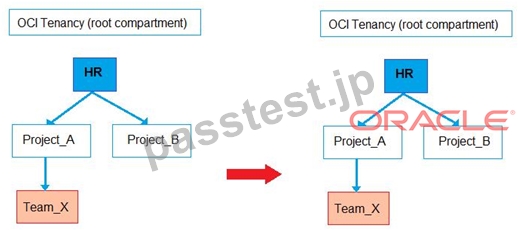
Compartment Team_x needs to be moved under a new parent compartment, Project_B The tenancy has the following policies defined for compartments Project_A and Project_B:
Policy1: Allow group G1 to manage instance-family in compartment HR:Project_A Policy2: Allow group G2 to manage instance-family in compartment HR:Project_B Which two statements describe the impacts after the compartment Team_x is moved? (Choose two.)
- A. Group G1 can now manage instance-families in compartment Project_A, compartment Project_B and compartment Team_X
- B. Group G2 can now manage instance-families in compartment Project_B and compart-ment Team_X
- C. Group G2 can now manage instance-families in compartment Project_B, compartment Project_A and compartment Team_X
- D. Group G1 can now manage instance-families in compartment Project_A but not in compartment Team_x
- E. Group G2 can now manage instance-families in compartment Project_A but not in compartment Team_x
正解:B、D
質問 # 51
......
合格させるOracle 1Z0-1067-25試験最速合格にはPassTest:https://www.passtest.jp/Oracle/1Z0-1067-25-shiken.html
1Z0-1067-25問題集で必ず試験合格させる:https://drive.google.com/open?id=1UZMY4IvAmtUHUH-XLTKTOVLuTY-t-ouF