

[2026年03月06日]CSP-Assessor試験ブレーン問題集で学習注釈と理論
合格させるSwift CSP-Assessorテスト練習テスト問題試験問題集
質問 # 70
Select the components a SwiftNet Link (SNL) may communicate with. (Choose all that apply.)
- A. The VPN boxes
- B. The messaging interface (such as Alliance Access)
- C. The Graphical User Interface
- D. The HSM device
正解:B、C、D
質問 # 71
Which of the following infrastructures has the smallest SWIFT footprint? (Select the correct answer)
*Connectivity
*Generic
*Products Cloud
*Products OnPrem
*Security
- A. A user with a Messaging Interface behind a Service Bureau
- B. Full stack of products up to the Messaging Interface
- C. Lite 2 or Alliance Cloud
- D. Alliance Remote Gateway
正解:C
質問 # 72
As a Swift CSP Certified Assessor. Swift contacted me to provide evidence on an assessment I have performed. This is required to support their quality assurance validation process. Is it allowed?
- A. No, it's confidential
- B. Yes, one of the obligations of the certification programme is that quality assessment can be performed by Swift
正解:B
解説:
This question addresses the obligations of a Swift CSP Certified Assessor regarding the provision of evidence to Swift for quality assurance purposes.
Step 1: Understand the Role of a Swift CSP Certified Assessor
A Swift CSP Certified Assessor is an independent professional or entity authorized to conduct CSP assessments under theIndependent Assessment Framework. The certification program, managed by Swift, includes specific obligations to ensure the integrity and quality of assessments.
Step 2: Analyze the Request for Evidence
* Swift has contacted the assessor to provide evidence from an assessment to support their quality assurance validation process. This request implies a review of the assessor's work to ensure compliance with CSP standards.
* TheSwift CSP Assessor Certification Program Guidelinesstate that certified assessors are obligated to cooperate with Swift's quality assurance processes. This includes providingevidence (e.g., assessment reports, workpapers) upon request to verify the accuracy and adherence to methodology, as part of Swift's oversight.
* Confidentiality is a concern, but theCSCF v2024andAssessor Certification Programclarify that assessors must share evidence with Swift under a non-disclosure agreement (NDA) or similar confidentiality framework, ensuring data protection while allowing validation.
Step 3: Evaluate Each Option
* A. Yes, one of the obligations of the certification programme is that quality assessment can be performed by SwiftTheSwift CSP Assessor Certification Program Guidelinesexplicitly outline that Swift may conduct quality assessments, and assessors must provide evidence to support this process.
This is a contractual obligation of certification, aligning with Swift's responsibility to maintain CSP integrity.Conclusion: This is correct.
* B. No, it's confidentialWhile confidentiality is critical (protected underControl 2.3: System Access Controland Swift's privacy policies), the certification program requires assessors to share evidence with Swift for quality assurance, subject to confidentiality agreements. Refusing to provide evidence would breach the assessor's obligations.Conclusion: This is incorrect.
Step 4: Conclusion and Verification
The answer isA, as theSwift CSP Assessor Certification Programmandates that certified assessors must support Swift's quality assurance validation by providing evidence, balancing confidentiality with compliance oversight.
References
* Swift Customer Security Controls Framework (CSCF) v2024, Control 2.3: System Access Control.
* Swift CSP Assessor Certification Program Guidelines, Section: Obligations and Quality Assurance.
* Swift Independent Assessment Framework, Section: Assessor Responsibilities.
質問 # 73
The cluster of VPN boxes is also called managed-customer premises equipment (M-CPE).
- A. FALSE
- B. TRUE
正解:B
質問 # 74
The Alliance Gateway application is considered a messaging interface.
*Connectivity
*Generic
*Products Cloud
*Products OnPrem
*Security
- A. TRUE
- B. FALSE
正解:B
解説:
Alliance Gateway (SAG) is a SWIFT product that facilitates connectivity between messaging interfaces and the SWIFT network. Let's evaluate the statement:
*A messaging interface in SWIFT terminology refers to applications like Alliance Access (SAA) or Alliance Entry, which are responsible for creating, validating, and processing SWIFT messages (e.g., FIN MT messages). These interfaces handle the business logic of message flows, interfacing with back-office systems and preparing messages for transmission.
*Alliance Gateway, however, is classified as a communication interface. It acts as a hub to consolidate message flows from multiple messaging interfaces (e.g., Alliance Access) and connects them to the SWIFT network via SwiftNet Link (SNL). SAG does not create or process messages; it manages their transport, ensuring secure transmission over the SWIFT Secure IP Network (SIPN). This distinction is clear in SWIFT documentation, where SAG is described as a connectivity layer, not a messaging interface.
*The CSCF reinforces this separation by applying specific controls to messaging interfaces (e.g., "2.1 Internal Data Transmission Security" for Alliance Access) and communication interfaces (e.g., "1.1 SWIFT Environment Protection" for SAG). Since SAG does not perform the functions of a messaging interface, the statement is false.
Summary of Correct answer:
Alliance Gateway is a communication interface, not a messaging interface, making the statement false.
References to SWIFT Customer Security Programme Documents:
*SWIFT Customer Security Controls Framework (CSCF) v2024: Differentiates messaging interfaces (Control
2.1) from communication interfaces (Control 1.1).
*SWIFT Alliance Gateway Documentation: Describes SAG as a communication interface for SWIFTNet connectivity.
*SWIFT Architecture Glossary: Clarifies the roles of messaging interfaces (e.g., Alliance Access) versus communication interfaces (e.g., Alliance Gateway).
========
質問 # 75
A Swift user has remediated an exception reported by the assessor. What are their obligations before updating and submitting an attestation reflecting the new compliance level?
- A. The exception must be re-assessed by an independent assessor. The assessor can be different to the one who initially raised the exception
- B. The first line of defense can confirm their level of compliance using a self-assessment approach
- C. The exception must be re-assessed by the same independent assessor that raised the exception
- D. None, if the remediation has been completed, a new attestation can be submitted reflecting the compliance of the control
正解:A
解説:
This question explores the process for updating an attestation after remediating an exception identified by an assessor:
* Step 1: CSP Attestation and Remediation Process
* The SWIFT CSP requires users to submit an annual attestation via the KYC Security Attestation (KYC-SA) application, reflecting compliance with CSCF controls. If anexception (non- compliance) is reported, remediation must occur, followed by validation before updating the attestation.
質問 # 76
Is the restriction of Internet access only relevant when having SWIFT-related components in a secure zone?
*Swift Customer Security Controls Policy
*Swift Customer Security Controls Framework v2025
*Independent Assessment Framework
*Independent Assessment Process for Assessors Guidelines
*Independent Assessment Framework - High-Level Test Plan Guidelines
*Outsourcing Agents - Security Requirements Baseline v2025
*CSP Architecture Type - Decision tree
*CSP_controls_matrix_and_high_test_plan_2025
*Assessment template for Mandatory controls
*Assessment template for Advisory controls
- A. No, because there can be in-scope general operator PCs used to access a SWIFT-related application hosted at a service provider
- B. Yes, because if there is no secure zone, then the internet connectivity does not need to be restricted
正解:A
解説:
The restriction of Internet access is a key control under the CSCF, specifically tied to Control "1.1 SWIFT Environment Protection," which mandates that SWIFT-related components in the secure zone be isolated from the general IT environment and the Internet to prevent unauthorized access and attacks. Let's evaluate the options:
*Option A: Yes, because if there is no secure zone, then the internet connectivity does not need to be restricted This is incorrect. The CSCF applies to all SWIFT users, regardless of whether they maintain a local secure zone. Even if SWIFT-related components (e.g., a customer connector or operator PC) are hosted externally (e.
g., by a service provider), the user's endpoints (e.g., operator PCs accessing the application) must still adhere to security controls, including restricting Internet access where applicable. The "Independent Assessment Framework" requires assessing all in-scope components, not just those in a secure zone.
*Option B: No, because there can be in-scope general operator PCs used to access a SWIFT-related application hosted at a service provider This is correct. General operator PCs used to access SWIFT-related applications (e.g., Alliance Lite2 Business Application hosted by a service provider) are in scope of the CSCF, as they handle sensitive SWIFT data or credentials. Control "1.1" and "6.1 Security Awareness" require these PCs to have restricted Internet access to prevent malware or unauthorized access, even if the application is hosted externally. The "CSP Architecture Type - Decision tree" includes such endpoints in the assessment scope, making Internet access restriction relevant beyond the secure zone.
Summary of Correct answer:
The restriction of Internet access is not only relevant when having SWIFT-related components in a secure zone; it applies to in-scope general operator PCs accessing hosted applications (B).
References to SWIFT Customer Security Programme Documents:
*Swift Customer Security Controls Framework v2025: Control 1.1 mandates Internet access restriction for in- scope components.
*Independent Assessment Framework: Includes operator PCs in scope, even with external hosting.
*CSP_controls_matrix_and_high_test_plan_2025: Applies controls to endpoints accessing SWIFT services.
========
質問 # 77
Select the correct statement(s) about the Swift Alliance Gateway. (Choose all that apply.)
- A. The Alliance Gateway can only be accessed by a SWIFTNet user
- B. It allows the creation and/or modification of some Swift messages (depending on the types &/or formats)
- C. It acts as the single window to SwiftNet messaging services byconcentratingyour traffic flows
- D. It allows sharing of PKI profiles between application or individuals, through the use of virtual profiles
正解:C、D
解説:
The Swift Alliance Gateway is a critical component in the Swift ecosystem, designed to facilitate secure messaging and connectivity. Let's evaluate each option based on theSwift Customer Security Controls Framework (CSCF) v2024and related documentation.
Step 1: Understand the Role of Swift Alliance Gateway
The Swift Alliance Gateway (SAG) is a software component that serves as a centralized entry point for SwiftNet messaging services. It handles traffic concentration, security, and connectivity management. This is detailed in theSwift Alliance Gateway User Guideand referenced in theCSCF v2024underControl 1.1: Swift Environment Protection.
Step 2: Evaluate Each Option
* A. It acts as the single window to SwiftNet messaging services by concentrating your traffic flows The SAG is designed to consolidate and manage all SwiftNet traffic from a user's environment,acting as a single point of access to SwiftNet services. This is a primary function, as confirmed in theSwift Alliance Gateway Technical Documentationand aligns withControl 1.1, which emphasizes secure traffic management.Conclusion: This statement is correct.
* B. It allows sharing of PKI profiles between application or individuals, through the use of virtual profilesThe SAG supports the use of virtual PKI profiles to enable secure sharing of cryptographic identities across applications or users within the Swift environment. This feature enhances flexibility while maintaining security, as noted in theSwift Security Best PracticesandControl 2.5B:
Cryptographic Key Management.Conclusion: This statement is correct.
* C. It allows the creation and/or modification of some Swift messages (depending on the types &
/or formats)The SAG is a gateway for message routing and security, not a tool for creating or modifying Swift messages. Message creation and modification are handled by applications like Alliance Access or Entry, not the Gateway. This is clarified in theSwift Alliance Gateway User Guide, which specifies its role as a connectivity and security layer.Conclusion: This statement is incorrect.
* D. The Alliance Gateway can only be accessed by a SWIFTNet userThe SAG is accessed by authorized systems and users within the Swift user's environment, not exclusively by SwiftNet users. It interfaces with operator systems, middleware, and other components, as perControl 1.2: Logical Access Control, which allows controlled access by authorized entities, not just SwiftNet users.
Conclusion: This statement is incorrect.
Step 3: Conclusion and Verification
The verified statements areAandB, as they accurately reflect the SAG's role in traffic concentration and PKI profile management, consistent with Swift CSP documentation.
References
* Swift Alliance Gateway User Guide, Section: Functionality Overview.
* Swift Customer Security Controls Framework (CSCF) v2024, Control 1.1: Swift Environment Protection, Control 2.5B: Cryptographic Key Management.
* Swift Security Best Practices, Section: Alliance Gateway Configuration.
質問 # 78
Select the correct statement about SWIFT Alliance Cloud.
*Connectivity
*Generic
*Products Cloud
*Products OnPrem
*Security
- A. Alliance Cloud is a cloud-based solution. It is offered by any public cloud provider that subscribed to the digital connectivity initiative
- B. Alliance Cloud is a SWIFT cloud-based solution. It consists of an Alliance Access instance deployed at one of the three SWIFT-approved public cloud providers
- C. Alliance Cloud is a SWIFT cloud-based solution. It provides a universal channel to the financial community and to SWIFT Value Added services and initiatives
- D. Alliance Cloud is a cloud-based solution. It is offered by the 3 official public cloud providers. This allows customers the choice to select their preferred cloud provider
正解:B
解説:
SWIFT Alliance Cloud is a managed cloud service provided by SWIFT to deliver a fully hosted SWIFT infrastructure, reducing the local footprint for users. Let's evaluate each option:
*Option A: Alliance Cloud is a SWIFT cloud-based solution. It provides a universal channel to the financial community and to SWIFT Value Added services and initiatives This is partially correct but incomplete. Alliance Cloud is indeed a SWIFT-managed cloud solution, and it facilitates connectivity to the financial community and SWIFT Value Added Services (e.g., SWIFT gpi, Sanctions Screening). However, the term "universal channel" is vague and not a precise description of Alliance Cloud's functionality, which is more accurately defined as a hosted messaging and connectivity platform. This option lacks specificity about the deployment model.
*Option B: Alliance Cloud is a cloud-based solution. It is offered by the 3 official public cloud providers. This allows customers the choice to select their preferred cloud provider This is incorrect. Alliance Cloud is a SWIFT-managed service deployed on specific public cloud providers approved by SWIFT, not a solution where customers can choose any of the "3 official public cloud providers." SWIFT partners with select providers (e.g., AWS, Microsoft Azure, Google Cloud) but controls the deployment and configuration, limiting customer choice to SWIFT-approved instances.
*Option C: Alliance Cloud is a cloud-based solution. It is offered by any public cloud provider that subscribed to the digital connectivity initiative This is incorrect. Alliance Cloud is not available on any public cloud provider that subscribes to a "digital connectivity initiative." It is hosted exclusively on SWIFT-approved public cloud providers, ensuring compliance with SWIFT's security and operational standards. The term "digital connectivity initiative" is not a recognized framework in SWIFT documentation for Alliance Cloud.
*Option D: Alliance Cloud is a SWIFT cloud-based solution. It consists of an Alliance Access instance deployed at one of the three SWIFT-approved public cloud providers This is correct. Alliance Cloud is a SWIFT-managed cloud solution that includes a hosted Alliance Access instance (a messaging interface) deployed on one of the three SWIFT-approved public cloud providers (e.g., AWS, Microsoft Azure, Google Cloud). This setup provides a fully managed environment for SWIFT connectivity, reducing the user's local infrastructure needs. The CSCF applies to this cloud deployment, with SWIFT managing many security controls (e.g., "1.1 SWIFT Environment Protection"). SWIFT documentation confirms this model, emphasizing the use of approved providers.
Summary of Correct answer:
The correct statement is D, accurately describing Alliance Cloud as a SWIFT-managed solution with an Alliance Access instance on SWIFT-approved public cloud providers.
References to SWIFT Customer Security Programme Documents:
*SWIFT Customer Security Controls Framework (CSCF) v2024: Supports cloud deployments on approved providers (Control 1.1).
*SWIFT Alliance Cloud Documentation: Details the deployment on SWIFT-approved public cloud providers with Alliance Access.
*SWIFT Cloud Partnership Guidelines: Lists approved providers like AWS, Azure, and Google Cloud.
========
質問 # 79
What does the CSCF expect in terms of Database Integrity? (Select the two correct answers that apply)
*Swift Customer Security Controls Policy
*Swift Customer Security Controls Framework v2025
*Independent Assessment Framework
*Independent Assessment Process for Assessors Guidelines
*Independent Assessment Framework - High-Level Test Plan Guidelines
*Outsourcing Agents - Security Requirements Baseline v2025
*CSP Architecture Type - Decision tree
*CSP_controls_matrix_and_high_test_plan_2025
*Assessment template for Mandatory controls
*Assessment template for Advisory controls
- A. Alerts generated from performed integrity checks are captured and analyzed for appropriate treatment
- B. Nothing is further expected when the messaging interface or connector integrates/embeds an integrity check functionality at each SWIFT transaction record level
- C. When a database is used by a messaging interface or connector, the related hosted database and its supporting system is expected to be protected as a SWIFT-related component, the identified exceptions alerted and followed-up
正解:A、C
解説:
CSCF Control "3.1 Database Integrity" focuses on ensuring the integrity of databases used by SWIFT-related components. Let's evaluate each option:
*Option A: Nothing is further expected when the messaging interface or connector integrates/embeds an integrity check functionality at each SWIFT transaction record level This is incorrect as a sole expectation. While embedding integrity checks (e.g., checksums or hashes) in a messaging interface or connector is a valid measure, the CSCF expects additional protections for the database itself, not just reliance on application-level checks. The "Swift Customer Security Controls Framework v2025" requires broader database security.
*Option B: When a database is used by a messaging interface or connector, the related hosted database and its supporting system is expected to be protected as a SWIFT-related component, the identified exceptions alerted and followed-up This is correct. Control 3.1 mandates that databases supporting SWIFT components (e.g., storing transaction data for Alliance Access) be protected as in-scope components. This includes securing the database and its system (e.g., via access controls, encryption) and addressing integrity exceptions through alerts and follow-up, as detailed in the "Assessment template for Mandatory controls."
*Option C: Alerts generated from performed integrity checks are captured and analyzed for appropriate treatment This is correct. The CSCF expects institutions to monitor database integrity (e.g., via logging) and analyze alerts to detect and respond to anomalies, aligning with Control "3.1" and "5.1 Operational Incident Response." The "CSP_controls_matrix_and_high_test_plan_2025" includes this as a compliance criterion.
Summary of Correct Answers:
The CSCF expects the database and its system to be protected with alerts and follow-up (B) and alerts to be captured and analyzed (C).
References to SWIFT Customer Security Programme Documents:
*Swift Customer Security Controls Framework v2025: Control 3.1 defines database integrity requirements.
*Assessment template for Mandatory controls: Includes protection and alert management.
*CSP_controls_matrix_and_high_test_plan_2025: Tests database integrity measures.
========
質問 # 80
Must Swift users submit a copy of their final assessment report to Swift?
- A. No, it is not required to provide Swift with any documents by default. However, Swift can request a copy of the Assessment completion letter
- B. Yes, all documents produced from the assessment must be provided proactively to Swift
- C. Yes, a copy of (only) the assessment report must be provided to Swift, no other documents
- D. Yes, in cases where a customer performs an Independent assessment rather than an audit then a copy of the assessment report must be provided. However, it is not required for the Swift user to provide any forms when an Internal/External Audit is performed
正解:A
解説:
This question addresses the obligations of Swift users regarding the submission of assessment-related documents to Swift under the Customer Security Programme (CSP).
Step 1: Understand CSP Assessment Submission Requirements
TheSwift Customer Security Controls Framework (CSCF) v2024and theIndependent Assessment Framework outline the process for CSP assessments, including what must be submitted to Swift. The focus is on ensuring compliance through attestation, with specific deliverables defined.
Step 2: Evaluate Each Option
* A. Yes, all documents produced from the assessment must be provided proactively to SwiftThis is incorrect. TheIndependent Assessment Frameworkdoes not require proactive submission of all assessment documents (e.g., detailed reports, working papers). Only the completion letter and attestation are typically submitted unless otherwise requested by Swift.Conclusion: Incorrect.
* B. No, it is not required to provide Swift with any documents by default. However, Swift can request a copy of the Assessment completion letterTheCSCF v2024andIndependent Assessment Frameworkstate that users are not required to proactively submit the full assessment report or other documents. However, Swift retains the right to request the completion letter (certifying assessment completion) or additional evidence during quality assurance reviews. This aligns with theSwift CSP Compliance Guidelines.Conclusion: Correct.
* C. Yes, a copy of (only) the assessment report must be provided to Swift, no other documentsThis is incorrect. The full assessment report is not mandated for proactive submission; only the completion letter is typically required unless requested. TheIndependent Assessment Frameworkemphasizes the completion letter as the key deliverable.Conclusion: Incorrect.
* D. Yes, in cases where a customer performs an Independent assessment rather than an audit then a copy of the assessment report must be provided. However, it is not required for the Swift user to provide any forms when an Internal/External Audit is performedThis is partially misleading. The Independent Assessment Frameworkdoes not distinguish between independent assessments and audits in terms of mandatory report submission. For both, the completion letter is the default submission, with reports requested only if needed. The differentiation based on assessment type is not supported byCSCF v2024guidelines.Conclusion: Incorrect.
Step 3: Conclusion and Verification
The correct answer isB, as theCSCF v2024andIndependent Assessment Frameworkdo not require proactive submission of the full assessment report, but Swift can request the completion letter as part of its oversight process.
References
* Swift Customer Security Controls Framework (CSCF) v2024, Section: Independent Assessment Requirements.
* Swift Independent Assessment Framework, Section: Deliverables and Submission.
* Swift CSP Compliance Guidelines, Section: Document Submission Rules.
質問 # 81
When hesitant on the applicability of a CSCF control to a particular component? What steps should you take? (Choose all that apply.)
- A. Open a case with Swift support via the case manager on swift com if further information or solution cannot be found in the documentation
- B. Check appendix F of the CSCF
- C. Call your Swift contact
- D. Check carefully the Introduction section of the CSCF
正解:A、B、C、D
質問 # 82
The SWIFT user's first line of defence has performed a detailed self-assessment demonstrating an adequate compliance level to each of the applicable controls. As an assessor, may I fully rely on this analysis if the SWIFT user can demonstrate that their conclusion was based on a valid testing approach? (Select the correct answer)
*Swift Customer Security Controls Policy
*Swift Customer Security Controls Framework v2025
*Independent Assessment Framework
*Independent Assessment Process for Assessors Guidelines
*Independent Assessment Framework - High-Level Test Plan Guidelines
*Outsourcing Agents - Security Requirements Baseline v2025
*CSP Architecture Type - Decision tree
*CSP_controls_matrix_and_high_test_plan_2025
*Assessment template for Mandatory controls
*Assessment template for Advisory controls
*CSCF Assessment Completion Letter
*Swift_CSP_Assessment_Report_Template
- A. Yes
- B. No, even if it could support the compliance level, additional testing will always be required by the independent assessor to confirm a controls compliance level
- C. Yes, but only if the CISO signs the completion letter at the end of the assessment
- D. No, except if the SWIFT user's chief auditor approves this approach
正解:B
解説:
The SWIFT CSP requires an independent assessment to ensure compliance with the CSCF, as outlined in the
"Independent Assessment Framework" and "Independent Assessment Process for Assessors Guidelines." Let' s evaluate each option:
*Option A: Yes
This is incorrect. The CSP mandates that an independent assessor, not the user's first line of defence, conducts the assessment to provide an unbiased evaluation. Relying solely on a self-assessment, even if detailed, does not meet the requirement for independence, as per the "Independent Assessment Framework."
*Option B: Yes, but only if the CISO signs the completion letter at the end of the assessment This is incorrect. While the Chief Information Security Officer (CISO) may sign the "CSCF Assessment Completion Letter" to acknowledge the assessment, this does not replace the need for independent testing.
The signature is a formal step, but the assessor must still perform their own validation.
*Option C: No, even if it could support the compliance level, additional testing will always be required by the independent assessor to confirm a controls compliance level This is correct. The "Independent Assessment Process for Assessors Guidelines" requires assessors to conduct their own testing, even if the user provides a valid self-assessment. This ensures objectivity and verifies the effectiveness of controls (e.g., Control 1.1 SWIFT Environment Protection). The self-assessment can serve as supporting evidence, but additional testing is mandatory, as detailed in the
"CSP_controls_matrix_and_high_test_plan_2025."
*Option D: No, except if the SWIFT user's chief auditor approves this approach This is incorrect. Chief auditor approval does not override the CSP's requirement for independent assessor testing. The assessment process is governed by SWIFT standards, not internal approvals.
Summary of Correct answer:
An assessor cannot fully rely on the user's self-assessment; additional testing is always required (C).
References to SWIFT Customer Security Programme Documents:
*Independent Assessment Framework: Mandates independent assessor testing.
*Independent Assessment Process for Assessors Guidelines: Requires additional validation.
*CSP_controls_matrix_and_high_test_plan_2025: Outlines assessor testing requirements.
========
質問 # 83
When hesitant on the applicability of a CSCF control to a particular component? What steps should you take?
(Choose all that apply.)
- A. Call your Swift contact
- B. Open a case with Swift support via the case manager on swift com if further information or solution cannot be found in the documentation
- C. Check appendix F of the CSCF
- D. Check carefully the Introduction section of the CSCF
正解:B、C、D
解説:
This question addresses the process for resolving uncertainty about the applicability of a CSCF control to a specific component.
Step 1: Understand the CSCF Documentation Structure
TheSwift Customer Security Controls Framework (CSCF) v2024provides detailed guidance on control applicability, including sections like the Introduction and appendices, as well as support mechanisms for users.
Step 2: Evaluate Each Option
* A. Call your Swift contactWhile contacting a Swift representative might be helpful, it is not the first recommended step inthe CSCF documentation. The framework prioritizes self-service through documentation and support channels like swift.com before direct contact.Conclusion: This is not a primary step.
* B. Check appendix F of the CSCFAppendix F of theCSCF v2024provides detailed guidance on control applicability, including scenarios, architecture types, and component mappings. It is a key resource for clarifying whether a control applies to a specific component.Conclusion: This is correct.
* C. Check carefully the Introduction section of the CSCFThe Introduction section of theCSCF v2024 outlines the scope, objectives, and applicability of controls, including definitions of in-scope components and architecture types. It's a critical starting point for understanding control applicability.
Conclusion: This is correct.
* D. Open a case with Swift support via the case manager on swift.com if further information or solution cannot be found in the documentationIf the CSCF documentation (e.g., Introduction, Appendix F) does not resolve the uncertainty, theSwift CSP FAQandSwift Support Guidelines recommend opening a case via the swift.com case manager. This ensures users can get official clarification from Swift support.Conclusion: This is correct.
Step 3: Conclusion and Verification
The verified steps areB, C, and D, as they align with the recommended process in theCSCF v2024for resolving uncertainty about control applicability: first consult the documentation (Introduction and Appendix F), then escalate to Swift support if needed.
References
* Swift Customer Security Controls Framework (CSCF) v2024, Introduction Section and Appendix F.
* Swift CSP FAQ, Section: Resolving Control Applicability.
* Swift Support Guidelines, Section: Case Manager Usage.
質問 # 84
Which statements are correct about the Alliance Access LSO and RSO? (Select the two correct answers that apply)
*Connectivity
*Generic
*Products Cloud
*Products OnPrem
*Security
- A. They are the business profiles that can sign the SWIFT financial transactions
- B. They are Alliance Security Officers
- C. Their PKI certificates are stored either on an HSM Token or on an HSM-box
- D. They are responsible for the configuration and management of the security functions in the messaging interface
正解:B、D
解説:
The Local Security Officer (LSO) and Remote Security Officer (RSO) are roles defined within the SWIFT Alliance suite, particularly for managing security in messaging interfaces like Alliance Access. Let's evaluate each option:
*Option A: They are Alliance Security Officers
This is correct. The LSO and RSO are collectively referred to as Alliance Security Officers within the SWIFT ecosystem. The LSO is typically an on-site officer responsible for local security management, while the RSO can perform similar functions remotely, often for distributed environments. These roles are critical for configuring and maintaining security settings in Alliance Access, as outlined in SWIFT's operational documentation. The CSCF Control "6.1 Security Awareness" emphasizes the importance of trained security officers, which aligns with the LSO/RSO roles.
*Option B: Their PKI certificates are stored either on an HSM Token or on an HSM-box This is incorrect. While PKI certificates are used for authentication and are managed within the SWIFT environment, they are not specifically tied to the LSO or RSO roles in terms of storage. PKI certificates for SWIFTNet are stored and managed by the Hardware Security Module (HSM), either as an HSM token (e.g., a smart card) or an HSM-box (e.g., a physical or virtual HSM device). However, these certificates are associated with the SWIFT application or user roles (e.g., for message signing), not the LSO/RSO profiles themselves. The LSO/RSO uses these certificates as part of their duties, but the statement implies ownership or storage, which is inaccurate. CSCF Control "1.3 Cryptographic Failover" specifies HSM management, not LSO/RSO certificate storage.
*Option C: They are the business profiles that can sign the SWIFT financial transactions This is incorrect. The LSO and RSO are security management roles, not business profiles authorized to sign financial transactions. Signing SWIFT financial transactions (e.g., MT103 messages) is the responsibility of authorized business users or automated processes within Alliance Access, who use PKI certificates managed by the HSM. The LSO/RSO's role is to configure and oversee security, not to perform transactional activities.
This distinction is clear in SWIFT's role-based access control documentation.
*Option D: They are responsible for the configuration and management of the security functions in the messaging interface This is correct. The LSO and RSO are tasked with configuring and managing security functions within Alliance Access, such as user access control, authentication settings, and compliance with CSCF requirements. This includes managing PKI certificate usage, setting up secure communication channels, and ensuring the messaging interface adheres to security policies. For example, the LSO can define security profiles and monitor access, as detailed in the Alliance Access Administration Guide, aligning with CSCF Control "2.1 Internal Data Transmission Security." Summary of Correct Answers:
The LSO and RSO are Alliance Security Officers (A) and are responsible for the configuration and management of security functions in the messaging interface (D). Their PKI certificates are not stored by them, and they do not sign transactions.
References to SWIFT Customer Security Programme Documents:
*SWIFT Customer Security Controls Framework (CSCF) v2024: Control 6.1 highlights the role of security officers like LSO/RSO.
*SWIFT Alliance Access Documentation: Describes LSO/RSO responsibilities for security configuration.
*SWIFT Security Guidelines: Details PKI certificate management by HSM, not LSO/RSO.
========
質問 # 85
Select the correct statement about Alliance Gateway.
- A. It is used to exchange messages over the Swift network
- B. It is used to create messages to send over the Swift network
正解:A
質問 # 86
Application Hardening basically applies the following principles. (Choose all that apply.)
- A. Enhanced Straight Through Processing
- B. Access on a need to have
- C. Reduced footprint for less potential vulnerabilities
- D. Least Privileges
正解:B、C、D
解説:
Application Hardening is a key concept within theSwift Customer Security Controls Framework (CSCF), specifically addressed under security controls related to protecting systems and reducing vulnerabilities. The CSCF outlines principles to secure applications by minimizing risks, particularly in the context of Swift- related systems. Let's break down the options and verify them against Swift CSP guidelines.
Step 1: Understand Application Hardening in the Context of Swift CSP
Application Hardening refers to the process of securing an application by reducing its attack surface, limiting access, and mitigating potential vulnerabilities. This aligns with Swift CSP's overarching goal of enhancing the security of the Swift user community, as outlined in theCSCF v2024(and prior versions like CSCF v2023).
Relevant controls fall under domains likeControl Objective 2: Protect Critical SystemsandControl Objective 6: Detect Anomalous Activity.
Step 2: Evaluate Each Option Against Swift CSP Principles
* A. Least PrivilegesThe principle of least privilege is a core tenet of application hardening. It ensures that applications (and users) only have the minimum permissions necessary to perform their functions, reducing the risk of misuse or exploitation. This is explicitly referenced in theCSCF v2024, under Control 2.1: Operating System Privileged Account Control, which emphasizes restricting privileges to the minimum required. Application Hardening extends this to software processes, ensuring they run with minimal rights.Conclusion: This applies.
* B. Access on a need to haveThis principle, often phrased as "need-to-know" or "need-to-have" in security contexts, ensures that access to applications or their components is granted only to entities that require it for their role. In the Swift CSP, this aligns withControl 2.3: System Access Control, which mandates that access to Swift-related systems (including applications) is restricted to authorized users or processes. Application Hardening incorporates this by ensuring that applications only expose interfaces or resources to authorized entities.Conclusion: This applies.
* C. Reduced footprint for less potential vulnerabilitiesReducing the attack surface (or "footprint") of an application is a fundamental hardening technique. This involves disabling unnecessary features, services, or modules that could be exploited. TheCSCF v2024addresses this underControl 2.5A:
Application Hardening, which explicitly requires users to minimize the attack surface of Swift-related applications by removing unused components and limiting exposed services. This directly correlates with reducing potential vulnerabilities.Conclusion: This applies.
* D. Enhanced Straight Through Processing (STP)Straight Through Processing refers to the automated, end-to-end processing of transactions without manual intervention, a concept often associated with operational efficiency in financial systems. While STP is relevant to Swift's messaging and transaction workflows, it is not a principle of Application Hardening. The CSCF does not link STP to security hardening practices, which focus on reducing vulnerabilities rather than optimizing transaction flows.Conclusion: This does not apply.
Step 3: Conclusion and Verification
Application Hardening, as per theSwift Customer Security Controls Framework (CSCF), focuses on security principles that minimize risks to applications. The verified principles areLeast Privileges (A),Access on a need to have (B), andReduced footprint for less potential vulnerabilities (C). These align with Swift CSP' s emphasis on securing critical systems and reducing attack surfaces.
References
* Swift Customer Security Controls Framework (CSCF) v2024, Control 2.5A: Application Hardening.
* Swift Customer Security Programme - Security Best Practices, Section: Application Security.
* CSCF v2024, Control 2.1: Operating System Privileged Account Control, and Control 2.3: System Access Control.
質問 # 87
Which encryption methods are used to secure the communications between the SNL host and HSM boxes?
- A. NTLS and Telnet
- B. Telnet and SSL
- C. NTLS and SSH
- D. MPLS and SSL
正解:C
解説:
This question focuses on the encryption methods securing communications between the SwiftNet Link (SNL) host and Hardware Security Module (HSM) boxes in the Swift environment.
Step 1: Understand SNL and HSM Communication
The SwiftNet Link (SNL) facilitates secure connectivity to the Swift network, while the HSM manages cryptographic keys. Secure communication between the SNL host and HSM is critical, as outlined inControl
2.5B: Cryptographic Key Managementof theCSCF v2024. These communications must use strong encryption protocols.
Step 2: Evaluate Each Option
* A. NTLS and SSH
* NTLS (Network Transport Layer Security): This is Swift's proprietary protocol for securing communications over the SwiftNet network, including between SNL and HSM. It provides end- to-end encryption and is widely used in Swift infrastructure, as confirmed in theSwift Alliance Gateway Technical Documentation.
* SSH (Secure Shell): SSH is used for secure management and administration of HSMs and SNL hosts, enabling encrypted remote access and configuration, as noted inSwift Security Best Practices.This combination aligns with Swift's security requirements for protecting HSM communications.Conclusion: This is correct.
* B. Telnet and SSL
* Telnet: An unencrypted protocol, unsuitable for secure communications, and not used in Swift's security framework perControl 2.6: Internet Accessibility Restriction.
* SSL (Secure Sockets Layer): An older encryption protocol, largely replaced by TLS in modern systems. Swift does not specify SSL for SNL-HSM communications, favoring NTLS.Conclusion: This is incorrect.
* C. NTLS and Telnet
* NTLS: As above, this is valid for SwiftNet communications.
* Telnet: As an unencrypted protocol, it is not acceptable for securing HSM communications, per Control 2.5B.Conclusion: This is incorrect.
* D. MPLS and SSL
* MPLS (Multiprotocol Label Switching): A networking technology for routing, not an encryption method, and not relevant to SNL-HSM security.
* SSL: As above, not used in this context by Swift.Conclusion: This is incorrect.
Step 3: Conclusion and Verification
The correct answer isA, as NTLS secures the data communication and SSH provides secure management access between the SNL host and HSM, consistent withCSCF v2024and Swift technical documentation.
References
* Swift Customer Security Controls Framework (CSCF) v2024, Control 2.5B: Cryptographic Key Management, Control 2.6: Internet Accessibility Restriction.
* Swift Alliance Gateway Technical Documentation, Section: Network Security Protocols.
* Swift Security Best Practices, Section: HSM and SNL Configuration.
質問 # 88
Select the correct statement about Alliance Gateway.
- A. It is used to exchange messages over the Swift network
- B. It is used to create messages to send over the Swift network
正解:A
解説:
This question revisits the role of the Swift Alliance Gateway (SAG), similar to Question 6, but with different statements.
Step 1: Recap the Role of Alliance Gateway
The Swift Alliance Gateway (SAG) is a connectivity and security layer that facilitates interaction with the Swift network, as detailed in theSwift Alliance Gateway User Guideand referenced inControl 1.1: Swift Environment Protectionof theCSCF v2024.
Step 2: Evaluate Each Option
* A. It is used to exchange messages over the Swift networkThe SAG acts as a gateway to concentrate and securely route SwiftNet traffic, enabling the exchange of messages over the Swift network. It handles connectivity, security (e.g., PKI), and message routing, as confirmed in theSwift Alliance Gateway Technical Documentation. This aligns with its role in the Swift ecosystem.Conclusion: This is correct.
* B. It is used to create messages to send over the Swift networkAs noted in Question 6, the SAG does not create messages. Message creation is handled by applications like Alliance Access or Entry. The SAG's role is to route and secure messages, not generate them, per theSwift Alliance Gateway User Guide.Conclusion: This is incorrect.
Step 3: Conclusion and Verification
The correct statement isA, as the Alliance Gateway's primary function is to facilitate the secure exchange of messages over the Swift network, consistent with Swift CSP documentation.
References
* Swift Alliance Gateway User Guide, Section: Functionality Overview.
* Swift Customer Security Controls Framework (CSCF) v2024, Control 1.1: Swift Environment Protection.
* Swift Alliance Gateway Technical Documentation, Section: Message Routing.
質問 # 89
Select the components a SwiftNet Link (SNL) may communicate with. (Choose all that apply.)
- A. The messaging interface (such as Alliance Access)
- B. The VPN boxes
- C. The Graphical User Interface
- D. The HSM device
正解:A、B、D
解説:
This question identifies the components with which the SwiftNet Link (SNL) communicates, based on its role in the Swift ecosystem under theSwift Customer Security Controls Framework (CSCF) v2024.
Step 1: Understand the Role of SwiftNet Link (SNL)
The SNL is a communication layer that facilitates secure connectivity between a Swift user's environment and the Swift network. It handles encrypted data transmission and interacts with specific infrastructure components, as detailed in theSwift Alliance Gateway Technical DocumentationandControl 1.1: Swift Environment Protectionof theCSCF v2024.
Step 2: Evaluate Each Option
* A. The Graphical User InterfaceThe GUI (e.g., operator interface) is used by personnel to interact with Swift applications (e.g., Alliance Access), but it does not directly communicate with the SNL. The SNL operates at the network and security layer, not the user interface layer, per theSwift User Handbook
.Conclusion: Incorrect.
* B. The VPN boxesThe SNL communicates with VPN boxes to establish secure tunnels (e.g., using NTLS) for data transmission to the Swift network, as specified in theSwift Security Best Practicesand Control 2.6: Internet Accessibility Restriction.Conclusion: Correct.
* C. The HSM deviceThe SNL interacts with the Hardware Security Module (HSM) to manage cryptographic keys and secure communications, as outlined inControl 2.5B: Cryptographic Key Managementand theSwift Alliance Gateway Technical Documentation.Conclusion: Correct.
* D. The messaging interface (such as Alliance Access)The SNL connects to the messaging interface (e.
g., Alliance Access or Entry) to transmit and receive Swift messages, a core function described in the CSCF v2024underControl 1.1.Conclusion: Correct.
Step 3: Conclusion and Verification
The correct answers areB, C, and D, as the SNL communicates with VPN boxes, HSM devices, and messaging interfaces to ensure secure and functional connectivity to the Swift network, consistent withCSCF v2024and related documentation.
References
* Swift Customer Security Controls Framework (CSCF) v2024, Control 1.1: Swift Environment Protection, Control 2.5B: Cryptographic Key Management, Control 2.6: Internet Accessibility Restriction.
* Swift Alliance Gateway Technical Documentation, Section: SNL Communication.
* Swift Security Best Practices, Section: Network Infrastructure.
質問 # 90
In the illustration, identify which components are in scope of the CSCF? (Choose all that apply.)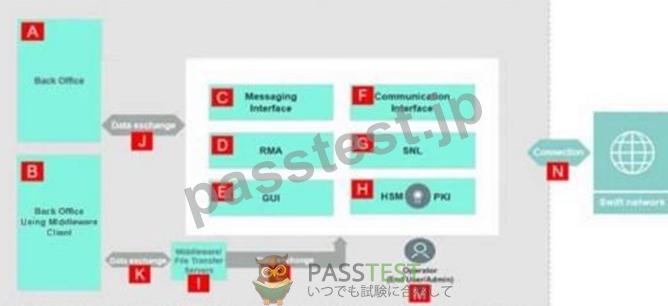
- A. Components F, G, H
- B. Components C, E, M
- C. Components J, K, I
- D. Components A, B, K
正解:B
質問 # 91
Using the outsourcing agent diagram. Which components must be placed in a secure zone? (Choose all that apply.)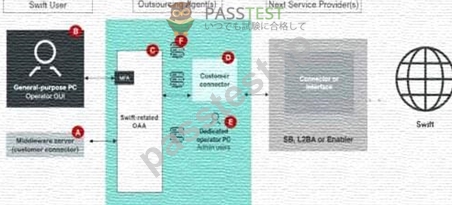
- A. Component C
- B. Component D
- C. Component A
- D. Component B
正解:A、B、C
解説:
The diagram provided represents a Swift user environment with an outsourcing agent, showing various components involved in the Swift workflow. The Swift Customer Security Programme (CSP) mandates specific security controls to protect critical components, particularly those handling Swift-related data or connectivity. Let's analyze the diagram and determine which components must be placed in asecure zoneas per theCSCF v2024.
Step 1: Understand the Secure Zone Requirement
Asecure zonein the Swift CSP context refers to a segregated, protected environment where critical Swift- related components are isolated from general-purpose systems to minimize risks. This is outlined inControl
1.1: Swift Environment Protectionof theCSCF v2024, which mandates that Swift infrastructure (e.g., messaging interfaces, connectors, and related systems) must be logically and physically separated from non- Swift systems. The secure zone ensures that only authorized systems and users can interact with Swift components.
Step 2: Analyze the Diagram and Identify Components
The diagram includes the following components:
* A. Middleware server (customer connector): Labeled as Component A, this server facilitates connectivity between the Swift user's systems and the outsourcing agent's infrastructure.
* B. General-purpose PC Operator GUI: This is a general-purpose system used by an operator to interact with the Swift environment.
* C. Swift-related OAA (Operational Application Architecture): Labeled as Component C, this represents the Swift messaging interface (e.g., Alliance Access/Entry) managed by the outsourcing agent.
* D. Customer connector: This component, within the outsourcing agent's environment, interfaces directly with the Swift connector or interface.
* E. Dedicated PC Admin users: This represents administrative systems used to manage the Swift environment.Additionally, there's aConnector or Interface(SB, L2BA, or Enabler) connecting to the Swift network.
Step 3: Determine Which Components Belong in a Secure Zone
* A. Middleware server (customer connector):This component facilitates connectivity between the Swift user and the outsourcing agent's Swift-related systems. According toControl 1.1: Swift Environment Protection, any system that directly interacts with the Swift messaging infrastructure (e.
g., as a connector) must reside in a secure zone to prevent unauthorized access or tampering. Since this middleware server is part of the Swift data flow, it must be in a secure zone.Conclusion: Component A must be in a secure zone.
* B. General-purpose PC Operator GUI:This is a general-purpose system used by operators, not a core Swift component. TheCSCF v2024underControl 1.2: Logical Access Controlrecommends that operator systems (e.g., GUIclients) should not reside in the same secure zone as critical Swift infrastructure to avoid introducing vulnerabilities from general-purpose systems. These systems typically connect to the secure zone via controlled interfaces (e.g., VPN or jump servers) but are not part of it.Conclusion: Component B does not need to be in a secure zone.
* C. Swift-related OAA:This represents the Swift messaging interface (e.g., Alliance Access/Entry), which is a core component of the Swift environment.Control 1.1explicitly requires that messaging interfaces be placed in a secure zone to protect them from external threats and ensure segregation from non-Swift systems. Since this component is directly involved in Swift message processing, it must be in a secure zone.Conclusion: Component C must be in a secure zone.
* D. Customer connector:This connector interfaces directly with the Swift connector or interface (SB, L2BA, or Enabler) to facilitate communication with the Swift network. As perControl 1.1, any component that directly connects to the Swift network or handles Swift traffic must be in a secure zone to ensure end-to-end security of the communication chain. This applies to the customer connector within the outsourcing agent's environment.Conclusion: Component D must be in a secure zone.
* E. Dedicated PC Admin users:Administrative systems used to manage the Swift environment are typically not placed in the same secure zone as the operational Swift components. According toControl
1.2: Logical Access Control, administrative access should be tightly controlled and segregated, often using jump servers or bastion hosts to access the secure zone. While these systems need secure access, they are not part of the secure zone itself.Conclusion: Component E does not need to be in a secure zone.
Step 4: Conclusion and Verification
Based on theCSCF v2024requirements, the components that must be placed in a secure zone are those directly involved in Swift message processing or connectivity to the Swift network. These are:
* A. Middleware server (customer connector)
* C. Swift-related OAA
* D. Customer connectorComponent B (general-purpose PC) and Component E (admin PC) are not required to be in the secure zone, as they are operator or administrative systems that should be segregated from the Swift operational environment.
References
* Swift Customer Security Controls Framework (CSCF) v2024, Control 1.1: Swift Environment Protection.
* Swift Customer Security Programme - Security Best Practices, Section: Secure Zone Configuration.
* CSCF v2024, Control 1.2: Logical Access Control.
質問 # 92
To verify the applicability of a CSCF control to a specific component, several actions may be considered.
Which one does not apply in this case?
*Swift Customer Security Controls Policy
*Swift Customer Security Controls Framework v2025
*Independent Assessment Framework
*Independent Assessment Process for Assessors Guidelines
*Independent Assessment Framework - High-Level Test Plan Guidelines
*Outsourcing Agents - Security Requirements Baseline v2025
*CSP Architecture Type - Decision tree
*CSP_controls_matrix_and_high_test_plan_2025
*Assessment template for Mandatory controls
*Assessment template for Advisory controls
*CSCF Assessment Completion Letter
*Swift_CSP_Assessment_Report_Template
- A. Check appendix F of the CSCF
- B. Check in the CSP Policy document
- C. Check carefully the Introduction section of the CSCF
- D. Open a case with SWIFT support via the case manager on swift.com if further information or solution cannot be found in the documentation
正解:B
解説:
Verifying the applicability of a CSCF control to a specific component involves consulting relevant SWIFT documentation and processes. The "Swift Customer Security Controls Framework v2025" and associated guidelines provide the framework for this determination. Let's evaluate each option:
*Option A: Check in the CSP Policy document
This does not apply. The "Swift Customer Security Controls Policy" is a high-level document outlining the CSP's objectives and requirements but does not provide detailed guidance on control applicability to specific components. Control applicability is determined by the CSCF itself (e.g., through appendices or the control matrix), not the policy document, which is more strategic than operational.
*Option B: Check appendix F of the CSCF
This applies. Appendix F of the CSCF (or a similar appendix in the v2025 version) typically includes guidance on control applicability, mapping controls to different architecture types and components. This is a standard action for assessors, as noted in the "Independent Assessment Process for Assessors Guidelines."
*Option C: Check carefully the Introduction section of the CSCF
This applies. The Introduction section of the CSCF provides an overview of the framework's scope, objectives, and how controls apply to various components, making it a relevant resource for verification.
*Option D: Open a case with SWIFT support via the case manager on swift.com if further information or solution cannot be found in the documentation This applies. If documentation does not resolve the applicability question, SWIFT support via the case manager on swift.com is a recognized escalation path, as outlined in the "Independent Assessment Framework" and SWIFT operational guidelines.
Summary of Correct answer:
Checking the CSP Policy document (A) does not apply, as it is not the appropriate resource for verifying control applicability to specific components.
References to SWIFT Customer Security Programme Documents:
*Swift Customer Security Controls Framework v2025: Provides applicability guidance in appendices (e.g., Appendix F) and the Introduction.
*Independent Assessment Process for Assessors Guidelines: Recommends using CSCF appendices and support channels.
*CSP_controls_matrix_and_high_test_plan_2025: Supports control applicability analysis.
========
質問 # 93
The outsourcing agent of the SWIFT user provided them with an independent assessment report covering the CSP components in their scope, and using the latest CSCF version for testing. Is it enough to support the CSP attestation for the outsourced components? (Select the correct answer)
*Swift Customer Security Controls Policy
*Swift Customer Security Controls Framework v2025
*Independent Assessment Framework
*Independent Assessment Process for Assessors Guidelines
*Independent Assessment Framework - High-Level Test Plan Guidelines
*Outsourcing Agents - Security Requirements Baseline v2025
*CSP Architecture Type - Decision tree
*CSP_controls_matrix_and_high_test_plan_2025
*Assessment template for Mandatory controls
*Assessment template for Advisory controls
*CSCF Assessment Completion Letter
*Swift_CSP_Assessment_Report_Template
- A. No, an audit report (and not an assessment) is required from the outsourcing agent as an external provider
- B. Yes, only if the outsourcing agent is a global trusted provider and published the report on their compliance portal
- C. No, except if the cloud provider components are partially covered by the SWIFT Alliance Connect Virtual programme
- D. Yes, after confirmation and validation of the scope
正解:D
解説:
The "Outsourcing Agents - Security Requirements Baseline v2025" and "Independent Assessment Framework" address reliance on outsourcing agents' assessments. Let's evaluate each option:
*Option A: Yes, after confirmation and validation of the scope
This is correct. The SWIFT user can rely on the outsourcing agent's independent assessment report if it covers the relevant CSP components and uses the latest CSCF version. However, the user's assessor must confirm and validate the scope and findings to ensure alignment with the user's attestation, as per the "Independent Assessment Process for Assessors Guidelines."
*Option B: Yes, only if the outsourcing agent is a global trusted provider and published the report on their compliance portal This is incorrect. The CSP does not require the outsourcing agent to be a "global trusted provider" or publish the report publicly; validation by the user's assessor is sufficient.
*Option C: No, an audit report (and not an assessment) is required from the outsourcing agent as an external provider This is incorrect. An independent assessment report is acceptable, not necessarily an audit report, as long as it meets CSCF standards, per the "Outsourcing Agents - Security Requirements Baseline v2025."
*Option D: No, except if the cloud provider components are partially covered by the SWIFT Alliance Connect Virtual programme This is incorrect. The Alliance Connect Virtual programme's coverage is irrelevant; the key is the report's validity and scope validation.
Summary of Correct answer:
The report is sufficient after confirmation and validation of the scope (A).
References to SWIFT Customer Security Programme Documents:
*Outsourcing Agents - Security Requirements Baseline v2025: Allows reliance on agent assessments.
*Independent Assessment Process for Assessors Guidelines: Requires scope validation.
*Swift_CSP_Assessment_Report_Template: Supports integrated reporting.
========
質問 # 94
......
厳密検証されたCSP-Assessor問題集と解答でCSP-Assessor問題集と正解付き:https://www.passtest.jp/Swift/CSP-Assessor-shiken.html
ベストCustomer Security Programme (CSP)学習ガイドCSP-Assessor試験:https://drive.google.com/open?id=1TBvRbu2Xc56vT2vbWIi21K0Pi5uTh3j1