

Associate-Cloud-Engineer更新された試験問題集で[2025年最新] 練習有効な試験問題集
Associate-Cloud-Engineerサンプルには正確で更新された問題
質問 # 115
Your organization is a financial company that needs to store audit log files for 3 years. Your organization has hundreds of Google Cloud projects. You need to implement a cost-effective approach for log file retention.
What should you do?
- A. Export these logs to Cloud Pub/Sub and write a Cloud Dataflow pipeline to store logs to Cloud SQL.
- B. Write a custom script that uses logging API to copy the logs from Stackdriver logs to BigQuery.
- C. Create an export to the sink that saves logs from Cloud Audit to a Coldline Storage bucket.
- D. Create an export to the sink that saves logs from Cloud Audit to BigQuery.
正解:D
質問 # 116
You have developed a containerized web application that will serve Internal colleagues during business hours.
You want to ensure that no costs are incurred outside of the hours the application is used. You have just created a new Google Cloud project and want to deploy the application. What should you do?
- A. Deploy the container on Cloud Run (fully managed), and set the minimum number of instances to zero.
- B. Deploy the container on App Engine flexible environment with autoscaling. and set the value min_instances to zero in the app yaml
- C. Deploy the container on App Engine flexible environment with manual scaling, and set the value instances to zero in the app yaml
- D. Deploy the container on Cloud Run for Anthos, and set the minimum number of instances to zero
正解:A
解説:
Explanation
https://cloud.google.com/kuberun/docs/architecture-overview#components_in_the_default_installation
質問 # 117
You are deploying a production application on Compute Engine. You want to prevent anyone from accidentally destroying the instance by clicking the wrong button. What should you do?
- A. Enable delete protection on the instance.
- B. Enable Preemptibility on the instance.
- C. Disable Automatic restart on the instance.
- D. Disable the flag "Delete boot disk when instance is deleted."
正解:A
解説:
Preventing Accidental VM Deletion
This document describes how to protect specific VM instances from deletion by setting the deletionProtection property on an Instance resource. To learn more about VM instances, read the Instances documentation.
https://cloud.google.com/compute/docs/instances/preventing-accidental-vm-deletion
質問 # 118
Your company wants to standardize the creation and management of multiple Google Cloud resources using Infrastructure as Code. You want to minimize the amount of repetitive code needed to manage the environment What should you do?
- A. Develop templates for the environment using Cloud Deployment Manager
- B. Create a bash script that contains all requirement steps as gcloud commands
- C. Use curl in a terminal to send a REST request to the relevant Google API for each individual resource.
- D. Use the Cloud Console interface to provision and manage all related resources
正解:A
質問 # 119
You are responsible for a web application on Compute Engine. You want your support team to be notified automatically if users experience high latency for at least 5 minutes. You need a Google-recommended solution with no development cost. What should you do?
- A. Create an alert policy to send a notification when the HTTP response latency exceeds the specified threshold.
- B. Export Cloud Monitoring metrics to BigQuery and use a Looker Studio dashboard to monitor your web applications latency.
- C. Use the Cloud Monitoring dashboard to observe latency and take the necessary actions when the response latency exceeds the specified threshold.
- D. Implement an App Engine service which invokes the Cloud Monitoring API and sends a notification in case of anomalies.
正解:A
質問 # 120
You are using multiple configurations for gcloud. You want to review the configured Kubernetes Engine cluster of an inactive configuration using the fewest possible steps. What should you do?
- A. Use kubectl config get-contexts to review the output.
- B. Use kubectl config use-context and kubectl config view to review the output.
- C. Use gcloud config configurations describe to review the output.
- D. Use gcloud config configurations activate and gcloud config list to review the output.
正解:B
解説:
Reference:
https://medium.com/google-cloud/kubernetes-engine-kubectl-config-b6270d2b656c
質問 # 121
Your team is using Linux instances on Google Cloud. You need to ensure that your team logs in to these instances in the most secure and cost efficient way. What should you do?
- A. Attach a public IP to the instances and allow incoming connections from the internet on port 22 for SSH.
- B. Create a bastion host with public internet access. Create the SSH tunnel to the instance through the bastion host.
- C. Use the gcloud compute ssh command with the --tunnel-through-iap flag. Allow ingress traffic from the IP range 35.235.240.0/20 on port 22.
- D. Use a third party tool to provide remote access to the instances.
正解:B
質問 # 122
Your customer has implemented a solution that uses Cloud Spanner and notices some read latency-related performance issues on one table. This table is accessed only by their users using a primary key. The table schema is shown below.
You want to resolve the issue. What should you do?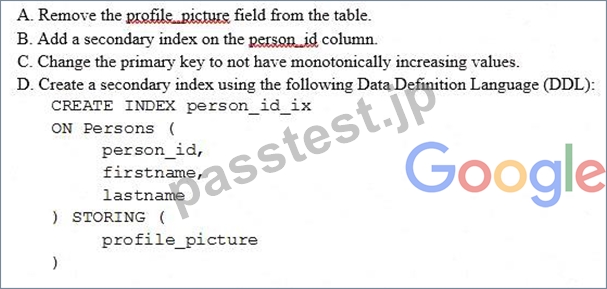
- A. Option A
- B. Option D
- C. Option C
- D. Option B
正解:C
解説:
As mentioned in Schema and data model, you should be careful when choosing a primary key to not accidentally create hotspots in your database. One cause of hotspots is having a column whose value monotonically increases as the first key part, because this results in all inserts occurring at the end of your key space. This pattern is undesirable because Cloud Spanner divides data among servers by key ranges, which means all your inserts will be directed at a single server that will end up doing all the work. https://cloud.
google.com/spanner/docs/schema-design#primary-key-prevent-hotspots
質問 # 123
Your learn wants to deploy a specific content management system (CMS) solution lo Google Cloud. You need a quick and easy way to deploy and install the solution. What should you do?
- A. Search for the CMS solution in Google Cloud Marketplace. Use Terraform and the Cloud Marketplace ID to deploy the solution with the appropriate parameters.
- B. Search for the CMS solution in Google Cloud Marketplace. Deploy the solution directly from Cloud Marketplace.
- C. Use the installation guide of the CMS provider. Perform the installation through your configuration management system.
- D. Search for the CMS solution in Google Cloud Marketplace. Use gcloud CLI to deploy the solution.
正解:B
質問 # 124
An external member of your team needs list access to compute images and disks in one of your projects. You want to follow Google-recommended practices when you grant the required permissions to this user. What should you do?
- A. Create a custom role based on the Compute Image User role Add the compute.disks, list to the includedPermissions field Grant the custom role to the user at the project level
- B. Grant the Compute Storage Admin role at the project level.
- C. Create a custom role, and add all the required compute.disks.list and compute, images.list permissions as includedPermissions. Grant the custom role to the user at the project level.
- D. Create a custom role based on the Compute Storage Admin role. Exclude unnecessary permissions from the custom role. Grant the custom role to the user at the project level.
正解:A
質問 # 125
Your developers are trying to connect to an Ubuntu server over SSH to diagnose some errors. However, the connection times out. Which command should help solve the problem?
- A. gcloud compute firewall-rules create "open-ssh" --network $NETWORK --allow tcp:3389
- B. gcloud compute firewall-rules create "open-ssh" --network $NETWORK --allow tcp:22
- C. gcloud compute firewall-rules create "open-ssh"
- D. gcloud compute firewall-rules create "open-ssh" --network $NETWORK --deny tcp:22
正解:B
質問 # 126
Your company publishes large files on an Apache web server that runs on a Compute Engine instance. The Apache web server is not the only application running in the project. You want to receive an email when the egress network costs for the server exceed 100 dollars for the current month as measured by Google Cloud Platform (GCP). What should you do?
- A. Set up a budget alert on the billing account with an amount of 100 dollars, a threshold of 100%, and notification type of "email."
- B. Set up a budget alert on the project with an amount of 100 dollars, a threshold of 100%, and notification type of "email."
- C. Export the billing data to BigQuery. Create a Cloud Function that uses BigQuery to sum the egress network costs of the exported billing data for the Apache web server for the current month and sends an email if it is over 100 dollars. Schedule the Cloud Function using Cloud Scheduler to run hourly.
- D. Use the Stackdriver Logging Agent to export the Apache web server logs to Stackdriver Logging. Create a Cloud Function that uses BigQuery to parse the HTTP response log data in Stackdriver for the current month and sends an email if the size of all HTTP responses, multiplied by current GCP egress prices, totals over 100 dollars. Schedule the Cloud Function using Cloud Scheduler to run hourly.
正解:D
質問 # 127
You have a Dockerfile that you need to deploy on Kubernetes Engine. What should you do?
- A. Create a docker image from the Dockerfile and upload it to Cloud Storage.
Create a Deployment YAML file to point to that image.
Use kubectl to create the deployment with that file. - B. Create a docker image from the Dockerfile and upload it to Container Registry.
Create a Deployment YAML file to point to that image.
Use kubectl to create the deployment with that file. - C. Use gcloud app deploy <dockerfilename>.
- D. Use kubectl app deploy <dockerfilename>.
正解:B
解説:
Create the image prior to deployment:
https://cloud.google.com/kubernetes-engine/docs/tutorials/hello-app
You cant deploy a docker file
質問 # 128
You are the team lead of a group of 10 developers. You provided each developer with an individual Google Cloud Project that they can use as their personal sandbox to experiment with different Google Cloud solutions. You want to be notified if any of the developers are spending above $500 per month on their sandbox environment. What should you do?
- A. Create a single billing account for all sandbox projects and enable BigQuery billing exports. Create a Data Studio dashboard to plot the spending per project.
- B. Create a single budget for all projects and configure budget alerts on this budget.
- C. Create a separate billing account per sandbox project and enable BigQuery billing exports. Create a Data Studio dashboard to plot the spending per billing account.
- D. Create a budget per project and configure budget alerts on all of these budgets.
正解:D
解説:
Reference:
https://cloud.google.com/billing/docs/how-to/budgets
質問 # 129
You create a Deployment with 2 replicas in a Google Kubernetes Engine cluster that has a single preemptible node pool. After a few minutes, you use kubectlto examine the status of your Pod and observe that one of them is still in Pendingstatus:
What is the most likely cause?
- A. The pending Pod's resource requests are too large to fit on a single node of the cluster.
- B. The node pool is configured with a service account that does not have permission to pull the container image used by the pending Pod.
- C. The pending Pod was originally scheduled on a node that has been preempted between the creation of the Deployment and your verification of the Pods' status. It is currently being rescheduled on a new node.
- D. Too many Pods are already running in the cluster, and there are not enough resources left to schedule the pending Pod.
正解:D
解説:
Reasons for a Pod Status Pending:
Troubleshooting Reason #1: Not enough CPU
Troubleshooting Reason #2: Not enough memory
Troubleshooting Reason #3: Not enough CPU and memory
https://managedkube.com/kubernetes/k8sbot/troubleshooting/pending/pod/2019/02/22/pending- pod.html
質問 # 130
You are using Google Kubernetes Engine with autoscaling enabled to host a new application. You want to expose this new application to the public, using HTTPS on a public IP address. What should you do?
- A. Create a Kubernetes Service of type NodePort to expose the application on port 443 of each node of the Kubernetes cluster. Configure the public DNS name of your application with the IP of every node of the cluster to achieve load-balancing.
- B. Create a Kubernetes Service of type NodePort for your application, and a Kubernetes Ingress to expose this Service via a Cloud Load Balancer.
- C. Create a HAProxy pod in the cluster to load-balance the traffic to all the pods of the application.
Forward the public traffic to HAProxy with an iptable rule. Configure the DNS name of your application using the public IP of the node HAProxy is running on. - D. Create a Kubernetes Service of type ClusterIP for your application. Configure the public DNS name of your application using the IP of this Service.
正解:B
質問 # 131
Your manager needs you to test out the latest version of MS-SQL on a Windows instance. You've created the VM and need to connect into the instance. What steps should you follow to connect to the instance?
- A. Connect in with your own RDP client using your Google Cloud username and password.
- B. Generate a Windows password in the console, then use a client capable of communicating via RDP and provide the credentials.
- C. From the console click the SSH button to automatically connect.
- D. Generate a Windows password in the console, then use the RDP button to connect in through the console.
正解:B、C
質問 # 132
You have an application on a general-purpose Compute Engine instance that is experiencing excessive disk read throttling on its Zonal SSD Persistent Disk. The application primarily reads large files from disk. The disk size is currently 350 GB. You want to provide the maximum amount of throughput while minimizing costs. What should you do?
- A. Migrate to use a Regional SSD on the instance.
- B. Increase the allocated CPU to the instance.
- C. Increase the size of the disk to 1 TB.
- D. Migrate to use a Local SSD on the instance.
正解:D
質問 # 133
Your company has an internal application for managing transactional orders. The application is used exclusively by employees in a single physical location. The application requires strong consistency, fast queries, and ACID guarantees for multi-table transactional updates. The first version of the application is implemented inPostgreSQL, and you want to deploy it to the cloud with minimal code changes. Which database is most appropriate for this application?
- A. Cloud SQL
- B. BigQuery
- C. Cloud Datastore
- D. Cloud Spanner
正解:A
質問 # 134
......
合格させるGoogle Associate-Cloud-Engineerプレミアムお試しセットテストエンジンPDFで無料問題集セット:https://www.passtest.jp/Google/Associate-Cloud-Engineer-shiken.html
Associate-Cloud-Engineer試験情報と無料練習テスト:https://drive.google.com/open?id=17XOmQKB4Uh7e8sCdjGOiRSggmEfAqZYv