

Development-Lifecycle-and-Deployment-Architect日本語 PDF問題集リアル2025最近更新された問題
リリースSalesforce Development-Lifecycle-and-Deployment-Architect日本語更新された問題PDF
質問 # 49
Universal Containers (UC) 環境管理アーキテクトは、さまざまな組織へのデプロイメントにパッケージ開発モデルを使用しています。
アーキテクトが手動で追跡する必要があるメタデータの変更はどれですか?
- A. ソース追跡でまだサポートされていないコンポーネントへの変更。
- B. 手動追跡は必要ありません。すべての変更は自動的に追跡されます。
- C. リリースのすべてのメタデータ変更。
- D. セットアップ UI を介して行われた変更のみ。
正解:A
解説:
The package development model relies on source tracking to automatically track the metadata changes in the package project. However, not all metadata components are supported by source tracking, and some changes may need to be tracked manually. For example, changes to profiles, permission sets, custom metadata types, and custom settings are not supported by source tracking. You can find the list of unsupported components here1. No manual tracking is required for the changes that are supported by source tracking, nor for the changes made via the Setup UI, as they are automatically captured by the package development model.
質問 # 50
Universal Containers (UC) は Service Cloud を実装しています。UC のコンタクト センターは 1 時間あたり 100 件の電話を受け、北米、ヨーロッパ、APAC 地域にわたって運営されています。UC は、将来の成長を考慮して、アプリケーションが 150 件の通話をサポートできるように応答性と拡張性を備えていることを望んでいます。推奨されるテスト負荷の考慮事項
- A. 現在の通話量を考慮して負荷をテストしています。
- B. 通話量が 50% 増加することを考慮した負荷のテスト。
- C. 現在の通話量の 10 倍を考慮した負荷のテスト。
- D. 通話量の半分を考慮した負荷のテスト。
正解:B
解説:
Testing load considering 50% more call volume is a reasonable test load consideration, as it can simulate the expected future growth and ensure that the application can handle the increased demand without compromising the performance or functionality.
質問 # 51
Universal Containers (UC) の革新的なアプリ部門は、取引先の Salesforce 環境にインストールできるアプリケーションをリリースしています。その後、パートナーはプロセス ビルダーとトリガーを使用してアプリケーションを構築できるため、コンテナ予約プロセスを取引パートナー自身のプロセスと統合できます。アプリケーションをリリースするための推奨メカニズムは何ですか?
- A. セットを変更します。
- B. 管理されていないパッケージ。
- C. Force.Com 移行ツールでデプロイ可能な ZIP ファイル。
- D. 管理パッケージ。
正解:D
解説:
Managed package is the recommended mechanism for releasing an application that can be installed in other Salesforce environments. Managed packages allow for versioning, licensing, and upgradeability of the application. They also protect the intellectual property of the developer by hiding the source code of the Apex classes and Visualforce pages.
質問 # 52
Universal Containers (UC) は、管理パッケージを使用して 5 つの組織に社内 Sales アプリをインストールします。各組織内には、管理パッケージのオブジェクトとの統合とローカル プロセスがあります。UC は、CI/CD プロセスとの統合を改善するために、ロック解除されたパッケージを使用したいと考えています。
Salesforce アーキテクトはこの移行について何を推奨しますか?
- A. 管理パッケージのオブジェクト/フィールドからすべてのデータをエクスポートし、アンインストールし、管理パッケージと同じ名前空間を持つロック解除されたパッケージをインストールして、すべてのデータを復元します。
- B. 管理パッケージを使用してすべての CI/CD プロセスを実行できるため、ロック解除されたパッケージに変更しないでください。
- C. すべてのクラス、Visualforce、コンポーネントを管理パッケージからロック解除されたパッケージに移行します。新しいバージョンの管理パッケージ (オブジェクト/フィールドのみ) とロック解除されたパッケージを他のコンポーネントとともにインストールします。
- D. 管理パッケージのオブジェクト/フィールドからすべてのデータをエクスポートし、アンインストールし、名前空間なしでロック解除されたパッケージをインストールして、すべてのデータを復元します。
正解:C
解説:
The best way to migrate from a managed package to an unlocked package is to split the components into two packages: one for the objects and fields, and one for the classes, Visualforce, and other components. This way, the data and integrations with the objects and fields of the managed package are preserved, and the classes and Visualforce can be modified and deployed using CI/CD processes with the unlocked package. Exporting and restoring the data from the managed package is not a feasible solution, as it would require a lot of effort and risk data loss or corruption. Installing the unlocked package with the same namespace as the managed package is not possible, as namespaces are unique and cannot be reused. Staying with the managed package is not a good option, as it does not allow for better integration with CI/CD processes.
質問 # 53
このリリースは、Salesforce が本番環境を更新してから 1 週間後の週末 (冬から春など) にデプロイされます。UC は、サンドボックスの完全な更新には数日かかる場合があることを発見しました。アーキテクトは最適な導入計画として何を提案すべきでしょうか?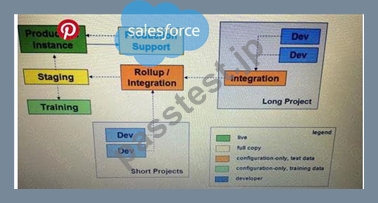
- A. ライブ開始の 1 か月前に、ステージングと実稼働サポートにデプロイします。運用開始時に運用サポートから運用にデプロイする
- B. 本番稼働の 2 週間前に、ステージングにデプロイしてから、ステージングおよび運用サポート サンドボックスを更新します。本番稼働時にステージングから本番環境にデプロイする
- C. 本番稼働の 1 週間前に、ステージング サンドボックスの更新を開始し、すぐにステージングにデプロイします。本番稼働時にステージングから本番環境にデプロイします。
- D. 公開の約 6 週間前に、サンドボックスがリリース プレビューに含まれていることを確認してください。本番稼働の 1 週間前に、ステージングにデプロイします。本番稼働時にステージングから本番環境にデプロイする
正解:D
解説:
The best option is to ensure the sandbox will be on the release preview, which means it will be upgraded to the new platform release before the production environment. This will allow the team to test the deployment in a realistic scenario and catch any potential issues. Option A is not ideal, as the staging and production support sandboxes will not be on the same platform version as the production environment. Option C is also not ideal, as the production support sandbox will not be on the same platform version as the production environment.
Option D is risky, as the staging sandbox refresh may not complete in time for the go-live.
質問 # 54
Universal Containers は最近、Salesforce を広範囲に使用する別の企業を買収しました。UC は、Salesforce 組織を統合して、1 つのビジネスの下で効果的に顧客の販売とサービスを提供したいと考えています。従来、UC はアジャイル開発手法に従って Salesforce 機能を提供してきました。事業の統合に伴い、UC はウォーターフォール開発手法を採用することが最善のアプローチであると確信しています。ウォーターフォール開発手法を使用することの利点を 2 つ挙げてください。
- A. 構築する必要がある複雑なプロセスは、コーディングを開始する前に徹底的に理解され、文書化されます。
- B. 設計作業の多くはプロセスの後の段階に押しやられるため、プロジェクトの開始コストは低くなります。
- C. マイルストーン、タイムライン、見積もりは、事前のデューデリジェンスにより、より正確で予測可能になる傾向があります。
- D. プロセスの後半での変更は予期されており、要件仕様に統合することで処理できます。
正解:A、C
解説:
Waterfall development methodology has some positive aspects, such as:
Complex processes that will need to be built are thoroughly understood and documented before coding begins, which can reduce the risk of ambiguity and rework.
Milestones, timelines and estimates tend to be more accurate and predictable due to the upfront due diligence, which can help with project management and stakeholder expectations.
質問 # 55
Universal Containers は、本番環境で Sev0 の欠陥を発見しました。数分のうちに数万件のレコードが誤ったデータで作成され、結果としてブランドに重大な損害が生じます。Salesforce 管理者は、欠陥のあるテキスト項目を本番環境で新しい選択リスト項目に直接置き換えることを提案しました。ページ レイアウトが変更され、テキスト フィールドが削除され、新しい選択リスト フィールドが追加されます。
Salesforce アーキテクトは何をアドバイスすべきでしょうか?
- A. その提案を拒否し、リスクが高すぎることと次のリリース期間が週末であることを全員に説明します。
- B. セキュリティ チームに電話し、侵入テストの準備を開始します。
- C. 管理者とペアになり、発生した各変更を確認します
- D. 本番環境で直接変更を加えることが認定されているのは開発者だけであることを説明します。
正解:C
解説:
Pairing with the administrator and reviewing each change as it happens is the best way to handle the situation of discovering a Sev0 defect in production. This way, the architect can ensure that the changes are done correctly and quickly, without compromising the quality or security of the application. The architect can also provide guidance and feedback to the administrator, as well as monitor the impact and outcome of the changes. Denying the suggestion, explaining that only developers are certified to make changes, or calling the security team are not advisable actions, as they can delay the resolution of the defect, increase the damage, or create unnecessary conflict.
質問 # 56
Universal Containers の組織は複雑ですが、依存関係を含むロック解除されたパッケージでよく整理されています。開発チームには新機能が求められ、変更されるパッケージはすでに特定されています。
この開発にはどの環境を使用する必要がありますか?
- A. すべてのパッケージがインストールされた Developer Pro サンドボックス。
- B. 変更されるパッケージ コードとその依存関係を含むスクラッチ組織
- C. すべてのパッケージがインストールされているスクラッチ組織。
- D. 変更されるパッケージ コードとその依存関係がインストールされた Developer Pro サンドボックス。
正解:B
解説:
The best environment for developing a new feature in an org with unlocked packages is a scratch org with the package code that will be changed and its dependencies. A scratch org is a source-driven and disposable deployment of Salesforce code and metadata that is fully configurable and can be created quickly. A scratch org can also install unlocked packages and their dependencies, which can help ensure compatibility and functionality of the new feature. A Developer Pro sandbox is not a good option, as it is not source-driven and can have outdated or conflicting data and metadata.
質問 # 57
Universal Containers は、メタデータ API を使用してデプロイメント プロセスを自動化しました。ただし、メタデータ API がまだすべてのコンポーネントをサポートしていないことがわかりました。これに対処するには何をすべきでしょうか?
- A. AppExchange 製品を使用して、サポートされていないコンポーネントをデプロイします。
- B. サポートされていないコンポーネントのデプロイには、force.com IDE を使用します。
- C. サポートされていないすべてのコンポーネントをデプロイするには、変更セットを使用します。
- D. サポートされていないコンポーネントをデプロイメントの前後に手動でデプロイします。
正解:D
解説:
Deploying unsupported components manually before/after deployment is the best way to address the issue of Metadata API not supporting all the components yet. Metadata API is a powerful tool for deploying changes between orgs, but it does not cover all the metadata types that are available in Salesforce. Some examples of unsupported components are email templates, dashboards, reports, and custom settings. These components need to be deployed manually by using other tools or methods, such as change sets, data loader, or manual configuration.
質問 # 58
Universal Containers は最近、本番環境に移行する両方の製品にレコード タイプ ID が一致することを確認するために新しい営業部門を追加しましたが、開発者は単体テストが失敗していると報告しています。テストが予測どおりに実行されるようにするには、アーキテクトは何をすべきでしょうか?
- A. レコードタイプ ID が本番組織と Sandbox 組織の両方に一致することを確認します。
- B. 単体テストが独自のテスト データを生成することを確認します。
- C. Apex テストが有効なユーザーとして実行されていることを確認します。
- D. AllData=true を参照して単体テストが実行されることを確認します。
正解:B
解説:
The best way to ensure that tests execute predictably is to ensure that unit tests generate their own test data, as this will avoid any dependency on the existing data or metadata in the org, which may vary across environments3. Option A is not correct, as ensuring that Record Type IDs match both Production and Sandbox orgs is not a reliable way to ensure test predictability, as Record Type IDs are not guaranteed to be the same across orgs, and may change due to refreshes or deployments4. Option B is not correct, as ensuring executed Apex test run as valid users is not a sufficient way to ensure test predictability, as valid users may have different permissions or profiles across orgs, and may not have access to the required data or metadata5.
Option D is not correct, as ensuring unit tests execute with seeAllData=true is not a recommended way to ensure test predictability, as this will make the tests dependent on the existing data in the org, which may not be consistent or isolated.
質問 # 59
ユニバーサル コンテナでは、最近更新されていないすべてのサンドボックスも、運用環境への最新の変更を受け取る必要があります。これは、その環境の機能を運用環境に移行する前に行う必要があります。この導入プロセスを自動化した方法で管理できる導入ツールはどれですか?
- A. Force.com 移行ツール
- B. 変更セット
- C. Force.com IDE
- D. ワークベンチ
正解:A
解説:
The best deployment tool for UC to use to manage their deployment process in an automated fashion is the Force.com Migration Tool, as it is a command-line tool that uses the Metadata API to deploy components from one org to another, and can be integrated with version control systems and continuous integration servers. Option A is not a good choice, as Workbench is a web-based tool that does not support automation or scripting. Option C is not a good choice, as Change Sets are a point-and-click tool that require manual steps to create and deploy. Option D is not a good choice, as Force.com IDE is a desktop tool that does not support automation or scripting.
質問 # 60
Universal Containers は、ライフサイクルの早い段階で進行中のパフォーマンスの問題を解決するために、データ ボリューム テストを導入したいと考えています。規制により、実稼働データを非実稼働環境で使用することは禁止されています。
建築家が推奨できる 2 つのオプションはどれですか?
2 つの答えを選択してください
- A. 運用データの形状と量を模倣するモック データを生成します。
- B. 更新後に完全なサンドボックスでデータ マスキングを実行します。
- C. 次の Salesforce リリース後にサンドボックスの部分コピーをリクエストします。
- D. 運用環境でクエリ アナライザーを使用します。
正解:A、B
解説:
The architect should recommend generating mock data that mimics production data shape and volume, and performing data masking on full sandbox after a refresh. These options allow the team to create realistic data sets for testing without violating the regulations that prohibit the use of production data in non-production environments. Requesting a partial sandbox copy after the next Salesforce release is not a valid option, as partial sandboxes are refreshed on demand and not tied to Salesforce releases. Using Query Analyzer in production is not a way to perform data volume testing, as it only analyzes the performance of SOQL queries.
質問 # 61
Universal Containers CUC) は、UC 管理者がよく受け取る一連の低リスクのユーザー ストーリーに対してマイナー変更ポリシーの実装を検討しています。このポリシーにより、管理者は運用環境でこれらの変更を直接行うことができます。UC には継続的インテグレーション/継続的デリバリー (CI/CD) が導入されていません。
新しい変更ポリシーに関してアーキテクトが UC に従うべき 3 つのベスト プラクティスはどれですか? 3 つの答えを選択してください
- A. すべての変更をテストする必要があります。
- B. マイナーな変更は徹底的に文書化され、ある種の標準的なリズムに従う必要があります。
- C. 本番環境が変更されても、ダウンストリーム環境は自動的に更新されません。
- D. マイナーな変更を適切に管理するには、CI/CD が必要です。
- E. 軽微な変更は文書化する必要がなく、いつでも変更できます。
正解:A、B、C
解説:
Minor changes should be thoroughly documented and follow some type of standard cadence, as this can help maintain the audit trail and visibility of the changes. All changes should still be tested, even if they are minor, as they can have unexpected impacts on other parts of the system or introduce bugs or security issues.
Downstream environments will not be automatically updated when production changes are made, so it is important to have a strategy to keep them in sync and avoid conflicts or overwrites. Minor changes do not need to be documented and can be made at any time is a wrong statement, as it can lead to poor governance and lack of accountability. CI/CD is not required to successfully manage minor changes, although it can help automate and streamline the process. See Application Lifecycle and Deployment for more details.
質問 # 62
Universal Containers (UC) は、Salesforce リリース管理プロセスの更新を検討しています。UC がリリース管理に関して考慮すべき 3 つのベスト プラクティスはどれですか? 3 つの答えを選択してください
- A. リリースの各フェーズのリリース カレンダーを公開します。
- B. リリースのサインオフは運用環境でのみ必要です。
- C. 各リリースの導入前/導入後のチェックリストを維持します。
- D. 回帰テストはリリースごとに必須です。
- E. リリースに適したサンドボックス戦略を設計します。
正解:C、D、E
解説:
Designing the right sandbox strategy for the release is a best practice, as it helps to ensure the quality and consistency of the code/configuration across different environments. Regression testing is mandatory for each release, as it helps to verify that the existing functionality is not broken by the new changes. Maintaining a pre
/post deployment checklist for each release is a best practice, as it helps to track the tasks and dependencies for each deployment. Release sign-off is not only required for Production, but also for other environments such as UAT and Staging. Publishing a release calendar for each phase of the release is not a best practice, as it may change due to unforeseen circumstances and create confusion.
質問 # 63
Universal Containers は Center of Excellence (COE) を開始します。アーキテクトが COE への参加を推奨する 2 つのユーザー グループはどれですか?
- A. コールセンター エージェント
- B. プログラム チーム
- C. エグゼクティブ スポンサー。
- D. インサイド セールス ユーザー。
正解:B、C
解説:
Program team and executive sponsors are two user groups that an architect should recommend to join the COE. A program team is a group of people who are responsible for managing and delivering the Salesforce projects and initiatives. They can provide the COE with the technical expertise, best practices, and project management skills. An executive sponsor is a senior leader who supports and advocates for the Salesforce program. They can provide the COE with the strategic direction, business alignment, and funding support.
質問 # 64
チームはスプリントを完了し、ビジネスの承認後にこれらの変更をデプロイする予定ですが、すぐに次のスプリントを開始します。
アーキテクトはどのような戦略を推奨すべきでしょうか?
- A. 現在のコードを UAT サンドボックスに移行します。Dev サンドボックスで新しいスプリント開発を開始します。UAT 環境で修正を行い、ビジネスの承認後に UAT を実稼働環境にデプロイします。
- B. 今後の変更を、develop ブランチにマージせずに features ブランチにコミットします。開発ブランチからデプロイし、新しいスプリント機能を開発ブランチにマージします。
- C. 新しいスプリントの最初のタスクは、デプロイメントの承認である必要があります。その後、スプリントの他のタスクは環境と Git で実行できます。
- D. Git を使用して、develop ブランチから release ブランチを作成します。すべての修正はリリース ブランチで行う必要があります。デプロイ後、リリースと開発をマージします。
正解:D
解説:
The architect should recommend using Git to create a release branch from the develop branch. All fixes must be made in the release branch. After deployment, merge release with develop. This strategy allows the team to isolate the changes that are ready for deployment from the changes that are still in progress. It also ensures that the fixes are applied to both the release and the develop branches. The other options do not follow the best practices of Git branching and merging.
質問 # 65
UniversalContainers CUC) は、単一組織内にマルチクラウド アーキテクチャを備えています。Sales Cloud 開発チームは、Dev Pro サンドボックス (DevProl) で作業しており、3 か月以内にリリースを提供します。Service Cloud のビジネス要件により、4 週間以内の迅速なリリースが保証されていますが、DevProl で完了する Sales Cloud 作業の一部が必要です。別の Dev Pro サンドボックス (DevPro2) を使用するかどうかの決定はまだ保留中です。DevProl は、2 週間前に次の Salesforce メジャー リリースのプレビューにアップグレードされました。
建築家は何を推奨すべきでしょうか?
- A. 2 番目の作業ストリーム チームに、同じ DevProl サンドボックスで作業するように依頼します。
- B. 別のワーク ストリームを追加するとリスクが伴うため、要件を押し戻します。
- C. DevPro1 は実稼働バージョンとは異なるバージョンであるため、クローンを作成できません。新しい DevPro2 を作成し、DevPro1 からメタデータを移行するだけです。
- D. Service Cloud 要件に対応する 2 番目の作業ストリームとして、DevPro1 サンドボックスのクローンを作成し、DevPro2 という名前を付けます。
正解:C
解説:
DevPro1 cannot be cloned because it is on a different version from Production, as it was upgraded to preview for the next Salesforce major release two weeks ago. Therefore, the architect should recommend creating a new DevPro2, and migrating metadata from DevPro1. This way, the second work stream can work on the Service Cloud requirements in a separate sandbox, without affecting the Sales Cloud dev team. Asking the second work stream team to work on the same DevPro1 sandbox would create conflicts and dependencies between the two teams, and would not allow them to release at different times. Pushing back on the requirements because adding another work stream will bring some risks with it would not be a good option, as the business needs might be urgent and important.
質問 # 66
Universal Containers (UC) には、異なるタイムラインで別々の作業ストリームに取り組む複数の開発チームがあります。各ストリームにはコードと構成のリリースが異なり、配信日もストリーム間で異なります。
推奨する適切な分岐ポリシーは何ですか?
- A. リーフベースの開発
- B. トランクベースの開発
- C. GitHub フロー
- D. スクラッチ組織ベースの開発
正解:B
解説:
A suitable branching policy to recommend for multiple development teams that work on separate streams of work, with different timelines, is trunk-based development. This policy allows each team to work on their own feature branches, and merge them to the main branch (trunk) frequently, using pull requests and code reviews. This can help avoid merge conflicts, ensure code quality, and enable continuous integration and delivery. Leaf-based development is not a valid branching policy, as it is a term used to describe the nodes in a tree data structure. GitHub flow is a specific implementation of trunk-based development, but it is not a branching policy by itself. Scratch-org-based development is not a branching policy, but a development model that uses scratch orgs as ephemeral environments. See Trunk-Based Development for more details.
質問 # 67
Universal Containers には、システム間の重要なプロセス オーケストレーションを備えた高度に統合された環境があります。UAT を更新すると、運用環境からの外部 ID を持つオブジェクトは、UAT 環境内の有効な外部 ID を指さなくなります。
これを解決するにはアーキテクトは何をすべきでしょうか?
- A. すべてのデータを削除し、自動テスト ツールを使用して、UAT のすべてのシステムにわたって新しいデータを作成します。
- B. 外部 ID をマスクして、誰も実稼働値を確認できないようにします。
- C. 更新後の計画で、外部 ID を UAT の既知の有効な値のセットに変更します。
- D. UAT が運用統合をポイントし、終了後に各トランザクションをロールバックします。
正解:C
解説:
In the post refresh plan, modifying external ids to a known valid set of values for UAT is the best way to resolve the issue of objects that have external ids from production no longer pointing to valid external ids in the UAT environment. This way, the data integrity and consistency across the integrated systems can be maintained. Letting UAT point to production integrations and rolling back each transaction after it finishes is not a good practice, as it can cause data loss or corruption in production. Deleting all the data and using an automated testing tool to create new data across all the systems in UAT is not feasible, as it can take a lot of time and resources. Masking the external id so nobody can see the production value is not a solution, as it does not address the underlying problem of invalid references.
質問 # 68
Universal Containers を使用する開発者は最近、開発者サンドボックスにフローを作成しました。フローの作業中、開発者はフローが期待通りに動作するまでにフローを非アクティブ化し、更新を複数回行いました。現在、開発者は変更セットを使用してフローを QA サンドボックスに移行することを計画しています。
変更セットを使用してフローを移行するときに考慮する必要がある 2 つのステートメントはどれですか?
2 つの答えを選択してください
- A. 複数のバージョン対応フローを含む変更セットがアップロードされ、使用可能なアクティブなバージョンがない場合、フローの最新の非アクティブなバージョンが含まれます。
- B. 複数のバージョンのフローを含む変更セットがアップロードされると、フローのすべてのバージョンが含まれます。
- C. 複数のバージョン対応フローを含む変更セットがアップロードされ、使用可能なアクティブなバージョンがない場合、例外がスローされます。
- D. 複数のバージョンのフローを含む変更セットがアップロードされる場合、フローのアクティブなバージョンのみが含まれます。
正解:A、D
解説:
When migrating a flow with change sets, the following statements should be considered: When a change set with a multiple versioned flow is uploaded, it includes only the active version of the flow. When a change set with a multiple versioned flow is uploaded, and no active version is available, it includes the most recent inactive version of the flow. These statements are based on the Salesforce documentation on how change sets handle flows with multiple versions. The other statements are incorrect, as they do not reflect the actual behavior of change sets.
質問 # 69
Universal Containers (UC) は、カスタム Force.com アプリケーションを開発しています。開発には次のツールが使用され、アプリの開発には Force.com IDE が使用されます。ソース管理システムおよび Git リポジトリとしての Git、およびソース管理からサンドボックスを更新するための Force.com 移行ツール。UC の現在の分岐戦略には 2 つの主要なブランチが必要です: 1) マスター 2) 開発 3 つのサポート ブランチ: 1) 機能 2) リリース 3) Hotflix 分岐戦略は次のように並列していると考えてください。 機能 |開発 |リリース |ホットフィックス |マスターとは開発者が開発のために採用すべき推奨される実践戦略は何ですか?
- A. 開発者は、Develop ブランチから取得された Feature ブランチを使用して作業し、Feature ブランチは Develop ブランチとマージされます。
- B. 開発者は、Master ブランチから取得された Feature ブランチを使用して作業し、Feature ブランチは Develop ブランチとマージされます。
- C. 開発者は、Release ブランチから取得された Feature ブランチを使用して作業し、Feature ブランチは Develop ブランチとマージされます。
- D. 開発者は、Develop ブランチから取得されたフィーチャー ブランチを使用して作業し、その後、フィーチャー ブランチがホットフィックス ブランチとマージされます。
正解:A
解説:
This is the correct answer because developers should work on feature branches that are derived from the develop branch, which represents the latest stable version of the code. The feature branches should then be merged back into the develop branch after they are completed and tested. This way, the develop branch always contains the most updated code that is ready for release.
質問 # 70
Universal Containers CUC) はエンタープライズ Salesforce 変革の取り組みに着手しており、UC は構築段階でさまざまなサンドボックスへの展開を合理化し、自動化したいと考えています。UAT が顧客に受け入れられると、同社は実稼働環境の展開も自動化するよう要求しました。
導入アーキテクトとして、顧客の要件を満たすための推奨事項は何ですか?
- A. SFDX の使用を推奨し、環境ごとに実行する手順を含むデプロイメント コマンドを文書化します。
- B. Continues 統合および Continues デプロイメント ツールを使用し、サンドボックスと運用環境にデプロイするためのパイプラインを構築することをお勧めします。
- C. ANT スクリプトを使用し、スクリプトを実行するカスタム アプリケーションを構築し、変更セットを使用してサポートされているメタデータをデプロイすることをお勧めします。
- D. デプロイメントコンポーネントをパッケージ化した AppExchange ソリューションを使用することをお勧めします。デプロイメントウィザードを実行してデプロイメント結果を追跡できます。
正解:B
解説:
The recommendation to satisfy the customer requirements is to use a Continuous Integration and Continuous Deployment tool and build the pipeline to deploy to sandboxes and production. A Continuous Integration and Continuous Deployment tool can automate the process of building, testing, and deploying the changes to different environments, as well as provide feedback and visibility into the deployment status and results. This can help to streamline and accelerate the deployment process, as well as to ensure consistency and quality across the environments. Using SFDX and documenting the deployment commands with steps to be executed for each environment is not a good recommendation, as it still requires manual intervention and execution, which can be error-prone and time-consuming. Using ANT script and building a custom application to run the script and use change sets to deploy supported metadata is not a good recommendation, as it involves using multiple tools and methods, which can increase the complexity and risk of the deployment process. Using an AppExchange solution that packages the deployment components and you can run the deployment wizard to track deployment result is not a good recommendation, as it may not support all the metadata types and features that need to be deployed, and it may not integrate well with the SFDX tools and methodologies that UC is using.
質問 # 71
Universal Containers (UC) は、いくつかの新機能リクエストについて現場からフィードバックを受けており、ビジネス目標において、フィードバックを迅速に取得してこれらのリクエストに優先順位を付ける方法を探しています。アーキテクトが推奨する 2 つのオプションはどれですか? 2 つの答えを選択してください
- A. プロジェクト管理ツールでバックログまたは優先リストを作成します。
- B. 要求された新機能に関する設計標準を作成します。
- C. Center of Excellence 会議で機能リクエストを発表します。
- D. 年末の正式なレビューのために IT 部門にリクエストを送信します。
- E. 機能リクエストをテスト マネージャーに提出し、品質チェックを受けます。
正解:A、C
解説:
Presenting the feature requests at a Center of Excellence meeting and creating the backlog or priority list in a project management tool are two options that can help to get feedback and prioritize the requests. A Center of Excellence meeting can provide a forum for discussing the business value, feasibility, and impact of the requests with the stakeholders. A project management tool can help to track, organize, and prioritize the requests based on the agreed criteria.
質問 # 72
プロジェクト運営委員会がどのような方法論を使用するかを決定する際に果たす役割は2つあります。
2件の回答
- A. 企業プロジェクトのステージゲートを選択した方法論の一部にすることを強制する
- B. プロジェクトの問題に対処するために必要な場合、選択した方法論からの逸脱を承認する
- C. 社内プロジェクトで使用するアジャイルまたはウォーターフォール手法を選択するための基準を設定する
- D. 特定のプロジェクトの要件を満たす方法論を設計する
正解:B、C
解説:
These are the correct answers because the project steering committee plays a role in approving deviations from the chosen methodology, when required to address project issues, and setting the criteria for selecting agile or waterfall methodology to be used on internal projects. The steering committee does not design a methodology, but rather chooses one from the existing ones. The steering committee does not enforce that corporate project stage gates are part of the chosen methodology but rather ensures that the chosen methodology aligns with the corporate project stage gates.
質問 # 73
......
Development-Lifecycle-and-Deployment-Architect日本語問題集と練習テスト(230試験問題):https://www.passtest.jp/Salesforce/Development-Lifecycle-and-Deployment-Architect-JPN-shiken.html