

まもなく無料セール終了!リアルNSE5_FSM-6.3のPDF解答で合格せよ [2024年11月03日]
最新の2024年11月試験NSE5_FSM-6.3問題集合格できる認証試験合格させます
Fortinet NSE5_FSM-6.3認定試験は、組織のセキュリティ情報とイベント管理システムの管理と維持を担当する専門家を対象としています。この試験の候補者は、ネットワーキングとセキュリティの概念、およびSIEMソリューションの操作の経験を十分に理解する必要があります。また、インストール、構成、メンテナンスなど、Fortisiemでの実際の経験も必要です。
Fortinet NSE5_FSM-6.3 の認定試験は、コンピューターベースのテストサービスを提供するリーディングカンパニーの Pearson VUE によって実施されます。英語、中国語、フランス語、ドイツ語、イタリア語、日本語、韓国語、ポルトガル語、ロシア語、スペイン語、トルコ語を含む複数の言語で受験が可能です。
質問 # 21
Refer to the exhibit.
An administrator is investigating a FortiSIEM license issue.
The procedure is for which offline licensing condition?
- A. The procedure is for offline license verification.
- B. The procedure is for offline license debug.
- C. The procedure is for offline license registration.
- D. The procedure is for offline license validation.
正解:C
解説:
Offline Licensing in FortiSIEM: FortiSIEM provides mechanisms for offline licensing to accommodate environments without direct internet access.
License Tool Command: The command./phLicenseTool --collect license_req.datis used to collect license information necessary for offline registration.
Procedure Analysis: The exhibit shows the output of this command, which indicates the collection of license information to a file namedlicense_req.dat.
Offline License Registration: This collected data file is then typically uploaded to the FortiSIEM support portal or provided to the FortiSIEM support team for processing and generating a license file.
References: FortiSIEM 6.3 Administration Guide, Licensing section, details the procedures for both online and offline license registration, including the use of thephLicenseToolfor offline scenarios.
質問 # 22
Which discovery scan type is prone to miss a device, if the device is quiet and the entry foe that device is not present in the ARP table of adjacent devices?
- A. Smart scan
- B. CMDB scan
- C. L2 scan
- D. Range scan
正解:A
質問 # 23
Three events are collected over a 10-minutc time period from two servers Server A and Server B.
Based on the settings being used for the rule subpattern. how many incidents will the servers generate?
- A. Server A will not generate any incidents and Server B will not generate any incidents
- B. Server B will generate one incident and Server A will not generate any incidents
- C. Server A will generate one incident and Server 8 will not generate any incidents
- D. Server A will generate one incident and Server 8 will generate one incident
正解:C
質問 # 24
To determine SNMP discovery issues, which is the best command from the backend?
- A. phSNMPTest
- B. snmpwalk
- C. snmptest
正解:B
質問 # 25
Refer to the exhibit.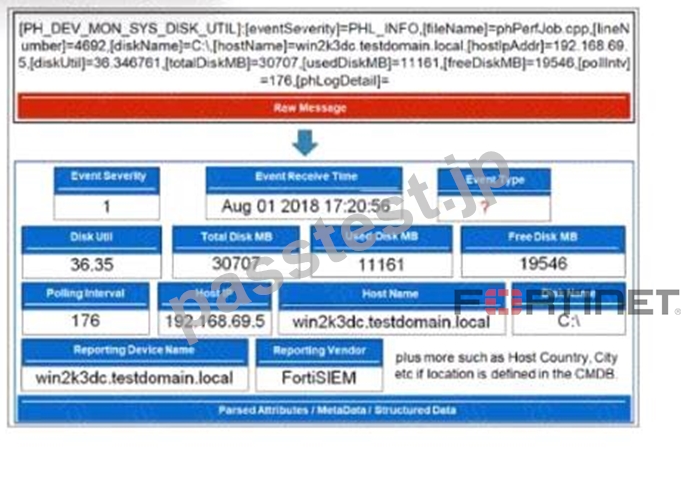
Which value will FortiSIEM use to populate the Event Type field?
- A. diskUtil
- B. PHL_INFO
- C. phPerfJob
- D. PH_DSV_MON_SYS_DISK_UTIL
正解:B
解説:
Event Type Population: In FortiSIEM, the Event Type field is populated based on specific identifiers within the raw message or event log.
Raw Message Analysis: The exhibit shows a raw message with various components, includingPH_DEV_MON_SYS_DISK_UTIL,PHL_INFO,phPerfJob, anddiskUtil.
Primary Event Identifier: ThePH_DEV_MON_SYS_DISK_UTILat the beginning of the raw message is the primary identifier for the event type. It categorizes the type of event, in this case, a system disk utilization monitoring event.
Event Type Field: FortiSIEM uses this primary identifier to populate the Event Type field, providing a clear categorization of the event.
References: FortiSIEM 6.3 User Guide, Event Processing and Event Types section, details how event types are identified and populated in the system.
質問 # 26
An administrator defines SMTP as a critical process on a Linux server.
If the SMTP process is stopped, FortiSIEM would generate a critical event with which event type?
- A. PH_DEV_MON_SMTP_STOP
- B. Postfix-Mail-Slop
- C. PH_DEV_MON_PROC_STOP
- D. Generic SMTP Process Exit
正解:C
質問 # 27
Which two FortiSIEM components work together to provide real-time event correlation?
- A. Worker and collector
- B. Collector and Windows agent
- C. Supervisor and worker
- D. Supervisor and collector
正解:C
解説:
FortiSIEM Architecture: The FortiSIEM architecture includes several components such as Supervisors, Workers, Collectors, and Agents, each playing a distinct role in the SIEM ecosystem.
Real-Time Event Correlation: Real-time event correlation is a critical function that involves analyzing and correlating incoming events to detect patterns indicative of security incidents or operational issues.
Role of Supervisor and Worker:
* Supervisor: The Supervisor oversees the entire FortiSIEM system, coordinating the processing and analysis of events.
* Worker: Workers are responsible for processing and correlating the events received from Collectors and Agents.
Collaboration for Correlation: Together, the Supervisor and Worker components perform real-time event correlation by distributing the load and ensuring efficient processing of events to identify incidents in real-time.
References: FortiSIEM 6.3 User Guide, Event Correlation and Processing section, details how the Supervisor and Worker components collaborate for real-time event correlation.
質問 # 28
Refer to the exhibit.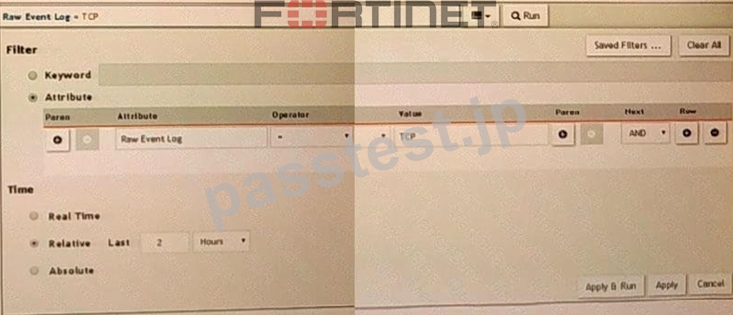
A FortiSIEM is continuously receiving syslog events from a FortiGate firewall The FortiSlfcM administrator is trying to search the raw event logs for the last two hours that contain the keyword tcp . However, the administrator is getting no results from the search.
Based on the selected filters shown in the exhibit, why are there no search results?
- A. The keyword is case sensitive Instead of typing TCP in the Value field. the administrator should type tcp.
- B. In the Time section, the administrator selected the Relative Last option, and in the drop-down lists, selected 2 and Hours as the lime period The time period should be 24 hours.
- C. The administrator selected AND in the Next drop-down list. This is the wrong boolean operator.
- D. The administrator selected - in the Operator column That a the wrong operator.
正解:A
解説:
Case Sensitivity in Searches: In FortiSIEM, search queries, including those for raw event logs, are case sensitive. This means that keywords must be entered exactly as they appear in the logs.
Keyword Mismatch: The exhibit shows the keyword "TCP" in the Value field. If the actual events use "tcp" (lowercase), the search will return no results because of the case mismatch.
Correct Keyword: To match the keyword correctly, the administrator should enter "tcp" in the Value field.
References: FortiSIEM 6.3 User Guide, Search and Filtering section, which discusses the importance of case sensitivity in search queries.
質問 # 29
Refer to the exhibit.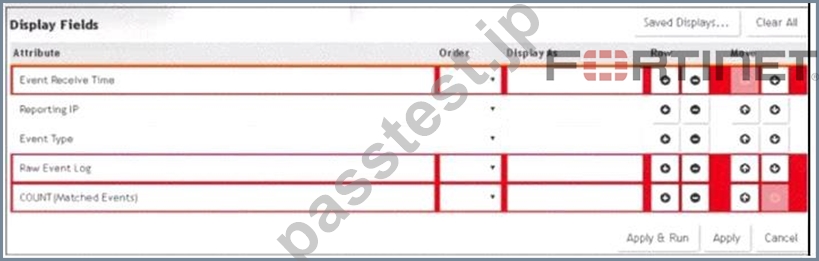
A FortiSIEM administrator wants to group some attributes for a report, but is not able to do so successfully.
As shown in the exhibit, why are some of the fields highlighted in red?
- A. No RAW Event Log attribute is available for devices.
- B. The attribute COUNT(Matched events) is an invalid expression.
- C. Unique attributes cannot be grouped.
- D. The Event Receive Time attribute is not available for logs.
正解:C
解説:
Grouping Attributes in Reports: When creating reports in FortiSIEM, certain attributes can be grouped to summarize and organize the data.
Unique Attributes: Attributes that are unique for each event cannot be grouped because they do not provide a meaningful aggregation or summary.
Red Highlighting Explanation: The red highlighting in the exhibit indicates attributes that cannot be grouped together due to their unique nature. These unique attributes includeEvent Receive Time,Reporting IP, Event Type,Raw Event Log, andCOUNT(Matched Events).
Attribute Characteristics:
* Event Receive Timeis unique for each event.
* Reporting IPandEvent Typecan vary greatly, making grouping them impractical in this context.
* Raw Event Logrepresents the unprocessed log data, which is also unique.
* COUNT(Matched Events)is a calculated field, not suitable for grouping.
References: FortiSIEM 6.3 User Guide, Reporting section, explains the constraints on grouping attributes in reports.
質問 # 30
Which database is used for storing anomaly data, that is calculated for different parameters, such as traffic and device resource usage running averages, and standard deviation values?
- A. SVN DB
- B. Event DB
- C. CMDB
- D. Profile DB
正解:D
質問 # 31
Which discovery scan type is prone to miss a device, if the device is quiet and the entry foe that device is not present in the ARP table of adjacent devices?
- A. L2 scan
- B. CMDB scan
- C. Smart scan
- D. Range scan
正解:A
解説:
Discovery Scan Types: FortiSIEM uses various scan types to discover devices on a network.
Layer 2 (L2) Scan: An L2 scan discovers devices based on ARP tables and MAC address information from adjacent devices.
* Limitation: If a device is quiet (not actively communicating) and its entry is not present in the ARP table of adjacent devices, the L2 scan may miss it.
Other Scan Types:
* CMDB Scan: Based on the existing Configuration Management Database (CMDB) entries.
* Range Scan: Scans a specified IP range for devices.
* Smart Scan: Uses a combination of methods to discover devices.
References: FortiSIEM 6.3 User Guide, Device Discovery section, which explains the different types of discovery scans and their characteristics.
質問 # 32
FortiSIEM is deployed in disaster recovery mode.
When disaster strikes, which two tasks must you perform manually to achieve a successful disaster recovery operation? (Choose two.)
- A. Promote the secondary supervisor to the primary role using the phSecondary2primary command.
- B. Change the configuration for shared storage NFS configured for EventDB to the secondary FortiSIEM.
- C. Change the DNS configuration to ensure that users, devices, and collectors log in to the secondary FortiSIEM.
- D. Promote the secondary workers to the primary rotes using the phSecworker2priworker command.
正解:C、D
解説:
Disaster Recovery Mode: FortiSIEM's disaster recovery (DR) mode ensures that there is a backup system ready to take over in case the primary system fails.
Manual Tasks for DR Operation: In the event of a disaster, certain tasks must be performed manually to ensure a smooth transition to the secondary system.
Promoting the Secondary Supervisor:
* Use the commandphSecondary2primaryto promote the secondary supervisor to the primary role. This command reconfigures the secondary supervisor to take over as the primary supervisor, ensuring continuity in management and coordination.
Changing DNS Configuration:
* Update the DNS configuration to direct all users, devices, and collectors to the secondary FortiSIEM instance. This ensures that all components in the environment cancommunicate with the newly promoted primary supervisor without manual reconfiguration of individual devices.
References: FortiSIEM 6.3 Administration Guide, Disaster Recovery section, provides detailed steps on promoting the secondary supervisor and updating DNS configurations during a disaster recovery operation.
質問 # 33
Which process converts raw log data to structured data?
- A. Data validation
- B. Data enrichment
- C. Data classification
- D. Data parsing
正解:D
解説:
Raw Log Data: When devices send logs to FortiSIEM, the data arrives in a raw, unstructured format.
Data Parsing Process: The process that converts this raw log data into a structured format is known as data parsing.
* Data Parsing: This involves extracting relevant fields from the raw log entries and organizing them into
* a structured format, making the data usable for analysis, reporting, and correlation.
Significance of Structured Data: Structured data is essential for effective event correlation, alerting, and generating meaningful reports.
References: FortiSIEM 6.3 User Guide, Data Parsing section, which details how raw log data is transformed into structured data through parsing.
質問 # 34
The FortiSIEM administrator is examining events for two devices to investigate an issue However, the administrator is not getting any results from their search.
Based on the selected fillers shown in the exhibit, why is the search returning no results?
- A. Parenthesis are missing
- B. The wrong option is selected in the Operator column
- C. The wrong boolean operator is selected in the Next column
- D. An invalid IP subnet is typed in the Value column
正解:C
質問 # 35
Which two FortiSIEM components work together to provide real-time event correlation?
- A. Worker and collector
- B. Collector and Windows agent
- C. Supervisor and worker
- D. Supervisor and collector
正解:C
質問 # 36
Which database is used for storing anomaly data, that is calculated for different parameters, such as traffic and device resource usage running averages, and standard deviation values?
- A. SVN DB
- B. Event DB
- C. CMDB
- D. Profile DB
正解:D
解説:
Anomaly Data Storage: Anomaly data, including running averages and standard deviation values for different parameters such as traffic and device resource usage, is stored in a specific database.
Profile DB: The Profile DB is used to store this type of anomaly data.
* Function: It maintains statistical profiles and baselines for monitored parameters, which are used to detect anomalies and deviations from normal behavior.
Significance: Storing anomaly data in the Profile DB allows FortiSIEM to perform advanced analytics and alerting based on deviations from established baselines.
References: FortiSIEM 6.3 User Guide, Database Architecture section, which describes the purpose and contents of the Profile DB in storing anomaly and baseline data.
質問 # 37
In the rules engine, which condition instructs FortiSIEM to summarize and count the matching evaluated data?
- A. Filters
- B. Aggregation
- C. Time Window
- D. Group By
正解:B
解説:
Rules Engine in FortiSIEM: The rules engine evaluates incoming events based on defined conditions to detect incidents and anomalies.
Aggregation Condition: The aggregation condition instructs FortiSIEM to summarize and count the matching evaluated data.
* Function: Aggregation is used to group events based on specified criteria and then perform operations such as counting the number of occurrences within a defined time window.
Purpose: This allows for the detection of patterns and anomalies, such as a high number of failed login attempts within a short period.
References: FortiSIEM 6.3 User Guide, Rules Engine section, which explains how aggregation is used to summarize and count matching data.
質問 # 38
When configuring collectors located in geographically separated sites, what ports must be open on a front end firewall?
- A. HTTPS, from the Internet to the collector and from the collector to the FortiSIEM cluster
- B. HTTPS, from the collector to the supervisor and worker upload settings addresses
- C. HTTPS, from the collector to the worker upload settings address only
- D. HTTPS,from the Internet to the collector
正解:B
解説:
FortiSIEM Architecture: In FortiSIEM, collectors gather data from various sources and send this data to supervisors and workers within the FortiSIEM architecture.
Communication Requirements: For collectors to effectively send data to the FortiSIEM system, specific communication channels must be open.
Port Usage: The primary port used for secure communication between the collectors and the FortiSIEM infrastructure is HTTPS (port 443).
Network Configuration: When configuring collectors in geographically separated sites, the HTTPS port must be open for the collectors to communicate with both the supervisor and the worker upload settings addresses.
This ensures that the collected data can be securely transmitted to the appropriate processing and analysis components.
References: FortiSIEM 6.3 Administration Guide, Network Ports section details the necessary ports for communication within the FortiSIEM architecture.
質問 # 39
Refer to the exhibit.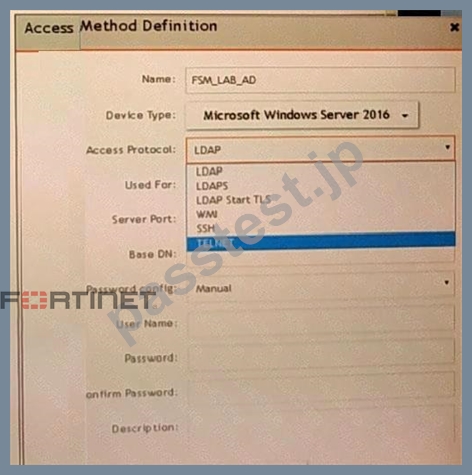
A FortiSIEM administrator wants to collect both SIEM event logs and performance and availability metrics (PAM) events from a Microsoft Windows server Which protocol should the administrator select in the Access Protocol drop-down list so that FortiSIEM will collect both SIEM and PAM events?
- A. WMI
- B. LDAPS
- C. TELNET
- D. LDAP start TLS
正解:A
解説:
Collecting SIEM and PAM Events: To collect both SIEM event logs and Performance and Availability Monitoring (PAM) events from a Microsoft Windows server, a suitable protocol must be selected.
WMI Protocol: Windows Management Instrumentation (WMI) is the appropriate protocol for this task.
* SIEM Event Logs: WMI can collect security, application, and system logs from Windows devices.
* PAM Events: WMI can also gather performance metrics, such as CPU usage, memory utilization, and disk activity.
Comprehensive Data Collection: Using WMI ensures that both types of data are collected efficiently from the Windows server.
References: FortiSIEM 6.3 User Guide, Data Collection Methods section, which details the use of WMI for collecting various types of logs and performance metrics.
質問 # 40
Consider thestorage of anomaly baseline date that is calculated for different parameters. Which database is used for storing this data?
- A. SVNDB
- B. Event DB
- C. CMDB
- D. Profile DB
正解:D
解説:
Anomaly Baseline Data: Anomaly baseline data refers to the statistical profiles and baselines calculated for various parameters to detect deviations indicative of potential security incidents.
Profile DB: The Profile DB is specifically designed to store such baseline data in FortiSIEM.
* Purpose: It maintains statistical profiles for different monitored parameters to facilitate anomaly detection.
* Usage: This data is used by FortiSIEM to compare real-time metrics against the established baselines to identify anomalies.
References: FortiSIEM 6.3 User Guide, Database Architecture section, which describes the different databases used in FortiSIEM and their purposes, including the Profile DB for storing anomaly baseline data.
質問 # 41
What operating system is FortiSIEM based on?
- A. Microsoft Windows
- B. RedHat
- C. Cent OS
- D. Ubuntu
正解:C
質問 # 42
A customer is experiencing slow performance while executing long, adhoc analytic searches Which FortiSIEM component can make the searches run faster?
- A. Storage worker
- B. Event worker
- C. Correlation worker
- D. Query worker
正解:D
解説:
Component Roles in FortiSIEM: Different components in FortiSIEM have specific roles and responsibilities, which contribute to the overall performance and functionality of the system.
Query Worker: The query worker component is specifically designed to handle and optimize search queries within FortiSIEM.
* Function: It processes search requests and executes analytic searches efficiently, handling large volumes of data to provide quick results.
* Optimization: By improving the efficiency of query execution, the query worker can significantly speed up long, ad hoc analytic searches, addressing performance issues.
Performance Impact: Utilizing the query worker ensures that searches are handled by a component optimized for such tasks, reducing the load on other components and improving overall system performance.
References: FortiSIEM 6.3 User Guide, System Components section, which describes the roles of different workers, including the query worker, and their impact on system performance.
質問 # 43
How was the FortiGate device discovered by FortiSIEM?
- A. Through GUI log discovery
- B. Through syslog discovery
- C. using the pull events method
- D. Through auto lag discovery
正解:D
質問 # 44
......
Fortinet NSE5_FSM -6.3(Fortinet NSE 5 -Fortisiem 6.3)認定試験は、FortinetのFortisiemを利用するセキュリティ情報およびイベント管理(SIEM)ソリューションの管理と運用における個人の知識とスキルを確認する専門的な認定試験です。この試験は、Fortisiemの構成、管理、およびトラブルシューティングの候補者の能力、および製品のコア機能と機能の理解を検証するように設計されています。
NSE5_FSM-6.3問題集が合格させる、一日でNSE 5 Network Security Analyst試験合格:https://www.passtest.jp/Fortinet/NSE5_FSM-6.3-shiken.html
最新でリアルなFortinet NSE5_FSM-6.3試験問題集解答:https://drive.google.com/open?id=1zEkVi15FcmwR_L1_X3c5M_d9ckVD2e6g