

[2024年08月08日]Professional-Cloud-Developerテスト準備できるトレーニング練習テスト試験問題
試験問題解答ブレーン問題集でProfessional-Cloud-Developer試験問題集PDFを使おう
Google Professional-Cloud-Developer 試験は、クラウドネイティブアプリケーションを開発することに特化した開発者にとって不可欠な認定です。この認定を取得することで、GCP のさらなる知識を習得し、スキルや経験を潜在的な雇用主にアピールし、クラウドコンピューティング分野でのキャリアアップにつなげることができます。
Google Professional-Cloud-Developer認定は、クラウドコンピューティング業界で非常に求められる資格です。これは、Google Cloud Platform上でクラウドベースのアプリケーションを開発する能力を示すものであり、世界的に認知されており、クラウドコンピューティングでキャリアを追求したい人にとっては大きなアセットとなります。クラウドコンピューティングでスキルや知識を向上させたい開発者にとって、必須の認定資格です。
質問 # 112
You are running a containerized application on Google Kubernetes Engine. Your container images are stored in Container Registry. Your team uses CI/CD practices. You need to prevent the deployment of containers with known critical vulnerabilities. What should you do?
- A. * Use Web Security Scanner to automatically crawl your application
* Review your application logs for scan results, and provide an attestation that the container is free of known critical vulnerabilities
* Use Binary Authorization to implement a policy that forces the attestation to be provided before the container is deployed - B. * Enable the Container Scanning API to perform vulnerability scanning
* Programmatically review vulnerability reporting through the Container Scanning API, and provide an attestation that the container is free of known critical vulnerabilities
* Use Binary Authorization to implement a policy that forces the attestation to be provided before the container is deployed - C. * Use Web Security Scanner to automatically crawl your application
* Review the scan results in the scan details page in the Cloud Console, and provide an attestation that the container is free of known critical vulnerabilities
* Use Binary Authorization to implement a policy that forces the attestation to be provided before the container is deployed - D. * Enable the Container Scanning API to perform vulnerability scanning
* Review vulnerability reporting in Container Registry in the Cloud Console, and provide an attestation that the container is free of known critical vulnerabilities
* Use Binary Authorization to implement a policy that forces the attestation to be provided before the container is deployed
正解:B
解説:
Explanation
https://cloud.google.com/binary-authorization/docs/creating-attestations-kritis
https://cloud.google.com/container-analysis/docs/os-overview
質問 # 113
You made a typo in a low-level Linux configuration file that prevents your Compute Engine instance from booting to a normal run level. You just created the Compute Engine instance today and have done no other maintenance on it, other than tweaking files. How should you correct this error?
- A. Configure and log in to the Compute Engine instance using a remote desktop client, and change the file
- B. Download the file using scp, change the file, and then upload the modified version
- C. Configure and log in to the Compute Engine instance through the serial port, and change the file
- D. Configure and log in to the Compute Engine instance through SSH, and change the file
正解:C
解説:
https://cloud.google.com/compute/docs/troubleshooting/troubleshooting-using-serial-console
質問 # 114
For this question, refer to the HipLocal case study.
HipLocal is expanding into new locations. They must capture additional data each time the application is launched in a new European country. This is causing delays in the development process due to constant schema changes and a lack of environments for conducting testing on the application changes. How should they resolve the issue while meeting the business requirements?
- A. Migrate data to Firestore in Native mode and set up instan
- B. Move from Cloud SQL to MySQL hosted on Compute Engine. Replicate hosts across regions in the Americas and Europe. Provide developers with local MySQL instances to conduct testing on the application changes.
- C. Migrate data to Bigtable. Instruct the development teams to use the Cloud SDK to emulate a local Bigtable development environment.
- D. Create new Cloud SQL instances in Europe and North America for testing and deployment. Provide developers with local MySQL instances to conduct testing on the application changes.
正解:C
質問 # 115
You work for a financial services company that has a container-first approach. Your team develops microservices applications You have a Cloud Build pipeline that creates a container image, runs regression tests, and publishes the image to Artifact Registry You need to ensure that only containers that have passed the regression tests are deployed to Google Kubernetes Engine (GKE) clusters You have already enabled Binary Authorization on the GKE clusters What should you do next?
- A. Create an attestor and a policy. Create an attestation for the container images that have passed the regression tests as a step in the Cloud Build pipeline.
- B. Deploy Voucher Server and Voucher Client Components. After a container image has passed the regression tests, run Voucher Client as a step in the Cloud Build pipeline.
- C. Create an attestor and a policy Run a vulnerability scan to create an attestation for the container image as a step in the Cloud Build pipeline.
- D. Set the Pod Security Standard level to Restricted for the relevant namespaces Digitally sign the container images that have passed the regression tests as a step in the Cloud Build pipeline.
正解:A
質問 # 116
Your company has a BigQuery data mart that provides analytics information to hundreds of employees. One user of wants to run jobs without interrupting important workloads. This user isn't concerned about the time it takes to run these jobs. You want to fulfill this request while minimizing cost to the company and the effort required on your part.
What should you do?
- A. Ask the user to run the jobs as batch jobs.
- B. Create a separate project for the user to run jobs.
- C. Add the user as a job.user role in the existing project.
- D. Allow the user to run jobs when important workloads are not running.
正解:B
質問 # 117
You have a mixture of packaged and internally developed applications hosted on a Compute Engine instance that is running Linux. These applications write log records as text in local files. You want the logs to be written to Cloud Logging. What should you do?
- A. Install a Google version of fluentd on the Compute Engine instance.
- B. Using cron, schedule a job to copy the log files to Cloud Storage once a day.
- C. Install a Google version of collectd on the Compute Engine instance.
- D. Pipe the content of the files to the Linux Syslog daemon.
正解:A
質問 # 118
In order to meet their business requirements, how should HipLocal store their application state?
- A. Put a memcache layer in front of MySQL.
- B. Move the state storage to Cloud Spanner.
- C. Use local SSDs to store state.
- D. Replace the MySQL instance with Cloud SQL.
正解:A
質問 # 119
You are developing an application that will be launched on Compute Engine instances into multiple distinct projects, each corresponding to the environments in your software development process (development, QA, staging, and production). The instances in each project have the same application code but a different configuration. During deployment, each instance should receive the application's configuration based on the environment it serves. You want to minimize the number of steps to configure this flow.
What should you do?
- A. When creating your instances, configure a startup script using the gcloud command to determine the project name that indicates the correct environment.
- B. In each project, configure a metadata key "environment" whose value is the environment it serves. Use your deployment tool to query the instance metadata and configure the application based on the "environment" value.
- C. Deploy your chosen deployment tool on an instance in each project. Use a deployment job to retrieve the appropriate configuration file from your version control system, and apply the configuration when deploying the application on each instance.
- D. During each instance launch, configure an instance custom-metadata key named "environment" whose value is the environment the instance serves. Use your deployment tool to query the instance metadata, and configure the application based on the "environment" value.
正解:B
質問 # 120
Your application is composed of a set of loosely coupled services orchestrated by code executed on Compute Engine. You want your application to easily bring up new Compute Engine instances that find and use a specific version of a service. How should this be configured?
- A. Define your service to use a fixed hostname and port to connect to the desired service. Replace the service at the endpoint with your new version.
- B. Define your service endpoint information to be retrieved from an environment variable at runtime and used to connect to the desired service.
- C. Define your service endpoint information as label data that is retrieved at runtime and used to connect to the desired service.
- D. Define your service endpoint information as metadata that is retrieved at runtime and used to connect to the desired service.
正解:D
解説:
Explanation
https://cloud.google.com/service-infrastructure/docs/service-metadata/reference/rest#service-endpoint
質問 # 121
You are running an application on App Engine that you inherited. You want to find out whether the application is using insecure binaries or is vulnerable to XSS attacks. Which service should you use?
- A. Cloud Security Scanner
- B. Cloud Amor
- C. Stackdriver Error Reporting
- D. Stackdriver Debugger
正解:A
解説:
Reference: https://cloud.google.com/security-scanner
質問 # 122
You need to copy directory local-scripts and all of its contents from your local workstation to a Compute Engine virtual machine instance.
Which command should you use?
gsutil cp --project "my-gcp-project" -r ~/local-scripts/ gcp-instance-name:~/
- A. instance-name:~/server-scripts/ --zone "us-east1-b"
- B. instance-name:~/server-scripts/ --zone "us-east1-b"
gcloud compute mv --project "my-gcp-project" --recurse ~/local-scripts/ gcp- - C. server-scripts/ --zone "us-east1-b"
gcloud compute scp --project "my-gcp-project" --recurse ~/local-scripts/ gcp- - D. server-scripts/ --zone "us-east1-b"
gsutil cp --project "my-gcp-project" -R ~/local-scripts/ gcp-instance-name:~/
正解:B
解説:
Explanation/Reference: https://cloud.google.com/sdk/gcloud/reference/compute/copy-files
質問 # 123
Case study
This is a case study. Case studies are not timed separately. You can use as much exam time as you would like to complete each case. However, there may be additional case studies and sections on this exam. You must manage your time to ensure that you are able to complete all questions included on this exam in the time provided.
To answer the questions included in a case study, you will need to reference information that is provided in the case study. Case studies might contain exhibits and other resources that provide more information about the scenario that is described in the case study. Each question is independent of the other questions in this case study.
At the end of this case study, a review screen will appear. This screen allows you to review your answers and to make changes before you move to the next section of the exam. After you begin a new section, you cannot return to this section.
To start the case study
To display the first question in this case study, click the Next button. Use the buttons in the left pane to explore the content of the case study before you answer the questions. Clicking these buttons displays information such as business requirements, existing environment, and problem statements. If the case study has an All Information tab, note that the information displayed is identical to the information displayed on the subsequent tabs. When you are ready to answer a question, click the Question button to return to the question.
Company Overview
HipLocal is a community application designed to facilitate communication between people in close proximity. It is used for event planning and organizing sporting events, and for businesses to connect with their local communities. HipLocal launched recently in a few neighborhoods in Dallas and is rapidly growing into a global phenomenon. Its unique style of hyper-local community communication and business outreach is in demand around the world.
Executive Statement
We are the number one local community app; it's time to take our local community services global. Our venture capital investors want to see rapid growth and the same great experience for new local and virtual communities that come online, whether their members are 10 or 10000 miles away from each other.
Solution Concept
HipLocal wants to expand their existing service, with updated functionality, in new regions to better serve their global customers. They want to hire and train a new team to support these regions in their time zones. They will need to ensure that the application scales smoothly and provides clear uptime data.
Existing Technical Environment
HipLocal's environment is a mix of on-premises hardware and infrastructure running in Google Cloud Platform.
The HipLocal team understands their application well, but has limited experience in global scale applications.
Their existing technical environment is as follows:
* Existing APIs run on Compute Engine virtual machine instances hosted in GCP.
* State is stored in a single instance MySQL database in GCP.
* Data is exported to an on-premises Teradata/Vertica data warehouse.
* Data analytics is performed in an on-premises Hadoop environment.
* The application has no logging.
* There are basic indicators of uptime; alerts are frequently fired when the APIs are unresponsive.
Business Requirements
HipLocal's investors want to expand their footprint and support the increase in demand they are seeing. Their requirements are:
* Expand availability of the application to new regions.
* Increase the number of concurrent users that can be supported.
* Ensure a consistent experience for users when they travel to different regions.
* Obtain user activity metrics to better understand how to monetize their product.
* Ensure compliance with regulations in the new regions (for example, GDPR).
* Reduce infrastructure management time and cost.
* Adopt the Google-recommended practices for cloud computing.
Technical Requirements
* The application and backend must provide usage metrics and monitoring.
* APIs require strong authentication and authorization.
* Logging must be increased, and data should be stored in a cloud analytics platform.
* Move to serverless architecture to facilitate elastic scaling.
* Provide authorized access to internal apps in a secure manner.
In order to meet their business requirements, how should HipLocal store their application state?
- A. Put a memcache layer in front of MySQL.
- B. Move the state storage to Cloud Spanner.
- C. Use local SSDs to store state.
- D. Replace the MySQL instance with Cloud SQL.
正解:A
質問 # 124
You are planning to deploy your application in a Google Kubernetes Engine (GKE) cluster. Your application can scale horizontally, and each instance of your application needs to have a stable network identity and its own persistent disk.
Which GKE object should you use?
- A. ReplicaSet
- B. Deployment
- C. ReplicaController
- D. StatefulSet
正解:D
解説:
Explanation/Reference: https://livebook.manning.com/book/kubernetes-in-action/chapter-10/46
質問 # 125
Examine the image.
Which feature in macOS is opened by clicking on this dock icon?
- A. Launchpad
- B. Spotlight
- C. System Preferences
- D. Finder
正解:A
解説:
Explanation/Reference: https://support.apple.com/en-us/HT202635
質問 # 126
Your website is deployed on Compute Engine. Your marketing team wants to test conversion rates between 3 different website designs.
Which approach should you use?
- A. Deploy the website on App Engine and use traffic splitting.
- B. Deploy the website on App Engine as three separate services.
- C. Deploy the website on Cloud Functions as three separate functions.
- D. Deploy the website on Cloud Functions and use traffic splitting.
正解:A
解説:
Explanation/Reference: https://cloud.google.com/appengine/docs/standard/python/splitting-traffic
質問 # 127
You are using Cloud Build to build and test application source code stored in Cloud Source Repositories. The build process requires a build tool not available in the Cloud Build environment.
What should you do?
- A. Download the binary from the internet during the build process.
- B. Ask to have the binary added to the Cloud Build environment by filing a feature request against the Cloud Build public Issue Tracker.
- C. Include the binary in your Cloud Source Repositories repository and reference it in your build scripts.
- D. Build a custom cloud builder image and reference the image in your build steps.
正解:D
質問 # 128
You are running a containerized application on Google Kubernetes Engine. Your container images are stored in Container Registry. Your team uses CI/CD practices. You need to prevent the deployment of containers with known critical vulnerabilities. What should you do?
- A. * Use Web Security Scanner to automatically crawl your application
* Review your application logs for scan results, and provide an attestation that the container is free of known critical vulnerabilities
* Use Binary Authorization to implement a policy that forces the attestation to be provided before the container is deployed - B. * Enable the Container Scanning API to perform vulnerability scanning
* Programmatically review vulnerability reporting through the Container Scanning API, and provide an attestation that the container is free of known critical vulnerabilities
* Use Binary Authorization to implement a policy that forces the attestation to be provided before the container is deployed - C. * Use Web Security Scanner to automatically crawl your application
* Review the scan results in the scan details page in the Cloud Console, and provide an attestation that the container is free of known critical vulnerabilities
* Use Binary Authorization to implement a policy that forces the attestation to be provided before the container is deployed - D. * Enable the Container Scanning API to perform vulnerability scanning
* Review vulnerability reporting in Container Registry in the Cloud Console, and provide an attestation that the container is free of known critical vulnerabilities
* Use Binary Authorization to implement a policy that forces the attestation to be provided before the container is deployed
正解:B
解説:
https://cloud.google.com/binary-authorization/docs/creating-attestations-kritis
https://cloud.google.com/container-analysis/docs/os-overview
質問 # 129
You have a container deployed on Google Kubernetes Engine. The container can sometimes be slow to launch, so you have implemented a liveness probe. You notice that the liveness probe occasionally fails on launch. What should you do?
- A. Add a startup probe.
- B. Add a readiness probe.
- C. Increase the CPU limit for the container.
- D. Increase the initial delay for the liveness probe.
正解:D
解説:
https://kubernetes.io/docs/tasks/configure-pod-container/configure-liveness-readiness-startup-probes/#configure-probes
質問 # 130
You have an application in production. It is deployed on Compute Engine virtual machine instances controlled by a managed instance group. Traffic is routed to the instances via a HTTP(s) load balancer. Your users are unable to access your application. You want to implement a monitoring technique to alert you when the application is unavailable.
Which technique should you choose?
- A. Smoke tests
- B. Stackdriver uptime checks
- C. Managed instance group - heath checks
- D. Cloud Load Balancing - heath checks
正解:B
解説:
Explanation/Reference: https://medium.com/google-cloud/stackdriver-monitoring-automation-part-3-uptime-checks-
476b8507f59c
質問 # 131
You have an HTTP Cloud Function that is called via POST. Each submission's request body has a flat, unnested JSON structure containing numeric and text dat a. After the Cloud Function completes, the collected data should be immediately available for ongoing and complex analytics by many users in parallel. How should you persist the submissions?
- A. Directly persist each POST request's JSON data into Datastore.
- B. Transform the POST request's JSON data, and store it in a regional Cloud SQL cluster.
- C. Persist each POST request's JSON data as an individual file within Cloud Storage, with the file name containing the request identifier.
- D. Transform the POST request's JSON data, and stream it into BigQuery.
正解:C
質問 # 132
You have an application deployed in Google Kubernetes Engine (GKE) that reads and processes Pub/Sub messages. Each Pod handles a fixed number of messages per minute. The rate at which messages are published to the Pub/Sub topic varies considerably throughout the day and week, including occasional large batches of messages published at a single moment.
You want to scale your GKE Deployment to be able to process messages in a timely manner. What GKE feature should you use to automatically adapt your workload?
- A. Horizontal Pod Autoscaler based on resources utilization
- B. Horizontal Pod Autoscaler based on an external metric
- C. Vertical Pod Autoscaler in Auto mode
- D. Vertical Pod Autoscaler in Recommendation mode
正解:B
解説:
https://kubernetes.io/docs/tasks/run-application/horizontal-pod-autoscale/
質問 # 133
Which service should HipLocal use for their public APIs?
- A. Cloud Endpoints
- B. Cloud Functions
- C. Shielded Virtual Machines
- D. Cloud Armor
正解:C
質問 # 134
You have decided to migrate your Compute Engine application to Google Kubernetes Engine. You need to build a container image and push it to Artifact Registry using Cloud Build. What should you do? (Choose two.) A) Run gcloud builds submit in the directory that contains the application source code.
B)
Run gcloud run deploy app-name --image gcr.io/$PROJECT_ID/app-name in the directory that contains the application source code.
C)
Run gcloud container images add-tag gcr.io/$PROJECT_ID/app-name gcr.io/$PROJECT_ID/app-name:latest in the directory that contains the application source code.
D)
In the application source directory, create a file named cloudbuild.yaml that contains the following contents:
E)
In the application source directory, create a file named cloudbuild.yaml that contains the following contents: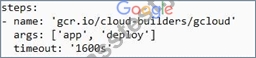
- A. Option D
- B. Option C
- C. Option B
- D. Option E
- E. Option A
正解:A、E
解説:
https://cloud.google.com/sdk/gcloud/reference/builds/submit
https://cloud.google.com/artifact-registry/docs/configure-cloud-build
質問 # 135
You need to migrate an internal file upload API with an enforced 500-MB file size limit to App Engine.
What should you do?
- A. Use FTP to upload files.
- B. Use CPanel to upload files.
- C. Change the API to be a multipart file upload API.
- D. Use signed URLs to upload files.
正解:D
解説:
Reference:
https://wiki.christophchamp.com/index.php?title=Google_Cloud_Platform
質問 # 136
......
無料ダウンロードGoogle Professional-Cloud-Developerリアルな試験問題で合格しよう:https://www.passtest.jp/Google/Professional-Cloud-Developer-shiken.html
Professional-Cloud-Developer試験問題集、Professional-Cloud-Developer練習テスト問題:https://drive.google.com/open?id=1sWFjb2SYyF0KzBDfZweEj-KOQwDf-2If