

最高でL4M2最新の2025問題集は100%試験合格率保証付きます
ベストな方法はCIPS L4M2練習試験問題集
CIPS L4M2試験は、調達とサプライチェーンの専門家がキャリアを進め、調達プロジェクトやイニシアチブをリードするために必要なスキルを開発することを目的としています。この試験で取得した認定は、グローバルに認められており、CIPS L4M2試験に合格した専門家は求人市場で競争力を持っています。全体的に、CIPS L4M2試験は、キャリアを次のレベルに進めたい調達専門家にとって重要な認定です。
質問 # 128
A procurement manager consolidates the company expense on printing and office supplies into broader range of spend category. Other senior managers are concerned that it may increase company's spend. Is that concern justified?
- A. No, because the broader range of spend category can increase the value of the contract and the buyer may get volume discount
- B. Yes, because the consolidation may create a large contract that costs more than placing each purchase order
- C. No, because the consolidation will help the supplier to shorten deliver time.
- D. Yes, because the suppliers can't provide a broader range of products and they will fail to deliver
正解:A
解説:
Printing and office supplies are often considered as low risk, low value items. Consolidation low value, low risk items into a broader range will dramatically increases the value of the contract and leverage of buying organisation in the negotiation.
質問 # 129
A purchaser is looking for alternative supplies if there is a major disruption to their supply chain, including logistics, manufacturing and all support services. Which of the following method is that purchaser applying?
- A. Tolerate the risk
- B. Treat the risk
- C. Terminate the risk
- D. Transfer the risk
正解:B
解説:
Risk control is the process by which an organization reduces the likelihood of a risk event occurring or mitigates the effects that risk should it occur. CIPS preferred way to determine your risk control strategy is to use the four T's Process:
Transferring Risk can be achieved through the use of various forms of insurance, or the payment to third parties who are prepared to take the risk on behalf of the organization Tolerating Risk is where no action is taken to mitigate or reduce a risk. This may be because the cost of instituting risk reduction or mitigation activity is not cost-effective or the risks of impact are at so low that they are deemed acceptable to the business. Even when these risks are tolerated they should be monitored because future changes may make it no longer tolerable.
Treating Risk is a method of controlling risk through actions that reduce the likelihood of the risk occurring or minimize its impact prior to its occurrence. Also, there are contingent measures that can be developed to reduce the impact of an event once it has occurred. Finding an alternative sup-plier is an example of treating the risk.
Terminating Risk is the simplest and most often ignored method of dealing with risk. It is the ap-proach that should be most favored where possible and simply involves risk elimination. This can be done by altering an inherently risky process or practice to remove the risk. The same can be used when reviewing practices and processes in all areas of the business.
If an item presents a risk and can be changed or removed without it materially affecting the busi-ness, then removing the risk should be the first option considered; rather than attempting the treat, tolerate or transfer it.
質問 # 130
Honda of America Manufacturing is a well established automobile manufacturer. It purchases tens of thousands of materials and parts from suppliers, however, only few of them are strategic. To these suppliers, Honda's procurement manager requires them to send details of labour, materials, overhead cost and profit. However, the suppliers are reluctant to submit such confidential infor-mation. Is the procurement manager's action appropriate?
- A. No, because procurement manager should conduct life-cycle analysis
- B. No, because no suppliers are willing to show sensitive information on their costs and profit.
- C. Yes, because the procurement manager can get a good insight from the market
- D. Yes, because strategies can be introduced for reducing cost and improving the supplier relationships.
正解:D
解説:
With strategic suppliers, the aim should be to work co-operatively with them to find ways of reducing costs to achieve a target cost. It is necessary to work with the suppliers in carrying out open book costing by having first persuaded them of the need to do it. Open book can be used to establish a Target Cost, a Compensation Event value and can eventually be used to ensure the payment of actual costs to an organization. A number of forms of contract cater for this functionality of which only the NEC goes to into any great depth of methodology.
If the suppliers worry about leak of confidential information, procurement team can suggest them to sign a non-disclosure agreement. The buying organisation should also comply with data protection regulations. The Employer / individual responsible for a project's costs should ultimately take a pragmatic and sensible approach with regard to commercially or personally sensitive data provided by the contractor. The primary goal of all open book cost management is to provide Employer comfort and security in the accuracy of commercial data; this effectively means striking a balance between undertaking full audits and blind faith.
Reference:
LO 1, AC 1.2
質問 # 131
A company department is writing a business case to justify the purchase of an expensive piece of capital equipment. Which of the following should be included in the business case?
* Terms and conditions of contract
* Tender evaluation criteria
* Degree of added value
* Financial plan
- A. 2 and 3 only
- B. 3 and 4 only
- C. 1 and 2 only
- D. 1 and 4 only
正解:B
質問 # 132
Total cost of ownership of a solar panel is $5,000 and it is expected that the panel will make a sav-ing of
$1,000 each year. So it would take 5 years for the benefits to repay the investment. Therefore, the firm plans to keep the solar panel for at least 5 years. Is payback period calculation right for making the business decision?
- A. No, because payback period doesn't take into account price fluctuations
- B. Yes, because payback period shows how long the firm recovers the investment
- C. Yes, because it takes everything into account
- D. No, because payback period can be only used to calculate the depreciation of a fixed asset
正解:B
解説:
There are many factors that need to be considered when making a business decision. Costs and benefits are among those factor. To estimate the length of time in which an investment reaches a break-even point, businesses often use the payback period. The payback period refers to the amount of time it takes to recover the cost of an investment.
'Yes, because it takes everything into account': It ignores the time value of money (TVM), unlike other methods of capital budgeting such as net present value (NPV), internal rate of return (IRR), and discounted cash flow.
'No, because payback period doesn't take into account price fluctuations': Though it doesn't take into account price fluctuation, payback period is still useful in financial and capital budgeting.
'No, because payback period can be only used to calculate the depreciation of a fixed asset': Payback period only calculates the length of time in which the benefits of a charge repay its costs.
LO 1, AC 1.3
質問 # 133
British Steel needs to source a set of instruments that will improve quality of steel. Without these instruments British Steel will loss control of the temperature. The bucket may freeze up, or if it is too hot it leaks out of the casting process, damaging the machine. There is limited supply on the market and quality varies greatly.
Which of the following will be the most appropriate managing approach to procure these items?
- A. Leverage market competition to drive down cost
- B. Seek continuity of supply
- C. Form partnership with supplier
- D. Bundle these instruments into larger contract
正解:C
解説:
The instrument plays a crucial role in steel manufacturing because it presents in the majority of products, in which case lacking this instrument would have significant impact on the organisation's output (production lines stop or damaging other machine). Otherwise, the risk of supply is high because there is limitation in supply. Therefore, it is considered as a strategic item in term of Kraljic's portfolio matrix. Procurement manager should form partnership with suppliers to maximise the value.
The following graph illustrates Kraljic's portfolio matrix: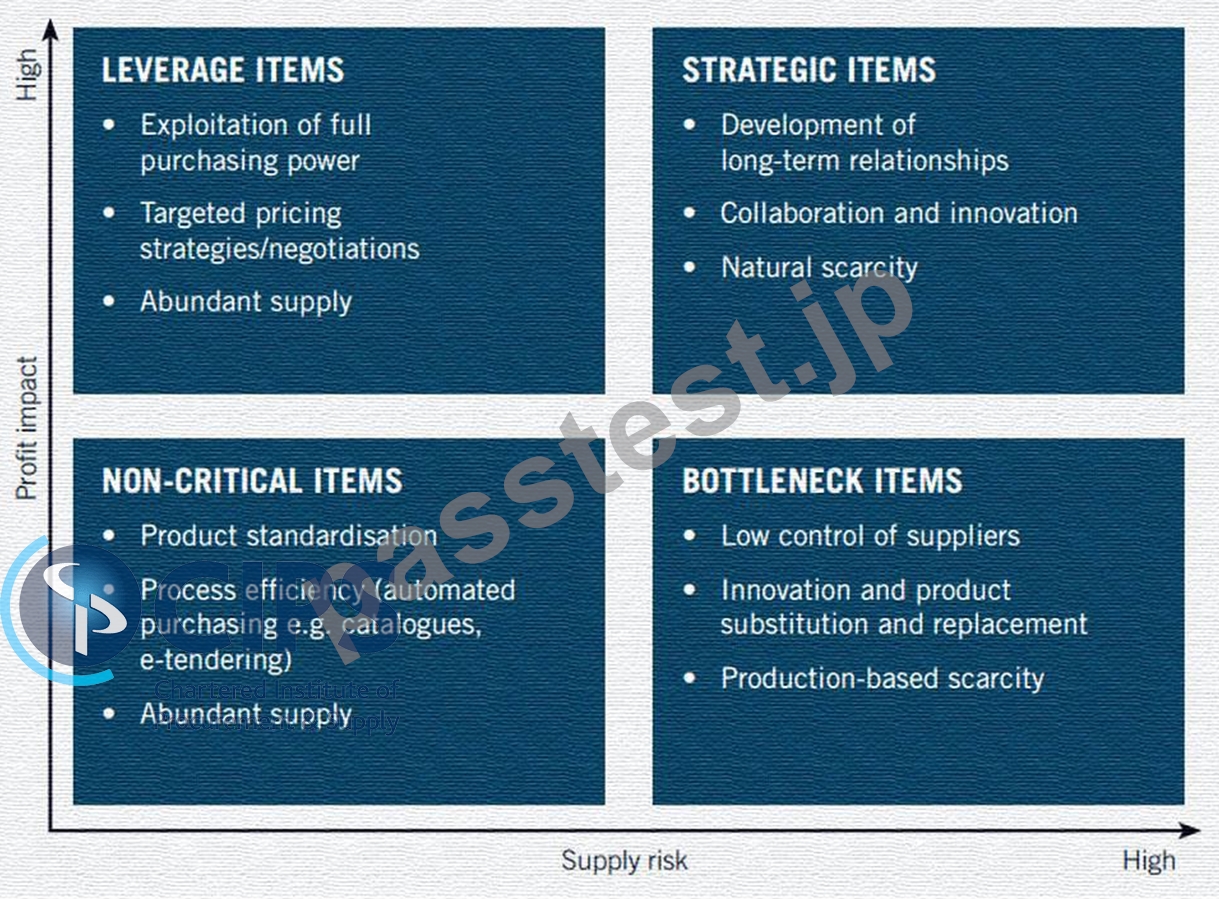
質問 # 134
Aldar Properties is a property developer in UAE. In last month, it spent $2,160 for 10 tons of steel. In this month, it had planned 10% increment in budget for steel comparing to last month. But the number of orders boosted and total spend on steel reached $1,992.1 while Aldar has imported 11 tons. What is the main cost driver of steel budget?
- A. Both price and quantity variances
- B. Price variance
- C. Quantity variance
- D. Inflation
正解:B
解説:
In this question, you have to calculate price variance and quantity variance.
Last month, 1 tonne of steel costed $216. This month, the price decreases to $181.1. Price variance = (P1 - P2)*Q2 = ($216-$181.1)*11 = $383.9 Quantity variance = (Q1-Q2)*P1 = -$216 Price variance is greater than quantity variance, therefore, price variance is the main cost driver.
LO 1, AC 1.4
質問 # 135
Azram, a procurement analyst, has been tasked with applying whole life asset management when purchasing a piece of laboratory equipment. Was this the correct course of action?
- A. No, because this covers various transactional costs
- B. Yes, because this considers all associated costs
- C. No, because this considers the costs of quality
- D. Yes, because this focuses only on the price of the equipment
正解:B
質問 # 136
Robert is a senior buyer at MMC Construction Ltd. His company is doing multiple development projects in the country, which increases procurement workload significantly. Meanwhile, most of the tasks are handled manually, which causes bottlenecks in the workflows. The procurement team is overwhelmed by the workload and complains from other departments. From previous experience, Robert knows that electronic system may help his procurement team. He writes a business case to submit to the senior management, in which he insists on the possible productivity improvement by adopting e-system in procurement. Is Robert's action reasonable?
- A. No, adopting e-system may make procurement department jobless
- B. Yes, his reason may appeal the senior management
- C. Yes, productivity improvement is a mandatory element in every business case
- D. No, there's no need to make a business case for new purchase
正解:B
解説:
Composing a compelling business case requires the proposer to write in the language of the approvers.
Generally, approvers are business executives or important shareholders whose major interest is the profitability of the firm. Business case proposer may embed the following contents:
- Return on investment: according to Investopedia, Return on Investment (ROI) is a performance measure used to evaluate the efficiency of an investment or compare the efficiency of a number of different investments. ROI tries to directly measure the amount of return on a particular investment, relative to the investment's cost. A business case would seem more attractive if the proposal is expected to have high ROI.
- Time to market: Time-to-market (TTM) refers to the time from which a company initially con-ceives a product or service idea to the point when the actual product or service is accessible to buyers in the market (Afonso et al., 2008). The speed at which companies can introduce products into the market is critical for sustaining competitive advantage, and the reduction of product development cycle time has become a strategic objective for many technology-driven firms.
- Customer satisfaction: Keeping existing customer to stay in the business can affect greatly on the profit margin of a firm. A new proposal that finds the way to innovate while keeping the current customers satisfied may gain the interest of senior management.
- Improving productivity: Productivity is the measure of how efficient and effective a firm is. Im-proving the productivity means that with the same or lesser input, better output is generated. In-creasing productivity also improves the profitability of a company.
- Risk management: Any business activity contains inherent risks. For example, for a mining company to be truly responsible, it must keep all of its workers safe, healthy and motivated, meet the expectations of the local community and government for the region in which it is operating, ensure it impacts on the environment positively if at all, as well as achieve the financial objectives set by its investors for both the short and long term. Managing risks well improves the production throughput and maintains customer satisfaction.
In the scenario, Robert is trying to convince the senior management to adopt e-procurement system by insisting on potential productivity improvement. This is the right approach. A business plan should engage and please senior management and directors. An appealing business case tells them how important things to the business (such as productivity, return on investment, customer satisfaction or costs) are affected by the plan.
質問 # 137
A company has installed a new piece of capital equipment but needs to arrange a maintenance contract for three years. The company wants to know as accurately as possible what this price will be for the full contract. What would be an appropriate type of pricing mechanism to use when asking suppliers to quote prices?
- A. Fixed price with adjustment for inflation
- B. Cost plus fixed fee
- C. Fixed price
- D. Cost plus percentage fee
正解:A
解説:
Detailed Explanation:A fixed price with adjustment for inflation provides cost predictability while accounting for potential increases due to inflation. This strikes a balance between fixed costs and market realities. Reference: CIPS Level 4, Pricing Strategies.
質問 # 138
At which stage of product life cycle, price competition between sellers will be the most intense?
- A. Maturity stage
- B. Introductory stage
- C. Growth stage
- D. Decline stage
正解:D
解説:
The term product life cycle refers to the length of time a product is introduced to consumers into the market until it's removed from the shelves. The life cycle of a product is broken into four stages-introduction, growth, maturity, and decline.
Chart, line chart Description automatically generated
Source: https://blueoceanoutsource.co.ke/the-product-life-cycle-concept/ At maturity stage, price competition sets in as more and more supply capacity has been added by new entrants, then the competition will be the most intense.
質問 # 139
In Kano model, which of the following types of requirement should be excluded from the product or service?
- A. Reverse requirements
- B. Must-be requirements
- C. Performance requirements
- D. Attractive requirements
正解:A
解説:
Kano model of excitement and basic quality (Kano et al, 1984; Berger et al, 1993; Matzler et al, 1996) brings a different perspective for the analysis of improvement opportunities in products and services because it takes in consideration the asymmetrical and non-linear relationship between performance and satisfaction. The Kano model classifies customers requirements in three categories (figure 3):
a) Basic Requirements (or Must-be requirement). The basic requirements fulfill the basic func-tions of a product. If they are not present or their performance is insufficient, customers will be extremely dissatisfied. On the other hand, if they are present or have sufficient performance, they don't bring satisfaction. Customers see them as prerequisites. For instance, for luxury automobiles, "air bags" are considered basic. A customer won't feel satisfied if the automobile has "air bag", however he/she will not buy it if "air bag" is not present.
b) Performance Requirements (or One-dimensional requirements). As for these requirements, satisfaction is proportional to the performance level - the higher the performance, the higher the customer's satisfaction will be and vice-versa. Gas consumption in automobiles is an example of these requirements. Usually customers explicitly demand performance requirements.
c) Excitement Requirements (or Attractive requirements). These requirements are key to cus-tomer satisfaction. If they are present or have sufficient performance, they will bring superior satisfaction. On the other hand, if they are not present or their performance is insufficient, customers will not get dissatisfied. For instance, a surprise gift at the end of a dinner in a restaurant will certainly bring satisfaction, but it will not cause dissatisfaction if not offered. These requirements are not demanded nor expected by customers.
Two other types of requirements may be identified in the Kano model: neutral and reverse ones. Neutral requirements do not bring either satisfaction or dissatisfaction. Reverse require-ments bring more satisfaction if absent than if present.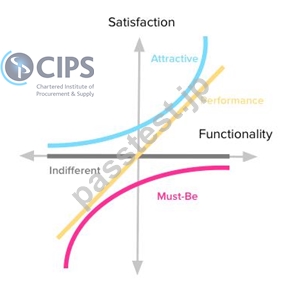
Reference:
- Integrating Kano model and QFD for Designing New Products
- CIPS study guide page 171-172
質問 # 140
Which of the following activities would apply to a straight rebuy procurement?
* Reviewing existing specifications and arrangements
* Engaging in extensive purchasing research
* Engaging in proactive value engineering
* Optimising inventory replenishment methods
- A. 2 and 3 only
- B. 1 and 4 only
- C. 1 and 3 only
- D. 2 and 4 only
正解:B
質問 # 141
A buying organisation may not have technical capability to produce a highly complex specification. Which of the following are sources of information that can be used to create the specification? Select TWO that apply
- A. Constitution
- B. Suppliers' know-how
- C. Standard terms and conditions
- D. Industry standards
- E. Name cards
正解:B、D
解説:
If an organisation doesn't have capability to produce a technical specification, they can draft one based on standards or consulting the suppliers.
質問 # 142
Which of the following factors should be assessed to understand the competitiveness of a supply market?
- A. Number of suppliers within the market
- B. Presence of a minimum wage
- C. Gross National Product of the country of manufacture
- D. Previous price paid for goods
正解:A
質問 # 143
Which of the following is a risk to buying organization when using conformance specification?
- A. Buyer is responsible for product failure
- B. Buyer cannot control the inputs
- C. Buyer may face liquidity risks
- D. Time to produce specification is shortened
正解:A
解説:
When using conformance specification, the buying organisation is responsible for the performance of the purchase. If the product fails due to poorly designed specification, the buyer is wholly responsible for it. It cannot blame the supplier for the failure because they still provided 'fit for purpose' product.
'Time to produce specification is shortened': Conformance specification requires details on dimen-sion, materials, design, etc. With such requirements, time to produce a complete conformance specification is often longer than producing performance specification.
'Buyer cannot control the inputs': Conformance specification is a list of inputs from buyer, so buyer has control over the inputs that will make the product. It also means that buyer is responsible for any product failure.
'Buyer may face liquidity risks': Liquidity means that how quick a business turns its assets into cash. This is a financial term, it does not link directly with specification failure.
Reference:
LO 3, AC 3.1
質問 # 144
A "modified re-buy" means ...
- A. The specification should not be considered for future treatment as a stock item because of the modification
- B. Both the specification and the market should be reviewed to manage the new circumstances
- C. The existing specifications should be reviewed but not the supply market, as this type of purchase is complex
- D. The existing supplier should be asked to supply the requirement because it is a modified re-buy of the same item
正解:B
質問 # 145
Which of the following is part of a conformance specification?
- A. Ideas, innovation, tolerances, and descriptions
- B. Material, dimensions, tolerances, and drawings
- C. Material, innovation, performance, and descriptions
- D. Ideas, dimensions, tolerances, and output
正解:B
解説:
Detailed Explanation:Conformance specifications are highly detailed, covering exact materials, dimensions, tolerances, and technical drawings. They ensure precision in manufacturing and consistency between suppliers. Reference: CIPS Level 4, Specification and Contract Development.
質問 # 146
Which of these have a negative effect on cash flow?
* A supplier reduces its payment terms
* The bank grants a loan to the company
* A customer agrees to pay upon purchase
* An increase in the amount of stock held
- A. 2 and 3 only
- B. 3 and 4 only
- C. 1 and 4 only
- D. 2 and 4 only
正解:C
質問 # 147
A procurement manager decided to use a conformance specification in a request for quotation (RFQ) for the manufacturing of a specialist item designed by their company. The company does not have the capability to manufacture the item in-house, but requires the item to be made to their detailed specification. Was this the correct thing to do?
- A. Yes, as it means that the company will get exactly what it has specified and meets its specific requirements
- B. No, as the item will be of non-standard construction and will not be able to be used by other competitors
- C. No, as it means that the chosen supplier will not be able to use their expertise and knowledge to manufacture the item
- D. Yes, as it means that the company will be able to get the most cost-effective price for the item from the chosen supplier
正解:A
解説:
Detailed Explanation:Conformance specifications are appropriate when the buyer has precise requirements that must be met. This ensures the final product aligns perfectly with the company's needs, even if it limits supplier flexibility. Reference: CIPS Level 4, Conformance Specification in Procurement.
質問 # 148
Which of the following are typical examples of secondary sources of market data? Select TWO that apply.
- A. Communication with suppliers
- B. Price comparison websites
- C. Trade fairs and exhibitions
- D. Supplier marketing publications
- E. Published market analysis
正解:B、E
質問 # 149
A charity is reviewing their spend and budget after an operation in flooded areas. They realise that the operators save money against the budgeting plan. This saving is known as...?
- A. Negative variance
- B. Negative budget
- C. Positive variance
- D. Positive budget
正解:A
解説:
The difference between the actual spend and budgeted spend is known as variance. The formula for variance is:
Variance = Actual spend - Budgeted spend
Variances can be adverse/unfavourable or favourable ie they can be positive or negative.
Be very careful with these terms. A positive or a negative variance may be favourable or it may be adverse/ unfavourable.
Adverse variances
Adverse variances are those variances that are unfavourable to the firm. Examples would be sales below plan; costs above budget, cash receipts lower than expected, and overtime payment more than forecast.
Favourable variances
Favourable variances are those variances that are beneficial to the business. Examples would be sales ahead of plan, costs below budget, and wages below forecast.
Positive variance
A positive variance occurs where 'actual' exceeds 'planned' or 'budgeted' value. Examples might be actual sales are ahead of the budget.
Negative variance
A negative variance occurs where 'actual' is less than 'planned' or 'budgeted' value. Examples would be when the raw materials cost less than expected, sales were less than predicted, and labour costs were below the budgeted figure.
When the operators create saving, it means that the Actual spend is less than Budgeted spend. Therefore the variance is negative.
Reference:
- Variance analysis
- CIPS study guide page 57-59
LO 1, AC 1.4
質問 # 150
Which of the following technology is likely to be an innovation in financial sector?
- A. Robotics
- B. E-commerce
- C. Blockchain
- D. E-auction
正解:C
解説:
Traditional financial systems operate with a centralised database, usually with a single point of authority. Blockchain technology, on the other hand, allows for a distributed database that holds a growing number of records. Instead of existing in one place, the ledger is continually updated and synchronised across multiple computers in a network. Therefore, any participant in the network with the proper authorisation can view the entire ledger - without relying on an intermediary or any one authority.
Another key feature of blockchain technology is a "smart contract," which is a self-executing protocol that enforces a previously agreed arrangement. For example, a smart contract could trigger an automatic refund under certain conditions or the automatic payment of an agreed commission after a sale. These smart contracts can eliminate delays in traditional Finance processes, while increasing transparency and reducing reliance on middlemen to follow through on their commitments. Moreover, like other parts of a blockchain, smart contracts are immutable, so they can enhance accuracy in the financial statements.
LO 2, AC 2.1
質問 # 151
Sealines Inc is developing its fleet of cargo ships. The company is planning to build a new ship powered by natural gas. Brian, the procurement manager at Sealines, suggests the project team to develop a through-life specification before engaging with the supplier. Is this a correct approach?
- A. Yes, this approach will lower the total cost of ownership
- B. No, a ship is used only once, through-life management is unnecessary
- C. No, the company just needs to select the lowest bidder
- D. Yes, decommissioning and disposal costs will not be accounted in this approach
正解:A
解説:
Through-life management is a approach applied to capital asset. According to Ward and Graves, Through-life Management involves the life-cycle management of the products, services and activities required to deliver a fully integrated capability to the customer, while reducing the cost of ownership for the customer. According to CIPS study guide, through-life management comprises of 6 parts:
1. Design
2. Manufacture
3. Installation
4. In-service support
5. Decommission and disposal
6. Customer support
In this scenario, the company is planning to procure a ship, which is a capital asset. Through life management is a good approach. Sealines can start with developing through-life specification. This approach may have several benefits:
- It lowers the costs over the whole life of the asset
- It lowers the risks as there is a single company accountable for costs and service over the life of the asset
- A closer match between the asset delivered and the users' needs
- Development of capability over the life of the asset as the supplier continues to get experience of the users' needs and can adapt services to meet them.
質問 # 152
ABC Ltd has recently set up a stationery contract with a large stationery provider, obtaining fixed prices on core stationery items. The brochures have been distributed within ABC Ltd and one of the key users wants to order a corner desk and office chair from the brochure. Is this within scope?
- A. Yes, because the contract is with the company and not just stationery
- B. No, because the corner desk wouldn't match existing furniture
- C. No, because the contract is for stationery only and not furniture
- D. Yes, because the office equipment is in the brochure and must be covered
正解:C
質問 # 153
......
CIPS L4M2コースは、ビジネスニーズの定義に関連する様々なトピックをカバーしており、ビジネス要件の識別、ビジネスケースの作成、調達戦略の策定などが含まれます。また、市場分析やステークホルダーの参加もカバーされ、調達活動がビジネスニーズに合わせていることを確認するために役立ちます。このコースは、ビジネスニーズを調達で定義することが組織の成功にどのように貢献できるかについて包括的な理解を提供することを目的として設計されています。
CIPS L4M2(ビジネスニーズの定義)試験は、ビジネスニーズを効果的に特定・定義するために必要な専門知識とスキルを検証する、世界的に認められた認定資格です。この資格は、調達やサプライチェーンの専門家が、効果的な調達ソリューションを提供するために必要なビジネス要件を収集、分析、解釈する能力を向上させたい場合に適しています。CIPS L4M2試験は、調達とサプライチェーン管理の国際的に認められた資格であるCIPS Level 4 Diploma in Procurement and Supplyの第2ユニットです。
Defining Business Needs認証サンプル問題と練習試験:https://www.passtest.jp/CIPS/L4M2-shiken.html
リアルな試験問題と解答でCIPS L4M2問題集が待ってます:https://drive.google.com/open?id=1_5tCo6O4OhWbgyA3IuuVPZdQB3zK2Bvi