

[2025年05月] ベストCIPS Level 4 Diploma in Procurement and Supply学習ガイドはL4M2試験問題集
L4M2認定ガイド問題と解答トレーニング
ビジネスニーズの定義ユニットは、調達の決定が行われるより広範なビジネスコンテキストを理解するのに役立つため、調達およびサプライチェーンの専門家に特に関連しています。ビジネスニーズを理解することにより、調達の専門家は、調達戦略が組織の目標と目的と一致するようにすることができます。
質問 # 62
Dana is an automobile manufacturer. It has a new electrification strategy that aims at making eco-friendly electric pick-up trucks. To implement this strategy, the procurement department must source new categories of parts that make motors, sensors, solenoids and stators. He starts to analyse the market by identifying specific supply market segments for those parts and finding suppliers who have the best capabilities in those segment. He intends to segment the market based on specific features of the products. Which variable is used by Dana procurement manager to shape and manage supply market?
- A. Geographical segments
- B. Buyer segments
- C. Channel segments
- D. Product segments
正解:D
解説:
In sales and marketing, market segmentation is the process of trying to understand clusters of cus-tomers in terms of their buying behavior and their buying characteristics. There are some traditional segmentation approaches: geography, demography, types of industry and the benefits. Then there are newer segmentation approaches: behavioral, situational, and psychographic.
Procurement professionals can learn market segmentation from sales and marketing. Segmenting the market can help them to shape and manage the supply market effectively. According to Michael Porter, a market can be segment with array of products and buyers.
Source: Porter, Michael E.. Competitive Advantage: Creating and Sustaining Superior Performance (p. 234). Free Press. Kindle Edition.
In the scenario, the products that Dana needs to source is distinct in their features. The best way is to segment the market by product varieties.
Reference:
LO 2, AC 2.1
質問 # 63
Which of the following factors are likely to be direct barriers to a new entrant in a supply market?
- A. Threat of forward integration
- B. Availability of substitutes
- C. Value to price
- D. Cost advantages
- E. Brand identity
正解:D、E
解説:
There are many types of barriers to entry into a market. Some of these include:
- Economies of Scale: When manufacturing or selling at a large scale, companies are able to avail cost advantages because per unit costs of the product fall. So the more the company produces in quantity the more the benefit. When existing companies have this advantage, it can act as a barrier to entry because a new entrant will have to try to match the scale to achieve the same cost ad-vantage as the existing company. This may not be possible at the initial stage.
- A Differentiated Product: If the product being sold by the existing company or companies is highly differentiated or enjoys strong brand loyalty, then this can act as a strong barrier to entry. The new entrant will have to invest in creating a product with newer and unique features and bene-fits that surpass those offered by the old company. In addition, there will need to be strong efforts to break existing brand loyalties and shift them to a new untested company.
- High Capital Costs: If an industry requires huge capital investments at the onset, then this will act as a barrier to entry for many of the potential entrants. Only those will attempt to enter the competitive fray who have the resources to make this high initial investment.
- Other Cost Advantages: Apart from those cost benefits that come from economies of scale, there are other advantages that an existing firm may enjoy. These include access to the best suppliers, an understanding of existing materials and knowledge of their quality, possession of any necessary and important patents, and proprietary information and technological knowledge. There are also learning advantages, achieved over years of business and experience.
- Cost of Switching: The cost associated with a consumer's move from one company or product or another is called the switching cost. If there are significant switching costs, then a new entrant may not be able to create means of removing these. Or, they may have to offer significant advantage to counter these switching costs at their own expense.
- Distribution Network: Often, distribution relationships are well established and may prove to be a strong barrier to entry for a new company. A new entrant will obviously need access to these dis-tribution channels but will need to invest extra in order to engage distributors who have established relations with existing competitors.
- Suppliers: As with distributors, suppliers may be vital to the operations of a new business. Exist-ing suppliers may have contracts or loyalties with existing companies and may prove to be difficult to form relationships with.
- Legal and Government Created Barriers: Government and regulatory requirements such as permits and licenses may be a strong barrier to entry. There may also be laws governing ways to conduct business that may conflict with a company's practices in other countries.
- Barriers to Exit: Interestingly, barriers to exit may act as a deterrent to entry by new companies. If a company is unable to easily leave a competitive environment in case business does not work out, then it will have to stay and compete even if that is a detrimental business practice. In this case, the company may choose to not enter the market in the first place.
質問 # 64
Which of the following might be consequences of over-specification? Select TWO that apply:
- A. Better contract management
- B. Reducing motion waste
- C. Lack of essential features
- D. Higher cost due to inessential features
- E. Limiting competition in supply market
正解:C、D
解説:
Over-specification can cause problems to buying organisation, include the following:
- Higher expense due to unnecessary features embedded into the product
- Stifle competition because higher requirements will lead to fewer suppliers in the market are able to supply
- Harder to evaluate the trade-offs between different features and attributes in the specification
質問 # 65
Which of the following are considered as direct costs in a construction company? Select TWO op-tions
- A. Clerical assistants who maintain the office
- B. Raw materials
- C. The materials and supplies needed for the company's day-to-day operations.
- D. An employee is hired to work on a project, either exclusively or for an assigned number of hours
- E. Advertising and marketing communication
正解:B、D
解説:
Direct costs are directly associated with the production of a good or service. In this question, 'An employee is hired to work on a project, either exclusively or for an assigned number of hours' and 'Raw materials' are directly related to producing the product.
Indirect costs are the general costs of the organisation - these costs cannot easily be attributed to specific products or services (also known as overheads). 'The materials and supplies needed for the company's day-to- day operations' or 'Clerical assistants who maintain the office' or 'Advertising and marketing communication' is example of indirect cost.
質問 # 66
Buyers are more powerful than the supplier when they are purchasing from monopoly market. Is this statement true?
- A. False, buyer will lack negotiating power on cost if the supplier has a monopoly in the market
- B. True, in monopoly market, buyer's switching costs from the incumbent supplier to an-other are relatively low
- C. False, the buyer will be unable to track and manage supplier's performance
- D. True, suppliers in monopoly market produce homogenous products
正解:A
解説:
A monopoly is a market with a single seller (called the monopolist) but with many buyers. In this market, the bargaining power of supplier is higher than of buyer since the supplier is the only seller.
Reference:
- CIPS study guide page 88-92
- Bargaining Power of Suppliers - Factors that Give Suppliers Power (corporatefinanceinsti-tute.com)
- Monopoly - Understanding How Monopolies Impact Markets (corporatefinanceinstitute.com) LO 2, AC 2.2
質問 # 67
Which of the following are considered as direct costs in a construction company? Select TWO op-tions
- A. Clerical assistants who maintain the office
- B. Raw materials
- C. The materials and supplies needed for the company's day-to-day operations.
- D. An employee is hired to work on a project, either exclusively or for an assigned number of hours
- E. Advertising and marketing communication
正解:B、D
解説:
Direct costs are directly associated with the production of a good or service. In this question, 'An employee is hired to work on a project, either exclusively or for an assigned number of hours' and 'Raw materials' are directly related to producing the product.
Indirect costs are the general costs of the organisation - these costs cannot easily be attributed to specific products or services (also known as overheads). 'The materials and supplies needed for the company's day-to-day operations' or 'Clerical assistants who maintain the office' or 'Advertising and marketing communication' is example of indirect cost.
Reference:
LO 1, AC 1.2
質問 # 68
Total cost of ownership of a solar panel is $5,000 and it is expected that the panel will make a sav-ing of $1,000 each year. So it would take 5 years for the benefits to repay the investment. Therefore, the firm plans to keep the solar panel for at least 5 years. Is payback period calculation right for making the business decision?
- A. Yes, because payback period shows how long the firm recovers the investment
- B. No, because payback period can be only used to calculate the depreciation of a fixed asset
- C. Yes, because it takes everything into account
- D. No, because payback period doesn't take into account price fluctuations
正解:A
解説:
There are many factors that need to be considered when making a business decision. Costs and benefits are among those factor. To estimate the length of time in which an investment reaches a break-even point, businesses often use the payback period. The payback period refers to the amount of time it takes to recover the cost of an investment.
'Yes, because it takes everything into account': It ignores the time value of money (TVM), unlike other methods of capital budgeting such as net present value (NPV), internal rate of return (IRR), and discounted cash flow.
'No, because payback period doesn't take into account price fluctuations': Though it doesn't take into account price fluctuation, payback period is still useful in financial and capital budgeting.
'No, because payback period can be only used to calculate the depreciation of a fixed asset': Payback period only calculates the length of time in which the benefits of a charge repay its costs.
LO 1, AC 1.3
質問 # 69
Which of the following is the process for improving the value of a new product or service?
- A. Value analysis
- B. Value engineering
- C. Planning and design
- D. Porter's Five Forces
正解:B
解説:
Value Engineering (VE) is concerned with new products. It is applied during product development. The focus is on reducing costs, improving function or both, by way of teamwork-based product evaluation and analysis. This takes place before any capital is invested in tooling, plant or equipment.
This is very significant, because according to many reports, up to 80% of a product's costs (throughout the rest of its life-cycle), are locked in at the design development stage. This is under-standable when you consider the design of any product determines many factors, such as tooling, plant and equipment, labour and skills, training costs, materials, shipping, installation, maintenance, as well as decommissioning and recycle costs.
Reference:
LO 3, AC 3.4
質問 # 70
Buyers in the same industry with the same understanding of relative value and price may still make different decisions about whether to switch. Which of the following factors may prompt a buying organization to incline toward substitute products?
1. There is potential for backward integration
2. Access to financial resources
3. The switching cost is high
4. The substitute fits organisation's strategy
- A. 2 and 4 only
- B. 3 and 4 only
- C. 1 and 2 only
- D. 1 and 4 only
正解:A
解説:
The threat of substitution is a function of three factors:
* The relative value/ price of a substitute compared to an industry's product
* The cost of switching to the substitute
* The buyer's propensity to switch
Buyers with different circumstances and in different industries do not all have equal propensities to substitute when faced with a comparable economic motivation. Differences in their circumstances lead buyers to respond to a given relative value to price (RVP) and switching cost differently. While such differences might be treated as factors that modify RVP or switching costs, it is more helpful in practice to isolate them.
Resources. Substitution often involves up-front investments of capital and other resources. Access to such resources will differ from one buyer to another.
Risk Profile. Buyers often have very different risk profiles, the result of such things as their past history, age and income, ownership structure, background and orientation of management, and nature of competition in their industry. Buyers prone to risk taking are more likely to substitute than buyers that are risk-averse.
Technological Orientation. Buyers experienced with technological change may be less concerned with some kinds of substitution risks, while extremely aware of others that a less technologically sophisticated buyer would be oblivious to.
Previous Substitutions. The second substitution may be easier for a buyer than the first, unless the first substitution has been a failure. The buyer's uncertainties over undertaking a substitution may have diminished if a past substitution has been successful, or risen if a past substitution has led to difficulties. In the soft drink industry, this seems to have worked to the benefit of aspartame.
Intensity of Rivalry. Buyers under intense competitive pressure and searching for competitive ad-vantage will tend to substitute more quickly to gain a given advantage than those that are not.
Generic Strategy. The RVP of a substitute will have different significance depending on the com-petitive advantage that industrial, commercial, or institutional buyers are seeking or the value of time and particular performance needs of the household buyer. A substitute that offers a cost saving will tend to be of more interest to a cost leader than a differentiator, for example.
Many of these factors that shape the buyer's propensity to substitute will be a function of the particular decision maker who is involved in the purchase decision.
Porter, Michael E.. Competitive Advantage: Creating and Sustaining Superior Performance (p. 278-289). Free Press. Kindle Edition.
Reference:
LO 2, AC 2.2
質問 # 71
When analyzing direct and indirect costs of potential suppliers for negotiations and planning pur-chasing budget, the procurement manager collects reports from specialist organisations like Mintel, Gartner and Forrester. Which kind of information source is used by the procurement manager?
- A. Technical data
- B. Company annual report
- C. RFI
- D. Market data
正解:D
解説:
Using Porter's value chain helps procurement professionals know what are direct and indirect costs of supplier. Information on direct and indirect costs will have been collected as part of the market analysis.
Information sources that may help include the following:
- Company annual reports
- Market data
- Technical data
- Request for information
- Plan visits
- Discount lists
Market data is the information that is collected and analysed by specialist organisations like Mintel, Gartner, Forrester,...
質問 # 72
When devising a business case for purchasing a new copier, Maria analyses its whole-life costs as following: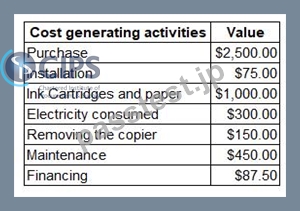
Though cost generating activities are identified, she has not categorised the costs. What is the total value of copier's end of life costs?
- A. $150
- B. $450
- C. $75
- D. $300
正解:A
解説:
Life cycle costing is a key asset management tool that takes into account the whole of life implications of planning, acquiring, operating, maintaining and disposing of an asset.
The process is an evaluation method that considers all ownership and management costs. These include;
- Concept and definition;
- Design and development;
- Manufacturing and installation;
- Maintenance;
- Support services; and
- Retirement, remediation and disposal costs.
End of life costs often comprise of decommissioning, removing and disposal costs. In the copier scenario, the end of life costs equal to removal cost, which is $150.
Reference:
- Life Cycle Cost Guidelines (dlgsc.wa.gov.au)
- CIPS study guide page 36-40
LO 1, AC 1.2
質問 # 73
Which of the following is the technology that disrupts traditional retail?
- A. Robotics
- B. E-commerce
- C. Self-Driving Cars
- D. Blockchain
正解:B
解説:
One of the biggest disruptors in retail has been e-commerce. According to a report by IDC, in the month of December 2018, which is also the holiday season in the west, the e-commerce sector globally, has grown by 20 percent.
LO 2, AC 2.2
質問 # 74
Which of the following activities are considered as primary activities of an organization according to Porter's value chain? Select TWO that apply:
- A. Maintenance
- B. Assembly design
- C. Sourcing transportation services
- D. Picking and delivery components
- E. Trainees recruitment
正解:A、D
解説:
Primary activities consist of inbound logistics, operations, outbound logistics, sales & marketing, service.
Second activities consist of firm infrastructure, human resource management, technology development and procurement The following graph illustrate the value chain (Source: Smartsheet)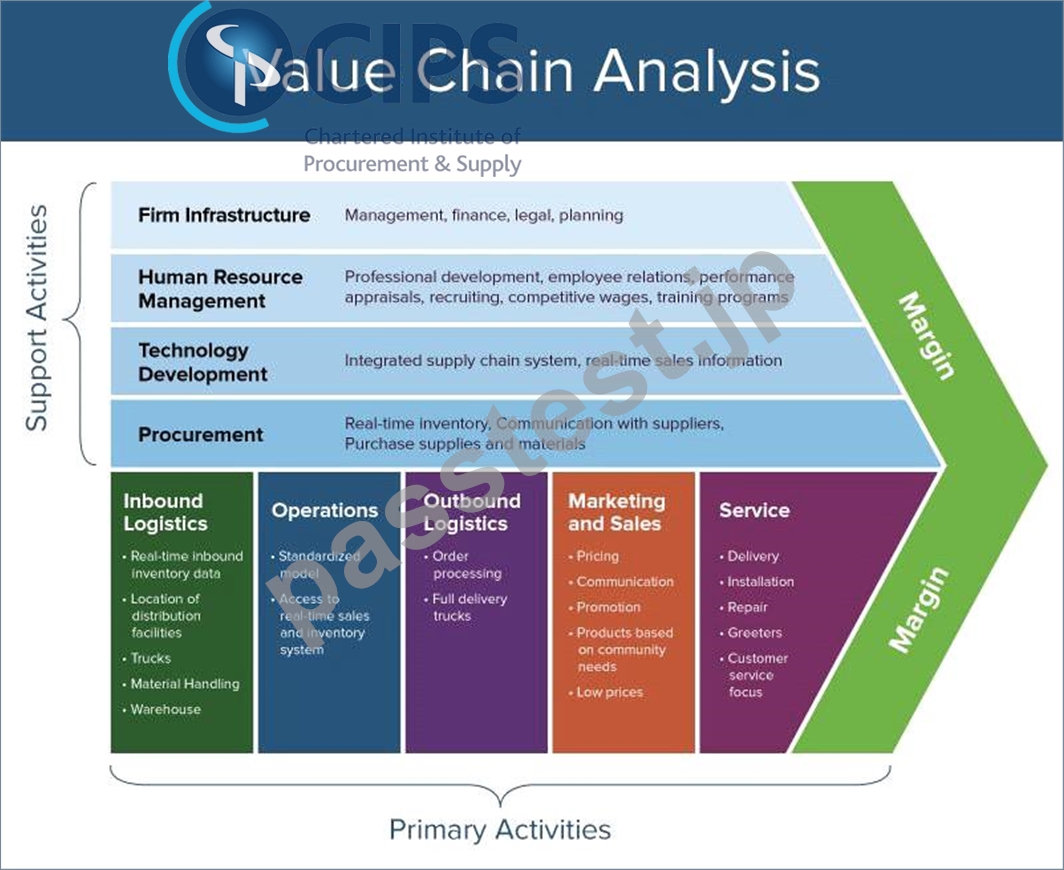
Picking and delivery components is inbound logistics.
Maintenance is an example of operations activity.
Sourcing transportation services is an activity of procurement
Assembly design is an activity in research and development (Technology) Recruiting is an activity of human resource management Reference:
LO 2, AC 2.1
質問 # 75
Product development consists of various stages, including planning and analysis, design develop-ment, pre-production, production and maintenance. At which stages the opportunities for cost re-duction will be the greatest?
1. Planning stage
2. Pre-design stage
3. Detail design stage
4. Production stage
5. Logistics support stage
- A. 1 and 2 only
- B. 2 and 3 only
- C. 1 and 4 only
- D. 2 and 5 only
正解:A
解説:
Writing a specification and then procuring and using the product or service has a number of stages. The further on in the process you are, the less potential there is for cost reductions. Therefore, opportunities for cost reduction will be greatest in the two first stages: planning stage and pre-design stage.
LO 3, AC 3.1
質問 # 76
An IT category buyer wishes to include social and environmental criteria within a supplier specification. The focus is on the avoidance of hardware manufacturing inputs that have been derived from 'conflict minerals', e.
g. from politically unstable areas. Is this the right approach?
- A. Yes, as this means the lowest cost within the market will be achieved
- B. Yes, as this can enhance the reputation of the brand
- C. No, because this will be in breach of competition laws
- D. No, because this will prevent innovation opportunities
正解:B
質問 # 77
Dana is an automobile manufacturer. It has a new electrification strategy that aims at making eco-friendly electric pick-up trucks. To implement this strategy, the procurement department must source new categories of parts that make motors, sensors, solenoids and stators. He starts to analyse the market by identifying specific supply market segments for those parts and finding suppliers who have the best capabilities in those segment. He intends to segment the market based on specific features of the products. Which variable is used by Dana procurement manager to shape and manage supply market?
- A. Geographical segments
- B. Buyer segments
- C. Channel segments
- D. Product segments
正解:D
解説:
In sales and marketing, market segmentation is the process of trying to understand clusters of cus-tomers in terms of their buying behavior and their buying characteristics. There are some traditional segmentation approaches: geography, demography, types of industry and the benefits. Then there are newer segmentation approaches: behavioral, situational, and psychographic.
Procurement professionals can learn market segmentation from sales and marketing. Segmenting the market can help them to shape and manage the supply market effectively. According to Michael Porter, a market can be segment with array of products and buyers.
Text Description automatically generated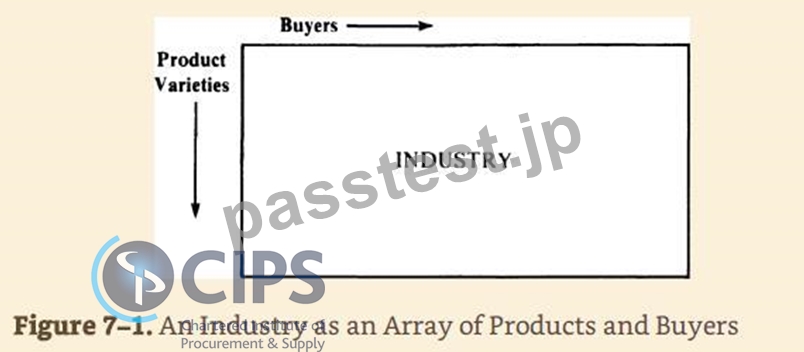
Source: Porter, Michael E.. Competitive Advantage: Creating and Sustaining Superior Performance (p. 234).
Free Press. Kindle Edition.
In the scenario, the products that Dana needs to source is distinct in their features. The best way is to segment the market by product varieties.
質問 # 78
FSB Group is developing a specification for the construction of a new building. The project stakeholders need the specification to set specific criteria to ensure fair labour practices and local employment opportunities are prioritised. Which of the following describes this type of sustainability criteria?
- A. Environmental Sustainability
- B. Economic Sustainability
- C. Social Sustainability
- D. Profit Sustainability
正解:C
解説:
Detailed Explanation:Social sustainability focuses on ethical considerations like fair labour practices, inclusivity, and community development. By addressing these criteria, FSB Group aligns with responsible business practices. Reference: CIPS Level 4, Sustainability in Procurement.
質問 # 79
Warwickshire Ambulance Service (WAS) is an NHS Trust. It operates throughout Warwickshire and the neighbouring areas. It has three core areas of activity, namely the provision of Emergency Ambulance Services, routine Patient Transport Services, and Logistic Medical Services. The agency is working towards higher service level through benchmarking. Which of the following is the benefit of benchmarking to WAS?
- A. It will help WAS analyse the competitors in the industry
- B. It will help WAS create performance standards derived from an analysis of the best in business
- C. It helps WAS identify better ways to deliver service through a cookbook process
- D. Benchmarking is a panacea for all WAS's problems
正解:B
解説:
Benchmarking is 'the pursuit by organisations of enhanced performance by learning from the suc-cessful practices of others. Benchmarking is a continuous activity; key internal processes are adjusted, performance is monitored, new comparisons are made with the current best performers and further changes are explored.
Where information about these key processes is obtained through a co-operative partnership with specific organisations (rather than via a third party such as an independently-maintained database), there is an expectation of mutual benefit over a period of time.
Text Description automatically generated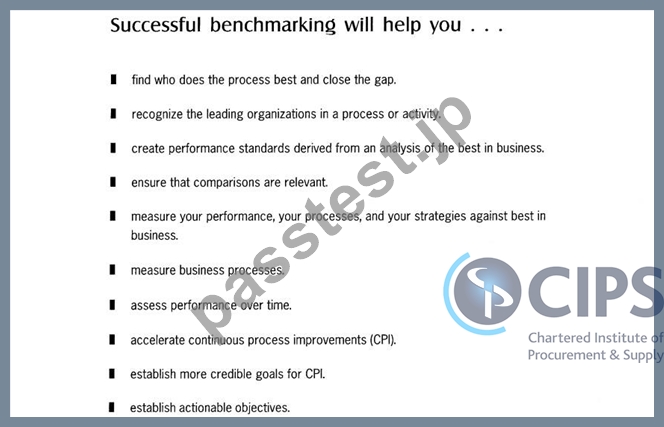
Graphical user interface, text, application, email Description automatically generated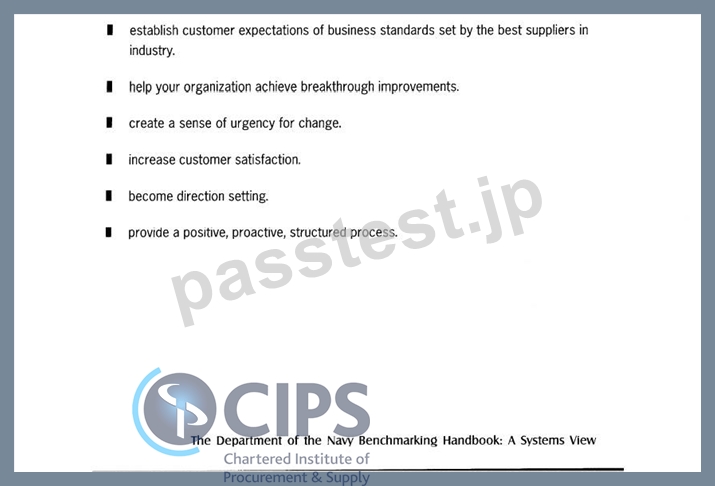
質問 # 80
Facing fiercer competition at home and abroad, IKEA, the leading furniture retailer, needs to im-prove its competitiveness. In order to do this, IKEA must decrease operating costs and improve quality of current and new retail stores. The company establishes a project team. The job of the team is to collect data on performance from multiple stores in several countries, then select the best performing one. The team will work closely with best performing store and study its processes. After the research, the team will recommend best practices to other retail stores. IKEA management can also apply these practices to new stores in the future. Which of the following correctly describe the process undertaken by IKEA project team?
- A. Internal audit
- B. Internal benchmarking
- C. Competitive benchmarking
- D. Site visit
正解:B
解説:
Basically, IKEA project team is undertaking the following process: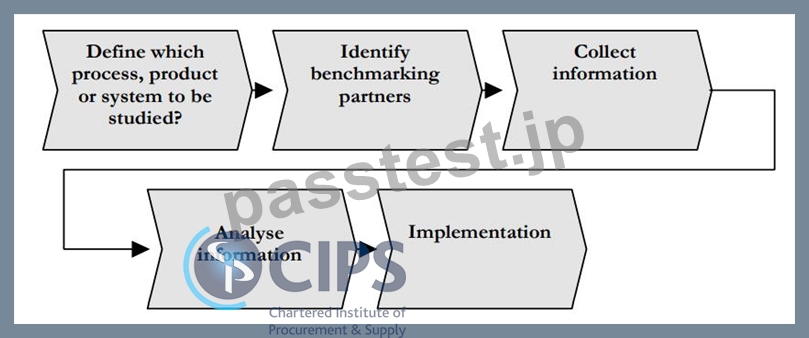
This is a typical benchmarking process. Benchmarking is defined as the process of measuring products, services, and processes against those of organizations known to be leaders in one or more aspects of their operations. Benchmarking provides necessary insights to help you understand how your organization compares with similar organizations, even if they are in a different business or have a different group of customers.
In the scenario, benchmarking process is undertaken within subsidiaries of IKEA, thus it is internal.
Reference:
- CIPS study guide page 49-51
- What is Benchmarking? Technical & Competitive Benchmarking Process | ASQ
- Internal Benchmarking at IKEA
LO 1, AC 1.3
質問 # 81
Why should the buying organisation require the supplier to carry out acceptance testing?
- A. To compare between the account payables and account receivables
- B. To see whether the supplier engages in unethical business practice
- C. To get the approval from the senior management
- D. To check whether the product matches the specification
正解:D
解説:
Acceptance testing, in the context of the engineering and software industries, is a functional trial performed on a product or prototype before it is put on the market or delivered, to decide whether the specifications or contract have been met. It also makes sure the quality and design of the product meet both contractual and regulatory obligations in terms of functionality, usability, durability, and safety.
If a product is found to be unacceptable at this stage, it can be sent back for modification, debug-ging, repair, or re-design before it can become a costly undertaking for the producer, as would be the case in a product recall.
質問 # 82
In 2016, ANA Airlines had to cancel some of its flight. The airline said it had discovered the cracks to the jet engine turbine blades. What should ANA procurement team do next to solve this problem?
- A. Collect data to identify the root cause
- B. Define the ideal solution
- C. Analyse the situation and draw conclusion
- D. Assess the risks
- E. Generate options addressing the issue
正解:A
解説:
Cracks on the jet engine is a closed-end problem. A typical problem solving process has 8 steps:
Step 1: Define the Problem
- What is the problem?
- How did you discover the problem?
- When did the problem start and how long has this problem been going on?
- Is there enough data available to contain the problem and prevent it from getting passed to the next process step? If yes, contain the problem.
Step 2: Clarify the Problem
- What data is available or needed to help clarify, or fully understand the problem?
- Is it a top priority to resolve the problem at this point in time?
- Are additional resources required to clarify the problem? If yes, elevate the problem to your leader to help locate the right resources and form a team.
- Consider a Lean Event (Do-it, Burst, RPI, Project).
- Ensure the problem is contained and does not get passed to the next process step.
Step 3: Define the Goals
- What is your end goal or desired future state?
- What will you accomplish if you fix this problem?
- What is the desired timeline for solving this problem?
Step 4: Identify Root Cause of the Problem
- Identify possible causes of the problem.
- Prioritize possible root causes of the problem.
- What information or data is there to validate the root cause?
Step 5: Develop Action Plan
- Generate a list of actions required to address the root cause and prevent problem from getting to others.
- Assign an owner and timeline to each action.
- Status actions to ensure completion.
Step 6: Execute Action Plan
- Implement action plan to address the root cause.
- Verify actions are completed.
Step 7: Evaluate the Results
- Monitor and Collect Data.
- Did you meet your goals defined in step 3? If not, repeate th 8-Step Process.
- Were there any unforeseen consequences?
- If problem is resolved, remove activities that were added previously to contain the problem.
Step 8: Continuously Improve
- Look for additional opportunities to implement solution.
- Ensure problem will not come back and communicate lessons learned.
- If needed, repeat the 8-Step Problem Solving Process to drive further improvements.
ANA has already known what is going on, the next step they should adopt is collecting more infor-mation on the problem. If the airline is hurry to the solution, it may choose 'Generate options ad-dressing the issue'. The crack on turbine blade can be welded, or the airline replaces a new blade. However, jumping to solution without knowing the root cause does not completely solve the prob-lem. The root cause is unaddressed, then it may occur in the future. Therefore, the airline should still collect information to find the root cause, then remove it.
質問 # 83
Royal Navy is preparing a through-life contract. They put to the contract a term on rectification of operational defects and planning and delivery of Fleet Time Support Periods. Which part of through-life requirement does this term belong to?
- A. Manufacture
- B. In-service support
- C. Installation
- D. Customer support
正解:B
解説:
There are 6 main components of the through-life requirements of an asset: Design, Manufacture, Installation, In-service support, Decommission and disposal and Customer support.
Rectification of operational defects and planning and delivery of Fleet Time Support Periods are maintenance activities which belong to in-service support. You may have chosen Customer support. However, in through- life asset management context, customer support does not include maintenance services. Instead, it is the services that go along the stages of asset life. It may include consulting, communication and information exchange.
Diagram, table Description automatically generated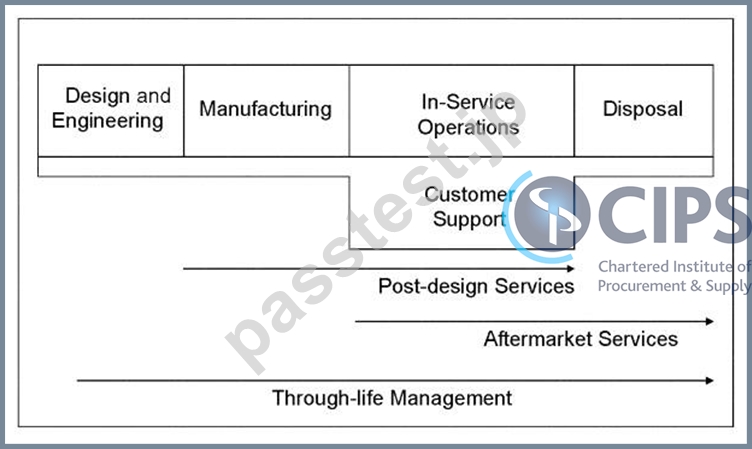
Source: Andrew Graves
質問 # 84
What is the contribution of marketing function to the development of specification?
- A. Marketing ensures that procurement function doesn't involve in developing specification
- B. Marketing consults on technical requirements of the product
- C. Marketing ensures that conformance specification will never be used
- D. Marketing provides ideas on customer's taste and market trends
正解:D
解説:
Marketing plays a critical role in sales. The marketing department introduces products to the con-sumer, and creates strategic messaging that elevates appeal and ultimately drives sales. The feed-back and response from consumers is measured by the marketing team on a variety of levels. Ad-vertising is one means of seeing what performs and what does not perform. Marketers will note trends and demand in their specific markets. This plays into new product development, because the marketing team can work with product developers to create products based on that demand.
In development of specification, the role of marketing is largely the same. They provide the market insight so that right specification is developed and it matches the demands from customers.
Reference:
- CIPS study guide page 173-175
- Role of Marketing Management in New Product Development (chron.com)
LO 3, AC 3.4
質問 # 85
......
CIPS L4M2試験は、調達戦略の開発、市場分析、ステークホルダー管理、リスク管理、契約管理など、幅広いトピックを扱います。これは、候補者が調達プロセスに深い理解を持ち、この知識を実世界のシナリオに適用できる能力を持っていることを要求する包括的な試験です。この試験に合格することは、候補者が組織のビジネスニーズに合わせた効果的な調達戦略を開発するために必要な知識とスキルを持っていることを示します。
CIPS L4M2(ビジネスニーズの定義)認定試験は、ビジネス分析またはプロジェクト管理のキャリアに関心のある個人の知識とスキルをテストするために設計された専門的な認定プログラムです。この認定試験は、調達、サプライチェーン管理、および関連分野で働く個人に専門能力開発とトレーニングを提供するグローバルな組織であるチャーターされた調達供給研究所(CIPS)の一部です。
ベストCIPS L4M2学習ガイドと問題集は2025年に更新されました:https://www.passtest.jp/CIPS/L4M2-shiken.html
L4M2認定お試しPDF最新L4M2問題集:https://drive.google.com/open?id=1hcL5sbDMij7VTeoRk8nYSY2XHbji0JRH