

無料Databricks-Generative-AI-Engineer-Associate試験ブレーン問題集認定ガイド問題と解答
Databricks-Generative-AI-Engineer-Associate認定概要最新のDatabricks-Generative-AI-Engineer-AssociatePDF問題集
質問 # 11
A Generative Al Engineer is tasked with developing an application that is based on an open source large language model (LLM). They need a foundation LLM with a large context window.
Which model fits this need?
- A. DistilBERT
- B. Llama2-70B
- C. MPT-30B
- D. DBRX
正解:B
解説:
* Problem Context: The engineer needs an open-source LLM with a large context window to develop an application.
* Explanation of Options:
* Option A: DistilBERT: While an efficient and smaller version of BERT, DistilBERT does not provide a particularly large context window.
* Option B: MPT-30B: This model, while large, is not specified as being particularly notable for its context window capabilities.
* Option C: Llama2-70B: Known for its large model size and extensive capabilities, including a large context window. It is also available as an open-source model, making it ideal for applications requiring extensive contextual understanding.
* Option D: DBRX: This is not a recognized standard model in the context of large language models with extensive context windows.
Thus,Option C(Llama2-70B) is the best fit as it meets the criteria of having a large context window and being available for open-source use, suitable for developing robust language understanding applications.
質問 # 12
A Generative Al Engineer has created a RAG application to look up answers to questions about a series of fantasy novels that are being asked on the author's web forum. The fantasy novel texts are chunked and embedded into a vector store with metadata (page number, chapter number, book title), retrieved with the user' s query, and provided to an LLM for response generation. The Generative AI Engineer used their intuition to pick the chunking strategy and associated configurations but now wants to more methodically choose the best values.
Which TWO strategies should the Generative AI Engineer take to optimize their chunking strategy and parameters? (Choose two.)
- A. Add a classifier for user queries that predicts which book will best contain the answer. Use this to filter retrieval.
- B. Choose an appropriate evaluation metric (such as recall or NDCG) and experiment with changes in the chunking strategy, such as splitting chunks by paragraphs or chapters.
Choose the strategy that gives the best performance metric. - C. Create an LLM-as-a-judge metric to evaluate how well previous questions are answered by the most appropriate chunk. Optimize the chunking parameters based upon the values of the metric.
- D. Change embedding models and compare performance.
- E. Pass known questions and best answers to an LLM and instruct the LLM to provide the best token count. Use a summary statistic (mean, median, etc.) of the best token counts to choose chunk size.
正解:B、C
解説:
To optimize a chunking strategy for a Retrieval-Augmented Generation (RAG) application, the Generative AI Engineer needs a structured approach to evaluating the chunking strategy, ensuring that the chosen configuration retrieves the most relevant information and leads to accurate and coherent LLM responses.
Here's whyCandEare the correct strategies:
Strategy C: Evaluation Metrics (Recall, NDCG)
* Define an evaluation metric: Common evaluation metrics such as recall, precision, or NDCG (Normalized Discounted Cumulative Gain) measure how well the retrieved chunks match the user's query and the expected response.
* Recallmeasures the proportion of relevant information retrieved.
* NDCGis often used when you want to account for both the relevance of retrieved chunks and the ranking or order in which they are retrieved.
* Experiment with chunking strategies: Adjusting chunking strategies based on text structure (e.g., splitting by paragraph, chapter, or a fixed number of tokens) allows the engineer to experiment with various ways of slicing the text. Some chunks may better align with the user's query than others.
* Evaluate performance: By using recall or NDCG, the engineer can methodically test various chunking strategies to identify which one yields the highest performance. This ensures that the chunking method provides the most relevant information when embedding and retrieving data from the vector store.
Strategy E: LLM-as-a-Judge Metric
* Use the LLM as an evaluator: After retrieving chunks, the LLM can be used to evaluate the quality of answers based on the chunks provided. This could be framed as a "judge" function, where the LLM compares how well a given chunk answers previous user queries.
* Optimize based on the LLM's judgment: By having the LLM assess previous answers and rate their relevance and accuracy, the engineer can collect feedback on how well different chunking configurations perform in real-world scenarios.
* This metric could be a qualitative judgment on how closely the retrieved information matches the user's intent.
* Tune chunking parameters: Based on the LLM's judgment, the engineer can adjust the chunk size or structure to better align with the LLM's responses, optimizing retrieval for future queries.
By combining these two approaches, the engineer ensures that the chunking strategy is systematically evaluated using both quantitative (recall/NDCG) and qualitative (LLM judgment) methods. This balanced optimization process results in improved retrieval relevance and, consequently, better response generation by the LLM.
質問 # 13
A Generative Al Engineer is tasked with developing a RAG application that will help a small internal group of experts at their company answer specific questions, augmented by an internal knowledge base. They want the best possible quality in the answers, and neither latency nor throughput is a huge concern given that the user group is small and they're willing to wait for the best answer. The topics are sensitive in nature and the data is highly confidential and so, due to regulatory requirements, none of the information is allowed to be transmitted to third parties.
Which model meets all the Generative Al Engineer's needs in this situation?
- A. Dolly 1.5B
- B. Llama2-70B
- C. BGE-large
- D. OpenAI GPT-4
正解:C
解説:
Problem Context: The Generative AI Engineer needs a model for a Retrieval-Augmented Generation (RAG) application that provides high-quality answers, where latency and throughput are not major concerns. The key factors areconfidentialityandsensitivityof the data, as well as the requirement for all processing to be confined to internal resources without external data transmission.
Explanation of Options:
* Option A: Dolly 1.5B: This model does not typically support RAG applications as it's more focused on image generation tasks.
* Option B: OpenAI GPT-4: While GPT-4 is powerful for generating responses, its standard deployment involves cloud-based processing, which could violate the confidentiality requirements due to external data transmission.
* Option C: BGE-large: The BGE (Big Green Engine) large model is a suitable choice if it is configured to operate on-premises or within a secure internal environment that meets regulatory requirements.
Assuming this setup, BGE-large can provide high-quality answers while ensuring that data is not transmitted to third parties, thus aligning with the project's sensitivity and confidentiality needs.
* Option D: Llama2-70B: Similar to GPT-4, unless specifically set up for on-premises use, it generally relies on cloud-based services, which might risk confidential data exposure.
Given the sensitivity and confidentiality concerns,BGE-largeis assumed to be configurable for secure internal use, making it the optimal choice for this scenario.
質問 # 14
A Generative AI Engineer is creating an LLM-powered application that will need access to up-to-date news articles and stock prices.
The design requires the use of stock prices which are stored in Delta tables and finding the latest relevant news articles by searching the internet.
How should the Generative AI Engineer architect their LLM system?
- A. Use an LLM to summarize the latest news articles and lookup stock tickers from the summaries to find stock prices.
- B. Create an agent with tools for SQL querying of Delta tables and web searching, provide retrieved values to an LLM for generation of response.
- C. Download and store news articles and stock price information in a vector store. Use a RAG architecture to retrieve and generate at runtime.
- D. Query the Delta table for volatile stock prices and use an LLM to generate a search query to investigate potential causes of the stock volatility.
正解:B
解説:
To build an LLM-powered system that accesses up-to-date news articles and stock prices, the best approach is tocreate an agentthat has access to specific tools (option D).
* Agent with SQL and Web Search Capabilities:By using an agent-based architecture, the LLM can interact with external tools. The agent can query Delta tables (for up-to-date stock prices) via SQL and perform web searches to retrieve the latest news articles. This modular approach ensures the system can access both structured (stock prices) and unstructured (news) data sources dynamically.
* Why This Approach Works:
* SQL Queries for Stock Prices: Delta tables store stock prices, which the agent can query directly for the latest data.
* Web Search for News: For news articles, the agent can generate search queries and retrieve the most relevant and recent articles, then pass them to the LLM for processing.
* Why Other Options Are Less Suitable:
* A (Summarizing News for Stock Prices): This convoluted approach would not ensure accuracy when retrieving stock prices, which are already structured and stored in Delta tables.
* B (Stock Price Volatility Queries): While this could retrieve relevant information, it doesn't address how to obtain the most up-to-date news articles.
* C (Vector Store): Storing news articles and stock prices in a vector store might not capture the real-time nature of stock data and news updates, as it relies on pre-existing data rather than dynamic querying.
Thus, using an agent with access to both SQL for querying stock prices and web search for retrieving news articles is the best approach for ensuring up-to-date and accurate responses.
質問 # 15
A Generative AI Engineer is developing an LLM application that users can use to generate personalized birthday poems based on their names.
Which technique would be most effective in safeguarding the application, given the potential for malicious user inputs?
- A. Increase the amount of compute that powers the LLM to process input faster
- B. Ask the LLM to remind the user that the input is malicious but continue the conversation with the user
- C. Implement a safety filter that detects any harmful inputs and ask the LLM to respond that it is unable to assist
- D. Reduce the time that the users can interact with the LLM
正解:C
解説:
In this case, the Generative AI Engineer is developing an application to generate personalized birthday poems, but there's a need to safeguard againstmalicious user inputs. The best solution is to implement asafety filter (option A) to detect harmful or inappropriate inputs.
* Safety Filter Implementation:Safety filters are essential for screening user input and preventing inappropriate content from being processed by the LLM. These filters can scan inputs for harmful language, offensive terms, or malicious content and intervene before the prompt is passed to the LLM.
* Graceful Handling of Harmful Inputs:Once the safety filter detects harmful content, the system can provide a message to the user, such as "I'm unable to assist with this request," instead of processing or responding to malicious input. This protects the system from generating harmful content and ensures a controlled interaction environment.
* Why Other Options Are Less Suitable:
* B (Reduce Interaction Time): Reducing the interaction time won't prevent malicious inputs from being entered.
* C (Continue the Conversation): While it's possible to acknowledge malicious input, it is not safe to continue the conversation with harmful content. This could lead to legal or reputational risks.
* D (Increase Compute Power): Adding more compute doesn't address the issue of harmful content and would only speed up processing without resolving safety concerns.
Therefore, implementing asafety filterthat blocks harmful inputs is the most effective technique for safeguarding the application.
質問 # 16
A Generative Al Engineer has successfully ingested unstructured documents and chunked them by document sections. They would like to store the chunks in a Vector Search index. The current format of the dataframe has two columns: (i) original document file name (ii) an array of text chunks for each document.
What is the most performant way to store this dataframe?
- A. Split the data into train and test set, create a unique identifier for each document, then save to a Delta table
- B. Store each chunk as an independent JSON file in Unity Catalog Volume. For each JSON file, the key is the document section name and the value is the array of text chunks for that section
- C. Flatten the dataframe to one chunk per row, create a unique identifier for each row, and save to a Delta table
- D. First create a unique identifier for each document, then save to a Delta table
正解:C
解説:
* Problem Context: The engineer needs an efficient way to store chunks of unstructured documents to facilitate easy retrieval and search. The current dataframe consists of document filenames and associated text chunks.
* Explanation of Options:
* Option A: Splitting into train and test sets is more relevant for model training scenarios and not directly applicable to storage for retrieval in a Vector Search index.
* Option B: Flattening the dataframe such that each row contains a single chunk with a unique identifier is the most performant for storage and retrieval. This structure aligns well with how data is indexed and queried in vector search applications, making it easier to retrieve specific chunks efficiently.
* Option C: Creating a unique identifier for each document only does not address the need to access individual chunks efficiently, which is critical in a Vector Search application.
* Option D: Storing each chunk as an independent JSON file creates unnecessary overhead and complexity in managing and querying large volumes of files.
OptionBis the most efficient and practical approach, allowing for streamlined indexing and retrieval processes in a Delta table environment, fitting the requirements of a Vector Search index.
質問 # 17
A Generative Al Engineer interfaces with an LLM with prompt/response behavior that has been trained on customer calls inquiring about product availability. The LLM is designed to output "In Stock" if the product is available or only the term "Out of Stock" if not.
Which prompt will work to allow the engineer to respond to call classification labels correctly?
- A. You will be given a customer call transcript where the customer asks about product availability. The outputs are either "In Stock" or "Out of Stock". Format the output in JSON, for example: {"call_id":
"123", "label": "In Stock"}. - B. You will be given a customer call transcript where the customer inquires about product availability.Respond with "In Stock" if the product is available or "Out of Stock" if not.
- C. Respond with "In Stock" if the customer asks for a product.
- D. Respond with "Out of Stock" if the customer asks for a product.
正解:A
解説:
* Problem Context: The Generative AI Engineer needs a prompt that will enable an LLM trained on customer call transcripts to classify and respond correctly regarding product availability. The desired response should clearly indicate whether a product is "In Stock" or "Out of Stock," and it should be formatted in a way that is structured and easy to parse programmatically, such as JSON.
* Explanation of Options:
* Option A: Respond with "In Stock" if the customer asks for a product. This prompt is too generic and does not specify how to handle the case when a product is not available, nor does it provide a structured output format.
* Option B: This option is correctly formatted and explicit. It instructs the LLM to respond based on the availability mentioned in the customer call transcript and to format the response in JSON.
This structure allows for easy integration into systems that may need to process this information automatically, such as customer service dashboards or databases.
* Option C: Respond with "Out of Stock" if the customer asks for a product. Like option A, this prompt is also insufficient as it only covers the scenario where a product is unavailable and does not provide a structured output.
* Option D: While this prompt correctly specifies how to respond based on product availability, it lacks the structured output format, making it less suitable for systems that require formatted data for further processing.
Given the requirements for clear, programmatically usable outputs,Option Bis the optimal choice because it provides precise instructions on how to respond and includes a JSON format example for structuring the output, which is ideal for automated systems or further data handling.
質問 # 18
A Generative AI Engineer wants to build an LLM-based solution to help a restaurant improve its online customer experience with bookings by automatically handling common customer inquiries. The goal of the solution is to minimize escalations to human intervention and phone calls while maintaining a personalized interaction. To design the solution, the Generative AI Engineer needs to define the input data to the LLM and the task it should perform.
Which input/output pair will support their goal?
- A. Input: Customer reviews; Output: Classify review sentiment
- B. Input: Online chat logs; Output: Group the chat logs by users, followed by summarizing each user's interactions
- C. Input: Online chat logs; Output: Buttons that represent choices for booking details
- D. Input: Online chat logs; Output: Cancellation options
正解:C
解説:
Context: The goal is to improve the online customer experience in a restaurant by handling common inquiries about bookings, minimizing escalations, and maintaining personalized interactions.
Explanation of Options:
* Option A: Grouping and summarizing chat logs by user could provide insights into customer interactions but does not directly address the task of handling booking inquiries or minimizing escalations.
* Option B: Using chat logs to generate interactive buttons for booking details directly supports the goal of facilitating online bookings, minimizing the need for human intervention by providing clear, interactive options for customers to self-serve.
* Option C: Classifying sentiment of customer reviews does not directly help with booking inquiries, although it might provide valuable feedback insights.
* Option D: Providing cancellation options is helpful but narrowly focuses on one aspect of the booking process and doesn't support the broader goal of handling common inquiries about bookings.
Option Bbest supports the goal of improving online interactions by using chat logs to generate actionable items for customers, helping them complete booking tasks efficiently and reducing the need for human intervention.
質問 # 19
What is an effective method to preprocess prompts using custom code before sending them to an LLM?
- A. Write a MLflow PyFunc model that has a separate function to process the prompts
- B. Rather than preprocessing prompts, it's more effective to postprocess the LLM outputs to align the outputs to desired outcomes
- C. Directly modify the LLM's internal architecture to include preprocessing steps
- D. It is better not to introduce custom code to preprocess prompts as the LLM has not been trained with examples of the preprocessed prompts
正解:A
解説:
The most effective way to preprocess prompts using custom code is to write a custom model, such as an MLflow PyFunc model. Here's a breakdown of why this is the correct approach:
* MLflow PyFunc Models:MLflow is a widely used platform for managing the machine learning lifecycle, including experimentation, reproducibility, and deployment. APyFuncmodel is a generic Python function model that can implement custom logic, which includes preprocessing prompts.
* Preprocessing Prompts:Preprocessing could include various tasks like cleaning up the user input, formatting it according to specific rules, or augmenting it with additional context before passing it to the LLM. Writing this preprocessing as part of a PyFunc model allows the custom code to be managed, tested, and deployed easily.
* Modular and Reusable:By separating the preprocessing logic into a PyFunc model, the system becomes modular, making it easier to maintain and update without needing to modify the core LLM or retrain it.
* Why Other Options Are Less Suitable:
* A (Modify LLM's Internal Architecture): Directly modifying the LLM's architecture is highly impractical and can disrupt the model's performance. LLMs are typically treated as black-box models for tasks like prompt processing.
* B (Avoid Custom Code): While it's true that LLMs haven't been explicitly trained with preprocessed prompts, preprocessing can still improve clarity and alignment with desired input formats without confusing the model.
* C (Postprocessing Outputs): While postprocessing the output can be useful, it doesn't address the need for clean and well-formatted inputs, which directly affect the quality of the model's responses.
Thus, using an MLflow PyFunc model allows for flexible and controlled preprocessing of prompts in a scalable way, making it the most effective method.
質問 # 20
A Generative AI Engineer I using the code below to test setting up a vector store: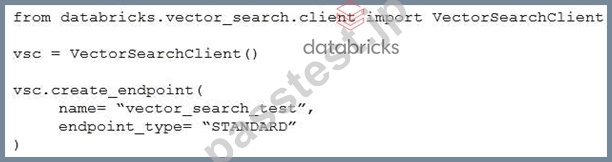
Assuming they intend to use Databricks managed embeddings with the default embedding model, what should be the next logical function call?
- A. vsc.create_delta_sync_index()
- B. vsc.get_index()
- C. vsc.similarity_search()
- D. vsc.create_direct_access_index()
正解:A
解説:
Context: The Generative AI Engineer is setting up a vector store using Databricks' VectorSearchClient. This is typically done to enable fast and efficient retrieval of vectorized data for tasks like similarity searches.
Explanation of Options:
* Option A: vsc.get_index(): This function would be used to retrieve an existing index, not create one, so it would not be the logical next step immediately after creating an endpoint.
* Option B: vsc.create_delta_sync_index(): After setting up a vector store endpoint, creating an index is necessary to start populating and organizing the data. The create_delta_sync_index() function specifically creates an index that synchronizes with a Delta table, allowing automatic updates as the data changes. This is likely the most appropriate choice if the engineer plans to use dynamic data that is updated over time.
* Option C: vsc.create_direct_access_index(): This function would create an index that directly accesses the data without synchronization. While also a valid approach, it's less likely to be the next logical step if the default setup (typically accommodating changes) is intended.
* Option D: vsc.similarity_search(): This function would be used to perform searches on an existing index; however, an index needs to be created and populated with data before any search can be conducted.
Given the typical workflow in setting up a vector store, the next step after creating an endpoint is to establish an index, particularly one that synchronizes with ongoing data updates, henceOption B.
質問 # 21
A Generative AI Engineer is designing an LLM-powered live sports commentary platform. The platform provides real-time updates and LLM-generated analyses for any users who would like to have live summaries, rather than reading a series of potentially outdated news articles.
Which tool below will give the platform access to real-time data for generating game analyses based on the latest game scores?
- A. Feature Serving
- B. AutoML
- C. Foundation Model APIs
- D. DatabrickslQ
正解:A
解説:
* Problem Context: The engineer is developing an LLM-powered live sports commentary platform that needs to provide real-time updates and analyses based on the latest game scores. The critical requirement here is the capability to access and integrate real-time data efficiently with the platform for immediate analysis and reporting.
* Explanation of Options:
* Option A: DatabricksIQ: While DatabricksIQ offers integration and data processing capabilities, it is more aligned with data analytics rather than real-time feature serving, which is crucial for immediate updates necessary in a live sports commentary context.
* Option B: Foundation Model APIs: These APIs facilitate interactions with pre-trained models and could be part of the solution, but on their own, they do not provide mechanisms to access real- time game scores.
* Option C: Feature Serving: This is the correct answer as feature serving specifically refers to the real-time provision of data (features) to models for prediction. This would be essential for an LLM that generates analyses based on live game data, ensuring that the commentary is current and based on the latest events in the sport.
* Option D: AutoML: This tool automates the process of applying machine learning models to real-world problems, but it does not directly provide real-time data access, which is a critical requirement for the platform.
Thus,Option C(Feature Serving) is the most suitable tool for the platform as it directly supports the real-time data needs of an LLM-powered sports commentary system, ensuring that the analyses and updates are based on the latest available information.
質問 # 22
When developing an LLM application, it's crucial to ensure that the data used for training the model complies with licensing requirements to avoid legal risks.
Which action is NOT appropriate to avoid legal risks?
- A. Only use data explicitly labeled with an open license and ensure the license terms are followed.
- B. Reach out to the data curators directly before you have started using the trained model to let them know.
- C. Use any available data you personally created which is completely original and you can decide what license to use.
- D. Reach out to the data curators directly after you have started using the trained model to let them know.
正解:D
解説:
* Problem Context: When using data to train a model, it's essential to ensure compliance with licensing to avoid legal risks. Legal issues can arise from using data without permission, especially when it comes from third-party sources.
* Explanation of Options:
* Option A: Reaching out to data curatorsbeforeusing the data is an appropriate action. This allows you to ensure you have permission or understand the licensing terms before starting to use the data in your model.
* Option B: Usingoriginal datathat you personally created is always a safe option. Since you have full ownership over the data, there are no legal risks, as you control the licensing.
* Option C: Using data that is explicitly labeled with an open license and adhering to the license terms is a correct and recommended approach. This ensures compliance with legal requirements.
* Option D: Reaching out to the data curatorsafteryou have already started using the trained model isnot appropriate. If you've already used the data without understanding its licensing terms, you may have already violated the terms of use, which could lead to legal complications. It's essential to clarify the licensing termsbeforeusing the data, not after.
Thus,Option Dis not appropriate because it could expose you to legal risks by using the data without first obtaining the proper licensing permissions.
質問 # 23
A Generative AI Engineer has been asked to build an LLM-based question-answering application. The application should take into account new documents that are frequently published. The engineer wants to build this application with the least cost and least development effort and have it operate at the lowest cost possible.
Which combination of chaining components and configuration meets these requirements?
- A. The LLM needs to be frequently with the new documents in order to provide most up-to-date answers.
- B. For the application a prompt, an agent and a fine-tuned LLM are required. The agent is used by the LLM to retrieve relevant content that is inserted into the prompt which is given to the LLM to generate answers.
- C. For the application a prompt, a retriever, and an LLM are required. The retriever output is inserted into the prompt which is given to the LLM to generate answers.
- D. For the question-answering application, prompt engineering and an LLM are required to generate answers.
正解:C
解説:
Problem Context: The task is to build an LLM-based question-answering application that integrates new documents frequently with minimal costs and development efforts.
Explanation of Options:
* Option A: Utilizes a prompt and a retriever, with the retriever output being fed into the LLM. This setup is efficient because it dynamically updates the data pool via the retriever, allowing the LLM to provide up-to-date answers based on the latest documents without needing tofrequently retrain the model. This method offers a balance of cost-effectiveness and functionality.
* Option B: Requires frequent retraining of the LLM, which is costly and labor-intensive.
* Option C: Only involves prompt engineering and an LLM, which may not adequately handle the requirement for incorporating new documents unless it's part of an ongoing retraining or updating mechanism, which would increase costs.
* Option D: Involves an agent and a fine-tuned LLM, which could be overkill and lead to higher development and operational costs.
Option Ais the most suitable as it provides a cost-effective, minimal development approach while ensuring the application remains up-to-date with new information.
質問 # 24
A small and cost-conscious startup in the cancer research field wants to build a RAG application using Foundation Model APIs.
Which strategy would allow the startup to build a good-quality RAG application while being cost-conscious and able to cater to customer needs?
- A. Limit the number of relevant documents available for the RAG application to retrieve from
- B. Pick a smaller LLM that is domain-specific
- C. Limit the number of queries a customer can send per day
- D. Use the largest LLM possible because that gives the best performance for any general queries
正解:B
解説:
For a small, cost-conscious startup in the cancer research field, choosing a domain-specific and smaller LLM is the most effective strategy. Here's whyBis the best choice:
* Domain-specific performance: A smaller LLM that has been fine-tuned for the domain of cancer research will outperform a general-purpose LLM for specialized queries. This ensures high-quality responses without needing to rely on a large, expensive LLM.
* Cost-efficiency: Smaller models are cheaper to run, both in terms of compute resources and API usage costs. A domain-specific smaller LLM can deliver good quality responses without the need for the extensive computational power required by larger models.
* Focused knowledge: In a specialized field like cancer research, having an LLM tailored to the subject matter provides better relevance and accuracy for queries, while keeping costs low.Large, general- purpose LLMs may provide irrelevant information, leading to inefficiency and higher costs.
This approach allows the startup to balance quality, cost, and customer satisfaction effectively, making it the most suitable strategy.
質問 # 25
A Generative AI Engineer is building an LLM to generate article summaries in the form of a type of poem, such as a haiku, given the article content. However, the initial output from the LLM does not match the desired tone or style.
Which approach will NOT improve the LLM's response to achieve the desired response?
- A. Include few-shot examples in the prompt to the LLM
- B. Provide the LLM with a prompt that explicitly instructs it to generate text in the desired tone and style
- C. Use a neutralizer to normalize the tone and style of the underlying documents
- D. Fine-tune the LLM on a dataset of desired tone and style
正解:C
解説:
The task at hand is to improve the LLM's ability to generate poem-like article summaries with the desired tone and style. Using aneutralizerto normalize the tone and style of the underlying documents (option B) will not help improve the LLM's ability to generate the desired poetic style. Here's why:
* Neutralizing Underlying Documents:A neutralizer aims to reduce or standardize the tone of input data. However, this contradicts the goal, which is to generate text with aspecific tone and style(like haikus). Neutralizing the source documents will strip away the richness of the content, making it harder for the LLM to generate creative, stylistic outputs like poems.
* Why Other Options Improve Results:
* A (Explicit Instructions in the Prompt): Directly instructing the LLM to generate text in a specific tone and style helps align the output with the desired format (e.g., haikus). This is a common and effective technique in prompt engineering.
* C (Few-shot Examples): Providing examples of the desired output format helps the LLM understand the expected tone and structure, making it easier to generate similar outputs.
* D (Fine-tuning the LLM): Fine-tuning the model on a dataset that contains examples of the desired tone and style is a powerful way to improve the model's ability to generate outputs that match the target format.
Therefore, using a neutralizer (option B) isnotan effective method for achieving the goal of generating stylized poetic summaries.
質問 # 26
Generative AI Engineer at an electronics company just deployed a RAG application for customers to ask questions about products that the company carries. However, they received feedback that the RAG response often returns information about an irrelevant product.
What can the engineer do to improve the relevance of the RAG's response?
- A. Use a different semantic similarity search algorithm
- B. Use a different LLM to improve the generated response
- C. Assess the quality of the retrieved context
- D. Implement caching for frequently asked questions
正解:C
解説:
In a Retrieval-Augmented Generation (RAG) system, the key to providing relevant responses lies in the quality of the retrieved context. Here's why option A is the most appropriate solution:
* Context Relevance:The RAG model generates answers based on retrieved documents or context. If the retrieved information is about an irrelevant product, it suggests that the retrieval step is failing to select the right context. The Generative AI Engineer must first assess the quality of what is being retrieved and ensure it is pertinent to the query.
* Vector Search and Embedding Similarity:RAG typically uses vector search for retrieval, where embeddings of the query are matched against embeddings of product descriptions. Assessing the semantic similarity searchprocess ensures that the closest matches are actually relevant to the query.
* Fine-tuning the Retrieval Process:By improving theretrieval quality, such as tuning the embeddings or adjusting the retrieval strategy, the system can return more accurate and relevant product information.
* Why Other Options Are Less Suitable:
* B (Caching FAQs): Caching can speed up responses for frequently asked questions but won't improve the relevance of the retrieved content for less frequent or new queries.
* C (Use a Different LLM): Changing the LLM only affects the generation step, not the retrieval process, which is the core issue here.
* D (Different Semantic Search Algorithm): This could help, but the first step is to evaluate the current retrieval context before replacing the search algorithm.
Therefore, improving and assessing the quality of the retrieved context (option A) is the first step to fixing the issue of irrelevant product information.
質問 # 27
A team wants to serve a code generation model as an assistant for their software developers. It should support multiple programming languages. Quality is the primary objective.
Which of the Databricks Foundation Model APIs, or models available in the Marketplace, would be the best fit?
- A. BGE-large
- B. CodeLlama-34B
- C. MPT-7b
- D. Llama2-70b
正解:B
解説:
For a code generation model that supports multiple programming languages and where quality is the primary objective,CodeLlama-34Bis the most suitable choice. Here's the reasoning:
* Specialization in Code Generation:CodeLlama-34B is specifically designed for code generation tasks.
This model has been trained with a focus on understanding and generating code, which makes it particularly adept at handling various programming languages and coding contexts.
* Capacity and Performance:The "34B" indicates a model size of 34 billion parameters, suggesting a high capacity for handling complex tasks and generating high-quality outputs. The large model size typically correlates with better understanding and generation capabilities in diverse scenarios.
* Suitability for Development Teams:Given that the model is optimized for code, it will be able to assist software developers more effectively than general-purpose models. It understands coding syntax, semantics, and the nuances of different programming languages.
* Why Other Options Are Less Suitable:
* A (Llama2-70b): While also a large model, it's more general-purpose and may not be as fine- tuned for code generation as CodeLlama.
* B (BGE-large): This model may not specifically focus on code generation.
* C (MPT-7b): Smaller than CodeLlama-34B and likely less capable in handling complex code generation tasks at high quality.
Therefore, for a high-quality, multi-language code generation application,CodeLlama-34B(option D) is the best fit.
質問 # 28
Which indicator should be considered to evaluate the safety of the LLM outputs when qualitatively assessing LLM responses for a translation use case?
- A. The similarity to the previous language
- B. The latency of the response and the length of text generated
- C. The ability to generate responses in code
- D. The accuracy and relevance of the responses
正解:D
解説:
* Problem Context: When assessing the safety and effectiveness of LLM outputs in a translation use case, it is essential to ensure that the translations accurately and relevantly convey the intended message. The evaluation should focus on how well the LLM understands and processes different languages and contexts.
* Explanation of Options:
* Option A: The ability to generate responses in code- This is not relevant to translation quality or safety.
* Option B: The similarity to the previous language- While ensuring that translations preserve the original's intent is important, this doesn't directly address the overall quality or safety of the translation.
* Option C: The latency of the response and the length of text generated- These operational metrics are less critical in assessing the qualitative aspects of translation safety.
* Option D: The accuracy and relevance of the responses- This is crucial in translation to ensure that the translated content is true to the original in meaning and appropriateness. Accuracy and relevance directly impact the effectiveness and safety of translations, especially in sensitive or nuanced contexts.
Thus,Option Dis the most important indicator when evaluating the safety of LLM outputs in translation, focusing on the core aspects that determine the utility and trustworthiness of translated content.
質問 # 29
A Generative AI Engineer is building a Generative AI system that suggests the best matched employee team member to newly scoped projects. The team member is selected from a very large team. Thematch should be based upon project date availability and how well their employee profile matches the project scope. Both the employee profile and project scope are unstructured text.
How should the Generative Al Engineer architect their system?
- A. Create a tool for finding available team members given project dates. Embed all project scopes into a vector store, perform a retrieval using team member profiles to find the best team member.
- B. Create a tool for finding team member availability given project dates, and another tool that uses an LLM to extract keywords from project scopes. Iterate through available team members' profiles and perform keyword matching to find the best available team member.
- C. Create a tool to find available team members given project dates. Create a second tool that can calculate a similarity score for a combination of team member profile and the project scope. Iterate through the team members and rank by best score to select a team member.
- D. Create a tool for finding available team members given project dates. Embed team profiles into a vector store and use the project scope and filtering to perform retrieval to find the available best matched team members.
正解:D
質問 # 30
......
Databricks Databricks-Generative-AI-Engineer-Associate 認定試験の出題範囲:
| トピック | 出題範囲 |
|---|---|
| トピック 1 |
|
| トピック 2 |
|
| トピック 3 |
|
| トピック 4 |
|
ベストなDatabricks Databricks-Generative-AI-Engineer-Associate学習ガイドと問題集には2025:https://www.passtest.jp/Databricks/Databricks-Generative-AI-Engineer-Associate-shiken.html
トップクラスDatabricks Databricks-Generative-AI-Engineer-Associate試験材料で学習ガイド!練習問題バージョンで挑もう:https://drive.google.com/open?id=1MEeQhvr76ySXb0qoNX9PYkAGZGr-qYfg