

[2025年05月]更新のPMI PMI-PBA問題集合格率を上げるならPMI-PBA試験問題集
あなたのゴールを成し遂げるための問題集!あなたのPMI Professional in Business Analysis (PMI-PBA)の試験準備を合格するために実際のPMI PMI-PBA問題集をおすすめします
質問 # 26
A business analyst captures an application's current limitations and consults with end users to identify new features for the next version. What can be used to analyze this information and determine project scope?
- A. Root cause analysis
- B. Requirements traceability matrix
- C. As-is process
- D. Capability table
正解:D
質問 # 27
What can a business analyst use to track requirements documentation?
- A. Affinity diagram
- B. Business rules matrix
- C. Version control system
- D. Data dictionary
正解:C
質問 # 28
A financial company deployed a new online product to their customers to invest in the stock market. The company notices a problem regarding financial calculations and starts the problem analysis. The company discovers that the new rules for taxes and fees were not implemented.
This problem could have been avoided by:
- A. implementing an automated issue tracking system to facilitate the tracing of defects to the requirements.
- B. rolling back the operations using a contingency process in order to avoid loss and client dissatisfaction.
- C. involving a business analyst during all phases of system development.
- D. using a table that shows each applicable business rule with the implemented functional requirement.
正解:D
解説:
Explanation
Using a table to map business rules to functional requirements ensures that all tax and fee calculations are implemented correctly. It helps in verifying that the system reflects current regulations and avoids calculation errors. References: PMI-PBA
Examination Content Outline, Business Analysis for Practitioners: A Practice Guide.
質問 # 29
A business analyst has elicited, documented, and verified the requirements, discovering that there are not enough resources to deliver all the requirements. Which technique should the business analyst employ to rectify the issue?
- A. Survey stakeholders on their likes and dislikes about the requirements.
- B. Ask stakeholders to vote on the requirements.
- C. Perform traceability to find out where the requirements originated.
- D. Hold a brainstorming workshop to build the rationale for the requirements.
正解:B
解説:
Asking stakeholders to vote on the requirements is a technique that the business analyst can employ to rectify the issue of not having enough resources to deliver all the requirements. Voting is a method of prioritizing requirements by asking stakeholders to rank or rate them according to their importance, urgency, value, or risk. Voting can help to identify the most critical or essential requirements that should be delivered first or within the available resources. Voting can also help to resolve conflicts or disagreements among stakeholders and reach a consensus on the priority of the requirements. Holding a brainstorming workshop to build the rationale for the requirements is not an effective technique to rectify the issue, as it does not address the resource constraint or the priority of the requirements. Brainstorming is a method of generating ideas or solutions by encouraging free and creative thinking from participants. Brainstorming can help to elicit or analyze requirements, but not prioritize them. Performing traceability to find out where the requirements originated is not a useful technique to rectify the issue, as it does not indicate the importance or value of the requirements. Traceability is a process of tracking the relationship between requirements and other project artifacts, such as design, test cases, or deliverables. Traceability can help to ensure completeness, consistency, and quality of the requirements, but not prioritize them. Surveying stakeholders on their likes and dislikes about the requirements is not a viable technique to rectify the issue, as it does not provide a clear or objective way of prioritizing the requirements. Surveying is a method of collecting feedback from stakeholders by asking them questions about their satisfaction, preferences, expectations, needs, problems, or suggestions. Surveying can help to validate or evaluate the requirements, but not prioritize them. References:
PMI Professional in Business Analysis (PMI-PBA)Examination Content Outline1, page 15; Business Analysis for Practitioners: A Practice Guide2, page 95.
質問 # 30
A document is being created that will detail the customer's needs for a product and will include a functional model, a data model, and a glossary of terms. This document is called a:
- A. standard operating manual.
- B. requirements specification.
- C. business case.
- D. project charter.
正解:B
解説:
Explanation/Reference: http://web.cse.ohio-state.edu/~bair.41/616/Project/Example_Document/Req_Doc_Example.html
質問 # 31
A business analyst is planning the business analysis activities for a new payroll project. Due to a tight timeline, the analyst advises stakeholders that the requirements sessions should begin as soon as possible.
Which key factor drives the selection of business analyst activities to be included in the project?
- A. Project life cycle
- B. Return on investment (ROI)
- C. Communication plan
- D. Payback period
正解:A
解説:
Explanation
The project life cycle is a key factor that drives the selection of business analyst activities to be included in the project. The project life cycle is the sequence of phases or stages that the project goes through from initiation to closure. The project life cycle can be selected based on various factors, such as the nature, complexity, size, and uncertainty of the project, the stakeholder preferences, the organizational culture, and the industry standards. The project life cycle can influence the approach that the business analyst and the project team use to plan, execute, monitor, and control the project, and to deliver the product or service. The project life cycle can also affect the type, level, and timing of the business analysis activities, such as elicitation, analysis, documentation, validation, and management of the requirements. References: PMI Professional in Business Analysis (PMI-PBA)
Examination Content Outline1, page 15; Business Analysis for Practitioners:
A Practice Guide2, page 84.
質問 # 32
The best way to ensure the integrity of requirements is to:
- A. implement version control, maintain a history of requirements changes, and track the status of each requirement.
- B. establish a requirements baseline, establish a change control board, and label each requirement uniquely.
- C. establish a change control board, track the status of each requirement, and use a requirements management tool.
- D. use a requirements management tool, measure requirements volatility, and maintain a history of requirements changes.
正解:A
解説:
Explanation
Version control is a technique that helps to manage changes to requirements and ensure that only authorized changes are made. It also helps to maintain a history of requirements changes, which records the date, reason, and impact of each change. Tracking the status of each requirement helps to monitor the progress and completion of requirements throughout the project life cycle. These practices help to ensure the integrity of requirements and avoid confusion, inconsistency, or ambiguity. References: = PMI Professional in Business Analysis (PMI-PBA)
Examination Content Outline (2019), page 8; Business Analysis for Practitioners: A Practice Guide (2015), page 38.
質問 # 33
A company is developing a new e-commerce platform to enter a new market segment. Development is well under way when the government issues a new set of regulations.
Which course of action should the business analyst take?
- A. Obtain management sign-off on the new set of regulations.
- B. Evaluate if the new set of regulations is aligned with the business case.
- C. Check the traceability matrix to identify affected use cases.
- D. Evaluate the impact of the change on the project schedule.
正解:C
解説:
The business analyst should check the traceability matrix to identify affected use cases. A traceability matrix can help the business analyst to find out which use cases are related to the new set of regulations, and how they will impact the scope, schedule, cost, quality, and risk of the project. The business analyst should also communicate the changes to the relevant stakeholders, and update the requirements documentation and the business analysis plan accordingly. References: PMI Professional in Business Analysis (PMI-PBA) Examination Content Outline1, page 20; Business Analysis for Practitioners: A Practice Guide2, page 100.
質問 # 34
A project affects the marketing unit and procurement unit. The project manager gives the business analyst an overview of the project for the first time.
What should the business analyst do immediately after the discussion?
- A. Develop an issues log.
- B. Assess the risks for the project.
- C. Schedule time with the process owners.
- D. Put the information into a project plan.
正解:B
解説:
The first thing the business analyst should do immediately after the discussion with the project manager is to schedule time with the process owners. The process owners are the people or groups responsible for a specific business process or procedure that is affected by the project5. The business analyst needs to understand the current state of the processes, the pain points and opportunities, the requirements and expectations, and the impact of the project on the processes. By meeting with the process owners, the business analyst can establish a relationship, gather relevant information, and ensure alignment and collaboration. Putting the information into a project plan is premature, as the business analyst needs to conduct more analysis and planning before creating a project plan. Developing an issues log is not necessary, as there are no issues identified at this stage. Assessing the risks for the project is important, but it is not the immediate action, as the business analyst needs to understand the scope and objectives of the project first. References: PMI Professional in Business Analysis (PMI-PBA)Examination Content Outline2, PMI Guide to Business Analysis3, Business Analysis for Practitioners: A Practice Guide4, What is a Process Owner? Definition & Responsibilities
質問 # 35
A business analyst has been assigned to Project Y. After a requirements gathering session, the project manager asks the business analyst to identify which requirements would be considered in scope and out of scope, based on the business need.
What document should the business analyst use to determine the relationship of the requirement to the business need?
- A. Traceability matrix
- B. Requirements management plan
- C. Reliability matrix
- D. Requirements package
正解:A
解説:
A traceability matrix is a document that the business analyst can use to determine the relationship of each requirement to the business need when working on Project Y. A traceability matrix is a table that shows how each requirement relates to other project artifacts, such as business needs, objectives, deliverables, design elements, test cases, or risks. A traceability matrix can help to ensure that each requirement is aligned with and contributes to the business need that initiated the project. It can also help to verify that each requirement is necessary, feasible, testable, and traceable throughout the project life cycle. A traceability matrix can also help to manage changes and measure progress in relation to the business need. A requirements baseline document is a version of the requirements specification that has been reviewed, approved, and formally established as the basis for further development and delivery of the solution. A requirements baseline document defines the scope of the project and the expected value of the solution. It does not show how each requirement relates to the business need explicitly. A requirements management plan is a document that describes how requirements will be elicited, analyzed, documented, validated, and managed throughout the project. A requirements management plan defines the roles, responsibilities, processes, and tools for managing requirements. It does not indicate the relationship of each requirement to the business need specifically. A requirements package is a document that presents the requirements in a structured and organized way for communication and verification purposes. A requirements package may include different types of requirements, such as functional, non-functional, quality, or transition requirements. It does not demonstrate how each requirement relates to the business need directly. A reliability matrix is not a standard document in business analysis, but it may refer to a tool that measures the reliability or dependability of a system or a process. A reliability matrix evaluates the performance or quality of a solution. It does not determine the relationship of each requirement to the business need. References: PMI Professional in Business Analysis (PMI-PBA)Examination Content Outline1, page 15; Business Analysis for Practitioners:
A Practice Guide2, page 95.
質問 # 36
A financial company deployed a new online product lo Iheir customers to invest in the stock market. The company notices a problem regarding financial calculations and starts the problem analysis. The company discovers that the new rules for taxes and fees were not implemented.
This problem could have been avoided by:
- A. implementing an automated Issue tracking system to facilitate the tracing of defects to the requirements.
- B. rolling back the operations using a contingency process in order to avoid loss and client dissatisfaction.
- C. involving a business analyst during all phases of system development.
- D. using a table that shows each applicable business rule with the implemented functional requirement.
正解:D
質問 # 37
In order to reduce product and project risk for a large, complex project, a business analyst is asked to help develop a change process that includes formal authorization and tracking throughout the life cycle of the project. The business analyst needs a capability that will help ensure that the product conforms to approved requirements, changes can be documented, and the status of each change can be reported.
What should the business analyst use?
- A. Traceability matrix
- B. Configuration management system
B Work breakdown structure - C. Context models
正解:B
解説:
Explanation
A configuration management system is a capability that will help ensure that the product conforms to approved requirements, changes can be documented, and the status of each change can be reported. A configuration management system is a system that consists of the processes, procedures, tools, and databases that are used to manage and control the configuration items of the project. A configuration item is any component of the project that has a defined and approved version, such as a requirement, a deliverable, a document, a model, a test case, etc. A configuration management system can help the business analyst and the project team to record, track, update, and maintain the configuration items throughout the project lifecycle, and to ensure their consistency, integrity, and traceability. A configuration management system can also help to handle changes, resolve issues, and measure the quality and performance of the project. References: PMI Professional in Business Analysis (PMI-PBA)
Examination Content Outline1, page 24; Business Analysis
for Practitioners: A Practice Guide2, page 133.
質問 # 38
A business analyst has been assigned to a project to implement a new phone system for a customer call center.
The business analyst will need to create a business case.
Which of the following components will the business analyst use as input to the business case?
- A. Work breakdown structure
- B. Product scope
- C. Project timeline
- D. Project scope
正解:B
解説:
Explanation
The business analyst will need to use the product scope as an input to the business case. The product scope is the description of the features, functions, and characteristics of the product, service, or result that the project will deliver. The product scope helps to define the business problem or opportunity, the desired outcomes, and the benefits of the solution. The product scope also helps to identify the assumptions, constraints, risks, and dependencies that may affect the project feasibility and viability. References: PMI Professional in Business Analysis (PMI-PBA)
Examination Content Outline1, page 9; Business Analysis for Practitioners: A Practice Guide2, page 36.
質問 # 39
A new business analyst has taken over on a project that is in the development phase. The project manager is looking for an update on requirements status.
What should the business analyst use to help communicate the status?
- A. Traceability matrix
- B. Project charter
- C. Business analysis plan
- D. Communication plan
正解:A
解説:
Traceability and Monitoring domain includes the activities related to managing the life cycle of requirements.
The tasks within this domain comprise the continuous monitoring and documenting of requirements as well as the communication of the requirements status to stakeholders.
質問 # 40
A stakeholder requests to add new critical requirements the day before the scheduled baseline requirements approval meeting. The stakeholder insists that these requirements must be taken into account despite time and budget constraints.
What is the most effective way to manage this situation?
- A. Postpone the baseline approval meeting, analyze the impact, and schedule a new meeting to discuss dependencies and priorities with stakeholders.
- B. Discuss the change with stakeholders during the baseline approval meeting and ask them to approve the new baseline.
- C. Share the new requirements with all stakeholders and ask them to submit their comments before the meeting.
- D. Ask for more resources to manage this change and justify these additional resources with the value the change will give to the company.
正解:C
解説:
Explanation
According to the PMI Guide to Business Analysis, one of the best practices for managing changes to requirements is to communicate them to all relevant stakeholders and solicit their feedback before approving or rejecting the change request. This ensures that the impact of the change is understood and agreed upon by all parties, and that the change does not introduce any conflicts or inconsistencies with the existing requirements. By sharing the new requirements with all stakeholders and asking them to submit their comments before the meeting, the business analyst can facilitate a constructive discussion and reach a consensus on how to proceed with the change request. References: PMI Guide to Business Analysis, page
287-288.
質問 # 41
A stakeholder wants to modify an existing feature. Which of the following would be used to determine the scope of the change on the product?
- A. Sequence diagram
- B. Requirements attributes table
- C. Requirements traceability matrix
- D. Project schedule and cost baseline
正解:C
解説:
Explanation/Reference: https://opentextbc.ca/projectmanagement/chapter/chapter-9-scope-planning-project- management/
質問 # 42
A type of requirements document that would be the most valuable to a database administrator would be:
- A. an object diagram.
- B. an entity relationship diagram.
- C. a data flow diagram.
- D. a business process diagram.
正解:B
解説:
Explanation/Reference: https://www.smartdraw.com/entity-relationship-diagram/
質問 # 43
A business analyst and stakeholders have completed documentation of the acceptance criteria for the requirements of a new vehicle leasing database A concern is raised that some of the key performance indicators may not validate the desired benefits of the implementation.
What should the business analyst do to ensure that the business need can be validated?
- A. Document a constraint.
- B. Document a business rule.
- C. Document a defect.
- D. Document an assumption.
正解:B
質問 # 44
The quality function deployment is best suited to assist in the process of:
- A. quality control by determining the control charts and the run charts.
- B. controlling the effects between the quality functions,
- C. relating the product features to customer value,
- D. quality assurance by structuring the quality audits.
正解:C
質問 # 45
A company is developing a new risk management system. The company expects the system to evolve in the near future due to changing government regulations.
Which approach will better cope with the requirements' volatility?
- A. Storyboarding
- B. Multivoting
- C. Comparative analysis
- D. Phased baselining
正解:D
解説:
Explanation
Phased baselining is an approach that involves dividing the requirements into smaller subsets or increments that can be approved, developed, and delivered separately. Phased baselining can help to cope with the requirements' volatility, as it allows the business analyst and the stakeholders to accommodate changes and feedback in each increment, and to adjust the scope and priorities of the subsequent increments accordingly. Phased baselining can also reduce the risk and uncertainty of the project, as it enables early validation and verification of the solution, and provides more flexibility and adaptability to the changing business environment and regulations. : PMI Professional in Business Analysis (PMI-PBA) Examination Content Outline1, page 24; Business Analysis for Practitioners: A Practice Guide2, page 133.
質問 # 46
Testing on a project has been completed. In order to proceed with deployment, a decision is needed.
Who should the business analyst contact to review the testing results and get approval to proceed with deployment?
- A. The project manager identified in the project charter
- B. The tester identified in the testing strategy
- C. The project sponsor identified in the scope document
- D. The person identified in the RACI matrix
正解:D
解説:
Explanation
The person identified in the RACI matrix as accountable for deployment approval is the one who should be contacted by the business analyst to review the testing results and get approval to proceed with deployment.
The RACI matrix defines who is Responsible, Accountable, Consulted, and Informed for each task or deliverable in a project or a process. The accountable person has the authority and accountability to approve or reject the work. The tester identified in the testing strategy is not necessarily the one who can approve deployment, as they may only be responsible for conducting testing. The project manager identified in the project charter may not have the authority to approve deployment, as they may only be responsible for managing the project. The project sponsor identified in the scope document may not be involved in deployment approval, as they may only be informed of the project progress and outcomes.
質問 # 47
A business analyst for Company A has been assigned to a three-year project to assist health insurance Company B with implementing and testing a new set of medical codes. The business analyst has identified many stakeholders who will participate in the project. For example, Company A will designate technical staff to write and code the requirements and provide a testing team to test the new functionality. The senior director of Company B will require weekly progress updates. The project manager from Company A will create project plans, schedule meetings, and provide meeting minutes.
In the scenario above, what is the role of the technical staff and testing team from Company A?
- A. Consult
- B. Inform
- C. Responsible
- D. Accountable
正解:D
解説:
Explanation/Reference:
質問 # 48 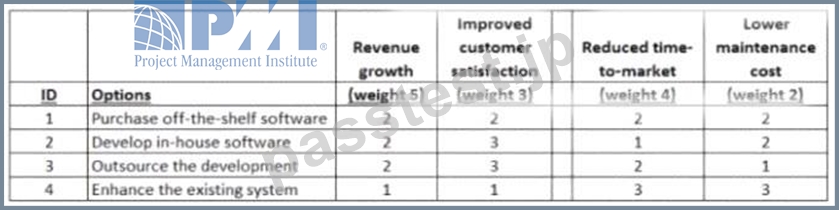
Which solution should be chosen according to the completed weighted-ranking matrix?
- A. Enhance the existing system.
- B. Purchase off-the-shelf software.
- C. Develop in-house software.
- D. Outsource the development.
正解:D
質問 # 49
Which of the following is the best approach to enable developers and product owners to be in constant communication so that changes or issues that occur during development are exposed and discussed as they develop?
- A. Waterfall
- B. Linear
- C. Agile
- D. Iterative
正解:C
解説:
Explanation
Agile is an approach to enable developers and product owners to be in constant communication so that changes or issues that occur during development are exposed and discussed as they develop. Agile emphasizes iterative and incremental delivery of value, collaboration, feedback, and adaptation. Agile methods include Scrum, Kanban, XP, and others. References: = PMI Professional in Business Analysis (PMI-PBA) Examination Content Outline (2019), page 14; Business Analysis for Practitioners: A Practice Guide (2015), page 17.
質問 # 50
......
100% 無料PMI-PBAデモ-試し読み [PDF]、今すぐゲットせよ:https://drive.google.com/open?id=1vW7Gwd_xPKc9j3_O-FPUuJnkM092Z1j2
正確でかつ完璧 アンサーはまるでリアル試験問題:https://www.passtest.jp/PMI/PMI-PBA-shiken.html