

CDCS練習問題集で検証済みで更新された60問題あります
更新されたCDCS試験問題集でPDF問題とテストエンジン
質問 # 17
Do you need to consider bullet (ballistics) protection when designing a data center?
- A. Bullet (ballistics) protection is only required if the facility is a potential target or the building is in the vicinity of a potential target.
- B. Bullet (ballistics) protection is required by ANSI/TIA-942 for data centers Rated 3/4.
- C. Bullet (ballistics) protection is only required when the data center is located in an area with a high crime rate.
- D. Bullet (ballistics) protection is required by ANSI/TIA-942 for all data centers.
正解:A
解説:
Bullet (ballistics) protection is typically considered only for data centers that are potential targets or located near such targets. While ANSI/TIA-942 does not specifically require bulletproofing for all data centers, it is prudent to consider it based on location risk assessments, especially if the facility is in a high-risk area or near critical infrastructure that could attract threats.
Detailed Explanation:
Protective measures like bulletproofing depend on the threat landscape and the data center's exposure to risks such as crime or terrorism. Assessments for physical security are typically customized based on location-specific risks rather than being universally required by data center standards.
EPI Data Center Specialist References:
EPI guidelines emphasize customizing physical security measures based on threat assessments, suggesting that bulletproofing is appropriate in specific circumstances where the facility's risk profile justifies additional security measures.
質問 # 18
You are working on the design of a new facility. The electrical riser of the building with high current power is located close to the area where sensitive IT equipment in the computer room will be located.
What should you recommend to reduce the amount of EMF coming from the electrical riser?
- A. Install bus bar trunking
- B. Install three-phase power cabling based on a combined cable (e.g. XLPE etc.)
- C. Install three-phase power cabling based on three individual core wires
- D. Install single-phase power cabling
正解:B
解説:
To reduce Electromagnetic Fields (EMF) emanating from the electrical riser near sensitive IT equipment, three-phase power cabling in a combined cable (such as XLPE) is effective. Combined cabling helps reduce EMF by keeping the conductors tightly packed, which minimizes magnetic fields generated by current flow. Cables like XLPE (cross-linked polyethylene) also offer better insulation, which helps mitigate EMF interference with nearby IT equipment.
Detailed Explanation:
Using a combined three-phase cable reduces EMF because the magnetic fields generated by each phase tend to cancel each other out when in close proximity. This arrangement helps reduce the overall magnetic field strength. In addition, XLPE and similar materials provide good insulation, making them a preferred choice for reducing EMF emissions around sensitive equipment.
EPI Data Center Specialist References:
EPI data center best practices recommend mitigating EMF interference through combined cabling arrangements, especially near areas where sensitive IT equipment is located. Reducing EMF is crucial to maintaining equipment reliability and ensuring compliance with safety standards.
質問 # 19
From the options indicated, what is the correct starting point for the raised floor installation?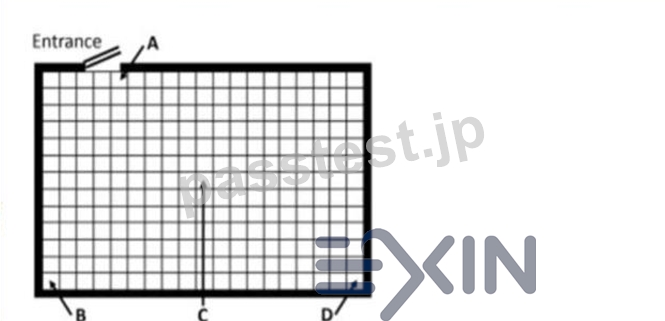
- A. Point A
- B. Point C
- C. Point D
- D. Point B
正解:D
解説:
When installing a raised floor, the best starting point is typically from the farthest corner away from the entrance, in this case, Point B. This method allows for the floor installation to progress towards the entrance, ensuring that workers can avoid walking over the newly installed tiles, thus minimizing the risk of damage and maintaining cleanliness during installation.
Detailed Explanation:
Starting at the farthest corner (Point B) and working towards the entrance (Point A) is a standard practice in raised floor installation. This approach ensures that installers do not walk over freshly laid tiles, which could lead to shifting or misalignment. Additionally, it allows for more controlled placement and alignment, as well as convenient egress when installation is complete.
EPI Data Center Specialist References:
EPI guidelines for raised floor installation emphasize beginning at the farthest point from the entrance and working back towards it, which aligns with industry best practices for efficiency and quality assurance. This method reduces potential damage and supports precise alignment across the floor area.
質問 # 20
A data center scores Rated-3 in mechanical, Rated-4 in electrical, and Rated-2 in architectural.
What is the overall Rating of this data center when the Rating is based on the ANSI/TIA-942?
- A. Rated-4 since electrical is more important than mechanical and architectural
- B. Rated-4 since that is the highest rating received
- C. Rated-2 since that is the lowest rating received
- D. Depends on the Rating scored in telecommunications
正解:C
解説:
According to ANSI/TIA-942 standards, the overall data center rating is determined by the lowest rating among all evaluated categories. Therefore, if a data center is rated 2 in architectural, despite being rated higher in mechanical and electrical, the overall rating is Rated-2. This approach ensures that all aspects meet a minimum standard and prevents a higher rating if any critical area does not comply.
Detailed Explanation:
ANSI/TIA-942 evaluates data centers across several areas, including mechanical, electrical, architectural, and telecommunications. The overall rating reflects the lowest rated category, ensuring that no aspect of the data center's design or operation falls below the specified level. Thus, in this case, the architectural rating of 2 dictates the final rating, ensuring a comprehensive and balanced assessment of reliability and resilience across all aspects.
EPI Data Center Specialist References:
EPI Data Center Specialist training aligns with ANSI/TIA-942, stating that the final rating must reflect the lowest score to ensure comprehensive reliability across all critical infrastructure categories. This avoids overstating the data center's resilience and ensures uniform standards across areas.
質問 # 21
When are the wet bulb and dry bulb temperatures identical?
- A. When the relative humidity is at the best practice value for relative humidity, being 50% RH
- B. When the relative humidity is 100%
- C. When the dry bulb's temperature is at the highest allowable temperature for IT equipment as per ASHRAE
- D. When the dry bulb's temperature is at the lowest allowable temperature for IT equipment as per ASHRAE
正解:B
解説:
The wet bulb and dry bulb temperatures become identical when the relative humidity reaches 100%. At this point, the air is fully saturated with moisture, meaning it can no longer absorb additional water vapor. As a result, the rate of evaporation decreases, and there is no difference between the dry bulb and wet bulb temperatures.
Detailed Explanation:
The dry bulb temperature measures the air temperature, while the wet bulb temperature takes into account the cooling effect of evaporation. When relative humidity is at 100%, the air has reached its saturation point, and no further evaporation occurs. This causes both the wet bulb and dry bulb thermometers to display the same temperature reading. This condition is critical in understanding environmental conditions, particularly in HVAC and data center environments, where humidity control is essential to avoid equipment overheating or corrosion.
EPI Data Center Specialist References:
The EPI Data Center Specialist training includes understanding humidity levels and their impact on data center environments. Knowing when wet bulb and dry bulb temperatures align helps data center operators manage moisture levels effectively, which is essential for preventing issues related to high humidity, such as condensation on IT equipment.
質問 # 22
The computer room has high levels of H2S gas contamination. What is the best option to resolve this issue?
- A. Provide more air changes per hour by adding more fresh air to the computer room.
- B. Clean the room and racks with a damp/wet cloth.
- C. Install air-scrubbers.
- D. Vacuum the whole room using a HEPA/S-Class-based filter.
正解:C
解説:
High levels of H2S (hydrogen sulfide) gas contamination in a computer room are best addressed by installing air-scrubbers. Air-scrubbers can effectively filter out contaminants, including corrosive gases like H2S, ensuring clean air circulation and protecting sensitive IT equipment from potential corrosion and damage.
Detailed Explanation:
Air-scrubbers are designed to remove various airborne contaminants and are particularly useful in environments where corrosive gases are present. These systems use filters or chemical reactions to neutralize harmful substances, making them ideal for data centers that need to maintain high air quality for equipment reliability.
EPI Data Center Specialist References:
EPI guidelines suggest air-scrubbing technologies to remove contaminants that pose risks to electronic equipment, maintaining air quality and reducing corrosion risk.
質問 # 23
The pipes of a VESDA smoke detection system are installed at the air intake of the air conditioner inside the computer room.
Is this a good practice from an early smoke detection point of view?
- A. It depends on the type of gas-based fire suppression which will be installed.
- B. No, it will give a longer reaction time for the smoke detection system and there might also be bypass airflow.
- C. Yes, as this reduces the amount of piping to be installed in the data center, as all air will go through the air conditioner.
- D. No, the piping should be installed at the air exhaust of the air conditioner, as there can also be a fire inside the air conditioner itself.
正解:B
解説:
For optimal early smoke detection in a data center, it is crucial that the Very Early Smoke Detection Apparatus (VESDA) system be installed at locations where smoke will be detected as soon as it appears. Positioning the VESDA pipes at the air intake of the air conditioner inside the computer room is not ideal. This placement could result in a delayed detection response and the potential for bypass airflow to occur, which would impede the system's ability to detect smoke effectively.
Detailed Explanation:
When VESDA pipes are installed at the air intake, the detection system relies on the smoke to be drawn into the air conditioning unit before detection can occur. This setup increases the reaction time as the smoke has to travel through the intake and get processed by the air conditioner. Furthermore, bypass airflow-a phenomenon where not all the air containing smoke particles passes through the VESDA pipes-could also delay or even prevent the system from detecting smoke early.
Ideally, VESDA pipes should be positioned where smoke is likely to accumulate first, such as near the ceiling or in the return airflow path to detect smoke at the earliest possible stage. This ensures that the detection system can quickly trigger alarms, providing more time to address potential fire hazards.
EPI Data Center Specialist References:
EPI Data Center Specialist training highlights that smoke detection should prioritize early response capabilities to maximize safety. The preferred installation for VESDA pipes is generally at points where smoke would naturally accumulate, rather than relying on air conditioning intakes where airflow can vary and delay detection. In their course materials, EPI emphasizes minimizing reaction time and reducing the impact of airflow dynamics on smoke detection efficiency.
質問 # 24
A computer room with a raised floor has been designed with racks in a hot/cold aisle setup.
What should you recommend for the placement of down-flow air conditioners?
- A. Air conditioners perpendicular to (at the end of the row of) the Hot-Aisle
- B. Air conditioners perpendicular to (at the end of the row of) the Cold-Aisle
- C. Air conditioner placement has no influence on cooling effectiveness and efficiency. Hence, they can be placed at any convenient location.
- D. Air conditioners should always be placed at both sides of each row of racks
正解:B
解説:
In a hot/cold aisle configuration, placing down-flow air conditioners perpendicular to the cold aisle ensures that cool air is directed efficiently into the cold aisles where server intakes are located. This layout allows for optimal cooling performance by aligning the airflow directly with the equipment intakes, minimizing hot spots and enhancing cooling efficiency.
Detailed Explanation:
With a raised floor design, cold air from the air conditioners is supplied into the cold aisle, where server intakes are located. Positioning the air conditioning units perpendicular to the cold aisles ensures that cool air is delivered directly into these aisles, preventing air mixing and optimizing cooling. This setup takes full advantage of the airflow management strategy inherent to the hot/cold aisle configuration.
EPI Data Center Specialist References:
EPI guidelines on cooling emphasize that down-flow air conditioners should be positioned to maximize the effectiveness of cold aisle delivery, which improves cooling efficiency and helps maintain consistent temperatures across server racks.
質問 # 25
Three data centers are benchmarked on facilities energy efficiency.
Data center A has achieved a PUE of 2.45.
Data center B has achieved a PUE of 1.20.
Data center C has achieved a PUE of 1.90.
Which of the data centers is operating at the highest facility efficiency?
- A. Data center B
- B. Data center C
- C. Data center A
- D. PUE does not indicate efficiency
正解:C
解説:
A Power Usage Effectiveness (PUE) of 1.20 (achieved by Data Center B) indicates the highest facility efficiency among the three data centers. A lower PUE value signifies better energy efficiency, as it means that a greater proportion of the total energy consumed is used directly for IT equipment rather than for cooling, lighting, or other facility needs.
Detailed Explanation:
PUE is calculated as the ratio of total facility energy to IT equipment energy. A PUE close to 1.0 suggests that almost all the energy is dedicated to computing processes, with minimal overhead. With PUE values of 2.45, 1.20, and 1.90, Data Center B (1.20) operates most efficiently by devoting a higher percentage of its total energy to IT equipment.
EPI Data Center Specialist References:
The EPI curriculum emphasizes PUE as a key metric for data center efficiency, with lower values representing better performance. Achieving a PUE near 1.0 aligns with industry best practices for energy-efficient data center design and operation.
質問 # 26
The logical overview of the data center looks as pictured. To what TIA-942 Rating is this design made based on electrical only?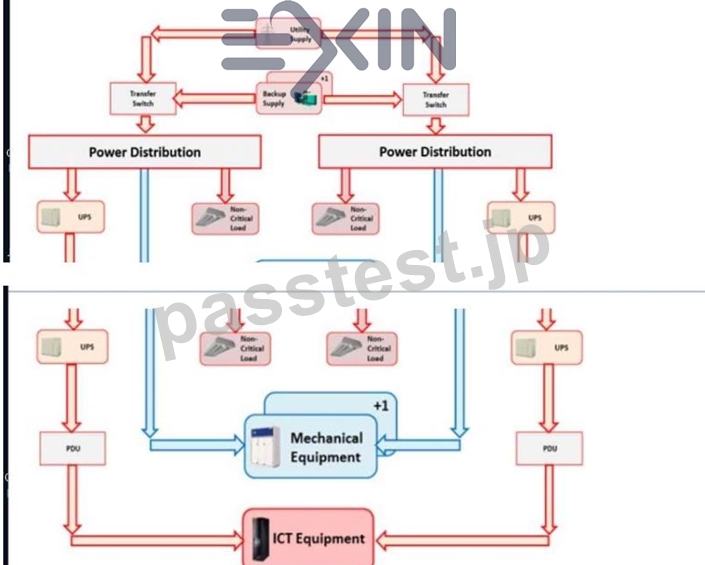
- A. Rating - 1
- B. Rating - 3
- C. Rating - 4
- D. Rating - 2
正解:C
解説:
The electrical design shown in the diagrams represents a TIA-942 Rating-4 configuration. This design includes full redundancy and fault tolerance, as demonstrated by the dual power distribution paths from the utility supply to the critical loads. Each power distribution path is equipped with its own UPS, ensuring that the ICT equipment and mechanical equipment have uninterrupted power in case of any single point of failure.
Detailed Explanation:
A Rating-4 data center requires two independent power paths that are fully redundant and capable of supporting the load independently. In the diagrams:
There are dual feeds from the utility supply, each going through separate transfer switches and power distribution paths.
Both paths have backup sources (+1) and serve critical components through separate UPS systems, providing a completely redundant setup.
The design also includes redundant paths to the mechanical equipment and ICT equipment, which further indicates the fault-tolerant characteristics of a Rating-4 infrastructure.
This setup allows for concurrent maintainability and ensures that no single failure in power distribution or UPS can impact the data center's operation, which is characteristic of the highest Tier/Rated-4 classification.
EPI Data Center Specialist References:
EPI guidelines confirm that TIA-942 Rating-4 requires full redundancy and fault tolerance for electrical infrastructure, ensuring continuous operation even during maintenance or failure events. This design meets all those requirements, thus aligning with Rating-4 standards.
質問 # 27
You are allowed to use a calculator for this question. The total power consumption of the ICT equipment in a rack is 6 kW. The equipment is traditional ICT equipment with a Delta-T of approximately 11 °C / 20 °F. Calculate the approximate CFM required to cool the equipment in the rack.
- A. Approximately 500 CFM
- B. Approximately 1,000 CFM
- C. Approximately 160 CFM
- D. Approximately 1,500 CFM
正解:B
解説:
To calculate the cooling airflow requirement for ICT equipment, you can use the formula:
CFM=Power (kW)×3160ΔT(°F)\text{CFM} = \frac{\text{Power (kW)} \times 3160}{\Delta T (\text{°F})}CFM=ΔT(°F)Power (kW)×3160 For equipment consuming 6 kW with a Delta-T of 20°F:
CFM=6×316020=948≈1,000 CFM\text{CFM} = \frac{6 \times 3160}{20} = 948 \approx 1,000 \, \text{CFM}CFM=206×3160=948≈1,000CFM Detailed Explanation:
This formula provides an estimate of the cubic feet per minute (CFM) of air required to cool the equipment based on its power consumption and the temperature difference (Delta-T) between intake and exhaust. The Delta-T represents the cooling effectiveness of the airflow.
EPI Data Center Specialist References:
EPI recommends using this calculation for determining airflow requirements in data centers, ensuring that cooling systems are adequately sized to maintain equipment within safe temperature limits.
質問 # 28
When installing a raised floor, can we use a spirit level bar to level the floor?
- A. No, because using a spirit level bar, a measurement error will be transferred from pedestal to pedestal.
- B. Yes, using a spirit level bar for raised floors higher than 40 cm is preferred.
- C. Yes, but spirit level bars can only be used in the vertical plane.
- D. Yes, spirit level bars can be used as long as their length is longer than 60 cm/2 ft (the size of a typical raised floor tile).
正解:A
解説:
A spirit level bar should not be used for leveling a raised floor, as measurement errors are likely to propagate from one pedestal to the next. Spirit levels can introduce cumulative errors, leading to uneven floors, particularly in large installations where precise leveling is critical.
Detailed Explanation:
Using a laser level or a precision leveling device is recommended to ensure accuracy across all floor tiles. Spirit levels, while adequate for short spans, can transfer small inaccuracies from one pedestal to another, which can cause alignment issues and floor instability over time.
EPI Data Center Specialist References:
EPI data center guidelines discourage the use of spirit levels for raised floors. Instead, they advocate for precision tools like laser levels that ensure consistency and accuracy in large-scale installations, aligning with best practices for raised floor construction.
質問 # 29
The location of a data center is just above the Arctic Circle (North Pole). The outside air temperature is never above 21°C/70°F.
Taking energy efficiency as the highest priority, which cooling system should you recommend?
- A. Waterside economizer
- B. Any cooling system can be efficient because the outside air temperature will not influence the temperature of the air intake of the ICT equipment
- C. Standard air conditioning units, as spares might not be readily available
- D. Airside economizer
正解:D
解説:
In locations with consistently cold temperatures, such as above the Arctic Circle, an airside economizer is the most energy-efficient cooling solution. Airside economizers use cool outside air to lower indoor temperatures, reducing or even eliminating the need for mechanical cooling. Given the consistently low temperatures, this method maximizes energy efficiency by leveraging natural cooling.
Detailed Explanation:
Airside economizers are ideal in environments where outside temperatures are consistently low. By drawing in and filtering cold outdoor air, they directly cool the indoor environment, thereby reducing energy consumption significantly compared to traditional air conditioning. This cooling approach aligns with energy efficiency goals by minimizing mechanical cooling demands.
EPI Data Center Specialist References:
EPI recommends the use of airside economizers in cold climates to achieve high energy efficiency, as they allow data centers to capitalize on ambient conditions for cooling, aligning with sustainability and cost-saving practices.
質問 # 30
The 'maximum exposed area' of the fire-rated glass is defined by the supplier as 3 sqm/32 sqft. The window area is 4 sqm/43 sqft.
What would be the best option?
- A. Do not use fire-rated glass due to the size limit and replace it with normal glass.
- B. Split the window in two equal parts fitted together with transparent silicon glue.
- C. Split the window in two equal parts using an aluminum frame.
- D. Split the window into parts smaller than specified as the maximum exposed area and ensure fire-rated frames are used.
正解:D
解説:
When the window area exceeds the maximum exposed area specified for fire-rated glass, it is necessary to split the window into sections that comply with the fire rating requirements. This means creating smaller sections that are each within the 3 sqm/32 sqft limit and using fire-rated frames to ensure that the entire assembly meets fire safety standards. This approach maintains the fire-rated integrity of the glass, while allowing for larger window areas.
Detailed Explanation:
Fire-rated glass is designed to contain fire and prevent it from spreading. If the window exceeds the maximum exposed area defined by the supplier, the integrity of the fire-rated glass could be compromised. By dividing the window into compliant sections with fire-rated frames, you ensure that each pane performs as intended in the event of a fire. Fire-rated frames help maintain the fire resistance across the entire assembly, making this option the best for safety and compliance.
EPI Data Center Specialist References:
EPI recommends adhering strictly to fire safety standards, especially when using materials like fire-rated glass. The guidelines emphasize that modifications should always respect the manufacturer's specifications to ensure the system remains effective in containing and preventing the spread of fire.
質問 # 31
In order to save energy, you are going to install an automated system to switch off lights. What should be taken into consideration when installing such a system?
- A. The system should not be based on motion detection as the lights might suddenly switch off while staff is still at work.
- B. Security guards should perform regular inspections verifying the system works.
- C. It is not advisable to use such a system since it will reduce the lifetime of LED lighting.
- D. At all times, the levels should allow for security cameras to function properly.
正解:D
質問 # 32
The air intake of the mission-critical server at the top of the rack is measuring 25 °C/77 °F.
Is this acceptable?
- A. Yes, this is allowed according to the standards and guidelines
- B. As long as it does not exceed the average server room temperature of 38 °C/100 °F
- C. No, the temperature needs to be 20 °C/68 °F
- D. Depends on the ANSI/TIA-942 Rating the data center needs to comply with
正解:A
解説:
An air intake temperature of 25 °C (77 °F) at the top of the rack is acceptable according to data center standards and guidelines, such as those from ASHRAE. This temperature falls within the recommended range for inlet temperatures, which is typically between 18°C (64°F) and 27°C (81°F).
Detailed Explanation:
ASHRAE standards provide guidelines on acceptable temperature ranges for air intake in data centers to balance cooling efficiency and equipment safety. A temperature of 25°C is within the recommended operational range, allowing data centers to optimize energy efficiency while maintaining safe conditions for IT equipment.
EPI Data Center Specialist References:
EPI guidelines align with ASHRAE recommendations for server intake temperatures, confirming that 25°C is within acceptable limits for most mission-critical equipment. This ensures the data center maintains an efficient and reliable environment.
質問 # 33
The electrical diagram of the data center shows the following UPS configuration and has a load of 80 kW.
What is the set-up in this data center?
- A. 2(N+1)
- B. (N+1)-(N+1)
- C. N+N(+1)
- D. 2+N+1
正解:A
解説:
A 2(N+1) configuration implies two independent UPS systems, each with N+1 redundancy. This configuration provides high availability by ensuring that each UPS system can independently support the load with an additional unit for redundancy. Given the 80 kW load, this setup implies that two separate N+1 systems are running, providing reliability and fault tolerance for the data center's power needs.
Detailed Explanation:
The N+1 notation denotes that each system has one additional unit beyond what is needed to carry the load, providing redundancy. With 2(N+1), there are two such setups, ensuring that if one fails, the other can still support the load without interruption, fulfilling high availability requirements.
EPI Data Center Specialist References:
EPI teaches that multiple redundant systems, such as 2(N+1), enhance data center reliability by ensuring that power is maintained even if a failure occurs in one system. This meets the stringent demands for uptime in critical environments.
質問 # 34
What is a significant difference between a halocarbon gas-based fire suppression system and an inert gas-based fire suppression system?
- A. Inert gas has smaller-sized gas containers than halocarbon gas.
- B. Halocarbon gas works on the basis of oxygen reduction and inert gas works on the basis of heat removal.
- C. Inert gas harms the environment and halocarbon gas does not.
- D. Halocarbon gas works on the basis of heat removal and inert gas works on the basis of oxygen reduction.
正解:D
解説:
A halocarbon gas-based fire suppression system primarily extinguishes fires through heat absorption. In contrast, an inert gas-based system works by reducing oxygen levels to a point where combustion cannot be sustained. Halocarbon agents, like FM-200, absorb heat from the fire, cooling it down, whereas inert gases, like nitrogen or argon, lower oxygen concentration.
Detailed Explanation:
Halocarbons are effective in quickly cooling flames and are suitable for electronic environments due to their fast action. Inert gases displace oxygen to suppress fires, making them ideal in occupied spaces where human safety can be managed during a fire event due to slower discharge times.
EPI Data Center Specialist References:
EPI training distinguishes between these suppression mechanisms, noting the importance of selecting the correct system based on specific needs like quick response versus oxygen displacement for environments with sensitive equipment.
質問 # 35
You are working with a customer who requires a guarantee that THDi levels coming from the UPS should not exceed more than 3% THDi. Furthermore, he wants to run a power-efficient data center. The UPS has a 6-Pulse SCR/Thyristor based rectifier. The current load on the UPS is approximately 80%. The customer indicates they are not expecting any changes on the ICT infrastructure for the next 3 years.
What should you recommend?
- A. Install an active harmonic filter on the UPS
- B. Nothing, the UPS will be able to take care of the right levels of THDi
- C. Install a passive harmonic filter on the UPS
- D. Install an isolation transformer rated at K13 or K20
正解:A
解説:
Given the customer's requirement to limit Total Harmonic Distortion (THDi) to below 3% and the presence of a 6-pulse SCR/Thyristor-based rectifier, an active harmonic filter is the best solution. A 6-pulse rectifier typically generates higher harmonic distortion, often exceeding 3%, especially under substantial loads like 80%. An active harmonic filter dynamically monitors and compensates for harmonic distortion, effectively reducing THDi and supporting a more power-efficient operation, aligning with the customer's energy efficiency goals.
Detailed Explanation:
Passive harmonic filters can reduce harmonics but are less effective at maintaining low THDi levels under varying loads. Active filters offer real-time correction and can achieve lower THDi levels than passive filters, especially in systems with fluctuating loads or where strict harmonic limits are required. Installing an active harmonic filter will ensure compliance with the specified THDi limits and optimize power quality.
EPI Data Center Specialist References:
EPI guidance on power quality management recommends active harmonic filters for environments where strict THDi levels are necessary. Active filters offer better control over harmonic levels, supporting both compliance and operational efficiency.
質問 # 36
......
EXIN CDCS 認定試験の出題範囲:
| トピック | 出題範囲 |
|---|---|
| トピック 1 |
|
| トピック 2 |
|
| トピック 3 |
|
最新(2025)EXIN CDCS試験問題集:https://www.passtest.jp/EXIN/CDCS-shiken.html
最適な練習法にはEXIN CDCS試験の素晴らしいCDCS試験問題PDF:https://drive.google.com/open?id=1B26hSyut6vvoiURzQ9hdL9pNDoUa4G9w