

初心者向けのIntegration-Architect試験 [2024] 問題集でSalesforceのPDF問題
Integration-Architectプレミアム試験エンジンPDFをダウンロード
質問 # 24
A company's cloud-based single page application consolidates data local to the application with data from on premise and 3rd party systems. The diagram below typifies the application's combined use of synchronous and asynchronous calls.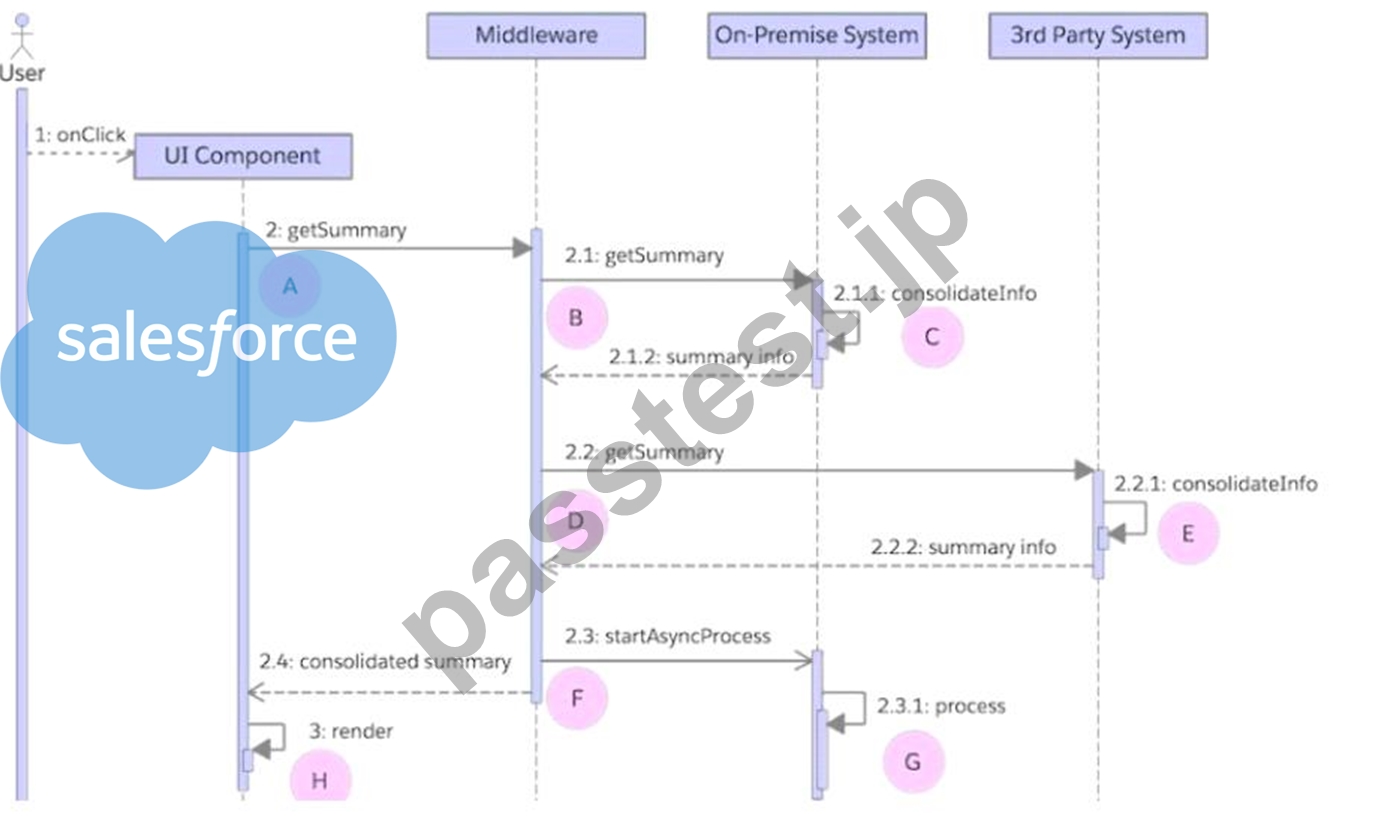
The company wants to use the average response time of its application's user interface as a basis for certain alerts. For this purpose, the following occurs:
1. Log every call's start and finish date and time to a central analytics data store.
2. Compute response time uniformly as the difference between the start and finish date and time - A to H in the diagram.
Which computation represents the end-to-end response time from the user's perspective?
- A. Sum of A, G, and H
- B. Sum of A and H
- C. Sum of A to H
- D. Sum of A to F
正解:B
質問 # 25
A company's cloud-based single page application consolidates data local to the application with data from on premise and 3rd party systems. The diagram below typifies the application's combined use of synchronous and asynchronous calls.
The company wants to use the average response time of its application's user interface as a basis for certain alerts. For this purpose, the following occurs:
1. Log every call's start and finish date and time to a central analytics data store.
2. Compute response time uniformly as the difference between the start and finish date and time - A to H in the diagram.
Which computation represents the end-to-end response time from the user's perspective?
- A. Sum of A, G, and H
- B. Sum of A and H
- C. Sum of A to H
- D. Sum of A to F
正解:B
解説:
Explanation
The end-to-end response time from the user's perspective is the time elapsed between the user's request and the user's receipt of the final response. In the diagram, this corresponds to the sum of A and H, which are the durations of the synchronous calls from the user interface to the cloud-based application and back. The other durations (B to G) are either internal to the cloud-based application or asynchronous calls that do not affect the user's perception of response time. Therefore, the correct answer is D, because it represents the sum of A and
H.
質問 # 26
Northern Trail Outfitters requires an integration to be set up between one of their Salesforce orgs and an external data source us Salesforce Connect. The external data source supports Open Data Protocol.
Which three configurations should an Integration Architect recommend be implemented in order to secure requests coming from Salesforce?
Choose 3 answers
- A. Configure Special Compatibility for OData connection,
- B. Configure a Certificate for OData connection.
- C. Configure CSRF Protection for OData connection.
- D. Configure Identity Type for OData connection.
- E. Configure CSRF Protection on External Data Source.
正解:B、C、D
解説:
https://help.salesforce.com/articleView?id=apex_add_external_data_source.htm&type=5
質問 # 27
An Enterprise Customer is planning to implement Salesforce to support case management. Below, is their current system landscape diagram.
Considering Salesforce capabilities, what should the Integration Architect evaluate when integrating Salesforce with the current system landscape?
- A. Integrating Salesforce with Data Warehouse, Order Management and Email Management System.
- B. Integrating Salesforce with Order Management System, Data Warehouse and Case Management System.
- C. Integrating Salesforce with Email Management System, Order Management System and Case Management System.
- D. Integrating Salesforce with Order Management System, Email Management System and Case Management System.
正解:A
解説:
Explanation
Integrating Salesforce with Data Warehouse, Order Management and Email Management System is the best option considering Salesforce capabilities. Salesforce can be used as the primary case management system, replacing the existing one. Salesforce can also integrate with the Data Warehouse to provide analytics and reporting on case data. Salesforce can integrate with the Order Management System to access order information related to cases. Salesforce can integrate with the Email Management System to send and receive emails from customers and agents. Reference: Salesforce Integration Architecture Designer Resource Guide, page 16
質問 # 28
When user clicks Check Preferences as part of a Lightning flow in Salesforce, preferences from an externally hosted RESTful service are to be checked in real-time. The RESTful service has OpenAPI 2.0 JSON definitions, responding in data types of Boolean and string values.
Which integration pattern and mechanism should be selected to meet the conditions?
- A. Data Virtualization: Salesforce Connect map data external REST data in external objects.
- B. Remote Call-In: Salesforce REST API with REST Composite Resources.
- C. Request-Reply: Enhanced External Services invokes a REST API.
- D. Fire and Forget: Process-driven platform events publishes events on Salesforce Event Bus.
正解:C
質問 # 29
Northern Trail Outfitters wants to improve the quality of call-outs from Salesforce to their REST APIs. For this purpose, they will require all API clients/consumers to adhere to RESTAPI Markup Language (RAML) specifications that include field-level definition of every API request and response payload. RAML specs serve as interface contracts that Apex REST API Clients can rely on.
Which two design specifications should the Integration Architect include in the integration architecture to ensure that ApexREST API Clients unit tests confirm adherence to the RAML specs?
Choose 2 answers
- A. Implement HttpCalloutMock to return responses per RAML specification.
- B. Call the Apex REST API Clients in a test context to get the mock response.
- C. Call the HttpCalloutMock implementation from the Apex REST API Clients.
- D. Require the Apex REST API Clients to implement the HttpCalloutMock.
正解:A、B
解説:
Explanation
The HttpCalloutMock interface allows testing HTTP callouts by returning a predefined response in a test context.
By implementing HttpCalloutMock to return responses per RAML specification, the Apex REST API Clients unit tests can confirm that the API requests and responses match the expected format and values.
Calling the Apex REST API Clients in a test context to get the mock response is also necessary to verify the adherence to the RAML specs. Calling the HttpCalloutMock implementation from the Apex REST API Clients or requiring the Apex REST API Clients to implement the HttpCalloutMock are not valid options because the HttpCalloutMock interface is implemented by a separate class that is passed as a parameter to the Test.setMock method2 References: 1: Idempotent REST APIs 2: Testing HTTP Callouts by Implementing the HttpCalloutMock Interface
質問 # 30
A company that is a leading provider of training delivers courses to students globally. The company decided to use customer community in order to allow Studer to log in to the community, register for courses and pay course fees. The company has a payment gateway that takes more than 30 seconds to process the pays transaction. Students would like to get the payment result in real-time so in case an error happens, the students can retry the payment process.
What is the recommended integration approach to process payments based on this requirement?
- A. Use continuation to process payment to the payment gateway.C Use change data capture to process payment to the payment gateway.
- B. Use platform event to process payment to the payment gateway.
- C. Use request and reply to make an API call to the payment gateway.
正解:A
解説:
Explanation
The continuation class in Apex allows you to make long-running requests to external web services and process their responses in a callback method. This is useful for scenarios where the response time exceeds the normal Apex limits, such as 10 seconds for synchronous transactions or 120 seconds for asynchronous transactions. By using continuation, you can avoid hitting these limits and provide a better user experience1 References: Callout Limits and Limitations
質問 # 31
Northern Trail Outfitters is seeking to improve the performance and security of outbound integrations from Salesforce to on-premise servers.
What should the Architect consider before recommending a solution?
- A. External gateway products in use
- B. ShieldPlatform Encryption Limitations
- C. Considerations for using Deterministic Encryption
- D. A Default gateway restrictions
正解:A
解説:
Explanation
Option A is correct because external gateway products in use can affect the performance and security of outbound integrations from Salesforce to on-premise servers. External gateway products are software or hardware devices that act as intermediaries between Salesforce and the on-premise servers, such as firewalls, proxies, load balancers, or VPNs. They can have different configurations, features, and limitations that can impact the speed, reliability, and security of the data transmission. For example, some external gateway products may require authentication, encryption, or compression of the data, which can add overhead and latency to the integration. Some external gateway products may also have bandwidth or throughput limits, which can affect the scalability and availability of the integration.
Therefore, the architect should consider the external gateway products in use before recommending a solution.
Option B is incorrect because a default gateway restriction is not a factor that can affect the performance and security of outbound integrations from Salesforce to on-premise servers. A default gateway restriction is a feature that allows administrators to restrict outbound requests from Salesforce to a specific IP address or domain name. This can help prevent unauthorized or malicious requests from Salesforce to external systems. However, this feature does not affect the performance or security of the outbound requests themselves, as it only acts as a filter for the destination of the requests.
Option C is incorrect because considerations for using deterministic encryption are not relevant for outbound integrations from Salesforce to on-premise servers. Deterministic encryption is a type of encryption that produces the same ciphertext for the same plaintext input. This can help preserve some functionality and performance of encrypted data in Salesforce, such as filtering, sorting, and indexing.
However, deterministic encryption is not applicable for outbound integrations from Salesforce to on-premise servers, as it is only supported for custom fields and not for standard fields or attachments.
Moreover, deterministic encryption does not affect the security of the data transmission itself, as it only encrypts the data at rest in Salesforce.
Option D is incorrect because Shield Platform Encryption limitations are not relevant for outbound integrations from Salesforce to on-premise servers. Shield Platform Encryption is a feature that allows administrators to encrypt sensitive data at rest in Salesforce using AES 256-bit encryption. This can help protect data from unauthorized access or theft. However, Shield Platform Encryption limitations are not relevant for outbound integrations from Salesforce to on-premise servers, as they only affect the functionality and performance of encrypted data in Salesforce, such as searching, reporting, or validation rules. Shield Platform Encryption does not affect the security of the data transmission itself, as it only encrypts the data at rest in Salesforce.
References: Salesforce Integration Patterns and Practices : Salesforce Integration Guide : Restrict Outbound Requests with a Default Gateway : Deterministic Encryption : Shield Platform Encryption Considerations :
Shield Platform Encryption : Shield Platform Encryption Architecture
質問 # 32
A company is planning on sending orders from Salesforce to a fulfillment system. The integration architect has been asked to plan for the integration.
Which two questions should the integration architect consider?
Choose 2 answers
- A. Can the fulfillment system create new addresses within the Order Create service?
- B. Can the fulfillment system implement a contract-first Outbound Messaging interface?
- C. Is the product catalog data identical at all times in both systems?
- D. Can the fulfillment system make a callback into Salesforce?
正解:B、D
解説:
https://www.youtube.com/watch?v=zQncznMLrt4 Contract first interface is important as it can impact integration design in terms of efficiency and collaboration.
質問 # 33
A large enterprise customer operating in a high regulated industry is planning to implement Salesforce for customer facing associates in both Sales and Service, and back-office staff. The business processes that Salesforce supports are critical to the business.
Salesforce will be integrated to multiple back-office systems to provide a single interface for associates.
Reliability and monitoring of these integrations are required as associates support customers.
Which integration solution should the architect consider when planning the implementation?
- A. Architect Services in back-office systems to support callouts from Salesforce and build reliability, monitoring and reporting capabilities.
- B. Decouple back-office system callouts into separate distinct services that have inbuilt error logging and monitoring frameworks.
- C. Leverage Middleware for all back-office system integrations ensuring real time alerting, monitoring and reporting capabilities.
- D. Build a custom integration gateway to support back-office system integrations and ensure reliability and monitoring capabilities.
正解:C
解説:
Explanation
Leveraging Middleware for all back-office system integrations ensuring real time alerting, monitoring and reporting capabilities is the best integration solution for this scenario. Middleware is a software layer that acts as an intermediary between Salesforce and other systems, providing a common platform for data transformation, routing, orchestration, security, error handling, logging, and monitoring. Middleware can help to ensure reliability and performance of the integrations, as well as provide visibility and control over the integration processes. Middleware can also support various integration patterns and protocols, such as SOAP, REST, JMS, etc. Reference: Salesforce Integration Architecture Designer Resource Guide, page 14
質問 # 34
What should an Integration architect consider when recommending Platform Events as an Integration solution?
- A. Event Monitoring Is used to track user activity, such as logins and running reports.
- B. Subscribe to an AssetTokenEvent stream to monitor OAuth 2.0 authentication activity.
- C. When an event definition Is deleted, It's permanently removed and can't be restored.
正解:C
解説:
Explanation
Event Monitoring is used to track user activity, such as logins and running reports, but it is not related to Platform Events. Subscribe to an AssetTokenEvent stream to monitor OAuth 2.0 authentication activity is also not related to Platform Events. When an event definition is deleted, it's permanently removed and can't be restored. This means that the event definition and its associated data are no longer available for subscribers or queries.
質問 # 35
A large enterprise customer operating in a high regulated industry is planning to implement Salesforce for customer facing associates in both Sales and Service, and back office staff. The business processes that Salesforce supports are critical to the business.
Salesforce will be integrated to multiple back office systems to provide a single interface for associates. Reliability and monitoring of these integrations is required as associates support customers.
Which integration solution should the architect consider when planning the implementation?
- A. Build a custom integration gateway to support back office system integrations and ensure reliability and monitoring capabilities.
- B. Decouple back office system callouts into separate distinct services that have inbuilt error logging and monitoring frameworks.
- C. Leverage Middleware for all back office system integrations ensuring real time alerting, monitoring and reporting capabilities.
- D. Architect Services in back office systems to support callouts from Salesforce and build reliability, monitoring and reporting capabilities.
正解:C
質問 # 36
Only authorized users are allowed access to the EBS and the Enterprise DMS.
Customers call Customer Support when they need clarification on their bills. Customer Support needs seamless access to customer billing information from the E and view generated bills from the DMS.
Which three authorization and authentication needs should an integration consultant consider while integrating the DMS and ESB with Salesforce?
should an integration consultant consider while integrating the DMS and ESB with Salesforce?
Choose 3 answers
- A. Identify options to maintain DMS and EBS authentication and authorization details in Salesforce.
- B. Consider options to migrate DMS and EBS into Salesforce.
- C. Users should be authenticated into DMS and EBS without having to enter username and password.
- D. Users should be authorized to view information specific to the customer they are servicing without a need to search for customer.
- E. Consider Enterprise security needs for access to DMS and EBS.
正解:C、D、E
解説:
Explanation
The integration consultant should consider the following authorization and authentication needs while integrating the DMS and ESB with Salesforce:
Users should be authorized to view information specific to the customer they are servicing without a need to search for customer. This means that the integration should provide a seamless and contextual access to the customer billing information and generated bills from the DMS and ESB, based on the customer record or case that the user is working on in Salesforce.
Consider Enterprise security needs for access to DMS and ESB. This means that the integration should comply with the security policies and standards of the Enterprise, such as encryption, auditing, logging, monitoring, etc.
Users should be authenticated into DMS and ESB without having to enter username and password. This means that the integration should use a single sign-on (SSO) mechanism that allows users to access multiple systems with one login credential, such as OAuth or SAML34 References: Authorization Through Connected Apps and OAuth 2.0, Single Sign-On for Desktop and Mobile Applications using SAML and OAuth
質問 # 37
Universal Containers (UC) currently owns a middleware tool and they have developed an API-led integration architecture with three API tiers. The first-tier interfaces directly with the systems of engagement, the second tier implements business logic and aggregates data, while the third-tier interfaces directly with systems of record. Some of the systems of engagement will be a mobile application, a web application, and Salesforce.
UC has a business requirement to return data to the systems of engagement in different formats while also enforcing different security protocols.
What should an Integration Architect recommend to meet these requirements?
- A. Leverage an Identity Provider solution that communicates with the API tiers via SAML
- B. Implement an API gateway that all systems of engagement must interface with first.
- C. Enforce separate security protocols and return formats at the second tier of the API-led architecture.
- D. Enforce separate security protocols and return formats at the first tier of the API-led architecture.
正解:D
解説:
Explanation
The integration architect should recommend enforcing separate security protocols and return formats at the first tier of the API-led architecture. The first tier is also known as the experience layer, which is responsible for providing a tailored interface for each system of engagement. By enforcing security and format at this layer, the integration architect can ensure that each system of engagement can access the data in a secure and consistent way, without affecting the other layers.
References: [API-led Connectivity]
質問 # 38
Universal Containers (UC) currently owns a middleware tool and they have developed an API-led integration architecture with three API tiers. The first tier interfaces directly with the systems of engagement, the second tier implements business logic and aggregates data, while the third tier interfaces directly with systems of record. Some of the systems of engagement will be a mobile application, a web application, and Salesforce.
UC has a business requirement to return data to the systems of engagement in different formats while also enforcing different security protocols.
What should an Integration Architect recommend to meet these requirements?
- A. Leverage an Identity Provider solution that communicates with the API tiers via SAML
- B. Enforce separate security protocols and return formats at the first tier of the API-led architecture.
- C. Enforce separate security protocols and return formats at the second tier of the API-led architecture.
- D. Implement an API gateway that all systems of engagement must interface with first.
正解:D
質問 # 39
A company accepts payment requests 24x7. Once they accept a payment request, their service level agreement (SLA) requires them to make sure each payment request is processed by their Payment System. They track payment requests using a globally unique identifier created at the Data Entry Point. Their simplified flow is as shown in the diagram.
They encounter intermittent update errors when two or more processes try to update the same Payment Request record at the same time.
Which two recommendations should an integration architect make to improve their SLA and update conflict handling?
Choose 2 answers
- A. Payment System should process a payment request only once.
- B. Data Entry Point and Middleware should automatically retry requests.
- C. Middleware should coordinate request delivery and payment processing.
- D. Payment System and Middleware should automatically retry requests.
正解:A、C
解説:
Explanation
Middleware should coordinate request delivery and payment processing, and Payment System should process a payment request only once. This solution ensures that each payment request is delivered to the Payment System in a reliable and consistent manner, and avoids duplicate or conflicting updates to the same Payment Request record. Middleware can act as a mediator between the Data Entry Point and the Payment System, and implement logic to handle errors, retries, and acknowledgments. Payment System can use the globally unique identifier to check if a payment request has already been processed, and avoid processing it again.
References: Certification - Integration Architect - Trailhead, [Integration Patterns and Practices]
質問 # 40
Universal containers are planning to implement Salesforce as their CRM system. Currently they have the following systems
1. Leads are managed in a Marketing System.
2. Sales people use Microsoft Outlook to enter contacts, emails and manage activities.
3. Inventory, Billing and Payments are managed in their ERP system. 4. The proposed CRM system is expected to provide Sales and Support people the ability to have a single view of their customers and manage their contacts, emails and activities in Salesforce CRM.
What should an Integration Consultant consider to support the proposed CRM system strategy?
- A. Plan for migration of customer and sales data across systems on a regular basis to keep them in sync.
- B. Propose a middleware system that can support interface between systems with Salesforce.
- C. Evaluate current and future data and system usage and then identify potential integration requirements to Salesforce.
- D. Explore Out of box Salesforce connectors for integration with ERP, Marketing and Microsoft Outlook systems.
正解:C
解説:
Explanation
The integration consultant should evaluate current and future data and system usage and then identify potential integration requirements to Salesforce. This approach can help to understand the business needs, data flows, data quality, data volume, data frequency, and data security of the proposed CRM system. Based on this analysis, the integration consultant can design and implement the best integration solution for each system, such as Marketing, ERP, or Outlook.
References: [Salesforce Integration Architecture Designer Resource Guide]
質問 # 41
Northern Trail Outfitters (NTO) uses different shipping services for each of the 34 countries it serves. Services are added and removed frequently to optimize shipping times and costs. Sales Representatives serve all NTO customers globally and need to select between valid service(s) for the customer's country and request shipping estimates from that service.
Which two solutions should an architect propose?
Choose 2 answers
- A. Invoke middleware service to retrieve valid shipping methods.
- B. Use middleware to abstract the call to the specific shipping services.
- C. Store shipping services in a picklist that is dependent on a country picklist.
- D. Use Platform Events to construct and publish shipper-specific events.
正解:A、B
解説:
Explanation
Invoking middleware service to retrieve valid shipping methods is a solution that can allow the sales representatives to select between valid services for the customer's country. The middleware service can act as a single point of entry for all shipping services and provide routing and transformation capabilities. Using middleware to abstract the call to the specific shipping services is a solution that can allow the sales representatives to request shipping estimates from the selected service. The middleware can hide the complexity and heterogeneity of the shipping services and provide mediation and orchestration capabilities.
Using Platform Events to construct and publish shipper-specific events is not a solution, as Platform Events are used for event-driven integration, not for web-service integration. Storing shipping services in a picklist that is dependent on a country picklist is not a solution, as it does not address how to request shipping estimates from the shipping services. Reference: Salesforce Integration Architecture Designer Resource Guide, page 16-17
質問 # 42
Universal Containers (UC) is a large printing company that sells advertisement banners. The company works with third-party agents on banner initial design concepts. The design files are stored in an on-premise file store that can be accessed by UC internal users and the third party agencies. UC would like to collaborate with the
3rd part agencies on the design files and allow them to be able to view the design files in the community.
The conceptual design files size is 2.5 GB.
Which solution should an integration architect recommend?
- A. Define an External Data Source and use Salesforce Connect to upload the files to an external object.
Link the external object using Indirect lookup. - B. Create a lightning component with a Request and Reply integration pattern to allow the community users to download the design files.
- C. Create a custom object to store the file location URL, when community user clicks on the file URL, redirect the user to the on-prem system file location.
- D. Use Salesforce Files to link the files to Salesforce records and display the record and the files in the community.
正解:C
解説:
Explanation
The best solution for this scenario is to use a custom object to store the file location URL and redirect the community user to the on-premise file store when they click on the URL. This way, the community user can access the large design files without having to download them or use any external data source. Option A is not feasible because the Request and Reply integration pattern is not suitable for large files and would cause performance issues. Option B is not correct because Salesforce Connect cannot upload files to an external object, only data. Option D is not possible because Salesforce Files has a limit of 2 GB per file, and the design files are 2.5 GB in size. References:
Salesforce Connect Developer Guide
Salesforce Files Developer Guide
質問 # 43
business requires automating the check and update of the phone number type classification (mobile vs. landline) for all in-coming calls delivered to their phone sales agents. The following conditions exist:
1. At peak, their call center can receive up to100,000 calls per day.
2. The phone number type classification is a service provided by an external service API.
3. Business is flexible with timing and frequency to check and update the records (throughout the night or every 6-12 hours is sufficient).
ARemote-Call-In pattern and/or Batch Synchronization (Replication via ETL: System -> Salesforce) are determined to work with a middleware hosted on custom premise.
In order to implement these patterns and mechanisms, which component should an integration architect recommend?
- A. ConnectedApp configured in Salesforce to authenticate the middleware.
- B. An API Gateway that authenticates requests from Salesforce into the Middleware (ETL/ESB).
- C. IoConfigure Remote Site Settings in Salesforce to authenticate the middleware.
- D. Firewall and reverse proxy are required to protect internal APIs and resource being exposed.
正解:A
解説:
Explanation
A Connected App is a framework that enables an external application to integrate with Salesforce using APIs and standard protocols, such as OAuth. By configuring a Connected App in Salesforce, the integration can authenticate the middleware and grant access to the Salesforce data and services. This is a secure and flexible solution that does not require configuring Remote Site Settings, API Gateway, or Firewall and reverse proxy2 References: 1: BatchApexErrorEvent 2: Connected Apps
質問 # 44
A call center manager uses a custom dashboard to track Case related metrics. The manager wants a component to display the number of closed Cases in real time.
What type of event should be used to meet this requirement?
- A. Change Data Capture Event
- B. Generic Event
- C. Platform Event
- D. Push Topic Event
正解:A
解説:
Explanation
Change Data Capture Event is the best option to meet this requirement. Change Data Capture Event is a type of streaming event that notifies subscribers of changes to Salesforce records, such as creation, update, delete, and undelete operations1. By subscribing to Change Data Capture Event for the Case object, the dashboard component can receive real-time updates on the number of closed Cases. Push Topic Event is another type of streaming event that notifies subscribers of changes to Salesforce records that match a SOQL query2. However, Push Topic Event has some limitations, such as not supporting all SOQL features and not capturing delete and undelete operations3. Platform Event is a type of streaming event that delivers custom notifications within the Salesforce platform or from external sources4. Platform Event is not suitable for this requirement because it is not tied to Salesforce records and requires custom logic to publish and subscribe. Generic Event is a type of streaming event that sends custom JSON notifications to subscribers without a predefined schema5. Generic Event is not suitable for this requirement because it is not tied to Salesforce records and requires custom logic to publish and subscribe.
質問 # 45
Northern Trail Outfitters (NTO) has recently changed their Corporate Security Guidelines. The guidelines require that all cloud applications pass through a secure firewall before accessing on-premise resources. NTO is evaluating middleware solutions to integrate cloud applications with on-premise resources and services.
What are two considerations an Integration Architect should evaluate before choosing a middleware solution?
Choose 2 answers
- A. An API gateway component is deployable behind a Demilitarized Zone (DMZ) or perimeter network.
- B. The middleware solution is capable of establishing a secure API gateway between cloud applications and on-premise resources.
- C. The middleware solution is able to interface directly with databases via an ODBC connection string.
- D. The middleware solution enforces the OAuth security protocol.
正解:A、B
質問 # 46
Northern Trail Outfitters has a requirement to encrypt few of widely used standard fields. They also want to be able to use these fields in workflow rules.
Which security solution should an Integration Architect recommend to fulfill the business use case?
- A. Classic Encryption
- B. Data Masking
- C. Platform Shield Encryption
- D. Cryptography Class
正解:C
解説:
https://help.salesforce.com/articleView?id=data_mask_overview.htm&type=5
https://help.salesforce.com/articleView?id=security_pe_vs_classic_encryption.htm&type=5
質問 # 47
Northern Trail Outfitters needs to secure an integration with an external Microsoft Azure API Gateway.
What integration security mechanism should be employed?
- A. Implement Salesforce Shield with Encryption at Rest and generate a tenant secret.
- B. Configure mutual server authentication with two-way SSL using CA issued certificates.
- C. Use an API only user profile and implement use an external identity provider with federated API access.
- D. Configure a connected app with an authorization endpoint of the API gateway and configure OAuth settings.
正解:D
解説:
Explanation
The OAuth protocol is a standard way to authorize access to web resources. By configuring a connected app with an authorization endpoint of the API gateway, Salesforce can obtain an access token from the API gateway and use it to invoke the external API securely. This avoids the need to manage certificates or user credentials for authentication2 References: 1: Data Virtualization Pattern 2: OAuth 2.0 Web Server Authentication Flow
質問 # 48
......
Salesforce Integration-Architect試験は、多肢選択試験とシナリオベースの試験の2つの部分に分かれています。複数選択試験は、統合の概念とベストプラクティスに関する候補者の知識を評価する60質問のテストです。シナリオベースの試験は、候補者がSalesforceプラットフォームを使用して複雑な統合ソリューションを設計および実装する必要がある実践的なテストです。
あなたを合格させるSalesforce試験にはIntegration-Architect試験問題集:https://www.passtest.jp/Salesforce/Integration-Architect-shiken.html
検証済みIntegration-Architect豪華お試しセットリアル試験問題集PDF:https://drive.google.com/open?id=1wYqfkh8u9RX5lyhZLridsWX80Ey5_zHy