

Salesforce Integration-Architect認証された練習解答、必ずあなたを試験合格させる![2023]
有効な合格方法Salesforce Integration Architecture DesignerのIntegration-Architect試験問題集
質問 # 63
A developer has been tasked by the integration architect to build a solution based on the Streaming API. The developer has done some research and has found there are different implementations of the events in Salesforce (Push Topic Events, Change Data Capture, Generic Streaming, Platform Events), but is unsure of to proceed with the implementation.The developer asks the system architect for some guidance.
What should the architect consider when making the recommendation?
- A. Push Topic Event can define a custom payload.B Change Data Capture does not have record access support.
- B. Change Data Capture can be published from Apex.
- C. Apex triggers can subscribe to Generic Events.
正解:B
解説:
Explanation
Push Topic Events can define a custom payload, which is one of the factors that should be considered when choosing a Streaming API implementation. Push Topic Events are based on SOQL queries that define the data changes to be notified of. You can specify the fields to be returned in the event message by using the SELECT clause in the query. This allows you to customize the payload according to your needs2 References: Create a PushTopic
質問 # 64
Northern Trail Outfitters has a registration system that is used for workshopsoffered at its conferences.
Attendees use a Salesforce community to register for workshops, but the scheduling system manages workshop availability based on room capacity. It is expected that there will be a big surge of requests for workshop reservationswhen the conference schedule goes live.
Which integration pattern should be used to manage the influx in registrations?
- A. Batch Data Synchronization
- B. Remote Process Invocation-Request and Reply
- C. Remote Process Invocation-Fire and Forget
- D. RemoteCall-In
正解:A
解説:
Explanation
The Batch Data Synchronization pattern is suitable for this business use case because it allows transferring large volumes of data between Salesforce and the scheduling system in batches. This can handle the surge of requests for workshop registrations without overloading the systems or affecting the performance. The batch process can run at regular intervals or on demand to synchronize the data between the systems1
1: Batch Data Synchronization Pattern
質問 # 65
Which WSDL should an architect consider when creating an integration that might be used for more than one salesforce organization and different met
- A. Corporate WSDL
- B. Partner WSDL
- C. SOAP API WSDL
- D. Enterprise WSDL
正解:B
質問 # 66
Northern Trail Outfitters (NTO) uses a custom mobile app to interact with their customers.
One of the features of the app are Salesforce Chatter Feeds. NTO wants to automatically post a Chatter item to Twitter whenever the post includes the #thanksNTO hashtag.
Which API should an Integration Architect use to meet this requirement?
- A. Connect REST API
- B. Apex REST
- C. Streaming API
- D. REST API
正解:A
質問 # 67
An enterprise architect has requested the Salesforce Integration architect to review the following (see diagram & description) and provide recommendations after carefully considering all constraints of the enterprise systems and Salesforce platform limits.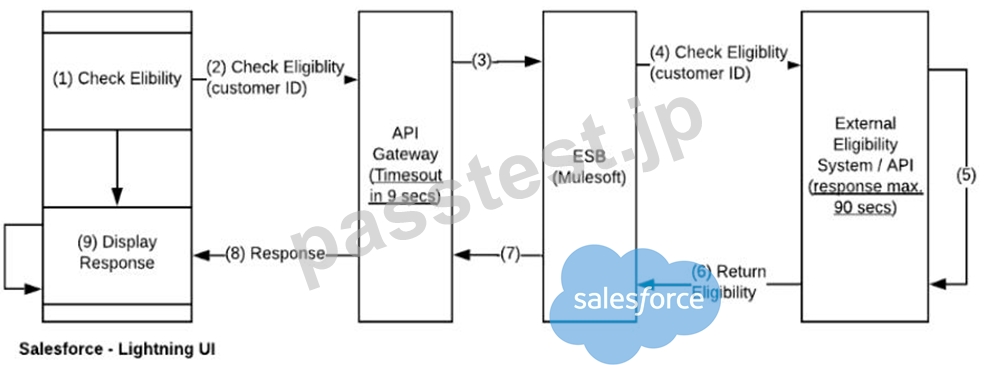
* About 3,000 phone sales agents use a Salesforce Lightning UI concurrently to check eligibility of a customer for a qualifying offer.
* There are multiple eligibility systems that provides this service and are hosted externally. However, their current response times could take up to 90 seconds to process and return (there are discussions to reduce the response times in future, but no commitments are made).
* These eligibility systems can be accessed through APIs orchestrated via ESB (MuleSoft).
* All requests from Salesforce will have to traverse through customer's API Gateway layer and the API Gateway imposes a constraint of timing out requests after 9 seconds.
Which three recommendations should be made?
Choose 3 answers
- A. Recommend synchronous Apex call-outs from Lightning UI to External Systems via Mule and implement polling on API gateway timeout.
- B. When responses are received by Mule, create a Platform Event in Salesforce via Remote-Call-In and use the empAPI in the lightning UI to serve 3,000 concurrent users.
- C. ESB (Mule) with cache/state management to return a requestID (or) response if available from external system.
- D. Implement a 'Check Update' button that passes a requestID received from ESB (user action needed).
- E. Use Continuation callouts to make the eligibility check request from Salesforce from Lightning UI at page load.
正解:C、D、E
質問 # 68
What is the first thing an Integration Architect should validate if a callout from a LightningWeb Component to an external endpoint is failing?
- A. The endpoint URL has been added to Remote Site Settings.
- B. The endpoint domain has been added to Cross-Origin Resource Sharing.
- C. The endpoint URL has been added to Content Security Policies.
- D. The endpoint URL has added been to an outbound firewall rule.
正解:A
解説:
Explanation
The first thing an integration architect should validate if a callout from a Lightning Web Component to an external endpoint is failing is the endpoint domain has been added to Cross-Origin Resource Sharing (CORS).
CORS is a mechanism that allows web browsers to make requests to servers on different origins, such as different domains, protocols, or ports. CORS requires the server to send back a special header that indicates whether the browser is allowed to access the resource or not. If the endpoint domain is not added to the CORS whitelist in Salesforce, the browser will block the callout and throw an error. Option B is not correct because Content Security Policies (CSP) are used to control what resources can be loaded on a Visualforce or Lightning page, such as scripts, stylesheets, images, etc. CSP does not affect the callout from a Lightning Web Component to an external endpoint. Option C is not correct because outbound firewall rules are used to restrict the network traffic from Salesforce to external systems. Firewall rules are configured at the network level, not at the Salesforce level. Option D is not correct because Remote Site Settings are used to specify the domains that are allowed for callouts from Apex code, not from Lightning Web Components. References:
Working with CORS and CSP to Call APIs from LWC
[Cross-Origin Resource Sharing (CORS)]
質問 # 69
Universal Containers is a global financial company that sells financial products and services including, bank accounts, loans, and insurance. UC uses Salesforce Service cloud to service their customer via calls, live chat. The support agents would open bank accounts on the spot for customers who are inquiring about UC bank accounts.
UC Core banking system is the system of record for bank accounts and all accounts opened in salesforce have to be synced in real-time to the core banking system. Support agents need to inform the customers with the newly created bank account ID which has to be generated from the core banking system.
Which integration pattern is recommended for this use case?
- A. Use outbound message.
- B. Use streaming API to generate push topic.
- C. Use salesforce platform event.
- D. Use request and reply.
正解:D
質問 # 70
A company wants to standardize exception tracking, handling, and analytics. Given the following actions:
1. Build a company wide logging service hosted on a middleware platform
2. Create case object records for exceptions based thresholds
3. Change all their Apex Loggers to publish Application Exceptions as custom Platform Events.
Which two specifications should the integration architect include in the logging service architecture?
Choose 2 answers
- A. Subscribe to the Application Exceptions using the Salesforce Streaming API.
- B. Create Salesforce Cases using the Salesforce REST, SOAP or Bulk API.
- C. Receive Application Events through Change Data Capture (CDC).
- D. Create Salesforce Cases conditionally using automatic Case creation rules.
正解:B、D
質問 # 71
A call center manager uses a custom dashboard to track Case related metrics. The manager wants a component to display the number of closed Cases in real time.
What type of event should be used to meet this requirement?
- A. Platform Event
- B. Change Data Capture Event
- C. Push Topic Event
- D. Generic Event
正解:B
解説:
Explanation
Change Data Capture Event is the best option to meet this requirement. Change Data Capture Event is a type of streaming event that notifies subscribers of changes to Salesforce records, such as creation, update, delete, and undelete operations1. By subscribing to Change Data Capture Event for the Case object, the dashboard component can receive real-time updates on the number of closed Cases. Push Topic Event is another type of streaming event that notifies subscribers of changes to Salesforce records that match a SOQL query2. However, Push Topic Event has some limitations, such as not supporting all SOQL features and not capturing delete and undelete operations3. Platform Event is a type of streaming event that delivers custom notifications within the Salesforce platform or from external sources4. Platform Event is not suitable for this requirement because it is not tied to Salesforce records and requires custom logic to publish and subscribe. Generic Event is a type of streaming event that sends custom JSON notifications to subscribers without a predefined schema5. Generic Event is not suitable for this requirement because it is not tied to Salesforce records and requires custom logic to publish and subscribe.
質問 # 72
Northern Trail Outfitters uses a custom Java application to display code coverage and test results for all of their enterprise applications and is planning to include Salesforce as well.
Which Salesforce API should an Integration Architect use to meet the requirement?
- A. SOAP API
- B. Tooling API
- C. Metadata API
- D. Analytics REST API
正解:B
解説:
https://developer.salesforce.com/docs/atlas.en-us.api_tooling.meta/api_tooling/tooling_api_objects_apexcodecoverage.htm
質問 # 73
A company's security assessment noted vulnerabilities on the un managed packages in their Salesforce orgs, notably secrets that are easily accessible and in plain text, such as usernames, passwords, and OAuth tokens used in callouts from Salesforce.
Which two persistence mechanisms should an integration architect require to be used to ensure that secrets are protected from deliberate or inadvertent exposure?
Choose 2 answers
- A. Protected Custom Metadata Types
- B. Encrypted Custom Fields
- C. Protected Custom Settings
- D. Named Credentials
正解:C、D
解説:
Explanation
Named Credentials and Protected Custom Settings are two persistence mechanisms that can be used to ensure that secrets are protected from deliberate or inadvertent exposure. Named Credentials allow you to specify the URL of a callout endpoint and its required authentication parameters in one definition. Salesforce manages all the authentication for Apex callouts that specify a named credential as the callout endpoint, and you don't have to add more authentication logic in your Apex code. Named Credentials can be defined to provide a secure and convenient way of setting up authenticated callouts, and they can also be used in Lightning components, Visualforce pages, and flows1.
Protected Custom Settings are a type of custom settings that store application-specific data that is hidden from subscribers. They are only accessible by the managed package that created them, and they can be used to store secrets such as encryption keys, passwords, or tokens. Protected Custom Settings can be accessed by Apex code, formulas, or validation rules within the same namespace as the settings2.
Encrypted Custom Fields are not a suitable mechanism for storing secrets, because they are not designed to prevent unauthorized access to sensitive data. Encrypted Custom Fields allow you to encrypt text fields using a standard encryption scheme. The encrypted data is masked in reports, list views, and search results, but it can still be viewed by users who have the "View Encrypted Data" permission. Encrypted Custom Fields are intended to protect data from unauthorized access by users within your organization, not from external threats or malicious code3.
Protected Custom Metadata Types are another type of custom metadata types that store application-specific data that is hidden from subscribers. They are similar to Protected Custom Settings, but they have some advantages such as being deployable using change sets or Metadata API, being accessible by SOQL queries, and being able to reference other metadata types or settings. However, Protected Custom Metadata Types cannot be used to store secrets, because they do not support encryption or masking of sensitive data. Protected Custom Metadata Types are intended to store configuration data that is specific to your managed package, not secrets that need to be secured.
Therefore, the correct answer is B and D, because Named Credentials and Protected Custom Settings are the only persistence mechanisms that can be used to securely store secrets in Salesforce.
References: 1: Named Credentials | Apex Developer Guide | Salesforce Developers 2: Custom Settings | Apex Developer Guide | Salesforce Developers 3: Encrypted Fields | Salesforce Help : [Protected Custom Metadata Types | ISVforce Guide | Salesforce Developers]
質問 # 74
A new Salesforce program has the following high-level abstract requirement: Business processes executed on Salesforce require data updates between their Internal systems and Salesforce.
Which relevant detail should an integration architect seek to specifically solve for integration architecture needs of the program?
- A. Core functional and non-functional requirements for User Experience design, Encryption needs, Community and license choices
- B. Integration skills, SME availability, and Program Governance details
- C. Timing aspects, real-time/near real-time (synchronous or asynchronous), batch and update frequency
正解:C
解説:
Explanation
Timing aspects, real-time/near real-time (synchronous or asynchronous), batch and update frequency are relevant details that an integration architect should seek to specifically solve for integration architecture needs of the program. These details help to determine the appropriate integration pattern, technology, and solution for the business requirements. Core functional and non-functional requirements for User Experience design, Encryption needs, Community and license choices are important for the overall program design, but not specific to the integration architecture needs. Integration skills, SME availability, and Program Governance details are also important for the program execution, but not specific to the integration architecture needs.
質問 # 75
A company's security assessment noted vulnerabilities on the un managed packages in their Salesforce orgs, notably secrets that are easily accessible and in plain text, such as usernames, passwords, and OAuth tokens used in callouts from Salesforce.
Which two persistence mechanisms should an integration architect require to be used to ensure that secrets are protected from deliberate or inadvertent exposure?
Choose 2 answers
- A. Encrypted Custom Fields
- B. Protected Custom Metadata Types
- C. Protected Custom Settings
- D. Named Credentials
正解:A、D
質問 # 76
Given the diagram below, a Salesforce org, middleware, and Historical data store (with
20million records and growing) exists with connectivity between them
Historical records are archived from Salesforce and moved to Historical Data store (which houses 20M records and growing; fine-tuned to be performant with search queries).
Call center agents use Salesforce, when reviewing occasional special cases, have requested access to view the related historical case items that relate to submit cases.
Which mechanism and patterns are recommended to maximize declarative configuration?
- A. C Use an ESB tool with a fire and forget pattern and then publish a platform event for the requested historical data.
- B. Use an ESB tool with Request-Reply pattern and then make a real-time Apex callout to the ESB endpoint to fetch and display component related to Case object
- C. Use ESB tool with Data Virtualization pattern, expose OData endpoint, and then use Salesforce Connect to consume and display the External Object alongside with the Caseobject.
- D. Use an ETL tool with a Batch Data Synchronization pattern to migrate historical data into Salesforce and into a custom object (historical data) related to Case object.
正解:C
質問 # 77
Northern Trail Outfitters (NTO) is looking to integrate three external systems that run nightly data enrichment processes in Salesforce. NTO has both of the following security and strict auditing requirements:
1. The external systems must follow the principle of least privilege, and
2. The activities of the eternal systems must be available for audit.
What should an Integration Architect recommend as a solution for these integrations?
- A. A unique integration user for each external system integration.
- B. A shared integration user for the three external system integrations.
- C. A Connected App for each external system integration.
- D. A shared Connected App for the three external system integrations.
正解:C
質問 # 78
Northern Trail Outfitters (NTO) has recently changed their Corporate Security Guidelines. The guidelines require that all cloud applications pass through a secure firewall before accessing on-premise resources. NTO is evaluating middleware solutions to integrate cloud applications with on-premise resources and services.
What are two considerations an Integration Architect should evaluate before choosing a middleware solution?
Choose 2 answers
- A. The middleware solution is capable of establishing a secure API gateway between cloud applications and on-premise resources.
- B. The middleware solution is able to interface directly with databases via an ODBC connection string.
- C. The middleware solution enforces the OAuth security protocol.
- D. An API gateway component is deployable behind a Demilitarized Zone (DMZ) or perimeter network.
正解:A、D
質問 # 79
Universal Containers (UC) is a leading provider of management training globally, UC embarked on a Salesforce transformation journey to allow students to register for courses in the Salesforce community. UC has a learning system that masters all courses and student registration.
UC requested a near real-time feed of student registration from Salesforce to the learning system. The integration architect recommends using Salesforce event.
Which API should be used for the Salesforce platform event solution?
- A. SOAP API
- B. Tooling API
- C. O REST AP
- D. Streaming API
正解:B
解説:
Explanation
The API that should be used for the Salesforce platform event solution is Tooling API.
Tooling API is a specialized API that exposes metadata used in developer tooling that you can access through REST or SOAP.
You can use Tooling API to create, update, or delete platform event definitions and fields4 Streaming API is used to subscribe to platform events and receive notifications when they are published5
References: Platform Events Developer Guide | Salesforce Developers, Define and Publish Platform Events Unit | Salesforce Trailhead
質問 # 80
Universal Containers has a requirement for all accounts that do NOT qualify for a business extension (Custom field on the account record) for the next month to send a meeting invite to their contacts from the marketing automation system to discuss the next steps. It is estimated there will be approximately 1MilIion contacts per month.
What is the recommended solution?
- A. Use Time-based workflow rule.
- B. Use Batch Apex.
- C. Use Process builder.
- D. Use Trigger.
正解:B
質問 # 81
business requires automating the check and update of the phone number type classification (mobile vs. landline) for all in-coming calls delivered to their phone sales agents. The following conditions exist:
1. At peak, their call center can receive up to100,000 calls per day.
2. The phone number type classification is a service provided by an external service API.
3. Business is flexible with timing and frequency to check and update the records (throughout the night or every 6-12 hours is sufficient).
ARemote-Call-In pattern and/or Batch Synchronization (Replication via ETL: System -> Salesforce) are determined to work with a middleware hosted on custom premise.
In order to implement these patterns and mechanisms, which component should an integration architect recommend?
- A. IoConfigure Remote Site Settings in Salesforce to authenticate the middleware.
- B. An API Gateway that authenticates requests from Salesforce into the Middleware (ETL/ESB).
- C. Firewall and reverse proxy are required to protect internal APIs and resource being exposed.
- D. ConnectedApp configured in Salesforce to authenticate the middleware.
正解:D
解説:
Explanation
A Connected App is a framework that enables an external application to integrate with Salesforce using APIs and standard protocols, such as OAuth. By configuring a Connected App in Salesforce, the integration can authenticate the middleware and grant access to the Salesforce data and services. This is a secure and flexible solution that does not require configuring Remote Site Settings, API Gateway, or Firewall and reverse proxy2 References: 1: BatchApexErrorEvent 2: Connected Apps
質問 # 82
Northern Trail Outfitters needs to use Shield Platform Encryption to encrypt social security numbers in order to meet a business requirement.
Which two considerations should an Integration Architect do prior to the implementation of Shield Platform Encryption?
Choose 2 answers
- A. Encrypt all the data so that it is secure.
- B. Use Shield Platform Encryption as a user authentication or authorization tool.
- C. Review shield platform encryption configurations.
- D. Encrypt the data using the most current key.
正解:C、D
質問 # 83
Northern Trail Outfitters (NTO) has recently implemented middleware for orchestration of services across platforms. The ERP system being used requires transactions be captured near real time at a REST endpoint initiated in Salesforce when creating an order object. Additionally, the Salesforce team has limited development resources and requires a low code solution.
Which two options will fulfill the use case requirements?
Choose 2 answers
- A. Implement Change Data Capture on the order object and leverage the replay Idin the middleware solution.
- B. Implement a Workflow Rule with Outbound Messaging to send SOAP messages to the designated endpoint.
- C. Use Remote Process Invocation fire and forget pattern on insert on the order object using Flow Builder.
- D. Use a process builder to create a Platform Event, selecting the record type as the Platform Event Name on insert of record.
正解:A、C
解説:
Explanation
Answer A is valid because the Remote Process Invocation fire and forget pattern allows sending a message from Salesforce to the ERP system without waiting for a response or acknowledgement. This enables near real-time integration and reduces the latency and complexity of the integration. The Flow Builder is a low code tool that can be used to invoke an Apex action that makes the HTTP callout to the REST endpoint on insert of the order object12 Answer C is valid because the Change Data Capture feature allows capturing changes in Salesforce data and publishing them as events to a streaming channel. The middleware can subscribe to the channel and receive the events that contain the order details. The replay Id is a unique identifier for each event that can be used by the middleware to resume from the last processed event in case of failures or interruptions. This ensures reliable and consistent integration between Salesforce and the ERP system3 Answer B is not valid because the Outbound Messaging feature uses SOAP messages to send notifications to external systems based on workflow rules. This requires configuring a SOAP endpoint and a WSDL file for the ERP system, which may not be compatible with the REST endpoint requirement. Moreover, Outbound Messaging does not guarantee delivery or order of messages, which may affect the accuracy and timeliness of the integration.
Answer D is not valid because the Platform Event feature allows publishing custom events from Salesforce to external systems or vice versa using a publish/subscribe model. However, this requires creating a platform event object and defining its fields and permissions, which may not be a low code solution. Moreover, using the record type as the platform event name may not be a valid or meaningful option, as record types are used to define different business processes or user interfaces for an object.
1: Remote Process Invocation-Fire and Forget 2: Invoke an Apex Class That Makes a Callout 3: Change Data Capture : Replay Events Using Middleware : Outbound Messaging Implementation Guide : Platform Events Developer Guide
質問 # 84
......
Salesforce Integration-Architect事前試験練習テストはPassTest:https://www.passtest.jp/Salesforce/Integration-Architect-shiken.html
Integration-Architect練習テスト問題、解答、解釈:https://drive.google.com/open?id=1W3brHp45aSN0RWgKlrQQkBcfpTbE1Crh