

更新された2024年02月合格させるOGEA-101試験リアル練習テスト問題
無料ダウンロードThe Open Group OGEA-101リアル試験問題
質問 # 29
What is presented as "striking a balance between positive and negative outcomes resulting from the realization of either opportunities or threats?
- A. Architecture Security
- B. Agile development
- C. Transition Management
- D. Risk Management
正解:D
解説:
Risk Management is the process of identifying, assessing, and responding to risks that may affect the achievement of the enterprise's objectives. Risk Management involves balancing positive and negative outcomes resulting from the realization of either opportunities or threats. Reference: The TOGAF Standard | The Open Group Website, Section 3.3.3 Risk Management.
質問 # 30
Which of the following is the ability to develop use and sustain the architecture of a particular enterprise using architecture to govern change?
- A. An EA repository
- B. An EA Capability
- C. An EA framework
- D. An Enterprise Architecture
正解:B
解説:
The ability to develop, use, and sustain the architecture of a particular enterprise using architecture to govern change is an EA Capability. An EA Capability is a set of skills, processes, roles, responsibilities, tools, and techniques that enable an enterprise to successfully develop and maintain its Enterprise Architecture and achieve its desired outcomes. An EA Capability is part of an enterprise's overall capability portfolio and should be aligned with its strategy and objectives. Reference: The TOGAF Standard | The Open Group Website, Section 3.2 Preliminary Phase.
質問 # 31
Which of the following describes a purpose of Architecture Principles?
- A. To describe likely impacts resulting from successful deployment of the target architecture.
- B. To form a contract between sponsoring organization and the enterprise architects
- C. To establish a common understanding of how to control the business in pursuit of strategic objectives
- D. To provide a better understanding about the enterprise's culture and values
正解:C
解説:
Architecture Principles are general rules and guidelines that inform and support the way in which an organization sets about fulfilling its mission. They reflect a level of consensus among the various elements of the enterprise, and form the basis for making future IT decisions. One of the purposes of Architecture Principles is to establish a common understanding of how to control the business in pursuit of strategic objectives, by providing a framework for evaluating and agreeing on the changes that affect the enterprise's architecture3 Reference: 3: The TOGAF Standard, Version 9.2, Part III: ADM Guidelines and Techniques, Chapter 23: Architecture Principles : The TOGAF Standard, Version 9.2, Part IV: Architecture Content Framework, Chapter 31: Architecture Principles
質問 # 32
What are the following activities part of?
. Risk classification
. Risk identification
. Initial risk assessment
- A. Security Architecture
- B. Phase A
- C. Phase G
- D. Risk Management
正解:D
解説:
Risk management is a generic technique that can be applied across all phases of the Architecture Development Method (ADM), as well as in the Preliminary Phase and the Requirements Management Phase2. Risk management involves the following steps1:
* Risk identification: This step involves identifying the potential risks that may affect the architecture project, such as technical, business, organizational, environmental, or legal risks. The risks can be identified through various sources, such as stakeholder interviews, workshops, surveys, checklists, historical data, or expert judgment.
* Risk classification: This step involves categorizing the risks based on their nature, source, impact, and priority. The risks can be classified according to different criteria, such as time, cost, scope, quality, security, or compliance. The classification helps in prioritizing the risks and allocating resources and efforts to address them effectively.
* Initial risk assessment: This step involves assessing the likelihood and impact of each risk, and determining the initial level of risk. The likelihood is the probability of the risk occurring, and the impact is the severity of the consequences if the risk occurs. The initial level of risk is the product of the likelihood and impact, and it indicates the urgency and importance of the risk. The initial risk assessment helps in identifying the most critical risks that need immediate attention and mitigation.
質問 # 33
Consider the following statements:
1. Groups of countries, governments, or governmental organizations (such as militaries) working together to create common or shareable deliverables or infrastructures
2. Partnerships and alliances of businesses working together, such as a consortium or supply chain What are those examples of according to the TOGAF Standard?
- A. Architectures Scopes
- B. Organizations
- C. Business Units
- D. Enterprises
正解:A
解説:
According to the TOGAF standard, the two statements provided refer to different scopes within which architecture can be developed:
1.Groups of countries, governments, or governmental organizations working together typically align with broader, often international, scopes of architecture that transcend individual enterprise boundaries.
1.Partnerships and alliances of businesses working together, such as a consortium or supply chain, refer to collaborative efforts that can define architecture at a scope involving multiple enterprises.
In both cases, the term "Architectures Scopes" is appropriate because it reflects the varying levels and contexts in which architectures can be defined, ranging from single business units to collaborative inter-organizational efforts.
質問 # 34
The_________________ensures that a project transitioning into implementation also smoothly transitions into appropriate Architecture Governance.
- A. Implementation Governance Model
- B. Transition Plan
- C. Migration Plan
- D. Implementation Strategy
正解:A
解説:
The Implementation Governance Model is a framework that defines the roles, responsibilities, processes, and standards for governing the implementation of the target architecture. It ensures that a project transitioning into implementation also smoothly transitions into appropriate Architecture Governance, which is the practice of ensuring compliance with the enterprise architecture and its principles, standards, and goals. The Implementation Governance Model is part of the Implementation and Migration Plan, which is the output of Phase F: Migration Planning of the Architecture Development Method (ADM)12 Reference: 1: The TOGAF Standard, Version 9.2, Part II: Architecture Development Method (ADM), Chapter 21: Phase F: Migration Planning 2: The TOGAF Standard, Version 9.2, Part VI: Architecture Capability Framework, Chapter 50: Architecture Governance
質問 # 35
Which ADM phase focuses on defining the problem to be solved, identifying the stakeholders, their concerns, and requirements?
- A. Phase
- B. Phase
- C. Preliminary Phase
- D. Phase A
正解:D
解説:
Phase A: Architecture Vision is the first phase of the Architecture Development Method (ADM) cycle, which is the core of the TOGAF standard. The main purpose of this phase is to define the scope and approach of the architecture development, and to create the Architecture Vision, which is a high-level description of the desired outcomes and benefits of the proposed architecture. To achieve this purpose, this phase focuses on defining the problem to be solved, identifying the stakeholders, their concerns, and requirements, and establishing the business goals and drivers that motivate the architecture work. This phase also involves obtaining the approval and commitment of the sponsors and other key stakeholders, and initiating the Architecture Governance process.
質問 # 36
Consider the following chart: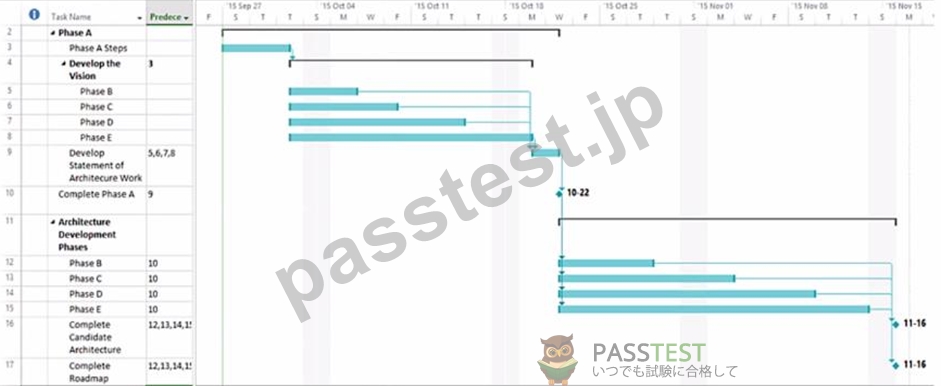
Which important concept for Enterprise Architecture Practitioners does it illustrate?
- A. Enterprise Architects must use Gantt charts to communicate with Stakeholders.
- B. An Enterprise Architecture must be developed in phases with a limited fixed duration.
- C. ADM phases must be run simultaneously until the relevant information has been produced.
- D. ADM phases must be run in a sequenced approach to produce the Architecture.
正解:D
解説:
The chart shown is a Gantt chart, which is commonly used for project management to illustrate a project schedule. In the context of TOGAF (The Open Group Architecture Framework), which is a framework for enterprise architecture, this Gantt chart is demonstrating the sequenced approach to the Architecture Development Method (ADM). The ADM is the core process of TOGAF which provides a tested and repeatable process for developing architectures. The ADM is described as being iterative, over the whole process, between phases, and within phases. For each iteration of the ADM, a fresh decision must be taken about each of the parameters (scope, granularity, time period, and architecture assets).
The ADM consists of a number of phases that have to be followed in sequence:
* Preliminary Phase: Framework and principles
* Phase A: Architecture Vision
* Phase B: Business Architecture
* Phase C: Information Systems Architectures, including Data and Application Architectures
* Phase D: Technology Architecture
* Phase E: Opportunities and Solutions
* Phase F: Migration Planning
* Phase G: Implementation Governance
* Phase H: Architecture Change Management
* Requirements Management
Each phase is dependent on the outputs of the previous phase and the Requirements Management phase runs throughout. The Gantt chart clearly shows the dependency and sequence in which these phases occur, implying that a structured approach is followed to produce the enterprise architecture.
Reference:
* The TOGAF Standard, Version 9.2, a standard of The Open Group
* The TOGAF documentation available at https://publications.opengroup.org/standards/architecture and https://publications.opengroup.org/guides/architecture
質問 # 37
What is an objective of the ADM Preliminary Phase?
- A. To create the initial version of the Architecture Roadmap
- B. To develop a vision of the business value to be delivered by the proposed enterprise architecture
- C. To select and implement tools to support the Architecture Capability
- D. To obtain approval for the Statement of Architecture Work
正解:C
解説:
The Preliminary Phase is the preparatory phase of the Architecture Development Method (ADM) cycle, which sets the context and direction for the architecture work. One of the objectives of this phase is to select and implement tools to support the Architecture Capability, which is the ability of an organization to perform enterprise architecture effectively and efficiently. Tools can include software applications, methods, techniques, standards, and frameworks that assist the architecture development and governance processes. The selection and implementation of tools should be based on the requirements and constraints of the organization, and the alignment with the Architecture Principles and the Architecture Vision3 Reference: 3: The TOGAF Standard, Version 9.2, Part II: Architecture Development Method (ADM), Chapter 6: Preliminary Phase : The TOGAF Standard, Version 9.2, Part VI: Architecture Capability Framework, Chapter 45: Establishing and Maintaining an Enterprise Architecture Capability : The TOGAF Standard, Version 9.2, Part VI: Architecture Capability Framework, Chapter 46: Tools for Architecture Development
質問 # 38
Which of the following supports the need to govern Enterprise Architecture?
- A. The Stakeholders preferences may go beyond the architecture project scope and needs control
- B. Best practice governance enables the organization to control value realization
- C. The Architecture Project mandates the governance of the target architecture
- D. The TOGAF standard cannot be used without executive governance
正解:B
解説:
This statement best supports the need to govern Enterprise Architecture. Best practice governance enables the organization to control value realization by ensuring that architectures are aligned with the enterprise's strategy and objectives, meet the quality and performance requirements, and deliver the expected benefits and outcomes. The Architecture Project does not mandate the governance of the target architecture, but rather follows the governance framework established by the enterprise. The TOGAF standard can be used without executive governance, but it is recommended that executive sponsorship and support are obtained for successful architecture development and transition. The Stakeholders preferences may go beyond the architecture project scope and need control, but this is not the primary reason for governing Enterprise Architecture. Reference: The TOGAF Standard | The Open Group Website, Section 3.3.6 Architecture Governance.
質問 # 39
Consider the following ADM phases objectives.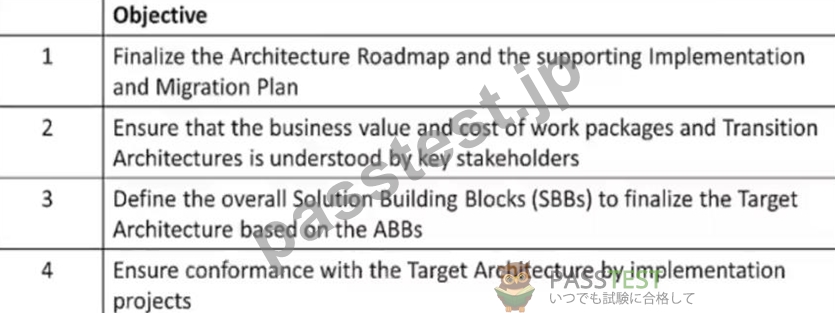
Which phase does each objective match?
- A. 1E-2F-3E-4G
- B. 1F-2G-3F-4F
- C. 1G-2E-3F-4E
- D. 1F-2F-3E-4G
正解:A
解説:
1E: To identify delivery vehicles (projects programs portfolios) that will deliver the Target Architecture 2F: To confirm readiness and ability to undergo change 3E: To determine whether an incremental approach is required and if so identify Transition Architectures that will deliver continuous business value 4G: To perform appropriate governance functions while the solution is being implemented
質問 # 40
Which section of the TOGAF template for Architecture Principles should describe the relationship to other principles?
- A. Name
- B. Rationale
- C. Implications
- D. Statement
正解:B
解説:
According to the TOGAF template for Architecture Principles, the Rationale section should describe the relationship to other principles, as well as the business benefits and the intentions of adhering to the principle. The Rationale section should use business terminology and point to the similarity of information and technology principles to the principles governing business operations. The Rationale section should also explain how the principle supports the achievement of the business objectives and key architecture drivers. Reference:
* Architecture Principles Template
* The TOGAF Standard, Version 9.2 - Architecture Principles
* The Open Group Exam OGEA-103 Topic 1 Question 4 Discussion
質問 # 41
Consider the following ADM phases objectives.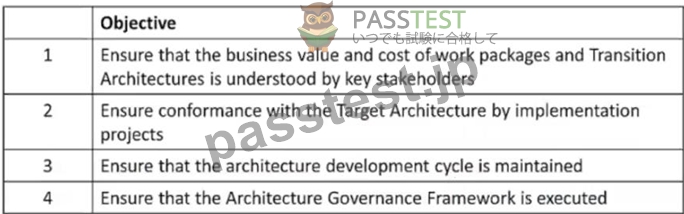
Which phase does each objective match?
- A. 1G-2H-3H-4F
- B. 1F-2G-3H-4H
- C. 1F-2G-3G-4H
- D. 1H-2F-3F-4G
正解:D
解説:
* According to the TOGAF Standard, Version 9.2, the ADM phases and their objectives are as follows1:
oPreliminary Phase: To prepare and initiate the architecture development cycle, including defining the architecture framework, principles, and governance.
oPhase A: Architecture Vision: To define the scope, vision, and stakeholders of the architecture initiative, and to obtain approval to proceed.
oPhase B: Business Architecture: To describe the baseline and target business architecture, and to identify the gaps between them.
oPhase C: Information Systems Architectures: To describe the baseline and target data and application architectures, and to identify the gaps between them.
oPhase D: Technology Architecture: To describe the baseline and target technology architecture, and to identify the gaps between them.
oPhase E: Opportunities and Solutions: To identify and evaluate the opportunities and solutions for implementing the target architecture, and to define the work packages and transition architectures.
oPhase F: Migration Planning: To finalize the implementation and migration plan, and to ensure alignment with the enterprise portfolio and project management.
oPhase G: Implementation Governance: To provide architecture oversight and guidance for the implementation projects, and to manage any architecture change requests.
oPhase H: Architecture Change Management: To monitor the changes in the business and technology environment, and to assess the impact and performance of the architecture.
oRequirements Management: To manage the architecture requirements throughout the ADM cycle, and to ensure alignment with the business requirements.
* Based on the above definitions, we can match each objective with the corresponding phase as follows:
oObjective 1: Ensure that the business value and cost of work packages and transition architectures is understood by key stakeholders. This objective is achieved in Phase H: Architecture Change Management, where the value realization and cost-benefit analysis of the architecture are performed2.
oObjective 2: Ensure conformance with the Target Architecture by implementation projects. This objective is achieved in Phase F: Migration Planning, where the conformance requirements and criteria for the implementation projects are defined3.
oObjective 3: Ensure that the architecture development cycle is maintained. This objective is achieved in Phase F: Migration Planning, where the architecture roadmap and iteration cycle are maintained3.
oObjective 4: Ensure that the Architecture Governance Framework is executed. This objective is achieved in Phase G: Implementation Governance, where the architecture governance processes and procedures are applied to the implementation projects4.
Reference:
* 1: The TOGAF Standard, Version 9.2, Chapter 5: Architecture Development Method (ADM)
* 2: The TOGAF Standard, Version 9.2, Chapter 21: Architecture Change Management
* 3: The TOGAF Standard, Version 9.2, Chapter 20: Migration Planning
* 4: The TOGAF Standard, Version 9.2, Chapter 19: Implementation Governance
質問 # 42
Complete the sentence The TOGAF standard covers the development of four architecture domains. Business. Data, Technology and__________________.
- A. Transition
- B. Segment
- C. Application
- D. Capability
正解:C
解説:
The TOGAF standard covers the development of four architecture domains: Business, Data, Technology and Application. These domains represent different aspects of an enterprise's architecture and provide a consistent way of describing, analyzing, and designing them. Reference: The TOGAF Standard | The Open Group Website, Section 2.2 Architecture Development Method (ADM).
質問 # 43
Which of the following best describes the purpose of the Architecture Roadmap?
- A. It lists work packages on a timeline showing progress towards the Target Architecture
- B. It provides for effective communication of the end architecture project to the stakeholders
- C. It forms the basis of a contractual agreement between the sponsor and the architecture organization
- D. It is sent from the sponsor and triggers the start of an architecture development cycle
正解:A
解説:
The purpose of the Architecture Roadmap is to provide a high-level view of how the Baseline Architecture will transition to the Target Architecture over time. It lists work packages on a timeline showing progress towards the Target Architecture, as well as dependencies, risks, and benefits. The Architecture Roadmap forms part of the Implementation and Migration Plan and guides the execution of the architecture projects. Reference: https://pubs.opengroup.org/architecture/togaf9-doc/arch/chap20.html
質問 # 44
Consider the following ADM phases objectives.
Objective:
1. Develop the Target Data Architecture that enables the Business Architecture and the Architecture Vision
2. Develop the Target Business Architecture that describes how the enterprise needs to operate to achieve the business goals
3. Develop a high-level aspirational vision of the capabilities and business value to be delivered as a result of the proposed Enterprise Architecture
4. Identify candidate Architecture Roadmap components based upon gaps between the Baseline and Target Technology Architectures Which phase does each objective match?
- A. 1A-2B-3C-4D
- B. 1C-2D-3B-4A
- C. 1B-2D-3A-4C
- D. 1C-2B-3A-4D
正解:D
解説:
* Phase A: Architecture Vision
o Develop a high-level aspirational vision of the capabilities and business value to be delivered as a result of the proposed Enterprise Architecture o Define the scope and boundaries of the architecture engagement o Identify the key stakeholders and their concerns and expectations o Define the Architecture Vision statement and the Architecture Definition Document o Obtain approval and commitment from the sponsors and stakeholders
* Phase B: Business Architecture
o Develop the Target Business Architecture that describes how the enterprise needs to operate to achieve the business goals o Define the Baseline Business Architecture, if not available o Perform a gap analysis between the Baseline and Target Business Architectures o Define candidate roadmap components for the Business Architecture o Resolve impacts across the Architecture Landscape
* Phase C: Information Systems Architecture
o Develop the Target Data Architecture that enables the Business Architecture and the Architecture Vision o Develop the Target Application Architecture that supports the Business Architecture and the Architecture Vision o Define the Baseline Data and Application Architectures, if not available o Perform a gap analysis between the Baseline and Target Data and Application Architectures o Define candidate roadmap components for the Information Systems Architecture o Resolve impacts across the Architecture Landscape
* Phase D: Technology Architecture
o Develop the Target Technology Architecture that enables the Information Systems Architecture and the Architecture Vision o Define the Baseline Technology Architecture, if not available o Perform a gap analysis between the Baseline and Target Technology Architectures o Identify candidate Architecture Roadmap components based upon gaps between the Baseline and Target Technology Architectures o Resolve impacts across the Architecture Landscape Therefore, the correct matching of the objectives and the phases is:
* 1C: Develop the Target Data Architecture that enables the Business Architecture and the Architecture Vision
* 2B: Develop the Target Business Architecture that describes how the enterprise needs to operate to achieve the business goals
* 3A: Develop a high-level aspirational vision of the capabilities and business value to be delivered as a result of the proposed Enterprise Architecture
* 4D: Identify candidate Architecture Roadmap components based upon gaps between the Baseline and Target Technology Architectures
質問 # 45
Which phase of the ADM has the purpose to develop an Enterprise Architecture Capability?
- A. Phase A
- B. Phase G
- C. Preliminary Phase
- D. Phase B
正解:C
解説:
According to the TOGAF Standard, 10th Edition, the Preliminary Phase of the Architecture Development Method (ADM) has the purpose to develop an Enterprise Architecture Capability 1. An Enterprise Architecture Capability is the ability of the organization to perform the activities and tasks related to Enterprise Architecture, such as defining the scope, principles, vision, governance, and stakeholders of the architecture. The Preliminary Phase also establishes the architecture framework, the architecture repository, the architecture tools, and the architecture team 1. The other options are not correct, as they have different purposes in the ADM. Phase G: Implementation Governance has the purpose to ensure that the implementation projects conform to the target architecture 2. Phase A: Architecture Vision has the purpose to define the scope, stakeholders, business drivers, and objectives of the architecture project 3. Phase B: Business Architecture has the purpose to describe the baseline and target business architecture, and to identify the gaps between them . Reference: 1: TOGAF Standard, 10th Edition, Part II: Architecture Development Method, Chapter 6: Preliminary Phase. 2: TOGAF Standard, 10th Edition, Part II: Architecture Development Method, Chapter 18: Phase G: Implementation Governance. 3: TOGAF Standard, 10th Edition, Part II: Architecture Development Method, Chapter 12: Phase A: Architecture Vision. : TOGAF Standard, 10th Edition, Part II: Architecture Development Method, Chapter 13: Phase B: Business Architecture.
質問 # 46
Consider the following statement.
According to the TOGAF standard, a governed approach of a particular deliverable will ensure adherence to the principles, standards, and requirements of the existing or developing architectures.
Which deliverable does this refer to?
- A. The Architecture Definition Document
- B. The Architecture Vision
- C. An Architecture Contract
- D. The Statement of Architecture Work
正解:C
解説:
According to the TOGAF Standard, 10th Edition, an architecture contract is "a formal agreement between a service provider and a service consumer that defines the mutual commitments and expectations for the delivery of an architecture" 1. An architecture contract is a governed approach of a particular deliverable that will ensure adherence to the principles, standards, and requirements of the existing or developing architectures, as it specifies the roles, responsibilities, deliverables, quality criteria, and acceptance criteria for the architecture work 1. The other options are not correct, as they are not governed approaches of a particular deliverable, but rather different types of deliverables within the architecture development process. An architecture vision is "a high-level, aspirational view of the target architecture" 1. A statement of architecture work is "a document that defines the scope and approach that will be used to complete an architecture project" 1. An architecture definition document is "a document that describes the baseline and target architectures for one or more domains" 1. Reference: 1: TOGAF Standard, 10th Edition, Part I: Introduction, Chapter 3: Definitions.
質問 # 47
Exhibit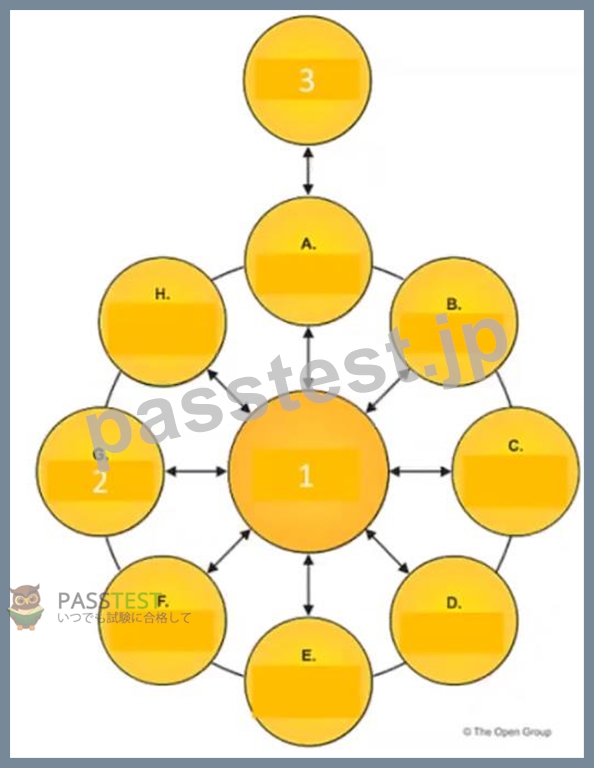
Consider the illustration showing an architecture development cycle Which description matches the phase of the ADM labeled as item 1?
- A. Provides architectural oversight for the implementation
- B. Conducts implementation planning for the architecture defined in previous phases
- C. Operates the process of managing architecture requirements
- D. Establishes procedures for managing change to the new architecture
正解:C
解説:
* The illustration shows an architecture development cycle based on the TOGAF ADM (Architecture Development Method), which is a method for developing and managing an enterprise architecture1.
* The ADM consists of nine phases, each with a specific purpose and output. The phases are1:
oPreliminary Phase: To prepare and initiate the architecture development cycle, including defining the architecture framework, principles, and governance.
oPhase A: Architecture Vision: To define the scope, vision, and stakeholders of the architecture initiative, and to obtain approval to proceed.
oPhase B: Business Architecture: To describe the baseline and target business architecture, and to identify the gaps between them.
oPhase C: Information Systems Architectures: To describe the baseline and target data and application architectures, and to identify the gaps between them.
oPhase D: Technology Architecture: To describe the baseline and target technology architecture, and to identify the gaps between them.
oPhase E: Opportunities and Solutions: To identify and evaluate the opportunities and solutions for implementing the target architecture, and to define the work packages and transition architectures.
oPhase F: Migration Planning: To finalize the implementation and migration plan, and to ensure alignment with the enterprise portfolio and project management.
oPhase G: Implementation Governance: To provide architecture oversight and guidance for the implementation projects, and to manage any architecture change requests.
oPhase H: Architecture Change Management: To monitor the changes in the business and technology environment, and to assess the impact and performance of the architecture.
* In addition to these phases, there is a central process called Requirements Management, which is labeled as item 1 in the illustration. This process operates throughout the ADM cycle, and its purpose is to manage the architecture requirements throughout the architecture development, ensuring that they are aligned with the business requirements and the stakeholder concerns2.
* Therefore, the description that matches the phase of the ADM labeled as item 1 is C. Operates the process of managing architecture requirements.
Reference:
* 1: The TOGAF Standard, Version 9.2, Chapter 5: Architecture Development Method (ADM)
* 2: The TOGAF Standard, Version 9.2, Chapter 17: Requirements Management
質問 # 48
Consider the following statement:
According to the TOGAF Standard a governed approach of a particular deliverable will ensure a system of continuous monitoring to check integrity changes decision-making and audit of all architecture-related activities Which deliverable is being referred to?
- A. The Architecture Definition Document
- B. The Architecture Vision
- C. An Architecture Contract
- D. The Statement of Architecture Work
正解:C
解説:
An Architecture Contract is a deliverable that specifies the responsibilities and obligations of the parties involved in the implementation and governance of an architecture. It ensures a system of continuous monitoring to check integrity changes decision-making and audit of all architecture-related activities. Reference: The TOGAF Standard | The Open Group Website, Section 3.3.4 Architecture Contracts.
質問 # 49
......
OGEA-101問題集100パー合格保証には最新のサンプル:https://www.passtest.jp/TheOpenGroup/OGEA-101-shiken.html
あなたを合格させる試験には100%確認済みOGEA-101試験問題:https://drive.google.com/open?id=1Qgkq0DVLcBU2P29iRYicmvXb6LoC49mn