

最高で有効なUiPath-ASAPv1試験問題と解答PDF UiPath-ASAPv1問題集(最近更新された108問あります)
試験問題解答はUiPath-ASAPv1学習ガイド
質問 # 27
What is the role of the Solution Architect in the creation of the ''The Automation Runbook" document?
- A. Constant -ensures the document is aligned with the PDD and SDD
- B. Accountable - ensures the document is approved and delivered
- C. Uninvolved - there is no Solution Architect involvement in this task
- D. Responsible - creates the document
正解:D
解説:
According to the UiPath Automation Solution Architect Learning Plan, the Solution Architect is responsible for creating the Automation Runbook document, which is a detailed guide for the deployment and maintenance of the automation solution. The Automation Runbook document contains information such as the automation objectives, scope, dependencies, risks, roles and responsibilities, deployment steps, testing scenarios, troubleshooting tips, and support contacts. The Automation Runbook document is created after the Solution Design Document (SDD) and before the deployment of the automation solution.
References:
UiPath Automation Solution Architect Learning Plan
Automation Suite - Alert Runbooks
Activities - Start Runbook
質問 # 28
Consider the following business scenario which has to be automated:
Invoices arrive in various mailboxes and their information must be extracted and entered into SAP Which architectural approach is best for this?
- A. Manually monitor and forward all the emails containing invokes to a centralized mailbox and then use a rule-based method to input the data into SAP.
- B. Design an architecture using UiPath Email activities to monitor emails and delegate the extraction and SAP input tasks to a third-party service that requires manual Input
- C. Design an architecture utilizing the UiPath Email activities to monitor and retrieve invoices from multiple mailboxes use Document Understanding to extract required information and employ the UiPath SAP activities to input the extracted data into SAP
- D. Design an architecture where each individual mailbox has its dedicated robot to download invoices use Document Understanding to extract required information and use SAP BAPi to input the extracted data into SAP
正解:C
解説:
This architectural approach is best for this scenario because it leverages the UiPath Platform capabilities to automate the end-to-end process of invoice processing. It uses the UiPath Email activities to connect to various mailboxes and retrieve the invoices as attachments. It then uses the UiPath Document Understanding framework to classify, extract, and validate the relevant information from the invoices, such as invoice number, date, amount, vendor, etc. It also uses the UiPath SAP activities to connect to the SAP system and input the extracted data into the appropriate fields and transactions. This approach is scalable, reliable, and efficient, as it does not require any manual intervention or third-party service. References: UiPath Automation Solution Architect Learning Plan, Module 4: High-Level Solution Design1; UiPath Automation Suite - Invoice Processing2; UiPath Academy - Roles of a Solution Architect in Automation, RPA Setting3.
質問 # 29
What is Storage Bucket used for in the following diagram?
- A. Storage of files for audit only
- B. Optimization of Al unit consumption
- C. Read only access to files
- D. Update of the classification data
正解:D
解説:
Storage buckets provide a per-folder storage solution for RPA developers to leverage in creating automation projects1. In the diagram, the Storage Bucket is used for updating information and uploading/moving unprocessed files. This is related to the classification data that is created and validated in the Action Center by the SME (Subject Matter Expert). The classification data is used to train the machine learning model that extracts data from the documents2.
References:
About Storage Buckets
UiPath Apps (Storage Bucket). Introduction
質問 # 30
What is the purpose of the UiPath Automation Hub within the UiPath ecosystem?
- A. Opportunity identification and pipeline management tor automations
- B. Construct process maps and accelerate the adoption of automations
- C. Digitization data integration and management for automations.
- D. Streamline communications between teams and orchestration of automatons
正解:A
解説:
UiPath Automation Hub is a collaborative tool that helps users discover and manage automation opportunities and process improvements, prioritized by impact and ROI. It also facilitates collaboration across SMEs, developers, and the CoE, and provides a central repository for process documentation and reusable components.
References:
Automation Hub - Automation Pipeline Management | UiPath
Automation Hub - Introduction
UiPath Automation Hub Overview | UiPath Academy
質問 # 31
A medium-sized insurance company is struggling with the repetitive, time-consuming task of processing insurance claims. The company management is looking for a low-cost innovative solution to streamline and Automate the claims processing workflow to increase efficiency and save time.
Which of the following approaches would you recommend?
- A. Integrate RPA with an AI-powered chatbot capable of intelligently answering claim-related inquiries from customers and processing claims without any human intervention.
- B. Implement RPA to automatically extract data and validate claims in real time as they are entered by the customers, notifying employees only if discrepancies or manual intervention are required.
- C. Build an RPA solution that extracts insurance claim data, validates the data, and processes the claims automatically, then sends summary to human approver before final submission.
- D. Develop an RPA solution that automation only the most time-consuming tasks involved in claims processing, leaving the rest of the process for human intervention.
正解:C
解説:
This approach is recommended because it can reduce the manual effort and errors involved in claims processing, while still maintaining human oversight and control over the final decision. RPA can automate the data extraction, validation, and processing steps, which are often tedious and time-consuming, and improve the accuracy and speed of claims handling. By sending a summary to a human approver before final submission, the company can ensure compliance and quality standards, and also handle any exceptions or complex cases that may require human judgment12 References:
How RPA Improves Insurance Claims Processing Efficiency | UiPath
Aspire Systems
質問 # 32
In the context of an Orchestration Process, what is the maximum number (or other job triggers) that a job can wait for at a time?
- A. 10,000
- B. 0
- C. 1,000
- D. There is no limit
正解:D
解説:
An Orchestration Process is a type of long-running workflow that supports service orchestration, human intervention, and long-running transactions in unattended environments1. An Orchestration Process can use persistence points, such as Wait for Queue Item and Resume or Wait for Job and Resume, to suspend and resume the execution based on certain conditions1. There is no limit on the number of jobs or other triggers that a job can wait for at a time, as long as there are enough runtimes available on the host machine2. However, if the number of pending jobs exceeds 10,000, a warning message is displayed in Orchestrator3.
References: 1: Studio - Orchestration Process 2: Orchestrator - About Jobs 3: Maximum number of pending jobs - Orchestrator
質問 # 33
Which of the following models are available in UiPath Al Center tor UAPath Automation Suite?
- A. Models built by - house data scientists
- B. Models built by independent freelance developers
- C. Models build by third-party integration platforms from UiPath Marketplace
- D. Models built by non-tech industry professionals
正解:C
解説:
UiPath AI Center is a service that allows users to deploy, manage, and consume machine learning models within RPA workflows in Studio. Users can bring their own models, use the pre-built models provided by UiPath, or select third-party models from the UiPath Marketplace. The UiPath Marketplace is a platform where users can find and install ready-made components, such as activities, workflows, connectors, dashboards, and machine learning models, that are integrated with UiPath products. The Marketplace offers models from various third-party integration platforms, such as AWS, Azure, Google Cloud, IBM Watson, and more. References: RPA & AI Integration with AI Center, AI Center - About AI Center, UiPath Marketplace
質問 # 34
Which is the best approach to invite 100 users simultaneously to UiPath Automation Cloud?
- A. Adding the users to a group.
- B. Inviting users in bulk
- C. Creating robot accounts.
- D. Inviting each user individually.
正解:B
解説:
Inviting users in bulk is the best approach to invite 100 users simultaneously to UiPath Automation Cloud.
This method allows you to use a .csv file containing the users to be invited and the user groups they belong to. You can invite up to 1000 users simultaneously with one CSV file1. This is more efficient and convenient than creating robot accounts, inviting each user individually, or adding the users to a group.
References:
Adding Users in Bulk
質問 # 35
Which of the following is listed under the use cases of Al Center for handling unstructured data?
- A. Inventory Forecasts
- B. Loan Defaults
- C. Language Translation
- D. Image Classification
正解:D
解説:
Image classification is one of the use cases of AI Center for handling unstructured data, as it allows robots to identify and categorize images based on their content and features. For example, image classification can be used to automate tasks such as sorting documents, detecting defects, or recognizing faces. AI Center provides pre-built models for image classification, as well as the option to upload custom models or use third-party models. Image classification can be integrated into RPA workflows using the ML Skill activity in UiPath Studio. References: RPA & AI Integration with AI Center | UiPath, AI Center - Using AI Center - UiPath Documentation Portal, [Image Classification :: AI Center].
質問 # 36
What is the correct flow from a high level design standpoint in UiPath Test Manager1?
Instructions: Drag me Description found on the left and drop on Via correct Step Sequence found on the right.
正解:
解説: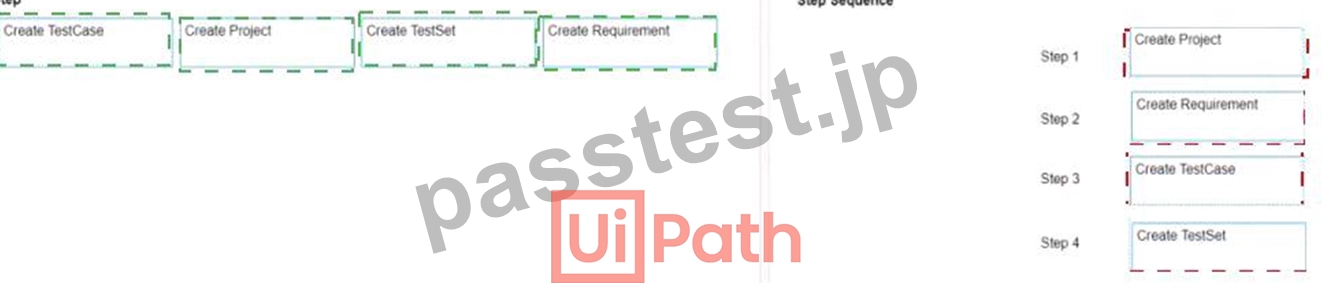
Explanation:
The correct flow from a high level design standpoint in UiPath Test Manager1 is:
Step 1 = Create Project Step 2 = Create Requirement Step 3 = Create TestCase Step 4 = Create TestSet According to the UiPath documentation and the Test Manager Overview Demo1, the high level design flow in UiPath Test Manager1 involves the following steps:
Create Project: A project is a container for all the testing artifacts related to a specific application or process. You can create a project in Test Manager by giving it a name, a description, and a type (RPA or Application). You can also import a project from another source, such as Jira or Azure DevOps 2.
Create Requirement: A requirement is a statement of what the application or process should do or achieve. You can create a requirement in Test Manager by giving it a name, a description, and a custom attribute. You can also import a requirement from another source, such as Jira or Azure DevOps 2.
Create TestCase: A test case is a set of steps or actions that verify a specific requirement. You can create a test case in Test Manager by giving it a name, a description, a type (manual or automated), and a custom attribute. You can also import a test case from another source, such as Studio or Task Capture 2.
Create TestSet: A test set is a collection of test cases that are executed together as part of a testing cycle.
You can create a test set in Test Manager by giving it a name, a description, a type (manual or automated), and a custom attribute. You can also import a test set from another source, such as Orchestrator 2.
References:
2: UiPath Test Manager - UiPath Documentation Portal
3: Task Capture - UiPath Test Manager - UiPath Documentation Portal
1: Test Manager Overview Demo - Test Automation Case | UiPath
質問 # 37
What is the functionality of the Jobs History widget horn the Automaton Cloud UI?
- A. Pulls in a real-time feed of the most popular components
- B. Promotes relevant content as per your persona type
- C. Provides quick-access cards to your tenants
- D. Shows the executions you initiated and their status
正解:D
解説:
According to the UiPath documentation1, the Jobs History widget is a component of the Automation Cloud UI that shows the executions you initiated and their status. You can use this widget to monitor the progress and outcome of your automation jobs, such as successful, failed, stopped, or pending. You can also filter the jobs by date range, status, or process name. The Jobs History widget also provides a link to the Orchestrator service where you can view more details and manage your jobs. References: 1: Jobs History Widget - UiPath Documentation Portal
質問 # 38
What is the purpose of using a standard business process model and notations when creating a high-level solution design?
- A. To make the diagrams visually appealing and engaging tor stakeholders
- B. To reduce the time spent on designing the solution by using obvious symbols
- C. To show the sequence of steps in the solution without focusing on details
- D. To ensure consistency and understanding across different process diagrams
正解:D
解説:
A standard business process model and notation (BPMN) is a graphical representation of the business processes and workflows in a solution. It helps to communicate the logic, flow, and interactions of the activities and actors involved in the solution. By using a standard BPMN, the solution architect can ensure that the solution design is consistent, clear, and understandable across different process diagrams, regardless of the level of detail or complexity. A standard BPMN also facilitates the alignment and integration of the solution with other systems and platforms, as well as the validation and verification of the solution requirements and functionality. References: UiPath Automation Solution Architect Learning Plan, Module 4: High-Level Solution Design1; UiPath Automation Suite - Deployment Architecture2; UiPath Academy - Roles of a Solution Architect in Automation, RPA Setting3.
質問 # 39
What is the man difference between the deployment models for UiPath products?
- A. How the product is managed from an IT infrastructure point of view.
- B. The types of processes that can be automated using the products.
- C. How each product I s licensed and billed
- D. The level of infrastructure integration between UiPath products.
正解:A
解説:
The deployment models for UiPath products refer to the different ways of installing, configuring, and running the UiPath components on various IT environments. The main difference between the deployment models is how the product is managed from an IT infrastructure point of view, such as the hardware, software, network, and security requirements, the scalability and availability options, the backup and recovery strategies, and the maintenance and support procedures. UiPath offers several deployment models to suit different customer needs and preferences, such as:
Standalone deployment: This is the simplest and most common deployment model, where each UiPath component is installed on a single machine or server, and communicates directly with other components without any intermediaries. This model is suitable for small-scale automation scenarios, where the number of robots, processes, and users is low, and the IT infrastructure is simple and stable. However, this model has some limitations in terms of performance, reliability, security, and flexibility, as it depends on the availability and capacity of the single machine or server hosting the component.
High-availability deployment: This is a more advanced and robust deployment model, where each UiPath component is installed on multiple machines or servers, and communicates with other components through a load balancer or a cluster manager. This model is suitable for large-scale automation scenarios, where the number of robots, processes, and users is high, and the IT infrastructure is complex and dynamic. This model offers several benefits in terms of performance, reliability, security, and flexibility, as it allows for load balancing, failover, scaling, and redundancy of the components.
Cloud deployment: This is a modern and flexible deployment model, where some or all of the UiPath components are hosted on a cloud platform, such as Microsoft Azure, Amazon Web Services, or Google Cloud Platform, and communicate with other components through the internet. This model is suitable for hybrid or distributed automation scenarios, where the number of robots, processes, and users is variable, and the IT infrastructure is elastic and scalable. This model offers several advantages in terms of cost, convenience, accessibility, and innovation, as it reduces the need for hardware, software, network, and security maintenance, and enables faster and easier deployment, configuration, and updates of the components.
References: About Deployment - Standalone, Automation Suite - Deployment architecture, UiPath Cloud Platform
質問 # 40
Which scope activity is needed in order to use any document classification algorithm in UiPath Studio?
- A. Classify Document Scope
- B. Train Classifiers Scope
- C. Train Extractors Scope
- D. Data Extraction Scope
正解:A
解説:
Option B is the most suitable approach for the process described above, as it uses the Robotic Enterprise Framework (ReFramework) template with TransactionItem set as DataRow and TransactionData as DataTable. This template provides a robust and scalable structure for transactional processes, with built-in mechanisms for exception handling, logging, retrying, and reporting. By setting the TransactionItem as DataRow and the TransactionData as DataTable, the process can read the invoice numbers from the CSV file and process them one by one in a loop. The template also allows the use of queues to store the transaction data and status, which enables the process to resume from the last successful transaction in case of a system exception. This way, the process can ensure that each invoice number is processed only once in each application, and avoid duplicate or skipped transactions. The template also integrates with UiPath Orchestrator, which provides centralized management, monitoring, and scheduling of the process. The template also supports the use of long-running workflows, which can handle human intervention scenarios using UiPath Action Center. The template also complies with the UiPath Automation Solution Architect best practices and standards, such as naming conventions, modularity, reusability, and maintainability. References:
UiPath Studio - Robotic Enterprise Framework Template
UiPath Studio - Working with Queues in the ReFramework
UiPath Studio - Long Running Workflow Template with UiPath Tasks
[UiPath Automation Solution Architect - Course Overview]
[UiPath Automation Solution Architect - Best Practices and Standards]
質問 # 41
What functionality does the Package Explorer offer?
- A. Explorer the graphical representation of only the entry xml file as well as the variables, arguments, and imports that are part of the latest package version.
- B. Explore the graphical representation of nay .xml file as well as the variables, arguments, and imports that are part of any package version.
- C. Explore the graphical representation of only the entry xml file without having access to the variable, arguments, and imports that are part of any package version.
- D. Explore the graphical representation of any .xml file without having access to the variables, arguments, and imports that are part of any package version.
正解:B
解説:
Package Explorer is a feature that enables you to view the contents of any package version uploaded to Orchestrator. You can access it from the Packages page, by clicking the Explore button next to the package name. Package Explorer displays a graphical representation of the entry .xml file of the package, as well as the variables, arguments, and imports that are part of it. You can also view the properties of each activity, such as selectors, text, or output variables. Package Explorer can help you troubleshoot errors, compare different versions of a package, or inspect the logic of a package without opening it in Studio.
References:
Package Explorer
New package Explorer options with 2019.10 Beta
質問 # 42
For implementing an unattended transactional process what pre-build UiPath Template is the best fit?
- A. Orchestration Process
- B. Background Process
- C. Generic Framework
- D. Robotic Enterprise Framework
正解:D
解説:
The Robotic Enterprise Framework is a pre-built template that follows the best practices for implementing an unattended transactional process. It is designed to handle exceptions, application errors, transactions, logging, and reporting. It also uses queues and orchestrator assets to manage the data and configuration of the process.
The Robotic Enterprise Framework is suitable for complex and long-running processes that require high reliability and scalability.
References:
Robotic Enterprise Framework
RPA Solution Architect Learning Plans
質問 # 43
Which trigger should be used for ''E3L''?
- A.

- B.

- C.

- D.

正解:B
解説:
References:
Orchestrator - Queue Triggers
Orchestrator - UI Automation Triggers
Orchestrator - Form Triggers
Orchestrator - Event Triggers
質問 # 44
What are two key indicators m estimating the development time for process development?
- A. Number of actions to be automated and complexity of architecture
- B. Correctness of documentation and triggers scheduling strategy
- C. Number of users who will use the process and number of applications 10 be automated
- D. Number of items to be processed and experience of developers
正解:A
解説:
The development time for process development depends on various factors, such as the scope, requirements, design, testing, deployment, and maintenance of the automation solution. However, two of the most important factors are the number of actions to be automated and the complexity of the architecture. The number of actions to be automated refers to the number of steps, activities, or tasks that the automation solution has to perform to achieve the desired outcome. The complexity of the architecture refers to the level of difficulty, integration, and customization involved in designing and implementing the automation solution. Both of these factors affect the amount of effort, resources, and skills required for the process development12.
References: Roles of a Solution Architect in Automation, RPA Setting, Become an Automation Solution Architect
質問 # 45
Invoices from various clients require processing Why would the "Unique Key" properly be used in the Orchestrator Queue configuration?
- A. To display processed invoices in a report
- B. To uniquely identify the queue in Orchestrator
- C. To ensure that each invoice is only processed once and to ovoid duplication
- D. To prioritize the processing of specific queue items over others
正解:C
解説:
The Unique Key property in the Orchestrator Queue configuration allows you to specify whether the queue items should have unique references or not. A reference is a string value that can be used to identify a queue item. If the Unique Key property is set to Yes, then Orchestrator checks if the reference of the new queue item already exists in the queue, and rejects the item if it does. This way, you can prevent adding duplicate items to the queue and ensure that each invoice is processed only once. If the Unique Key property is set to No, then Orchestrator does not perform this check and allows adding items with the same reference to the queue. This option can be useful if you want to process the same invoice multiple times for different purposes or scenarios. References: Managing Queues in Orchestrator - UiPath Documentation Portal, Managing Queues in Orchestrator - UiPath Documentation Portal, Orchestrator Queue - "unique reference" is enforced - Help - UiPath Community Forum
質問 # 46
In which model is the Admin Portal and Analyzer used with UiPath unassisted Task Mining delivered, and where is it built and hosted?
- A. Google Cloud
- B. Amazon Web Services
- C. Oracle Cloud infrastructure
- D. Microsoft Azure
正解:D
解説:
UiPath Unassisted Task Mining is a cloud-based service that collects and analyzes employee desktop data to identify tasks with high automation potential. The Admin Portal and Analyzer are web applications that are used to manage and review the Unassisted Task Mining projects. They are delivered as part of the UiPath Automation Cloud, which is built and hosted on Microsoft Azure. Microsoft Azure is a cloud computing platform that provides various services and solutions for building, deploying, and managing applications and data. UiPath Automation Cloud leverages Microsoft Azure's security, scalability, and reliability features to offer a seamless and secure user experience.
(https://docs.uipath.com/task-mining/automation-cloud/latest/user-guide/unassisted-task-minining-introduction) References:
Unassisted Task Mining - Introduction - UiPath Documentation Portal
UiPath Automation Cloud - Introduction - UiPath Documentation Portal
Microsoft Azure - Overview
質問 # 47
How can automated Test Sets be executed?
- A. Only from Orchestrator
- B. Only from Test Manager
- C. From boll Studio and Test Manager
- D. From both Orchestrator and Test Manager
正解:D
解説:
Automated Test Sets can be executed from both Orchestrator and Test Manager, depending on the source and type of the test cases. Test Sets that have been linked from Orchestrator can be executed automatically or manually, if they have manual steps defined. Test Sets that have been created in Test Manager can also be executed automatically or manually, if they have test cases linked from Studio or manual steps12.
References:
Test Suite - Test Sets
Test Suite - Executing Tests
質問 # 48
What is the difference between rule-based and model-based data extraction methodologies?
- A. Rule-based extraction requires manual data labeling while model-based extraction does not need any label or tracing data
- B. Rule-based extraction relies on predefined rules and patterns, while model-based extraction utilizes machine learning algorithms to automatically identify and extract data
- C. Rule-based extraction is more computationally intensive whereas model based systems are simpler and require fewer computational resources
- D. Model-based extraction is only effective for structured data sources whereas rule-based extraction can handle both structured and unstructured data sources seamlessly
正解:B
解説:
Rule-based extraction is a technique that applies a set of predefined rules and patterns to extract data from a document. For example, you can use document templates, data position, occurrence patterns, or regular expressions to define the rules. Rule-based extraction is suitable for structured documents, such as forms, that have a fixed format and layout. However, rule-based extraction can be limited by the complexity and variability of the rules, and it may not be able to handle semi-structured or unstructured documents, such as invoices, contracts, or emails, that have different formats, layouts, or data types.
Model-based extraction is a technique that uses machine learning algorithms to automatically learn and extract data from a document. For example, you can use classification, clustering, or regression algorithms to train a model based on a set of labeled or unlabeled data. Model-based extraction is effective for semi-structured or unstructured documents, such as invoices, contracts, or emails, that have similar types of information but different formats, layouts, or data types. However, model-based extraction can require more computational resources and data preparation, and it may not be as accurate or consistent as rule-based extraction.
References:
Document Processing with Improved Data Extraction | UiPath
Data Extraction Types & Techniques: A Complete Guide
NLP Methods' Information Extraction for Textual Data: An Analytical ...
質問 # 49
How does scalability impact the design of a UiPath automaton flowchart and what strategies can ensure it handles increased process volume?
- A. To achieve salacity flowchart design should be rigid and not allow for changes or adaptations to the process response lo evolving business needs.
- B. Scalability is crucial in high-level flowchart design to handle larger volumes efficiently involving design adjustments and resource optimization if needed
- C. Scalability is irrelevant in high-level flowchart design, as it is solely a concern for the deployment phase
- D. Scalability primarily focuses on reducing the number of steps in the flowchart to make it more efficient for smaller-scale processes
正解:B
解説:
Scalability is the ability of a system or a process to handle growing amounts of work or demand in a graceful manner. Scalability impacts the design of a UiPath automation flowchart because it determines how well the automation can cope with increased process volume, complexity, or variability. A scalable flowchart design should consider the following strategies:
Modularization: Breaking down the process into smaller, reusable, and maintainable components that can be easily modified or replaced if needed. Modularization also facilitates testing, debugging, and error handling.
Parameterization: Using variables, arguments, configuration files, assets, or queues to store and pass data that can change depending on the process execution. Parameterization allows for flexibility and adaptability of the automation to different scenarios or environments.
Optimization: Reducing unnecessary or redundant steps, activities, or data in the flowchart to improve the performance, efficiency, and reliability of the automation. Optimization also involves choosing the best methods or techniques to achieve the desired outcome, such as using selectors, data scraping, or computer vision.
Orchestration: Managing the resources, schedules, triggers, and dependencies of the automation to ensure that it runs smoothly and effectively. Orchestration also involves monitoring, logging, and reporting the status and results of the automation, as well as handling exceptions and alerts.
References: Enhancing UiPath Solutions' Design Scalability, Roles of a Solution Architect in Automation, RPA Setting, Studio - Flowcharts.
質問 # 50
......
認定問題集でUiPath Certified Professional - Developer Track UiPath-ASAPv1ガイド100%有効な:https://www.passtest.jp/UiPath/UiPath-ASAPv1-shiken.html
問題集であなたのUiPath-ASAPv1 UiPath Automation Solution Architect Professional v1.0 Examは100%一発でパス:https://drive.google.com/open?id=1txElZaGXC69fER7YoKDtaSnvjfI3SKIC