

合格させちゃうUiPath Certified Professional - Developer Track UiPath-ASAPv1試験簡単かつ正確なPDF問題 [2024年05月08日]
UiPath-ASAPv1認証試験問題集解答を提供しています
質問 # 12
When statement below accurately identifies the correct option regarding the various types of deployment?
- A. Single-node deployment option is recommended tor production use
- B. Single-node deployment option is recommended for evaluation and demo scenarios
- C. In a single-node deployment High Availability (HA) is enabled by default
- D. A single-node deployment involves 3 or more server nodes behind a load balancer
正解:B
解説:
The single-node deployment option is recommended for evaluation and demo scenarios because it is simpler and faster to set up and requires less resources. It involves installing the Automation Suite on a single server node, which hosts both the cluster management services and the UiPath products and shared components. This option is not suitable for production use, as it does not provide high availability, scalability, or fault tolerance.
It also does not support special workloads that require GPU capabilities, such as Task Mining analysis and Document Understanding pipelines. References:
Automation Suite - Deployment architecture - UiPath
Automation Suite - Supported use cases for single-node and multi-node installations - UiPath
質問 # 13
Invoices from various clients require processing Why would the "Unique Key" properly be used in the Orchestrator Queue configuration?
- A. To ensure that each invoice is only processed once and to ovoid duplication
- B. To display processed invoices in a report
- C. To prioritize the processing of specific queue items over others
- D. To uniquely identify the queue in Orchestrator
正解:A
解説:
The Unique Key property in the Orchestrator Queue configuration allows you to specify whether the queue items should have unique references or not. A reference is a string value that can be used to identify a queue item. If the Unique Key property is set to Yes, then Orchestrator checks if the reference of the new queue item already exists in the queue, and rejects the item if it does. This way, you can prevent adding duplicate items to the queue and ensure that each invoice is processed only once. If the Unique Key property is set to No, then Orchestrator does not perform this check and allows adding items with the same reference to the queue. This option can be useful if you want to process the same invoice multiple times for different purposes or scenarios. References: Managing Queues in Orchestrator - UiPath Documentation Portal, Managing Queues in Orchestrator - UiPath Documentation Portal, Orchestrator Queue - "unique reference" is enforced - Help - UiPath Community Forum
質問 # 14
When elements of UiPath Automaton Platform are best suited for managing long-running activities in RPA projects?
- A. Queues tasks jobs
- B. Libraries assets triggers
- C. Folders, entities permissions
- D. Tenants packages webhooks
正解:C
解説:
Folders, entities and permissions are the elements of UiPath Automation Platform that are best suited for managing long-running activities in RPA projects. Folders enable the organization and isolation of data, processes, queues, and other resources within a tenant. Entities are custom data structures that can store information related to long-running workflows, such as invoices, orders, or contracts. Permissions control the access and actions that users and robots can perform on folders, entities, and other resources.
References:
Folders
Entities
Permissions
質問 # 15
What is a layer that is redundant for a Solution Architect to take into account when designing the Reusable Components for a project?
- A. Logic layer
- B. Persistence layer (saving data)
- C. Process steps that are not part of the User Interlace interaction layer or the Logic layer or the Persistence layer
- D. User interface interaction layer (interact with applications)
正解:C
解説:
A reusable component is a workflow that can be compiled and packaged as an activity and reused in multiple processes. A reusable component should be designed with a clear purpose, input and output parameters, and error handling. A reusable component should also follow the best practices of modularity, reusability, maintainability, and scalability. A reusable component can be categorized into three layers: User Interface interaction layer, Logic layer, and Persistence layer. The User Interface interaction layer is responsible for interacting with applications, such as clicking, typing, or scraping data. The Logic layer is responsible for implementing the business logic, such as calculations, validations, or decision making. The Persistence layer is responsible for saving or retrieving data, such as using databases, files, or queues. These three layers are essential for designing reusable components, as they represent the common functionalities that can be shared across different processes. However, process steps that are not part of these three layers are redundant for a Solution Architect to take into account when designing the reusable components for a project. Process steps that are not part of these three layers are specific to a particular process or scenario, and they may not be applicable or compatible with other processes. For example, a process step that involves sending an email notification to a specific recipient or group may not be relevant or suitable for another process that uses the same reusable component. Therefore, such process steps should be avoided or separated from the reusable components, and instead be implemented in the main workflow of the process that requires them. References:
18.3 - Library (Reusable components) - UiPath Community Forum
How to make useful Libraries (Reusable components) - UiPath Community Forum Reusable Components - UiPath Documentation Portal
質問 # 16
What are long-running workflows?
- A. Workflow for which one can set a Stop Time
- B. Processes are designed to run continuously for an extended period of time.
- C. Master projects that supports orchestration and human intervention.
- D. Workflow intended to be used only by attended robots.
正解:C
解説:
This answer is correct because long-running workflows are processes that require logical fragmentation or human intervention (validations, approvals, exception handling) such as invoice processing and performance reviews. They are handled with a set of instruments in the UiPath suite: a dedicated project template in Studio called Orchestration Process, actions and resource allocation capabilities in Orchestrator. Long-running workflows use a pair of activities to introduce a condition that suspends the main job until the condition is met, and then resumes the job with the obtained data. The condition can be a job, a queue item, a form action, or an external action12 References:
Orchestrator - Working With Long-running Workflows
Designing long-running workflows - UiPath Documentation Portal
質問 # 17
Which of the Mowing can be achieved by using Automaton Ops?
- A. Preform remote installations of UPath products (Such as Studio Assistant)
- B. Configure and deploy governance policies
- C. Define the licensing availability and strategy
- D. Configure connection between different products inside the UiPath ecosystem
正解:B
解説:
According to the UiPath documentation1, Automation Ops is a component of the UiPath platform meant for creating, deploying, and managing Robotic Process Automation (RPA) governance policies in UiPath Studio, UiPath StudioX, and UiPath Assistant. You can use a single, simple web portal to manage and implement governance rules based on user profiles, such as defining the acceptable feeds, packages, widgets, and activities, restricting the applications and URLs that can be automated, and assigning roles and responsibilities for reviewing and approving the automation projects. Automation Ops also integrates with Git repositories and CI/CD pipelines to provide source control and automation delivery capabilities. Therefore, the correct answer is D. Configure and deploy governance policies, as this is one of the main functionalities of Automation Ops. References: 1: Automation Ops - UiPath Documentation
質問 # 18
What is the involvement of an RPA Solution Architect throughout the stages of an RPA project?
- A. Offering consultations during the initial planning stage then withdrawing from the project before development begins
- B. Acting as technical lead during the lull RPA project Lifecycle from planning through implementation and hypercare
- C. Response for giving presentations and training sessions on RPA products without involvement in protect planning
- D. Performing post-deployment code reviews and inspecting the final RPA solution without engaging in earlier stages
正解:B
解説:
According to the UiPath Automation Solution Architect course1, the role of an RPA Solution Architect is to design, develop, and deliver end-to-end automation solutions for various business processes. The RPA Solution Architect is involved in all the stages of an RPA project, from the initial analysis and planning, to the development and testing, to the deployment and maintenance. The RPA Solution Architect also acts as a technical lead and mentor for the RPA developers, ensuring that the best practices and standards are followed.
The RPA Solution Architect also collaborates with the business analysts, process owners, and other stakeholders to ensure that the automation solutions meet the business requirements and expectations.
References: 1: UiPath Automation Solution Architect Course
質問 # 19
A user is designing a solution lot a business process that uses the following Personal Identifiable Information (Pll):
Employee Name and Employee Date of Birth
Taking into consideration that PH should not be accessible to Database Administrators how should the details be stored in UiPath Orchestrator Queues?
- A. Store Employee Name and Date of Birth in Transaction item Specific Content and set "Store in encrypted format" as True
- B. Store the Employee Name and Date of Birth in Transaction Item Specific Content
- C. Store Employee Name and Date of Birth as Transaction item Reference so the business users can search by name
- D. Store Employee Name and Date of Birth as Transaction item Reference and set "Store in encrypted format as True
正解:A
解説:
Personal Identifiable Information (PII) is any data that potentially identifies a specific individual, allows for distinctions to be made between individuals, or could be used to de-anonymize anonymous data1. PII should be handled with care and protected from unauthorized access or disclosure. UiPath Orchestrator Queues are a way to store and process data items for automation projects. Queues have two types of data: Reference and Specific Content. Reference is a unique identifier for the data item, while Specific Content is a collection of key-value pairs that store the actual data2. To store PII in UiPath Orchestrator Queues, the best option is to use Specific Content and enable the "Store in encrypted format" option. This option encrypts the data using AES-256 encryption and prevents anyone, including database administrators, from viewing the data in plain text. Only the robots that have access to the queue can decrypt and process the data3. This ensures the security and privacy of the PII data.
References: About Queues and Transactions, Managing Queues in Studio, UiPath for Compliance, a GDPR Automation Solution
質問 # 20
What is the purpose of using a standard business process model and notations when creating a high-level solution design?
- A. To ensure consistency and understanding across different process diagrams
- B. To reduce the time spent on designing the solution by using obvious symbols
- C. To show the sequence of steps in the solution without focusing on details
- D. To make the diagrams visually appealing and engaging tor stakeholders
正解:A
解説:
A standard business process model and notation (BPMN) is a graphical representation of the business processes and workflows in a solution. It helps to communicate the logic, flow, and interactions of the activities and actors involved in the solution. By using a standard BPMN, the solution architect can ensure that the solution design is consistent, clear, and understandable across different process diagrams, regardless of the level of detail or complexity. A standard BPMN also facilitates the alignment and integration of the solution with other systems and platforms, as well as the validation and verification of the solution requirements and functionality. References: UiPath Automation Solution Architect Learning Plan, Module 4: High-Level Solution Design1; UiPath Automation Suite - Deployment Architecture2; UiPath Academy - Roles of a Solution Architect in Automation, RPA Setting3.
質問 # 21
What argument types can be used for a workflow that is invoked with the Isolated" option?
- A. Simple types
- B. Class types
- C. Serializable types
- D. Reference types
正解:C
解説:
The Isolated option for the Invoke Workflow File activity allows the invoked workflow to run in a separate Windows process, which can help with isolating a faulty workflow from the main workflow. However, this option requires that the arguments passed to the invoked workflow are serializable, meaning that they can be converted into a binary format that can be transferred across processes. Simple types, such as integers, strings, booleans, etc., are serializable by default. Reference types, such as arrays, lists, dictionaries, etc., are serializable if they implement the ISerializable interface or have the [Serializable] attribute. Class types are serializable if they meet the same criteria as reference types. Data Row is an example of a non-serializable type that cannot be used as an argument for an isolated workflow. References: Invoke Workflow File, Using Arguments, What is the the use of "isolated" property of invoke workflow, How to pass arguments to Isolated Workflow.
質問 # 22
The interaction between UiPath Studio and the UiPath Robot Service performs which of the following functions?
- A. Sends the heartbeat and logs
- B. triggers unattended processes
- C. Process version control (git SVN etc.)
- D. Executes or debugs a process
正解:D
解説:
The interaction between UiPath Studio and the UiPath Robot Service performs the function of executing or debugging a process. UiPath Studio is the design tool that allows users to create, edit, and test automation workflows. UiPath Robot Service is the component that runs the automation workflows on the machine. It communicates through an inter-process communication channel with Studio, the UiPath Assistant, and Robot Command Line Interface to receive and process information, and then to provide the necessary instructions to the Robot Executor. When a user wants to execute or debug a process from Studio, the Robot Service receives the command and launches the Robot Executor in the appropriate mode and session. The Robot Executor then performs the actions defined in the workflow and sends back the status and logs to the Robot Service, which in turn relays them to Studio. References:
Robot - Robot Service - UiPath Documentation Portal
Studio - Debugging - UiPath Documentation Portal
Robot - Executing Processes - UiPath Documentation Portal
質問 # 23
What is the UiPath Document Understanding (DU) Process template purpose role?
- A. To allow deploying a new Document Understanding process as an Unattended implementation already tailored to your business use case Further development is optional and only required when the business presents additional requirements. The testing debugging and scaling are easy and the template is bum with the community's best practices in mmd.
- B. To allow a seamless start for any new Document Understanding process that is suitable for all use cases, production-ready has a common architecture tor both Attended and Unattended implementations makes development lasting deployment debugging, and scaling easy and follows the best practices pertaining to RPA Document Understanding Orchestration Processes and Long-running workflows
- C. To allow deploying a new Document Understanding process as an Attended implementation already tailored to your business use case making the lasting debugging and scaling easy and following the community best practices II also makes development optional the template being ready for production deployment out of the box (needed only when the business comes with extraordinary requirements)
- D. To allow one generic implementation to address all business needs without further development testing and debugging The DU template can be deployed immediately used as is without any performance concerns and following the best practices pertaining to RPA Document Understanding Orchestration Processes and Long-running workflows.
正解:B
解説:
The UiPath Document Understanding Process template is a fully functional UiPath Studio project template based on a document processing flowchart. Its aim is to offer a Document Understanding tool at hand that is easy to use and easy to execute for any developer who wants to start working either on a simple demo or on large-scale implementation. The process provides logging, exception handling, retry mechanisms, and all the methods that should be used in a Document Understanding workflow, out of the box. The process is preconfigured with a series of basic document types in a taxonomy, a classifier configured to distinguish between these classes, and extractors to showcase how to use the Data Extraction capabilities of the framework. It is meant to be used as a best practice example that can be adapted to your needs while displaying how to configure each of its components. The workflow has an architecture decoupled from other connected automations: it does not matter where the files to be processed are coming from or what triggers the execution, this is the responsibility of an upstream process; it does not matter where the extracted information should be used, this is the responsibility of a downstream process. The architecture is common for both attended robots and unattended robots running Document Understanding and having human-in-the-loop validation via Action Center. Items are not processed in bulk. Instead, there is one job for each input file.
Indeed, a dispatcher is required every time but this flexible approach makes it simpler to get started, to develop, debug, and scale Document Understanding processes. The process supports Visual Basic flavored projects. The default dependencies in a Document Understanding Process are:
UiPath.DocumentUnderstanding.ML.Activities, UiPath.Excel.Activities, UiPath.IntelligentOCR.Activities, UiPath.PDF.Activities, UiPath.System.Activities, and UiPath.UIAutomation.Activities. (123) References:
1: Document Understanding Process: Studio Template - UiPath
2: Document Understanding Process: Studio Template
3: Activities - About Document Understanding Process: Studio Template - UiPath
質問 # 24
Which UiPath component allows UiPath Apps to connect to entity data sources?
- A. UiPath Assistant
- B. UiPath Studio
- C. UiPath Storage Bucket
- D. UiPath Data service
正解:D
解説:
UiPath Data Service is a persistent data storage service that brings powerful no-code data modeling and storage capabilities to your Robotic Process Automation (RPA) projects1. UiPath Apps can connect and interact with entities from UiPath Data Service to create better, more complex apps2. Entities are data models that define the structure and relationships of the data you want to store and use in your automation projects3. You can reference an entity from Data Service in your app and bind it to various controls such as dropdown lists, tables, and custom lists2.
References:
About Data Service
Referencing an Entity in Your App
Creating an Entity
質問 # 25
Consider a process a that has a dependency Library B. Library B has defined an Object Repository for the application C where UI objects are stored.
Assuming a developer wants to use a UI Object defined in the Object Repository for application C insider process A, what is the best solution for that?
- A. Export the Object Repository for the application C as an UI library and import in it process A. Then one can access the UI Objects defined.
- B. Avoid referencing the UI object since it has already been defined and just use the selector.
- C. Define a new Object Repository for application C in process A and reference the elements from there.
- D. Since process A already references Library B which has the Object Repository for the application C, one can directly access the UI Objects from the Object Repository for the application C.
正解:D
解説:
This answer is correct because the Object Repository allows for creating and reusing UI taxonomies inside and across automation projects. By referencing Library B, which contains the Object Repository for application C, process A can reuse the UI elements defined there without creating a new Object Repository or using selectors. This way, process A can benefit from the centralized management, reusability, and reliability of the UI elements in the Object Repository12 References:
Studio - About Object Repository - UiPath Documentation Portal
Object Repository | UiPath UI Library | UiPath Academy
質問 # 26
Which of the following is listed under the use cases of Al Center for handling unstructured data?
- A. Inventory Forecasts
- B. Loan Defaults
- C. Language Translation
- D. Image Classification
正解:D
解説:
Image classification is one of the use cases of AI Center for handling unstructured data, as it allows robots to identify and categorize images based on their content and features. For example, image classification can be used to automate tasks such as sorting documents, detecting defects, or recognizing faces. AI Center provides pre-built models for image classification, as well as the option to upload custom models or use third-party models. Image classification can be integrated into RPA workflows using the ML Skill activity in UiPath Studio. References: RPA & AI Integration with AI Center | UiPath, AI Center - Using AI Center - UiPath Documentation Portal, [Image Classification :: AI Center].
質問 # 27
What is the correct flow from a high level design standpoint in UiPath Test Manager1?
Instructions: Drag me Description found on the left and drop on Via correct Step Sequence found on the right.
正解:
解説: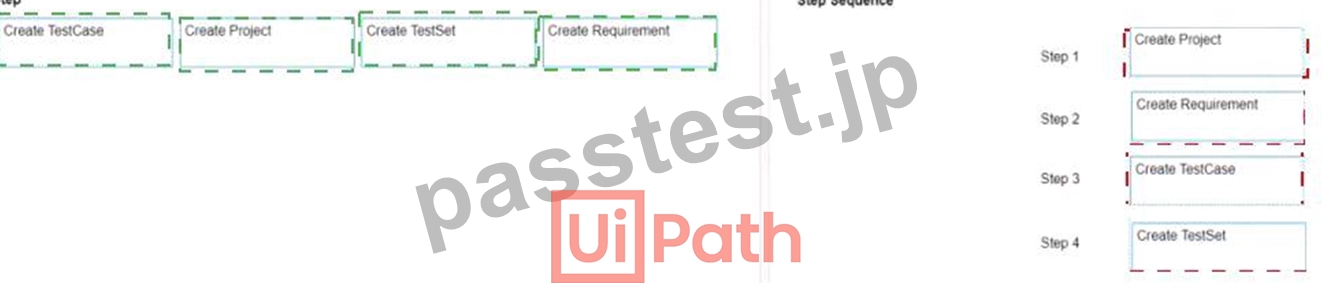
Explanation:
The correct flow from a high level design standpoint in UiPath Test Manager1 is:
Step 1 = Create Project Step 2 = Create Requirement Step 3 = Create TestCase Step 4 = Create TestSet According to the UiPath documentation and the Test Manager Overview Demo1, the high level design flow in UiPath Test Manager1 involves the following steps:
Create Project: A project is a container for all the testing artifacts related to a specific application or process. You can create a project in Test Manager by giving it a name, a description, and a type (RPA or Application). You can also import a project from another source, such as Jira or Azure DevOps 2.
Create Requirement: A requirement is a statement of what the application or process should do or achieve. You can create a requirement in Test Manager by giving it a name, a description, and a custom attribute. You can also import a requirement from another source, such as Jira or Azure DevOps 2.
Create TestCase: A test case is a set of steps or actions that verify a specific requirement. You can create a test case in Test Manager by giving it a name, a description, a type (manual or automated), and a custom attribute. You can also import a test case from another source, such as Studio or Task Capture 2.
Create TestSet: A test set is a collection of test cases that are executed together as part of a testing cycle.
You can create a test set in Test Manager by giving it a name, a description, a type (manual or automated), and a custom attribute. You can also import a test set from another source, such as Orchestrator 2.
References:
2: UiPath Test Manager - UiPath Documentation Portal
3: Task Capture - UiPath Test Manager - UiPath Documentation Portal
1: Test Manager Overview Demo - Test Automation Case | UiPath
質問 # 28
......
検証済みで更新されたUiPath-ASAPv1問題集と解答で100%一発合格保証の問題集:https://drive.google.com/open?id=1ow5i14L6SAAlu5Sx6F7ip1fMhFth0D5v
更新されたUiPath-ASAPv1試験練習テスト問題:https://www.passtest.jp/UiPath/UiPath-ASAPv1-shiken.html