

2024年最新のPEGAPCDC87V1試験問題集で最近更新された182問題
Pegasystems PEGAPCDC87V1リアル2024年最新のブレーン問題集で模擬試験問題集
Pegasystems PEGAPCDC87V1試験は、Pega Decisioningの専門知識を証明したい人々を対象に設計されています。Pega Decisioningコンサルタントのスキルと知識を検証する認定試験であり、Pega Decisioningツールを使用して意思決定戦略を設計および実装する能力を証明することを目的としています。この認定は、業界で世界的に認知され、高く評価されています。
質問 # 107
Reference module: Creating and understanding decision strategies
In a Prioritize component, the top action can be determined based on the value of ________ .
- A. Primary.Income
- B. average margin of all actions
- C. Customer.Value
- D. the propensity
正解:D
解説:
In a Prioritize component in Pega Customer Decision Hub, the top action is determined based on the propensity value. Propensity refers to the likelihood that a customer will respond positively to a given action.
Here's a detailed explanation:
* Definition of Propensity:
* Propensity is a score that indicates the probability of a customer taking a desired action, such as accepting an offer or responding to a campaign. It is calculated using predictive models that analyze historical data and customer behavior.
* Role in Prioritize Component:
* The Prioritize component in a decision strategy uses the propensity values to rank actions. Actions with higher propensity values are given higher priority, ensuring that the most relevant and likely-to-succeed actions are selected for the customer.
* Configuration Steps:
* Step 1: In the strategy canvas, add a Prioritize component.
* Step 2: Configure the component to use the propensity value for ranking actions. This can be done by selecting the appropriate property that holds the propensity score, typically provided by a prediction model.
* Step 3: Connect the Prioritize component to other components in the strategy to ensure the highest priority actions are selected and offered to the customer.
* Benefits:
* Using propensity to determine the top action helps in making data-driven decisions, increasing the chances of customer engagement and improving overall campaign effectiveness.
References:
* Pega-Customer-Decision-Hub-User-Guide-85.pdf: "Understanding the Next-Best-Action strategy framework" section.
* Pega documentation on "Creating and understanding decision strategies".
質問 # 108
U+ Bank recently introduced a new credit card offer, Platinum Plus, for its premium customers. As the bank has some financial targets to meet, the business has decided to boost the Platinum plus card.
As a decisioning consultant, how can you ensure that the Platinum Plus offer is prioritized over other offers?
- A. Increase the context weight of the Platinum Plus card.
- B. Increase the action value of the Platinum Plus card.
- C. Increase the starting propensity of the Platinum Plus card.
- D. Increase the business weight of the Platinum Plus card.
正解:D
質問 # 109
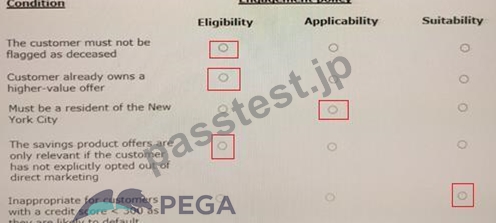
In the Answer Area, select the correct engagement policy for each condition.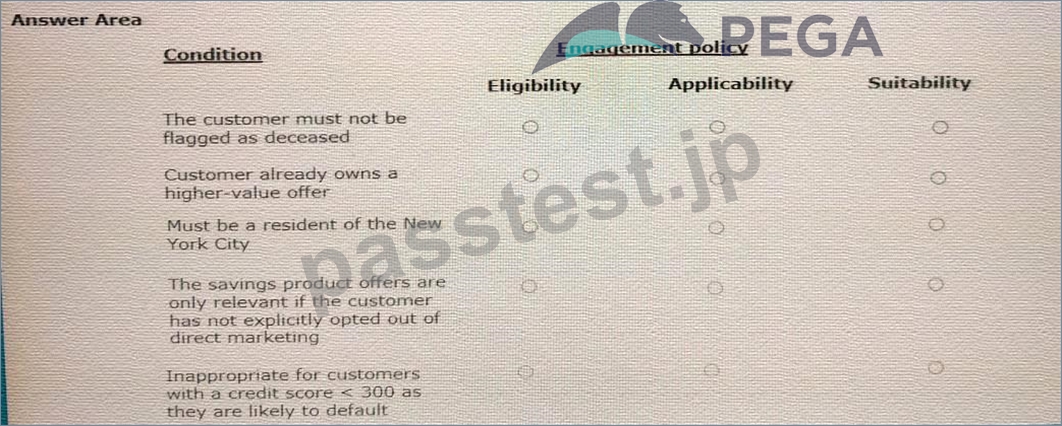
正解:
解説: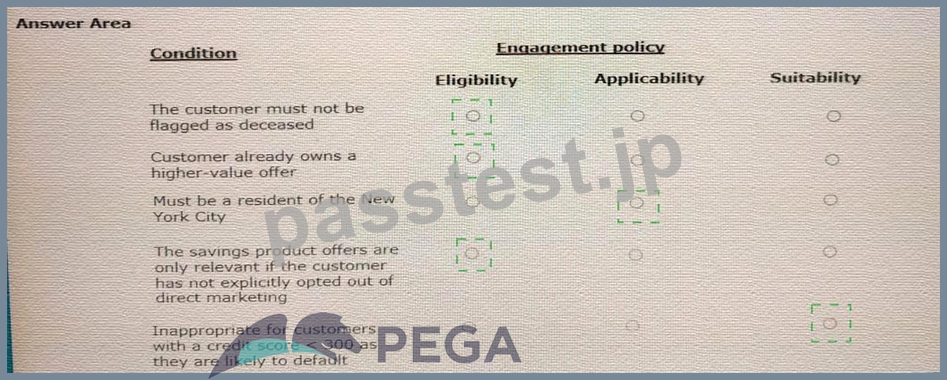
質問 # 110
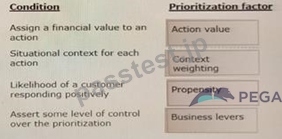
You are a decisioning consultant responsible for configuring offer prioritization for home loan offers based on the business requirements.
Select each prioritization factor on the left and drag it to the correct condition on the right.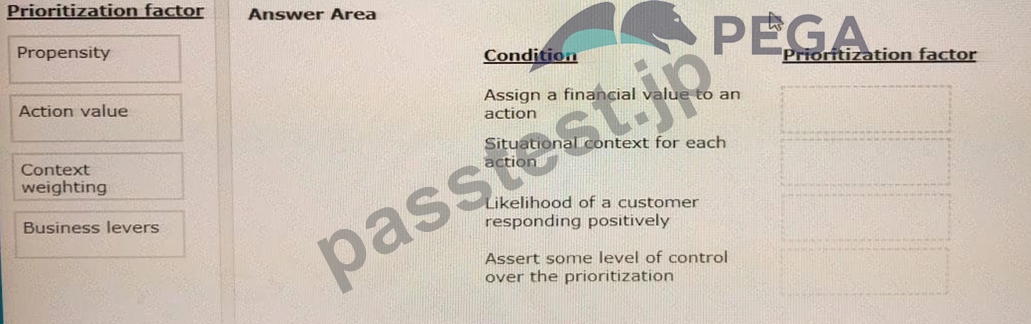
正解:
解説: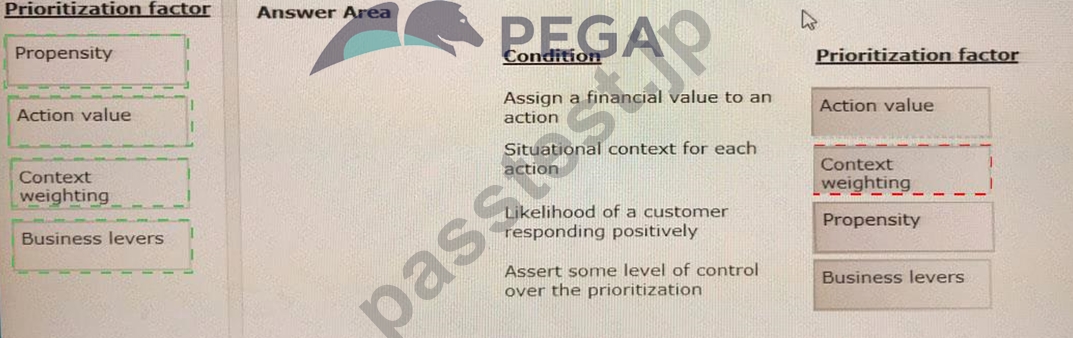
質問 # 111
Reference module: Defining an action for outbound
Which statement is true about email treatments?
- A. You can personalize the email subject, for example, Dear <customer name>
- B. When you use a seed list to test an email, the personalization attributes do not appear in the received email
- C. You must always embed the images in the email
- D. When you design emails using external tools, you cannot include Pega-specific personalization tags
正解:A
質問 # 112
Reference module: Creating and understanding decision strategies. Enrichment decision components provide the ability to ________.
- A. set customer properties
- B. filter actions based on priority and relevance
- C. set a text value to a strategy property
- D. enrich a decision strategy with comments
正解:C
質問 # 113
U+, a retail bank, has recently implemented a project in which credit card offers are presented to qualified customers when they log in to the web self-service portal. To show the offers per the bank's requirements, the bank added all existing contact policy conditions. What is the immediate next step they should take?
- A. Go live for all customers and check the performance on a weekly basis
- B. Go live for a limited number of customers and check the performance on a daily basis
- C. Add unit tests using persona testing before going live
- D. Conduct numerous what-if simulations before going live
正解:C
解説:
* Contact Policy Conditions - U+ Bank has added all existing contact policy conditions, ensuring that offers comply with set business rules.
* Unit Tests with Persona Testing - Before going live, it is essential to validate the implementation through persona-based unit tests. This helps verify that the strategy gives the expected results for different customer personas.
* Process:
* Design test personas that represent various customer segments.
* Run tests to ensure that each persona receives appropriate offers.
* Validate the expected outcomes, ensuring no regressions or policy breaches.
質問 # 114
To calculate the total number of customer responses of four actions in a group, you must use________________.
- A. one Set Property component
- B. one Group By component
- C. four Group By components
- D. four Set Property components
正解:B
質問 # 115
Reference module: Leveraging predictive model.
U+, a retail bank, wants to show a retention offer to customers who are likely to leave the bank in the near future based on historical customer interaction data. Which type of model do you use to implement this requirement?
- A. A predictive model
- B. An adaptive model
- C. An entity model
- D. A text analytics model
正解:A
解説:
Requirement:
* U+ wants to show a retention offer to customers likely to leave the bank based on historical interaction data.
Model Types:
* Entity Model: Used for recognizing entities within data.
* Text Analytics Model: Used for analyzing text data.
* Predictive Model: Used for making predictions based on historical data.
* Adaptive Model: Used for real-time adaptation based on new data.
Suitable Model:
* For predicting customer churn (likelihood of leaving), a predictive model is best suited because it leverages historical data to make future predictions.
Verification from Pega Documentation:
* Pega documentation on leveraging predictive models for customer retention and churn analysis.
質問 # 116
U+ Bank is currently running outbound communications for home loan offers and credit cards. They have added five new actions to the Credit Cards group. They would like to enable these actions in the email channel. What are the two minimum configurations that must be made? (Choose Two)
- A. Configure each action with an email treatment
- B. Configure each action to reference its own action flow
- C. Enable the email channel in Next-Best-Action->Channels
- D. Configure each action to reference a single action flow
- E. Configure one action with an email treatment.
正解:A、C
解説:
Requirement:
* U+ Bank has added five new actions to the Credit Cards group and wants to enable these actions in the email channel.
Configuring Each Action with an Email Treatment:
* Each action must be configured with an appropriate treatment for the email channel.
* Treatments define how the actions are presented in the channel, including the content and format of the email.
* This step ensures that the actions are prepared to be sent via email with the correct content.
質問 # 117
In a decision strategy, you can use aggregation components to_______________.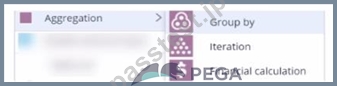
- A. make calculations based upon a list of actions
- B. choose between actions
- C. filter actions based on priority and relevance
- D. set a text value to a strategy property
正解:A
解説:
* Understanding Aggregation Components: Aggregation components in Pega decision strategies are used to perform calculations based on a list of actions. This can include summing values, calculating averages, or other statistical measures.
* Use Case of Aggregation Components:
* Set a Text Value: This is typically handled by Set Property or Data Transform components.
* Filter Actions: Filters are used for filtering actions based on priority and relevance.
* Choose Between Actions: This is typically handled by a Decision or Filter component.
Aggregation is specifically used to perform calculations based on a group of actions. It can be used to sum the total value of actions, calculate the average propensity, etc.
* Implementation in Decision Strategy:
* Add Aggregation Component: In the decision strategy, add an Aggregation component.
* Define Calculation: Specify the type of calculation (sum, average, count, etc.) and the actions to be included in the calculation.
The Pega Customer Decision Hub User Guide mentions the use of aggregation components to perform calculations on action lists, confirming their primary function is for making calculations based on a list of actions (Reference: Pega-Customer-Decision-Hub-User-Guide-85.pdf, Chapter on "Using aggregation components in decision strategies").
Conclusion: In a decision strategy, aggregation components are used to make calculations based upon a list of actions, enabling the strategy to derive meaningful metrics from groups of actions.
質問 # 118
Which two of these statements is true about Value Finder? (Choose Two)
- A. Projects estimated value of the subsequent next-best-action run
- B. Identifies opportunities for improvement
- C. Shows the distribution of under-served customers across different groups
- D. Identifies engagement policy conditions with bias
正解:B、C
質問 # 119
To access a property from an unconnected component, you use the____________.
- A. dot-property value directly
- B. property value
- C. component-dot-property construct
- D. customer-dot-property construct
正解:C
質問 # 120
U+ Bank wants to send promotional emails related lo credit card offers to their qualified customers. The business intends to use the same action flow template with the desired flow pattern for all credit card actions.
What do you configure to implement this requirement?
- A. Email treatment
- B. File template
- C. Dynamic template
- D. Output template
正解:C
解説:
To use the same action flow template with the desired flow pattern for all credit card actions, you should configure a dynamic template.
* Understanding Dynamic Templates:
* Dynamic Templates: These templates allow you to define a reusable flow pattern that can be applied to multiple actions. They support dynamic configuration of treatments and other flow elements.
* Configuration Steps:
* Step 1: Create a dynamic template in Pega Customer Decision Hub.
* Step 2: Define the flow pattern within the dynamic template, including all necessary steps and treatments.
* Step 3: Apply the dynamic template to each credit card action, ensuring that the flow pattern is consistent across all actions.
* Benefits:
* Using dynamic templates ensures consistency in the flow patterns and simplifies the maintenance process.
* Any updates to the flow pattern can be made in the template and will automatically apply to all actions using that template.
* Example:
* U+ Bank configures a dynamic template for their promotional email flows. This template includes steps for sending the email, waiting for a response, and following up as needed. Each credit card action uses this dynamic template to ensure a consistent customer experience.
References:
* Pega-Customer-Decision-Hub-User-Guide-85.pdf: "Creating and using dynamic templates" section.
* Pega documentation on "Action flow templates and dynamic configuration".
質問 # 121
U+ Bank has launched a new credit card for all customers with a premium bank account. As a decisioning consultant, you need to create actions that involve the full customer life cycle: marketing, sales, and service.
Which two valid actions do you create? (Choose Two)
- A. 1% cash back credit card
- B. Credit card number
- C. Credit card status
- D. No annual fee credit card
正解:A、D
質問 # 122
U+ Bank wants to offer credit cards only to low-risk customers. The customers are divided into various risk segments from Good to Very Poor. The risk segmentation rules that the business provides use the Average Balance and the customer Credit Score.
As a decisioning consultant, you decide to use a decision table and a decision strategy to accomplish this requirement in Pega Customer Decision Hub.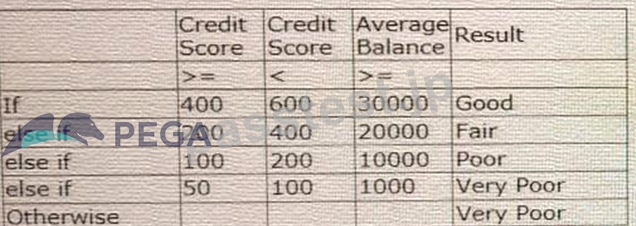
Which property allows you to use the risk segment computed by the decision table in the decision strategy?
- A. pxOutcome
- B. pxSegment
- C. pxRiskSegment
- D. pxResu/t
正解:A
解説:
* Decision Table Results: In Pega, the standard property that holds the result of a decision table evaluation is pxOutcome.
* Property Usage: This property can be used to reference the result of the decision table within a decision strategy.
References: This usage of pxOutcome is consistent with Pega's approach to handling results from decision tables and mapping these results into strategies .
質問 # 123
MyCo, a mobile company, uses Pega Customer Decision Hub to display offers to customers on its website. The company wants to present more relevant offers to customers based on customer behavior. The following diagram is the action hierarchy in the Next-Best-Action Designer.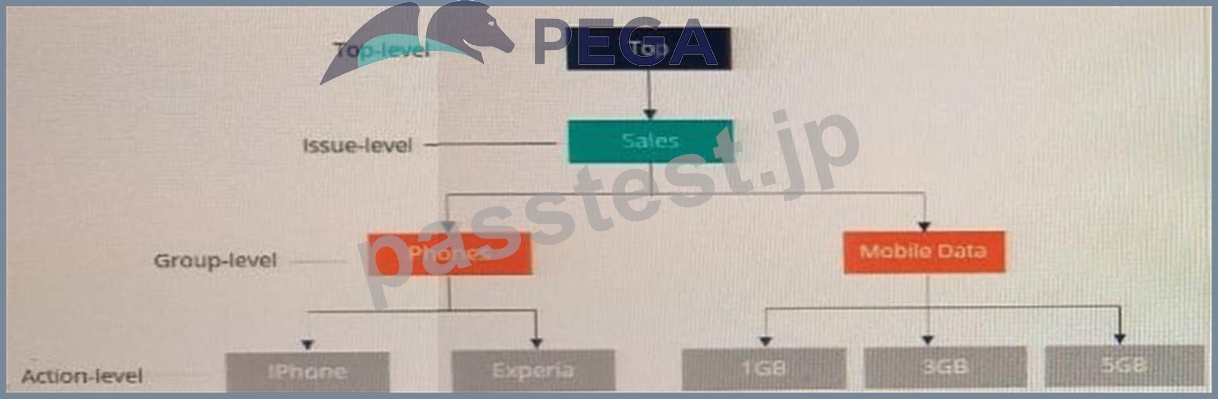
The company wants to present offers from both the groups and arbitrate across the two groups to select the best offer based on customer behavior.
As a decisioning consultant, what do you configure to select the best offer from both groups based on customer behavior?
- A. Create a prioritization decision strategy at the Group-level.
- B. Ensure that the propensity is enabled in Arbitration tab.
- C. Create an adaptive model rule at the Issue-level.
- D. Enable an action value in the prioritization formula.
正解:C
質問 # 124
......
Pegasystems PEGAPCDC87V1(Certified Pega Decisioning Consultant(PCDC)87V1)試験は、Pega Decisioningにおけるプロフェッショナルのスキルと知識をテストするために設計された認定試験です。試験は、Pega Decisioningのアーキテクチャ、戦略、および実装などのトピックをカバーしています。Pega Decisioningコンサルタント認定は、クライアントと共にPega Decisioningソリューションを開発および実装するプロフェッショナルを対象としています。
厳密検証されたPEGAPCDC87V1試験問題集と解答で無料提供のPEGAPCDC87V1問題と正解付き:https://www.passtest.jp/Pegasystems/PEGAPCDC87V1-shiken.html
PEGAPCDC87V1試験問題 リアルPEGAPCDC87V1練習問題集:https://drive.google.com/open?id=1FcT5lmsbr2R1RGtko-yVDddiRQFiTrpJ