

B2B-Solution-Architect合格させる問題集でSalesforce24時間で試験合格できます
最新問題を使おうB2B-Solution-Architect試験問題と解答でPDFで一年間無料更新
Salesforce Certified B2B Solution Architect認定を取得することで、Salesforceテクノロジーを使用した効果的なB2Bソリューションの設計と実装における専門知識を証明することができ、キャリアアップを図ることができます。この認定は世界的に認められており、雇用主から高い評価を受けているため、Salesforceエコシステムでキャリアを発展させたい人にとって貴重な資産となります。
Salesforce Certified B2B Solution Architect 認定は、Salesforceを使用して複雑なビジネスの問題解決能力を検証するプロフェッショナルのスキルを認定するために設計されています。認定試験は、ソリューション設計、データモデリング、統合、セキュリティ、およびパフォーマンスなど、様々なトピックをカバーしています。これは、Salesforceプラットフォームとその能力について深い理解が必要な包括的な試験です。
Salesforce B2B-Solution-Architect 認定試験は、Salesforce プラットフォームを使用して B2B ソリューションを設計および実装する最低 2 年の経験を持つプロフェッショナルを対象としています。候補者は、Salesforce アーキテクチャ、データモデリング、および統合技術に強い理解を持つ必要があります。さらに、候補者は、大企業の顧客と複雑なビジネス要件で働く経験を持っている必要があります。
質問 # 61
Universal Containers uses an ERP as system of record (SOR) for its product data, and Sales Cloud and Revenue Cloud for its sales dat a. The Product data must be synced with Salesforce so that sales representatives can add the products to their Opportunities and Quotes. As Products are deactivated within the ERP, they should no longer be available. Since Sales Cloud is the SOR for Opportunities and Revenue Cloud is the SOR for Quotes, the Solution Architect has been asked to come up with an archiving strategy that preserves Opportunity and Quote data related to these deactivated products m Salesforce for historical reference.
What should a Solution Architect recommend to manage the deactivation of the Products and archiving of the Saks data?
- A. Delete the Product in Salesforce once it is deactivated in the ERP. Archive the Opportunity and Quote data m a third-party system and bring back into Salesforce as External Objects.
- B. Deactivate the Product in Salesforce once it is deactivated m the ERP. Mark the Opportunity and Quote data in Salesforce as inactive so they do not show up in reporting.
- C. Remove the Product from active Opportunities and Quotes. Archive the Opportunity and Quote data in a third-parry system and bring back into Salesforce as External Objects.
- D. Deactivate the Product m Salesforce once it is deactivated m the ERP. Archive the Opportunity and Quote data in a third-party system and bring back into Salesforce as External Objects.
正解:D
質問 # 62
Northern Trail Outfitters (WTO) has around 500,000 active customers stored m the Account object. NTO gets an average of two orders per customer each month from both internal and online sales channels. NTO is expecting growth of 15% year-over-year (YoY). Various NTO users have recently started complaining about slower performances while accessing order information or running reports. NTO customers are also teeing slower responses while accessing their order history on B2B Commerce.
Which two options should a Solution Architect consider to improve performance' Choose 2 answers
- A. Use external objects instead of standard B2B Commerce Order object.
- B. Create a custom component to display all order information.
- C. Develop an archiving strategy around order records from Salesforce based on a criteria that works with customer.
- D. Enable reporting snapshots to store summarised information.
正解:C、D
解説:
1. Develop an archiving strategy around order records from Salesforce based on criteria that works with customers. This will help to reduce the load on the system by removing older order records that are not frequently accessed.
2. Enable reporting snapshots to store summarised information. This will allow users to access summarised data instead of running resource-intensive reports on large datasets.
According to 1, developing an archiving strategy around order records from Salesforce based on a criteria that works with customer can improve performance by reducing the amount of data stored in Salesforce and improving query efficiency. You can use tools like Data Loader or third-party apps to export and archive old order records that are no longer needed.
According to 2, enabling reporting snapshots to store summarised information can improve performance by reducing the need to run complex reports on large data sets. Reporting snapshots let you report on historical data by capturing data from report results and storing them as custom objects. You can then use these custom objects to create reports and dashboards.
質問 # 63
AC Computers has decided to extend its existing Sales Cloud solution by implementing Service Cloud and Marketing Cloud Account Engagement. AC Computers has defined two different work streams for Service Cloud and Marketing Cloud Account Engagement and wants each workstream to work iteratively in separate sandboxes and migrate to a single sandbox for UAT and integration testing. With the multiple workstreams, AC Computers needs a more rigorous change management process and an audit process.
Which two options should AC Computers consider to support both implementation workstreams?
Choose 2 answers
- A. Use package-based deployments and scratch orgs to merge the workstream builds.
- B. Use scratch orgs and continuous deployment tools to merge the workstream builds.
- C. Use a version control system and CLI-based deployment tools to merge the workstream builds.
- D. Use multiple development sandboxes and merge the workstream builds using change sets.
正解:B、C
解説:
These answers show how AC Computers can use modern development tools and practices to support multiple workstreams and implement Service Cloud and Marketing Cloud Account Engagement. A version control system can help track changes, manage conflicts, and audit code quality. A CLI-based deployment tool can help automate deployments and run tests across different environments. A scratch org is a source-driven and disposable deployment of Salesforce code and metadata that can be used for development and testing purposes. A continuous deployment tool can help integrate changes from different sources and deploy them automatically to a target environment.
https://help.salesforce.com/s/articleView?id=sf.deploy_connection_parent.htm&language=en_US&type=5
質問 # 64
Universal Containers (UC) recently completed a successful implementation of B2B Commerce classic and saw an immediate increase in both its customer experience ratings and overall bottom line due to the influx of sales through its commerce application. After this initial experience, UC decided to target its internal Sales team for the same successful outcome with Salesforce CPQ and Sales Cloud.
UC's requirements include that its internal Sales team be able to sell its current commerce catalog and expand this catalog to include even more products. In addition, UC wants to give its internal Sales team the ability to utilize CPQ's discounting functionality, along with approval rules for its Sales leadership team. Today, product and pricing is mastered in B2B Commerce and orders are fulfilled in the ERP.
What should a Solution Architect recommend when architecting a solution to meet UC's requirements?
- A. The Product and Pricing Data should be mastered in the ERP and then integrated into both B2B Commerce and CPQ via REST API.
- B. The Product and Pricing data should be mastered in B2B Commerce and integrated into CPQ via REST API, and finally integrated to the ERP via SOAP API.
- C. The Product data should be mastered inside B2B Commerce, while Pricing should be mastered inside CPQ. Both solutions should be integrated via Apex and then integrated to the ERP via SOAP API.
- D. The Product and Pricing data should be mastered in CPQ and integrated to B2B Commerce via Apex, and then finally integrated into the ERP via a middleware solution.
正解:B
解説:
it leverages the existing product and pricing data that is mastered in B2B Commerce and integrates it into CPQ via REST API, which is a standard and flexible way of exchanging data between different systems. There are connectors available on AppExchange that can help synchronize product and pricing data between B2B Commerce and CPQ, as well as streamline channel experiences and align order history. Integrating the final orders to the ERP via SOAP API can also ensure that the fulfillment process is consistent and accurate.
https://appexchange.salesforce.com/appxListingDetail?listingId=a0N3u00000MSk6gEAD
質問 # 65
Universal Containers (UC) is implementing a Salesforce B2B multi-cloud project with large volumes of data and daily transactions from multiple third-party systems via multiple integrations. UC is looking at transactions of more than 1 million records a week and, in higher seasons, 10 million records a week. UC has made the decision to get a full copy sandbox to use to test all of its third-party integrations across its multiple clouds. UC has also invested in MuleSoft and the Anypoint Platform as the single enterprise service bus for all of the third-party data going into Salesforce.
Which type of performance testing should a Solution Architect recommend for testing data at scale on this project?
- A. Perform page load testing against production after go live.
- B. Perform API load test against the partial copy sandbox before go live.
- C. Perform API load test against the full copy sandbox before go live.
- D. Perform unit testing against the full copy sandbox codebase before go live in production.
正解:C
質問 # 66
AC Computers has decided to extend its existing Sales Cloud solution by implementing Service Cloud and Marketing Cloud Account Engagement. AC Computers has defined two different work streams for Service Cloud and Marketing Cloud Account Engagement and wants each workstream to work iteratively in separate sandboxes and migrate to a single sandbox for UAT and integration testing. With the multiple workstreams, AC Computers needs a more rigorous change management process and an audit process.
Which two options should AC Computers consider to support both implementation workstreams?
Choose 2 answers
- A. Use package-based deployments and scratch orgs to merge the workstream builds.
- B. Use scratch orgs and continuous deployment tools to merge the workstream builds.
- C. Use a version control system and CLI-based deployment tools to merge the workstream builds.
- D. Use multiple development sandboxes and merge the workstream builds using change sets.
正解:B、C
質問 # 67
Universal Containers (UC) needs to provide a portal for its customers to order spare parts for the equipment that has been sold to them. Spare parts orders are fulfilled in uC's ERP system and need to be integrated with the solution. Order status would need to be reflected in the solution. Additionally, m the future, UC wants this order integration scaled to additional applications. UC also needs customers to be able to schedule appointments for service for their equipment.
Which products should a Solution Architect recommend implementing to meet these requirements?
- A. B2B Commerce. Salesforce Field Service, Experience Cloud, and MuleSoft
- B. B2B Commerce. Salesforce Field Service, Experience Cloud, and Meroku
- C. B2B Commerce, Service Cloud, Experience Cloud, and Salesforce Connect
- D. B2B Commerce, Salesforce Field Serv.ee, Experience Cloud, and Sales Cloud
正解:A
質問 # 68
Universal Containers (UC) is currently utilizing Sales Cloud and Revenue Cloud for its direct Sales team. UC would like to create an indirect Sales team with its vendors using Experience Cloud as the front end with the same kind of quoting functionality the direct Sales team uses within Revenue Cloud. However, UC wants to ensure that data from the internal direct Sales team is not visible to the external indirect Sales team in Experience Cloud.
What is the first configuration a Solution Architect should consider when implementing Experience Cloud in this scenario?
- A. Enable External Sharing Model to create external organization-wide defaults.
- B. Make internal organization-wide defaults Public Read Only to create external visibility.
- C. Start creating Sharing Sets for Experience Cloud users to access Sales Cloud.
- D. Add Indirect Sales Team to existing Direct Sales Team Role Hierarchy.
正解:A
解説:
Enable External Sharing Model to create external organization-wide defaults. This allows you to set different sharing settings for internal and external users based on profiles or roles. You can also use criteria-based sharing rules to grant access to records based on field values1.
https://architect.salesforce.com/diagrams/template-gallery/automotive-dealer-solution-architecture
質問 # 69
Universal Containers (UC) uses Salesforce Sales Cloud to track Opportunities, Quotes, and Orders and is interested in offering self-service capability to its customers via an Experience Cloud site. Most products that UC offers are relatively simple, but some are complex and need to be configured and reviewed by a sales representative before an order can be officially placed. The CIO is concerned about the time to market and would like to see two options to address UC's need.
Which two options should a Solution Architect recommend and present to UC?
Choose 2 answers
- A. Implement a templated self-service Experience Cloud site to show product information, add a "Request a Quote" component, and recommend B2B Commerce implementation in a follow-up phase.
- B. Implement B2B Commerce on Experience Cloud to allow customers to purchase simple products with Add complex product configurations in a follow-up phase.
- C. Implement a custom Experience Cloud site with "product configurator" functionality first, then add headless commerce functionality in a follow-up phase.
- D. Implement Salesforce CPQ internally first, then build "product configurator" functionality in a custom Experience Cloud site in a follow-up phase.
正解:B、D
解説:
https://appexchange.salesforce.com/appxListingDetail?listingId=a0N3u00000MSk6gEAD Implement B2B Commerce on Experience Cloud to allow customers to purchase simple products with Add complex product configurations in a follow-up phase. This option would allow UC to quickly launch a self-service site for their customers to buy simple products online, while also leveraging the existing Sales Cloud data and processes for Opportunities, Quotes, and Orders. In a follow-up phase, UC can use the Salesforce CPQ and B2B Commerce for Lightning Experience Connector1 to enable customers to configure complex products on their site and sync them with Sales Cloud2.
Implement Salesforce CPQ internally first, then build "product configurator" functionality in a custom Experience Cloud site in a follow-up phase. This option would allow UC to streamline their internal sales process for complex products using Salesforce CPQ, while also maintaining their existing Sales Cloud data and processes for Opportunities, Quotes, and Orders. In a follow-up phase, UC can build custom "product configurator" functionality on their Experience Cloud site using Apex or Lightning Web Components and integrate it with Salesforce CPQ using APIs3.
質問 # 70
Refer to the images below: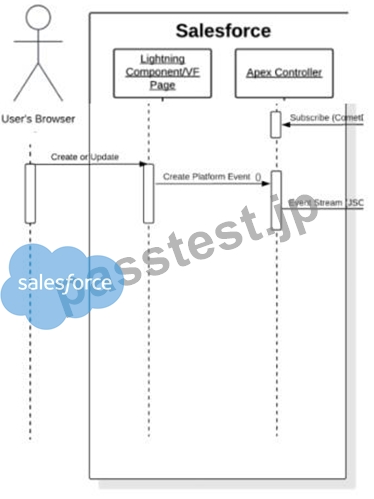
As part of its solution to accelerate overall sales. Universal Containers (UC) has chosen to implement a CPQ solution using Salesforce CPQ. As part of the CPQ solution, there is a requirement to retain UC's ERP as the Pricing and Product master.
UC's business process results in Products and Pricing being updated sporadically once a week, and then on a much larger scale on a monthly basis, which could result in a large amount of records that need to be updated in Salesforce.
Which strategy should the Solution Architect choose to handle this scenario?
- A. Option B, utilizing Process Builder and Platform Events to communicate with the external services Subscriber Listener
- B. Option C, utilizing a VF/Lightning component in combination with an Apex Controller to make a call utilizing the Streaming API
- C. Option D, utilizing an external ETL tool to batch load the records into Salesforce
- D. Option A, utilizing a VF/Lightning component in combination with an Apex Controller to make a REST call to the external service
正解:C
解説:
Salesforce CPQ is an extension of the Salesforce CRM that automates the generation and processing of quotes, orders, and contracts. It enables your sales team to create quotes quickly and with minimal errors and efforts.
Salesforce CPQ can be integrated with ERP systems by converting Salesforce CPQ lead-to-order data into transactional data. This allows ERP systems to take over matching data and use it for accounting functions.
an external ETL tool can be used to batch load the records into Salesforce from the ERP system. This can handle large amounts of records that need to be updated sporadically or on a monthly basis.
https://www.rapidionline.com/blog/salesforce-cpq-data-integration-increase-sales
https://www.salesforce.com/products/cpq/resources/what-is-salesforce-cpq/
質問 # 71
A Solution Architect has gathered requirements from discovery with Northern Trail Hot Tubs below:
* Northern Trail Hot Tubs sells through a B2B2C model with Dealers.
* Northern Trail Hot Tubs tracks Dealer Opportunities in Salesforce, but wishes to have more insight into the sales process from its Dealers.
* Dealers would like to be able to get custom Hot Tub pricing quickly from Northern Trail Hot Tubs without having to wait for configuration estimates to come back from Northern Trail Hot Tubs.
* Northern Trail Hot Tubs supports its Dealers and Customers directly, and Dealers would like better insightinto support thattheir Customers receive.
Which capabilities should a Solution Architect suggest to provide to Northern Trail Hot Tub Dealers?
- A. Experience Cloud and Revenue Cloud for Dealers to get Quotes and view Cases
- B. Experience Cloud and Sales Cloud for Dealers to be able to create Opportunities and add Opportunity Products
- C. Experience Cloud and Service Cloud for Dealers to be able to request pricing through Cases and track Customer Cases
- D. B2B Commerce for Dealers to get pricing and Service Cloud for Cases
正解:B
質問 # 72
A Solution Architect has gathered requirements from discovery with Northern Trail Hot Tubs below:
* Northern Trail Hot Tubs sells through a B2B2C model with Dealers.
* Northern Trail Hot Tubs tracks Dealer Opportunities in Salesforce, but wishes to have more insight into the sales process from its Dealers.
* Dealers would like to be able to get custom Hot Tub pricing quickly from Northern Trail Hot Tubs without having to wait for configuration estimates to come back from Northern Trail Hot Tubs.
* Northern Trail Hot Tubs supports itsDealers and Customers directly, and Dealers would like better insight into support that their Customers receive.
Which capabilities should a Solution Architect suggest to provide to Northern Trail Hot Tub Dealers?
- A. Experience Cloud and Service Cloud for Dealers to be able to request pricing through Cases and track Customer Cases
- B. Experience Cloud and Revenue Cloud for Dealers to get Quotes and view Cases
- C. Experience Cloud and Sales Cloud for Dealers to be able to create Opportunities and add Opportunity Products
- D. B2B Commerce for Dealers to get pricing and Service Cloud for Cases
正解:B
解説:
Experience Cloud can provide dealers with a self-service portal to track opportunities and support cases, while Revenue Cloud (which includes Salesforce CPQ) can enable dealers to get custom pricing and generate quotes quickly. This combination meets all the outlined requirements, providing visibility into the sales process and support activities, as well as enabling efficient quoting. Salesforce's documentation on the capabilities of Experience Cloud and Revenue Cloud supports this recommendation.
* Key Requirements:
* Quick Custom Pricing: Dealers need to generate custom quotes without waiting for manual configuration.
* Insight into Customer Support: Dealers want visibility into support cases for their customers.
* Enhanced Sales Process Insights: Northern Trail Hot Tubs seeks better tracking of Dealer Opportunities.
* Analysis of Options:
* Option A (Experience Cloud + Sales Cloud):While Experience Cloud provides a portal for Dealers to create Opportunities and add Products via Sales Cloud, it does not address the need for automated, rapid quote generation, which requires CPQ (Configure, Price, Quote) functionality.
* Option C (Service Cloud + Service Cloud):Using Cases to request pricing introduces delays, conflicting with the requirement to eliminate waiting for configuration estimates.
* Option D (Commerce Cloud + Service Cloud):Commerce Cloud focuses on transactional e- commerce, not complex product configuration or quoting. CPQ (Revenue Cloud) is better suited for custom pricing.
* Option B (Experience Cloud + Revenue Cloud):
* Revenue Cloud (CPQ): Enables Dealers to self-serve by generating accurate, automated quotes without manual intervention. This directly addresses the need for quick custom pricing.
* Experience Cloud: Provides a portal where Dealers can access:
* CPQ (Revenue Cloud) for quotes.
* Service Cloud integration (implied) to view Cases related to their customers.
Salesforce's Experience Cloud seamlessly integrates with Service Cloud to expose Cases, even though Service Cloud isn't explicitly listed in the option.
* Why Option B is Correct:
* Revenue Cloud (CPQ) solves the custom pricing requirement.
* Experience Cloud acts as the unified portal for Dealers to:
* Generate quotes (via CPQ).
* View Cases (via Service Cloud integration).
* While Service Cloud powers Cases in the background, the question focuses on capabilities provided to Dealers, which are delivered through Experience Cloud and Revenue Cloud.
References:
* Revenue Cloud (CPQ): Salesforce CPQ Documentation
* Experience Cloud for Partner Portals: Experience Cloud Guide
* Service Cloud Integration with Experience Cloud: Service Cloud in Communities This solution aligns with Salesforce best practices for B2B partner management, combining self-service quoting (CPQ) and customer support visibility (Service Cloud via Experience Cloud).
質問 # 73
A Solution Architect is working with a complex enterprise architecture that supports multiple business processes. Many previous transformation projects have struggled because of the interdependencies between the Salesforce production environment and other systems, as well as a lack of documentation.
In which two ways can a Solution Architect gain a better understanding of the current state of the Salesforce production environment?
Choose 2 answers
- A. Speak to the business stakeholders to gather their suggestions for improvement.
- B. Work with the system administrator to identify who has the most knowledge of the current configuration.
- C. Identify which system integrator did the previous implementation and ask them to document their work.
- D. Examine the details of the current configuration to see how it is set up.
正解:C、D
質問 # 74
UC Foods, a global manufacturing organisation, builds and sells a varietyof food processing equipment on its B2B Commerce site. Customers often tailor their equipment by selecting from several product variants.
Depending on the options selected, an order will sometimes require manual intervention by a sales person to determinethe price for the customized piece of equipment.
Once the machines have been purchased, each machine comes with a 1-year warranty, which entitles the customer to quarterly visits to inspect and perform maintenance on the machines to keep them in proper working order.
How can a Solution Architect use a multi-cloud solution to address the needs of the organization to efficiently support the selling of equipment and planning of quarterly visits for the machines?
- A. Use the B2B Commerce aggregated product or dynamic kits to drive the selection of the product options, then automatically create a case when manual intervention is required. For the quarterly visits, use Service Contracts and Entitlements.
- B. Use a third-party plugin configurator to support the selection of the product options, then create a CPQ quote when manual intervention is required. For the quarterly visits, use Field Service Maintenance Plans.
- C. Use the B2B Commerce aggregated product or dynamic kits to drive the selection of theproduct options, then create a CPQ quote when manual intervention is required. For the quarterly visits, use Field Service Maintenance Plans.
- D. Use the B28 Commerce aggregated product or dynamic kits to drive the selection of the product options, then create a CPQ quote when manual intervention is required. For the quarterly visits, use Service Contracts and Entitlements.
正解:C
解説:
Utilizing B2B Commerce for product selection allows customers to tailor their equipment with available options. When customization requires sales intervention, CPQ facilitates accurate pricing and quoting. For post-sale service, Salesforce Field Service's Maintenance Plans automate scheduling of regular maintenance visits, ensuring consistent service delivery and optimizing resource planning.
質問 # 75
Universal Containers (UC) delivers packaging solutions to its customers based on volume schedule, which is part of a contract that UC is closing. Customers place orders against these contracts, and the orders are maintained in an ERP system outside of Salesforce.
Employees of UCwant to track invoicing payment status on a monthly basis so that they can identify early when customer orders fall short of the contractual target.
Which two solution components should a Solution Architect recommend to meet this requirement?
Choose 2 answers
- A. Opportunities and Opportunity Products from Sales Cloud
- B. Invoicing payment status sync between Salesforce Billing and ERP
- C. Product and Revenue Schedules from Sales Cloud
- D. Orders and Order Products from Sales Cloud and a MuleSoft integration with the ERP
正解:B、D
解説:
To track invoicing payment status and identify discrepancies in customer orders against contractual targets, integrating Salesforce Billing with the ERP system is essential. This integration allows for real-time synchronization of invoicing and payment statuses, providing UC employees with up-to-date information.
Using MuleSoft for integration facilitates seamless data exchange between Salesforce and the ERP, ensuring that order information is accurately reflected in Salesforce. This setup supports efficient monitoring and management of contractual obligations and financial transactions. Salesforce Billing offers capabilities for managing invoicing and payments within the Salesforce ecosystem, while MuleSoft's Anypoint Platform enables robust API-led connectivity between systems, aligning with Salesforce's recommended practices for system integration and data management.
質問 # 76
Universal Containers (UC) is concerned about potential data storage issues in Salesforce due to the Invoice, Order, and Inventory data that would be flowing in from various on-premise legacy CRM and ERP applications. UC would like to view and occasionally report on this data on-demand for day-to-day operational processes and would prefer not to store the data in Salesforce due to data residency requirements.
Which recommendation should the Solution Architect make to meet this requirement?
- A. Re-architect the implementation using Salesforce Connect and external objects.
- B. Use Salesforce Orchestrator with MuleSoft to retrieve the data when it is needed.
- C. Push the data into Salesforce and implement an archival strategy.
- D. Write custom Apex code to retrieve the data in real time from external systems.
正解:A
質問 # 77
SharpField is a fast-growing company that provides SaaS for commercial service providers. SharpField has been acquiring other similar companies and plans to continue to do so for the near future.
After a recent acquisition of a company that also has a Salesforce org, the CIO wants to know the correct path forward on deciding whether to integrate the acquired companies into SharpField's existing landscape.
What should a Solution Architect recommend to the CIO to ensure the correct org strategy for SharpField going forward?
- A. Recommend a single-org strategy and development of strict processes for all acquired companies to follow.
- B. Prioritize migrating the newly acquired company to SharpField's Salesforce org first, then perform an org strategy analysis to assess the Business, Technology, Governance, and Operations requirements for any future acquisitions.
- C. Recommend a multi-org strategy and development of required integration layers to move the required shared data between instances of any and all acquired Salesforce instances.
- D. Prioritize completing an in-depth org strategy analysis, focused on the Business, Technology, Governance, and Operations requirements at SharpField.
正解:C
質問 # 78
A Solution Architect was asked by AC Computers to provide solution recommendations for a rebate enrollment and management solution on Salesforce. The primary goal and requirement is to easily launch rebate programs for partners that an administrator can implement and manage in Salesforce. AC Computers currently uses Sales Cloud, Salesforce CPQ, and Experience Cloud to expose opportunity and quote information to partners.
Based on the business requirements, which solution should the Solution Architect recommend?
- A. Implement Salesforce Service Contracts with line items to track rebate accruals and expose the data in the Experience Cloud site.
- B. Implement Salesforce Rebate Management Module and expose the data in the Experience Cloud site.
- C. Implement a custom solution to track rebates, accruals, and actuals and expose the data in the Experience Cloud site.
- D. Implement B2B Commerce on Lightning Experience to track rebates and expose the data in the Experience Cloud site.
正解:D
質問 # 79
......
最新問題をダウンロードB2B-Solution-Architect問題集で2025年最新のB2B-Solution-Architect試験問題集:https://www.passtest.jp/Salesforce/B2B-Solution-Architect-shiken.html
最新のSalesforce B2B-Solution-Architect認定練習テスト問題:https://drive.google.com/open?id=1W8G_pdSuP1tZDl-M_O25vuxM3vhNu7xG