

PECBは2025年最新のISO-45001-Lead-Auditorテスト解説(更新されたのは44問があります)
ISO-45001-Lead-Auditor試験問題集を提供していますPECB問題
質問 # 12
On behalf of a certification body, you are conducting a combined audit of Shelf-Fit. The organization designs, manufacturing install interiors for retail stores. They employ subcontractors for the installation work.
Representing the ISO 45001 audit, you ask the Purchase Manager about the identification of health and safety hazards for contractors on site. Having previously reviewed the hazards list (HZD-21/11 Rev.3), you found that various health and safety hazards were listed but not were associated with contractor working on-site.
When you ask about the use of contractors, the response is, ''We know that contractors use chemicals, such as glues, paints and vanishes. We trust them since they know more than we do about the safe handling of such issues''. The auditor made the same enquiry to an accompanying member of the health and safety team and was told that chemical safety had never been a problem with the installation process.
- A. The organization failed to include its OH&S policy in contracts for installation contractors (5.2.f)
- B. There was not communication between the organization and site contractors (7.4.1.c.2)
- C. Some safety data sheets for chemical used were missing for some of the installation contractors.(clause 8.1.4.2)
- D. No hazard assessment by Shelf-Fit were in place for installation works on customer sites. (Clause 6.1.2.2)
- E. The purchase manager confirmed that the safe use of chemicals in installation work was left to the contractor
- F. The internal audit programme does not include installation sites. The audit programme does not cover the full OHS management system (Clause 9.2.2)
- G. Staff indicated that chemical hazards on installation sites are the same as at the factory. The hazard List does not reference this. (Clause 6.1.2.2)
- H. After gathering more evidence, you note down findings against several clauses of ISO 45001. Select three options to determine which findings stated are major nonconformities.
- I. The organization did not have a documented process in place to control outsourced work. (8.1.4.3)
正解:B、G、I
解説:
Major nonconformities are raised when there is a systemic failure to meet ISO 45001 requirements that could lead to significant risks.
Analysis of Options:
B . Lack of a documented process for controlling outsourced work (8.1.4.3):
Major nonconformity. A failure to control outsourced work is a serious systemic issue.
C . Failure to include OH&S policy in contractor contracts (5.2.f):
Not a major nonconformity. While this is a nonconformity, it is procedural and not critical.
D . No hazard assessment for installation works (6.1.2.2):
Major nonconformity. A lack of hazard assessment for site-specific tasks is a serious issue.
E . Missing safety data sheets for contractor chemicals (8.1.4.2):
Not a major nonconformity. While important, this issue does not indicate systemic failure.
G . Chemical hazards on installation sites not referenced in the hazard list (6.1.2.2):
Major nonconformity. This reflects a failure in hazard identification and risk assessment.
H . Internal audit program does not cover installation sites (9.2.2):
Not a major nonconformity. This is a gap in auditing scope but does not directly endanger safety.
I . Safe use of chemicals left to contractors:
Not a major nonconformity. This could be addressed through improved contractor oversight rather than indicating systemic failure.
ISO Reference:
Clause 8.1.4.3: Control of outsourced processes.
Clause 6.1.2.2: Hazard identification and risk assessment.
Clause 7.4.1: Communication requirements.
質問 # 13
An adventure park has the following and safety policy document displayed in the reception area:
This organization is committed to providing safe experiences, In accordance with health and safety regulations for their delivery. The organisation will strive to increase the health and safety awareness of its personal, contracts and customers. Continual health and safety improvement is a permanent objective of the organisation. This policy shall be communicated to all interested parties.
Referring to the policy statement, select three options for which the organization is meeting ISO 45001 requirements.
- A. The organisation uses contractors committed to health and safety.
- B. The organisation meets oil statutory requirements.
- C. The organisation is committed to continual health and safety improvement.
- D. The management is committed to health and safety improvement.
- E. The management Is committed to health and safety Improvement.
- F. The organisation satisfies Its customers' health and safety requirement.
- G. The organisation's processes deliver the Intended Improvement to health and safety.
- H. The organization has a good reputation for safe experiences.
- I. The organization intends to communicate its policy to external parties.
正解:C、E、I
解説:
Comprehensive Detailed Explanation along with All ISO 45001 Audit Reference Clause 5.2 of ISO 45001:2018 outlines requirements for the OH&S policy, emphasizing commitment to continual improvement, compliance with legal requirements, and communication of the policy to interested parties.
Analysis of Options:
A . The management is committed to health and safety improvement:
Correct. The policy explicitly states the organization's commitment to improvement, meeting Clause 5.2 requirements.
C . The organization has a good reputation for safe experiences:
Not relevant to ISO 45001 requirements; reputation is not a policy criterion.
D . The organization intends to communicate its policy to external parties:
Correct. Clause 5.2 requires the policy to be communicated to interested parties.
E . The organization is committed to continual health and safety improvement:
Correct. This directly aligns with Clause 5.2, which mandates continual improvement.
F . The organization meets all statutory requirements:
The policy does not explicitly state compliance with legal requirements, even though this is implied.
G . The organization satisfies its customers' health and safety requirements:
The policy does not specifically address customer requirements.
H . The organization uses contractors committed to health and safety:
Not stated in the policy.
I . The organization's processes deliver the intended improvement to health and safety:
This is not evident from the policy statement.
ISO Reference:
Clause 5.2: OH&S policy.
質問 # 14
Which of the following standards talk about the Environment Management System? Select all the correct options, and then select Submit.
- A. Integrated Management system
- B. ISO 14501
- C. ISO 14001
- D. ISO 45001
正解:A、C
解説:
Analysis of Options:
A . Integrated Management System:
Correct. An Integrated Management System (IMS) combines multiple standards like ISO 45001, ISO 14001, and ISO 9001, addressing environment management as part of the integration.
B . ISO 14501:
Incorrect. ISO 14501 pertains to milk and milk products, not environmental management.
C . ISO 45001:
Incorrect. ISO 45001 focuses on Occupational Health and Safety, not environmental management.
D . ISO 14001:
Correct. ISO 14001 is the primary standard for Environmental Management Systems.
ISO Reference:
ISO 14001: Environment Management Systems.
Integrated Management Systems: Combines standards like ISO 14001 and ISO 45001.
質問 # 15
Select two options that are corrections.
- A. Changing the name of a tutor that did not deliver a course to the name of the tutor that did.
- B. Adding a missing signature to a corrective action record.
- C. Reviewing workers training records.
- D. Using OHSMS induction training to address an identified lack OHSMS awareness among winkers.
- E. Updating the emergency preparedness plan as a result of carrying out a practical test.
- F. Changing a process to reduce its inherent risk.
正解:A、B
解説:
Comprehensive Detailed Explanation along with All ISO 45001 Audit Reference Corrections address immediate issues, such as errors or omissions, without addressing root causes. Clause 10.2 of ISO 45001:2018 allows for corrections alongside corrective actions.
Analysis of Options:
A . Adding a missing signature to a corrective action record:
Correct. This is a correction addressing an administrative oversight.
B . Changing a process to reduce its inherent risk:
Incorrect. This is a corrective action aimed at addressing root causes, not a correction.
C . Changing the name of a tutor that did not deliver a course to the name of the tutor that did:
Correct. This corrects an error in records without addressing systemic issues.
D . Reviewing workers' training records:
Incorrect. This is part of ongoing monitoring or auditing, not a correction.
E . Updating the emergency preparedness plan as a result of carrying out a practical test:
Incorrect. This is a corrective action resulting from performance evaluation, not a correction.
F . Using OHSMS induction training to address an identified lack of OHSMS awareness among workers:
Incorrect. This is a preventive or corrective action, not a correction.
ISO Reference:
Clause 10.2: Nonconformity and corrective action.
Clause 7.5: Control of documented information
質問 # 16
You are conducting an ISO 45001 audit of Widgets Inc.., an organization manufacturing machine parts for the aerospace industry, You find a short entry in the incident report file connecting a machine operator who suffered minor injury to his face four weeks ago when a small ribbon of metal hit him while operating his machine.
The subsequent investigation found that he was not wearing the required protective Personal Protective Equipment (PPE). He was subject to disciplinary action and warned that he would lose his job if it happened again.
Select two option of points of investigation which you would consider in order to determine conformity or nonconformity with clause 10.2 of ISO 45001.
- A. Find out when the operator's machine was last subject to a maintenance programme.
- B. Establish whether the Incident Investigation determined the root cause of the Incident
- C. Check whether any corrective actions were taken to eliminate or reduce the risk of recurrence of the Incident.
- D. find out whether the operator was sent to the hospital.
- E. Determine whether the Health and Safety Authority was notified of the incident
- F. Interview the operator to check if the was wearing the correct PPE.
正解:B、C
解説:
Clause 10.2 of ISO 45001 requires organizations to investigate incidents, determine root causes, and implement corrective actions to prevent recurrence.
Analysis of Options:
A . Check whether corrective actions were taken.
This directly relates to the requirement to implement corrective actions to address the identified risks and hazards. Failure to do so would indicate nonconformity.
B . Determine whether the Health and Safety Authority was notified.
Notification is a legal requirement in certain jurisdictions, but it is not explicitly required under ISO 45001 unless the legal context demands it.
C . Establish whether the root cause was determined.
Root cause analysis is fundamental for effective corrective action. Without this, corrective measures may not address the underlying problem.
D . Find out when the operator's machine was last subject to maintenance.
While maintenance is important, it does not directly address the incident's nonconformity.
E . Find out whether the operator was sent to the hospital.
Sending the operator to the hospital is a reactive step and not relevant to compliance with Clause 10.2.
F . Interview the operator about PPE usage.
This is relevant but insufficient for determining compliance with Clause 10.2.
ISO Reference:
Clause 10.2: Investigation of incidents, determination of causes, and implementation of corrective actions.
Clause 8.1.2: Hierarchy of controls and risk reduction.
質問 # 17
You are an audit team leader overseeing the activity of a trainee auditor. Your team has just completed a surveillance audit and is assembling the final report.
The trainee has not contributed to a final report before and is clearly struggling with what she should provide to you for inclusion.
Which three of her following statements would be appropriate?
- A. The OHS Management team were extremely helpful and went out of their way to facilitate access to required records.
- B. The Production Manager is kicky to have a job as he does not appear to understand how anything works around here.
- C. The audit client's objectives for this audit were never realistic. That's why we were unable to complete the audit plan.
- D. The Sales Manager was kind and seems to be a nice person.
- E. The OHS Manager disagreed with me In respect of all of the nonconformances I raised. He still does not accept any of them.
- F. The Sales Manager said he had forgotten the password to the Sales Ordering system and so too had everyone else In his department
- G. The guide was trying to be helpful and would not stop talking during the audit.
- H. The maintenance team could not replace a lightbulb, let alone an air conditioning unit.
正解:A、C、F
解説:
Audit reports should focus on objective evidence, observations, and findings relevant to the management system and the audit process. Personal opinions, unrelated remarks, or derogatory comments are inappropriate.
Analysis of Statements:
A . The guide was trying to be helpful and would not stop talking during the audit:
Incorrect. This is irrelevant to the audit findings or conclusions.
B . The Sales Manager was kind and seems to be a nice person:
Incorrect. Personal opinions about individuals are not appropriate in audit reports.
C . The audit client's objectives for this audit were never realistic. That's why we were unable to complete the audit plan:
Correct. This is relevant as it relates to the audit process and highlights challenges in meeting objectives.
D . The maintenance team could not replace a lightbulb, let alone an air conditioning unit:
Incorrect. This is derogatory and irrelevant to the audit report.
E . The OHS Management team were extremely helpful and went out of their way to facilitate access to required records:
Correct. This is a valid observation about cooperation during the audit process.
F . The OHS Manager disagreed with me in respect of all of the nonconformances I raised. He still does not accept any of them:
Incorrect. While disagreements may occur, this statement is overly subjective and not constructive.
G . The Production Manager is lucky to have a job as he does not appear to understand how anything works around here:
Incorrect. Personal attacks or irrelevant judgments have no place in the report.
H . The Sales Manager said he had forgotten the password to the Sales Ordering system and so too had everyone else in his department:
Correct. This relates to system access and could indicate a nonconformance or an opportunity for improvement.
ISO Reference:
ISO 19011:2018, Clause 6.7: Reporting audit results.
質問 # 18
Like many other quality management systems, ISO 45001 uses what is known as a 'PDCA' circle. What do those initials stand for?
- A. Plan, Do, Check, Act
- B. Prepare, Deliver, Control, Assess
- C. Plan, Deliver, Control, Achieve
- D. Plan, Do, Check, Ask
正解:A
解説:
The PDCA (Plan-Do-Check-Act) model is a continuous improvement framework used in ISO 45001 and other management systems.
Plan: Establish objectives and processes to deliver results in line with the OH&S policy.
Do: Implement the processes.
Check: Monitor and measure processes against the policy, objectives, and requirements.
Act: Take actions to continually improve the system's performance.
Analysis of Options:
A . Plan, Do, Check, Act:
Correct. This is the standard PDCA cycle.
B . Plan, Do, Check, Ask:
Incorrect. "Ask" is not part of the cycle.
C . Plan, Deliver, Control, Achieve:
Incorrect. This is not the PDCA cycle.
D . Prepare, Deliver, Control, Assess:
Incorrect. This deviates from the PDCA framework.
ISO Reference:
Clause 0.3: PDCA model.
質問 # 19
An audit team leader arrives at a fabrication organisation that manufactures stairways to ..certification audit. At a meeting with the OHSMS Manager the audit finds that the responsibility for worker consultation and participation lies with the managerial team. Select from the options four actions by the managerial team that encourage worker consultation and participation.
- A. Implementing methods tor engaging workers
- B. Promoting collaborating workers to higher positions
- C. Conducting toolbox talks on health and safety
- D. Implementing a payment scheme to reward worker's OHS performance
- E. Giving ownership of health and safety matters
- F. Ignoring worker's suggestions
- G. threatening reprisals to whistleblowers
- H. Appointing worker's representatives
正解:A、C、E、H
解説:
Comprehensive Detailed Explanation along with All ISO 45001 Audit Reference Clause 5.4 of ISO 45001:2018 emphasizes the importance of worker consultation and participation in the OHS management system. It requires organizations to establish processes that ensure workers are actively involved in decision-making and implementation of OHS practices.
Analysis of Options:
A . Promoting collaborating workers to higher positions:
While promotions may boost morale, they do not directly contribute to worker consultation and participation in the OHSMS.
B . Appointing worker representatives:
This action fosters direct communication and representation of workers' interests in health and safety matters.
C . Conducting toolbox talks on health and safety:
Toolbox talks are an effective way to engage workers in discussing and addressing health and safety issues.
D . Giving ownership of health and safety matters:
Involving workers in decision-making and giving them responsibility for specific health and safety tasks encourages participation.
E . Ignoring workers' suggestions:
This undermines consultation and is contrary to ISO 45001 principles.
F . Implementing a payment scheme to reward workers' OHS performance:
While incentives can motivate safe behavior, they are not a consultation or participation mechanism as required by Clause 5.4.
G . Implementing methods for engaging workers:
This aligns directly with Clause 5.4, as effective engagement methods (e.g., surveys, focus groups) enhance participation.
H . Threatening reprisals to whistleblowers:
This violates ISO 45001 principles and discourages worker participation.
ISO Reference:
Clause 5.4: Worker consultation and participation.
Clause 5.1: Leadership's responsibility to foster participation.
質問 # 20
An audit team leader arrives at a steel fabrication organisation that manufactures stairways to carry out a Stage2 certification audit. At a meeting with the OHSMS Manager, she is told that they have won their biggest contact from a construction organization to manufacture and install stairways.
During the audit, a team member found that several employees had suffered hand injuries over several months due to handrail welds not being property polished. The OHSMS Manager blames the new employees they had to take on because of the big contract. The auditor raises a nonconformance against clause 10.2 erf ISO 45001.
In relation to the nonconformity raised by the auditor and in line with the policy of the certification body, the audit team raise improvement opportunities in the audit report.
Which three of the options would represent acceptance opportunities for improvement in the report?
- A. The molding polishers should be disciplined for Incompetency.
- B. Additional internal audits of the OHS management system may reduce production problems.
- C. Operational planning activities may benefit from an improved risk based approach based on international standards tor risk management.
- D. The requirement for wearing protective gloves could be extended to shop floor workers across all operations.
- E. All workers should be given competence test.
- F. A first aid station could be located next to the handrail polishing operation.
- G. The induction programme for new employees could include an awareness training video in health and safety.
- H. A quality control programme could involve non-destructive testing of the welded handrails
正解:C、D、G
解説:
Comprehensive Detailed Explanation along with All ISO 45001 Audit Reference Opportunities for improvement (OFIs) are suggestions provided during audits that do not indicate nonconformities but are aimed at enhancing the system's performance.
Analysis of Options:
A . A quality control program could involve non-destructive testing of the welded handrails:
While beneficial, this focuses on product quality rather than OH&S improvements.
B . Operational planning activities may benefit from an improved risk-based approach based on international standards for risk management:
Correct. Enhancing risk-based thinking aligns with Clause 6.1.1.
C . A first aid station could be located next to the handrail polishing operation:
While useful, first aid station placement is an operational matter, not directly related to OH&S management system improvement.
D . Additional internal audits of the OHS management system may reduce production problems:
Internal audits should address system performance, not production problems.
F . The induction program for new employees could include an awareness training video on health and safety:
Correct. Enhanced training for new employees addresses Clause 7.2 (competence).
G . The requirement for wearing protective gloves could be extended to shop floor workers across all operations:
Correct. This improves hazard control in line with Clause 8.1.2.
H . The molding polishers should be disciplined for incompetency:
Disciplinary actions are outside the scope of system improvement.
ISO Reference:
Clause 6.1.1: Risk management.
Clause 7.2: Competence.
Clause 8.1.2: Hierarchy of controls.
質問 # 21
What is the definition of the term 'audit' as per clause 3.32 of ISO 45001:2018?
- A. A legal requirement to comply with health and safety standards
- B. A document that outlines safety procedures and guidelines
- C. A systematic process to assess the risks in a workplace
- D. An evaluation of the effectiveness of health and safety measures
正解:D
解説:
According to Clause 3.32 of ISO 45001:2018, an audit is defined as a systematic, independent, and documented process for obtaining objective evidence and evaluating it to determine the extent to which audit criteria are fulfilled.
This involves assessing the effectiveness of health and safety measures implemented in the organization's OH&S management system.
Analysis of Options:
A . A systematic process to assess the risks in a workplace:
Incorrect. While audits may include risk assessments, the purpose is broader and involves evaluating the entire OH&S management system.
B . An evaluation of the effectiveness of health and safety measures:
Correct. This aligns with the definition of an audit as per ISO 45001:2018.
C . A legal requirement to comply with health and safety standards:
Incorrect. An audit is not necessarily a legal requirement but a process to assess conformity.
D . A document that outlines safety procedures and guidelines:
Incorrect. An audit is a process, not a document.
ISO Reference:
Clause 3.32: Audit definition.
質問 # 22
You are conducting a Stage 2 certification audit to ISO 45001 at an adventure park in the Scottish Highlands. The park offers treetop walks, zip-line rides, walking trails, and horse-riding trips. The park is open to adults and children of any age. You are particularly interested in compliance with legal requirements and interview the Park Manager.
You: How do you evaluate the risks to participants that the various activities present?
Park Manager: Our risks are covered by insurance, and we operate under health and safety legislation that requires frequent checks of all our facilities. For example, we trust staff to check all our harnesses every morning.
You: Are you required to have an independent inspection carried out of zip lines, for example?
Park Manager: Yes, our insurance company employs a reputable body to do that sort of thing.
You: Can you show me a copy of the latest inspection report? Park Manager: I'd need to get that from the insurance organisation. I have the initial one when we opened eight years ago.
You examine the inspection report, which takes the form of a checklist that does not identify individual zip lines, treetop platforms, harnesses, or rope ladders. It is dated eight years previously and has a scribbled signature with no other identification of the inspection engineer. Select the two statements for which there is evidence of a nonconformity to ISO 45001.
Select two statements.
- A. The organisation did not monitor the safety checks by the staff of equipment.
- B. Testing to determine the safe loading of equipment was not carried out.
- C. The park relied on the insurance organisation to evaluate its OHS risks.
- D. The inspection organisation employed by the insurance organisation was not evaluated.
- E. The park did not have the required documentation to demonstrate compliance with legal requirements.
正解:D、E
解説:
ISO 45001 requires organizations to identify and maintain documentation to demonstrate compliance with legal and other requirements (Clause 7.5 and Clause 9.1.2). It also requires the evaluation and control of outsourced processes (Clause 8.1.4.3).
Analysis of Options:
A . The park did not have the required documentation to demonstrate compliance with legal requirements:
Correct. The outdated and incomplete inspection report (8 years old, lacking detailed identification) fails to demonstrate compliance with health and safety legislation.
B . The organization did not monitor the safety checks by staff of equipment:
Incorrect. While there is a potential gap in monitoring, the evidence provided does not directly indicate a lack of monitoring of staff checks.
C . The inspection organization employed by the insurance organization was not evaluated:
Correct. ISO 45001 requires the organization to evaluate outsourced services, including those provided by the inspection body, to ensure their adequacy.
D . The park relied on the insurance organization to evaluate its OHS risks:
Incorrect. Reliance on external evaluations may not constitute a nonconformity if risks are properly managed, but there is no evidence provided for noncompliance here.
E . Testing to determine the safe loading of equipment was not carried out:
Incorrect. While load testing is crucial, there is no evidence presented to confirm this specific issue as a nonconformity.
ISO Reference:
Clause 7.5: Control of documented information.
Clause 8.1.4.3: Control of outsourced processes.
Clause 9.1.2: Evaluation of compliance.
質問 # 23
A well-known fast-food organisation (ISO 45001 certified) contracts young people to deliver orders; last week one of them died in a street accident riding for the first time a new motorbike provided by the organisation. You will lead the recertification audit in two weeks, and you plan to prepare a checklist to investigate this incident. The following are potential questions you might ask; match them to the related ISO 45001 clause/subclause.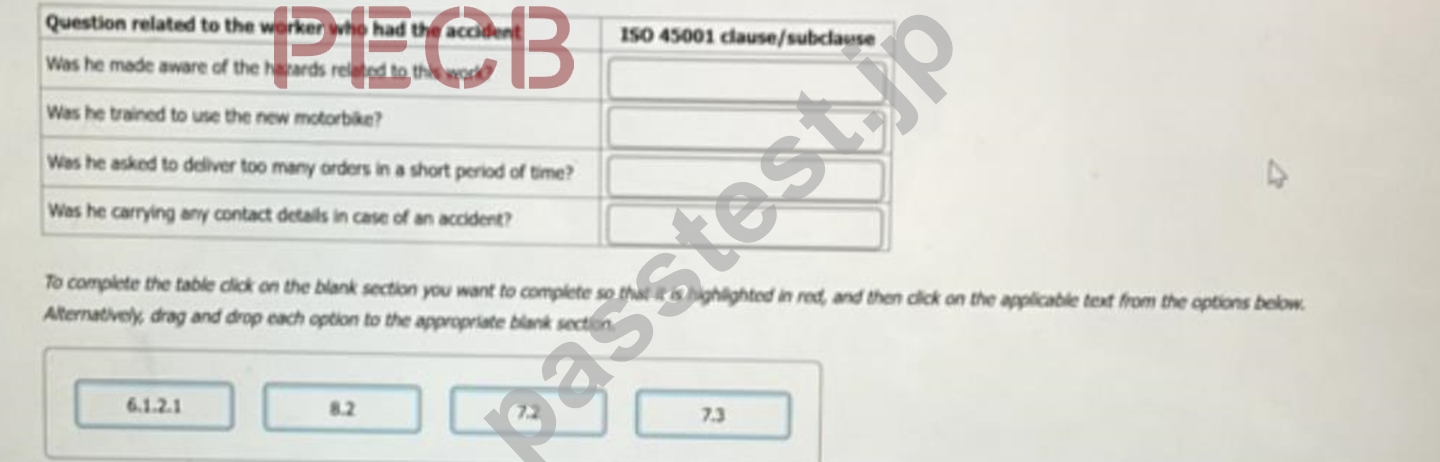
正解:
解説: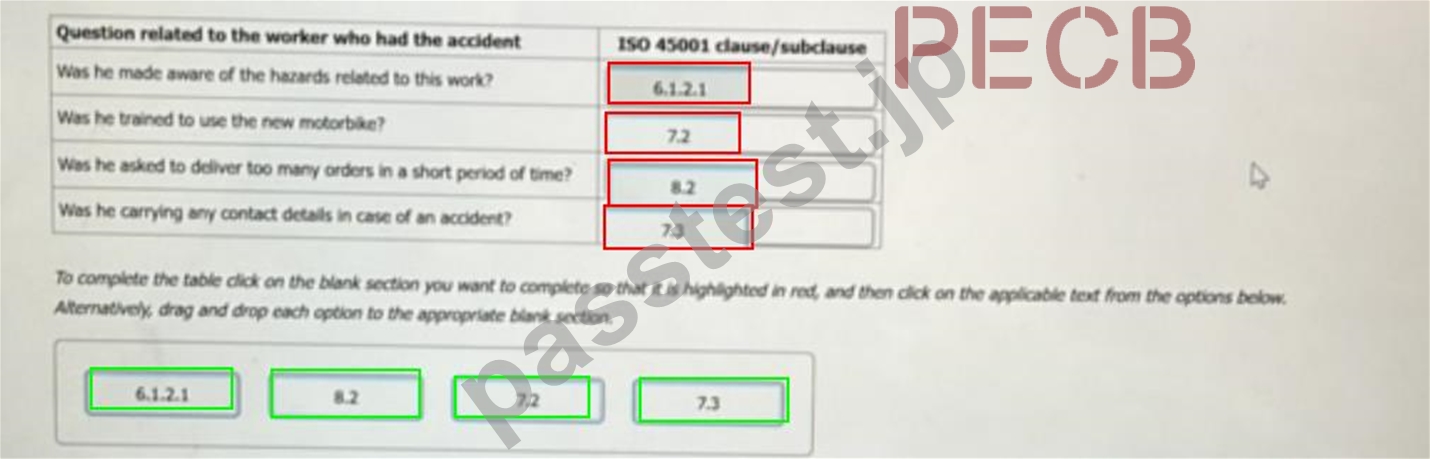
質問 # 24
Out of the following, which is not the Part of PDCA cycle ISO 45001? Select the correct option, and then select Submit.
- A. Treatment of Risks
- B. Analyzing OHSMS Performance
- C. Environment Management Program
- D. OHSMS Policy
正解:C
解説:
The PDCA cycle (Plan-Do-Check-Act) is a core framework in ISO 45001 for continual improvement of the OH&S management system. An Environmental Management Program is part of ISO 14001 (Environmental Management System) and not ISO 45001.
Analysis of Options:
A . Treatment of Risks:
Correct. Risk treatment is part of the Plan phase.
B . OHSMS Policy:
Correct. The policy is developed in the Plan phase.
C . Environment Management Program:
Incorrect. This is outside the scope of ISO 45001 and relates to ISO 14001.
D . Analyzing OHSMS Performance:
Correct. Performance analysis is part of the Check phase.
ISO Reference:
Clause 0.3: PDCA framework in ISO 45001.
質問 # 25
Showitoff is an organization specialization in the design and production of wall decorating materials for the domestic market.
During an ISO 45001 certification audit of the site, the auditor comes across an open, walled area just outside the maintenance department. It contains various scraps of wood and metal as well as serveral rusty components. Several heavy concrete beams are learning against a thin brick wall in which cracks are available. When asked about it, the OHS Manager states that he presumes that the materials come from maintenance work, so it is the Maintenance Manager's responsibility.
The auditor interview the Maintenance Manager in his department. He asks about the area outside and is told that it contains some excess material that the Manager likes to keep in case they come in handy at some stage. The auditor points out that the wall appears to be unstable and could collapse at any moment. The Maintenance Manager is not aware of such a situation.
The auditor decides to review the process for evaluation of compliance with health and safety regulations in more depth.
Select six option that provide a meaningful audit trail for this process.
- A. What input does the Maintenance Manager have in the determination of legal compliance?
- B. How arc OH&S objectives verified?
- C. How is the cost of safety Improvements calculated?
- D. What are the qualifications of the OHS Manager and Maintenance Managers?
- E. What hazards have been identified as being associated with regulations?
- F. What knowledge does the OHS Manager have in relevant safety leaislation?
- G. How ore updates to OH&S regulations monitored?
- H. How arc maintenance start made aware of regulatory requirements?
- I. How are OHSMS records of compliance evaluations controlled and managed?
- J. What is the cost of repairing the wall?
正解:A、E、F、G、H、I
解説:
Comprehensive Detailed Explanation along with All ISO 45001 Audit Reference An audit trail for evaluating compliance with regulations should focus on the identification, communication, and monitoring of legal and other requirements. Clause 9.1.2 of ISO 45001:2018 requires organizations to evaluate compliance with applicable OH&S legal and other requirements.
Analysis of Options:
A: What is the cost of repairing the wall?
Irrelevant to compliance evaluation, as cost considerations are not part of legal compliance.
B: What hazards have been identified as being associated with regulations?
Correct. Identifying hazards is a critical step in understanding compliance obligations (Clause 6.1.2).
C: How are maintenance staff made aware of regulatory requirements?
Correct. Communication and training are vital for compliance (Clause 7.3).
D:How are OH&S objectives verified?
Not directly relevant to compliance evaluations, as objectives pertain to performance improvement.
E:How are OHSMS records of compliance evaluations controlled and managed?
Correct. Proper documentation and record-keeping are essential for demonstrating compliance (Clause 7.5).
F :How are updates to OH&S regulations monitored?
Correct. Monitoring regulatory changes is critical for maintaining compliance (Clause 6.1.3).
G :How is the cost of safety improvements calculated?
Irrelevant to compliance, as cost analysis is not required by ISO 45001.
H:What are the qualifications of the OHS Manager and Maintenance Manager?
While competence is important, this does not directly relate to compliance evaluations.
I :What input does the Maintenance Manager have in the determination of legal compliance?
Correct. Understanding the roles and responsibilities of key personnel ensures effective compliance (Clause 5.3).
J :What knowledge does the OHS Manager have in relevant safety legislation?
Correct. Awareness of applicable legislation is critical for effective compliance evaluation (Clause 7.2).
ISO Reference:
Clause 9.1.2: Evaluation of compliance.
Clause 6.1.2: Hazard identification and risk assessment.
Clause 7.5: Documented information.
質問 # 26
During a second-party audit at a sawmill, you find that the OHSMS Manager conducted the hazard identification process. In the risk assessment report, hazards were listed as physical hazards, chemical hazards, biological hazards and psychosocial hazards, with the hazards categories as low medium and high to be addressed. The OHSMS Manager did not have an action plan for low and medium risks, saying that they ignored those He stated that they brought in a health and safety consultant to advise on treatment for the high risks.
When interviewing the OHSMS Manager, the auditor presents a nonconformity relating to potential hazards In the factory If the dust extraction system broke down. The OHSMS Manager said that. If that happened, the agreed planned action is that workers would put masks on.
Select one of the options for how the auditor should respond to this statement.
- A. Advise that the factory should cease its operations It the dust extraction equipment malfunctioned.
- B. Suggest that they should increase their maintenance checks.
- C. Seek evidence that the response action is both Implemented and effective.
- D. Ask the OH5MS Manager to confirm that this action meets regulatory requirements for air purity.
正解:C
解説:
The auditor should assess whether the organization's planned action (using masks in case of dust extraction failure) is both implemented and effective. This aligns with ISO 45001 requirements to ensure that control measures are functional and meet the intended objectives.
Clause 8.1.2 (Hierarchy of Controls):
The use of PPE, such as masks, is considered a last resort in the hierarchy of controls. The organization must demonstrate that the measure is:
Implemented (e.g., PPE is available and workers are trained to use it).
Effective (e.g., masks provide adequate protection against dust).
Analysis of Options:
A . Advise that the factory should cease operations if the dust extraction equipment malfunctioned.
While ceasing operations may be a necessary control in extreme situations, it is not a practical or realistic recommendation unless a high-risk scenario cannot be otherwise managed.
B . Ask the OHSMS Manager to confirm regulatory compliance.
Regulatory compliance is important but does not fully address the requirement to ensure the action is effective.
C . Seek evidence that the response action is both implemented and effective.
This is the most appropriate response. The auditor must verify implementation and effectiveness to determine conformity.
D . Suggest increasing maintenance checks.
Maintenance is important for preventing equipment breakdowns, but this option does not address the immediate audit finding about the adequacy of response actions.
ISO Reference:
Clause 8.1.2: Emphasizes applying the hierarchy of controls effectively.
Clause 9.1.1: Requires monitoring and measuring controls to ensure effectiveness.
質問 # 27
You are auditing a site of Good Food Shack, a restaurant chain. In the kitchen area, you notice a half-filled open drum sitting in a pool of liquid, which is dribbling across a work are a. You ask the head Chef what is in the drum and are told it is waste the frying process. When you ask why it is kept there, You are told that it is not normally kept there, but it not a problem and says that he will arrange it to be moved to a storeroom and will give the floor a good clean.
Look around the kitchen, you observe knives and cleavers lying around on worktops, staff wearing no protective gloves and a large pot of boiling water with nobody near it. There is no evidence of any fire extinguishers of fine blankets within sight.
You decide to raise a nonconformance. Select one of the options that best describes the finding against clause 8.1.2 of ISO 45001.
- A. Failure to reduce risks associated with working in the kitchen.
- B. Staff are at risk of serious injury while working in the kitchen.
- C. Measures to prevent slippage in the kitchen from waste cooking oil were not taken.
- D. Training of the kitchen staff was not effective enough to prevent poor safety awareness in the kitchen area.
正解:A
解説:
Comprehensive Detailed Explanation along with All ISO 45001 Audit Reference Clause 8.1.2 of ISO 45001 pertains to Eliminating Hazards and Reducing OH&S Risks. Organizations must implement appropriate controls to manage workplace hazards effectively.
Issue Identified:
The kitchen environment at the audited site presents multiple hazards, including:
Oil spillage creating a slip hazard.
Open drums of waste material posing a chemical or hygiene hazard.
Unsecured knives and cleavers increasing the risk of cuts.
Boiling water left unattended, posing a risk of burns.
Lack of visible fire extinguishers or fire blankets, increasing fire risk.
Analysis of Options:
A . Failure to reduce risks associated with working in the kitchen.
This option accurately captures the broader failure to implement effective measures to eliminate or reduce hazards across multiple areas in the kitchen.
B . Measures to prevent slippage in the kitchen from waste cooking oil were not taken.
This is specific to one hazard (oil spillage) and does not address other significant risks observed, such as fire safety or sharp tools.
C . Staff are at risk of serious injury while working in the kitchen.
While true, this is more of a general observation and does not address the root cause of the hazards or the failure of controls.
D . Training of the kitchen staff was not effective enough to prevent poor safety awareness in the kitchen area.
Although training deficiencies may contribute to the issue, this option does not reflect the overarching systemic failure to manage hazards effectively.
Best Description of the Nonconformance:
Failure to reduce risks associated with working in the kitchen (Option A) is the most comprehensive finding, reflecting the organization's lack of adequate controls to mitigate hazards.
ISO Reference:
Clause 8.1.2: Organizations must establish controls to eliminate or minimize OH&S risks systematically.
Clause 7.2: Ensuring competency through training is important but must be coupled with hazard control measures.
質問 # 28
When calculating an ISO 45001 third party initial audit duration, which two of the following statements are false?
- A. Consider the number of sites to be sampled
- B. Include the time allocated for lunch breaks
- C. Include outsourced processes
- D. Incorporate the time taken to travel to/from the audit location
- E. Consider the number of functions related to OHS management
- F. Think about the complexity of the organization's business
正解:B、D
解説:
Comprehensive Detailed Explanation along with All ISO 45001 Audit Reference Analysis of Each Option:
A . Consider the number of functions related to OHS management.
True.
The number of functions related to OHS management directly impacts the audit duration. More functions require additional time for the auditor to review documentation, processes, and implementation across those areas.
Reference: IAF MD 5:2020, Clause 2.3.1 (factors affecting audit time).
B . Consider the number of sites to be sampled.
True.
For multi-site organizations, the number of sites to be sampled is critical in calculating audit duration. Sampling requirements are determined using guidelines such as IAF MD 1:2022 and depend on the complexity, size, and risks associated with each site.
Reference: IAF MD 1:2022, Clause 4.2.
C . Include outsourced processes.
True.
Outsourced processes that affect the OHS management system must be evaluated as part of the audit. This includes reviewing the organization's control over such processes. Auditing these aspects impacts the audit duration.
Reference: ISO 45001:2018, Clause 8.1.4 and IAF MD 5:2020, Clause 2.3.1.
D . Include the time allocated for lunch breaks.
False.
Lunch breaks are not considered part of the audit duration as they do not contribute to the assessment of the management system. Audit time calculations exclude non-working hours, including breaks.
Reference: IAF MD 5:2020, Clause 2.5.
E . Incorporate the time taken to travel to/from the audit location.
False.
Travel time is excluded when calculating the audit duration. While travel logistics are considered in audit planning, they do not count towards the total audit time.
Reference: IAF MD 5:2020, Clause 2.5.
F . Think about the complexity of the organization's business.
True.
The complexity of the organization's business, including the nature of hazards, risks, and legal obligations, significantly affects the audit duration. More complex operations typically require longer audit times.
Reference: IAF MD 5:2020, Clause 2.3.1.
Key ISO and IAF Reference:
ISO 45001:2018: Clause 9.2.2 (Audit Program).
IAF MD 5:2020: "Determination of Audit Time of Quality and Environmental Management Systems." IAF MD 1:2022: "Audit and Certification of Multiple Sites Based on Sampling."
質問 # 29
Out of the following, which is not the Part of PDCA cycle of ISO 45001? Select the correct option, and then select Submit.
- A. Treatment of Risks
- B. Analyzing OHSMS Performance Submit
- C. Environment Management Program
- D. OHSMS Policy
正解:C
解説:
The PDCA (Plan-Do-Check-Act) cycle is a core principle of ISO 45001 and many other management systems. It does not include environmental management, as ISO 45001 focuses on Occupational Health & Safety (OH&S), while environmental aspects are covered by ISO 14001.
Analysis of Options:
A . Treatment of Risks:
Correct. Risk assessment and control are part of the Plan phase.
B . OHSMS Policy:
Correct. The OH&S policy is established in the Plan phase.
C . Environment Management Program:
Incorrect. This is outside the scope of ISO 45001 and pertains to ISO 14001.
D . Analyzing OHSMS Performance:
Correct. Performance analysis occurs in the Check phase of the PDCA cycle.
ISO Reference:
Clause 0.3: PDCA model in ISO 45001.
質問 # 30
......
ISO-45001-Lead-Auditor認定ガイドPDFは100%カバー率でリアル試験問題:https://www.passtest.jp/PECB/ISO-45001-Lead-Auditor-shiken.html
合格させるISO-45001-Lead-Auditorレビューガイド、信頼され続けるISO-45001-Lead-Auditorテストエンジン:https://drive.google.com/open?id=1od9B8_l2gx6UcQoFUD694KR43rcQqx_C