

[2023年04月25日] あなたを合格させるCAPM無料最新問題集でPMI練習テスト
無料でゲット!高評価PMI CAPM試験問題集を今すぐダウンロード!
PMI CAPM 認定試験の出題範囲:
| トピック | 出題範囲 |
|---|---|
| トピック 1 |
|
| トピック 2 |
|
| トピック 3 |
|
| トピック 4 |
|
| トピック 5 |
|
| トピック 6 |
|
| トピック 7 |
|
| トピック 8 |
|
質問 359
A measure of cost performance that is required to be achieved with the remaining resources in order to meet a specified management goal and is expressed as the ratio of the cost needed for finishing the outstanding work to the remaining budget is known as the:
- A. earned value management (EVM)
- B. to-complete performance index
- C. budget at completion (BAC)
- D. cost performance index
正解: B
解説:
Explanation/Reference:
Explanation:
TCPI = (BAC - EV)/(BAC - AC)
質問 360
The process of monitoring the status of the project and product scope as well as managing the changes to the scope baseline is known as:
- A. Control Scope.
- B. Validate Scope.
- C. Plan Scope Management.
- D. Define Scope.
正解: A
質問 361
While implementing an approved change, a critical defect was introduced. Removing the defect will delay the product delivery. What is the MOST appropriate approach to managing this situation?
- A. Utilize the change control process.
- B. Crash the schedule to fix the defect.
- C. Leave the defect in and work around it.
- D. Fast-track the remaining development.
正解: A
質問 362
A technique used to determine the cause and degree of difference between baseline and actual performance is:
- A. Document analysis.
- B. Decomposition.
- C. Variance analysis.
- D. Product analysis.
正解: C
解説:
Explanation/Reference:
Explanation:
5.6.2.1 Variance Analysis
Variance analysis is a technique for determining the cause and degree of difference between the baseline and actual performance. Project performance measurements are used to assess the magnitude of variation from the original scope baseline. Important aspects of project scope control include determining the cause and degree of variance relative to the scope baseline (Section 5.4.3.1) and deciding whether corrective or preventive action is required.
質問 363
Organizational process assets
Tools & Techniques
1. Expert judgment
2. Meetings
Outputs
1. Scope management plan
2. Requirements management plan
4.Which tool or technique is an examination of industry and specific vendor capabilities?
- A. Analytical techniques
- B. Market research
- C. Bidder conferences
- D. Independent estimates
正解: B
質問 364
The staffing management plan is part of the:
- A. resource calendar.
- B. human resource plan.
- C. organizational process assets.
- D. Develop Project Team process.
正解: B
解説:
Section: Volume E
質問 365
Cost variance (CV) is equal to earned value:
- A. Minus planned value [EV - PV].
- B. Divided by planned value [EV/PV].
- C. Divided by actual cost [EV/AC].
- D. Minus actual cost [EV - AC].
正解: D
質問 366
What risk response strategy involves removing high-risk scope elements from a project?
- A. Exploit
- B. Avoid
- C. Transfer
- D. Accept
正解: B
解説:
Section: Volume E
質問 367
Which component of the human resource management plan describes when and how project team members are acquired and how long they will be needed?
- A. Project organizational chart
- B. Resource breakdown structure
- C. Scope management plan
- D. Staffing management plan
正解: D
解説:
Explanation/Reference:
Explanation:
Staffing management plan. The staffing management plan is a component of the human resource management plan that describes when and how project team members will be acquired and how long they will be needed. It describes how human resource requirements will be met. The staffing management plan can be formal or informal, highly detailed, or broadly framed, depending upon the needs of the project. The plan is updated continually during the project to direct ongoing team member acquisition and development actions.
質問 368
Which of the following correctly lists the configuration management activities included in the Integrated Change Control process?
- A. Configuration definition, configuration status reporting, configuration monitoring and Control
- B. Configuration identification, configuration status reporting, configuration verification and audit
- C. Configuration definition, configuration status accounting, configuration monitoring and control
- D. Configuration identification, configuration status accounting, configuration verification and audit
正解: D
解説:
Explanation/Reference:
Explanation:
Configuration control is focused on the specification of both the deliverables and the processes; while change control is focused on identifying, documenting, and approving or rejecting changes to the project documents, deliverables, or baselines.
Some of the configuration management activities included in the Perform Integrated Change Control process are as follows:
Configuration identification. Identification and selection of a configuration item to provide the basis for
which the product configuration is defined and verified, products and documents are labeled, changes are managed, and accountability is maintained.
Configuration status accounting. Information is recorded and reported as to when appropriate data
about the configuration item should be provided. This information includes a listing of approved configuration identification, status of proposed changes to the configuration, and the implementation status of approved changes.
Configuration verification and audit. Configuration verification and configuration audits ensure the
composition of a project's configuration items is correct and that corresponding changes are registered, assessed, approved, tracked, and correctly implemented. This ensures the functional requirements defined in the configuration documentation have been met.
質問 369
The Verify Scope process is primarily concerned with:
- A. accuracy of the work deliverables.
- B. formalizing approval of the scope statement.
- C. accuracy of the work breakdown structure (WBS).
- D. formalizing acceptance of the completed project deliverables.
正解: D
質問 370
Power, urgency, and legitimacy are attributes of which stakeholder classification model?
- A. Power/influence
- B. Influence/impact
- C. Power/interest
- D. Salience
正解: D
質問 371
Which set of competencies should a project manager have?
- A. Expertise in every detail on project activities, PMP certification, and leadership
- B. Expertise in the industry, leadership and business management, and bilingual skills
- C. Technical project management, expertise in every role, and PMP certification
- D. Leadership, strategic and business management, and technical project management
正解: D
解説:
Section: Volume E
質問 372
Which of the following correctly describes when organizations and stakeholders are willing to accept varying degrees of risk?
- A. Risk analysis
- B. Risk tolerance
- C. Risk management
- D. Risk attitude
正解: B
解説:
Section: Volume E
Explanation:
11 PROJECT RISK MANAGEMENT
[..]
Organizations perceive risk as the effect of uncertainty on projects and organizational objectives. Organizations and stakeholders are willing to accept varying degrees of risk depending on their risk attitude. The risk attitudes of both the organization and the stakeholders may be influenced by a number of factors, which are broadly classifed into three themes:
Risk appetite, which is the degree of uncertainty an entity is willing to take on in anticipation of a reward.
Risk tolerance, which is the degree, amount, or volume of risk that an organization or individual will withstand.
Risk threshold, which refers to measures along the level of uncertainty or the level of impact at which a
stakeholder may have a specific interest. Below that risk threshold, the organization will accept the risk. Above that risk threshold, the organization will not tolerate the risk.
For example, an organization's risk attitude may include its appetite for uncertainty, its threshold for risk levels that are unacceptable, or its risk tolerance at which point the organization may select a different risk response.
Positive and negative risks are commonly referred to as opportunities and threats. The project may be accepted if the risks are within tolerances and are in balance with the rewards that may be gained by taking the risks. Positive risks that offer opportunities within the limits of risk tolerances may be pursued in order to generate enhanced value. For example, adopting an aggressive resource optimization technique is a risk taken in anticipation of a reward for using fewer resources.
質問 373
Which item is an input to the Define Activities process?
- A. Scope baseline
- B. Schedule data
- C. Activity list
- D. Risk register
正解: A
解説:
Section: Volume A
Explanation:
5.4.3.1 Scope Baseline
The scope baseline is the approved version of a scope statement, work breakdown structure (WBS), and its associated WBS dictionary, that can be changed only through formal change control procedures and is used as a basis for comparison. It is a component of the project management plan. Components of the scope baseline include:
Project scope statement. The project scope statement includes the description of the project scope, major
deliverables, assumptions, and constraints.
WBS. The WBS is a hierarchical decomposition of the total scope of work to be carried out by the project
team to accomplish the project objectives and create the required deliverables. Each descending level of the WBS represents an increasingly detailed definition of the project work. The WBS is finalized by assigning each work package to a control account and establishing a unique identifier for that work package from a code of accounts. These identifiers provide a structure for hierarchical summation of costs, schedule, and resource information. A control account is a management control point where scope, budget, actual cost, and schedule are integrated and compared to the earned value for performance measurement. Control accounts are placed at selected management points in the WBS. Each control account may include one or more work packages, but each of the work packages should be associated with only one control account. A control account may include one or more planning packages. A planning package is a work breakdown structure component below the control account with known work content but without detailed schedule activities.
WBS dictionary. The WBS dictionary is a document that provides detailed deliverable, activity, and
scheduling information about each component in the WBS. The WBS dictionary is a document that supports the WBS. Information in the WBS dictionary may include, but is not limited to:
○ Code of account identifier,
○ Description of work,
○ Assumptions and constraints,
○ Responsible organization,
○ Schedule milestones,
○ Associated schedule activities,
○ Resources required,
○ Cost estimates,
○ Quality requirements,
○ Acceptance criteria,
○ Technical references, and
○ Agreement information
Process: 6.2 Define Activities
Definition: The process of identifying and documenting the specific actions to be performed to produce the project deliverables.
Key Benefit: The key benefit of this process is to break down work packages into activities that provide a basis for estimating, scheduling, executing, monitoring, and controlling the project work.
Inputs
1. Schedule management plan
2. Scope baseline
3. Enterprise environmental factors
4. Organizational process assets
Tools & Techniques
1. Decomposition
2. Rolling wave planning
3. Expert judgment
Outputs
1. Activity list
2. Activity attributes
3. Milestone list
質問 374
Inputs to the Plan Schedule Management process include:
- A. Time tables and Pareto diagrams.
- B. Activity attributes and resource calendars.
- C. Enterprise environmental factors and schedule tools.
- D. Organizational process assets and the project charter,
正解: D
解説:
Section: Volume A
Explanation
Explanation:
2.1.4 Organizational Process Assets
Organizational process assets are the plans, processes, policies, procedures, and knowledge bases specific to and used by the performing organization. They include any artifact, practice, or knowledge from any or all of the organizations involved in the project that can be used to perform or govern the project. The process assets also include the organization's knowledge bases such as lessons learned and historical information.
Organizational process assets may include completed schedules, risk data, and earned value data.
Organizational process assets are inputs to most planning processes. Throughout the project, the project team members may update and add to the organizational process assets as necessary. Organizational process assets may be grouped into two categories: (1) processes and procedures, and (2) corporate knowledge base.
6.1 Plan Schedule Management
Definition: The process of establishing the policies, procedures, and documentation for planning, developing, managing, executing, and controlling the project schedule.
Key Benefit: The key benefit of this process is that it provides guidance and direction on how the project schedule will be managed throughout the project.
Inputs
1. Project management plan
2. Project charter
3. Enterprise environmental factors
4. Organizational process assets
Tools & Techniques
1. Expert judgment
2. Analytical techniques
3. Meetings
Outputs
1. Schedule management plan
質問 375
Which can be used to determine whether a process is stable or has predictable performance?
- A. Flowchart
- B. Control chart
- C. Matrix diagram
- D. Histogram
正解: B
解説:
Explanation/Reference:
Explanation:
Control charts, are used to determine whether or not a process is stable or has predictable performance.
Upper and lower specification limits are based on requirements of the agreement. They reflect the maximum and minimum values allowed. There may be penalties associated with exceeding the specification limits. Upper and lower control limits are different from specification limits. The control limits are determined using standard statistical calculations and principles to ultimately establish the natural capability for a stable process. The project manager and appropriate stakeholders may use the statistically calculated control limits to identify the points at which corrective action will be taken to prevent unnatural performance. The corrective action typically seeks to maintain the natural stability of a stable and capable process. For repetitive processes, the control limits are generally set at ±3 s around a process mean that has been set at 0 s. A process is considered out of control when: (1) a data point exceeds a control limit; (2) seven consecutive plot points are above the mean; or (3) seven consecutive plot points are below the mean. Control charts can be used to monitor various types of output variables.
Although used most frequently to track repetitive activities required for producing manufactured lots, control charts may also be used to monitor cost and schedule variances, volume, and frequency of scope changes, or other management results to help determine if the project management processes are in control.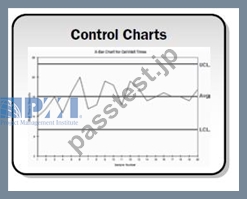
質問 376
Monte Carlo is which type of risk analysis technique?
- A. Qualitative
- B. Quantitative
- C. Probability
- D. Sensitivity
正解: B
質問 377
Which process involves the creation of a document that provides the project manager with the authority to apply resources to a project?
- A. Develop Project Charter
- B. Define Activities
- C. Develop Project Management Plan
- D. Direct and Manage Project Work
正解: A
解説:
Section: Volume B
Explanation:
Process: 4.1. Develop Project Charter
Definition: The process of developing a document that formally authorizes the existence of a project and provides the project manager with the authority to apply organizational resources to project activities.
Key Benefit: The key benefit of this process is a well-defined project start and project boundaries, creation of a formal record of the project, and a direct way for senior management to formally accept and commit to the project.
Inputs
1. Project statement of work
2. Business case
3. Agreements
4. Enterprise environmental factors
5. Organizational process assets
Tools & Techniques
1. Expert judgment
2. Facilitation techniques
Outputs
1. Project charter
質問 378
Make-or-buy analysis is a tool and technique of which process?
- A. Plan Procurement Management
- B. Analyze Procurements
- C. Conduct Procurements
- D. Control Procurements
正解: A
質問 379
In which project cost management process is work performance data an output?
- A. Estimate Costs
- B. Determine Budget
- C. Control Costs
- D. Plan Cost Management
正解: C
質問 380
To please the customer, a project team member delivers a requirement which is uncontrolled.
This is not part of the plan. This describes:
- A. deliverables.
- B. scope creep.
- C. work performance information.
- D. a change request.
正解: B
質問 381
Which type of probability distribution is used to represent uncertain events such as the outcome of a test or a possible scenario in a decision tree?
- A. Continuous
- B. Linear
- C. Discrete
- D. Uniform
正解: C
質問 382
The following is a network diagram for a project.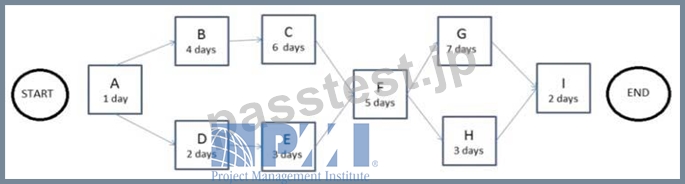
What is the critical path for the project?
- A. A-B-C-F-H-I
- B. A-D-E-F-G-I
- C. A-B-C-F-G-I
- D. A-D-E-F-H-I
正解: C
質問 383
Which process should be conducted from the project inception through completion?
- A. Monitor and Control Project Work
- B. Perform Integrated Change Control
- C. Monitor and Control Risks
- D. Perform Quality Control
正解: B
質問 384
......
一発合格の秘訣は無料でゲット!CAPMCertified 試験エンジンPDF:https://www.passtest.jp/PMI/CAPM-shiken.html
CAPM試験問題集合格には最新なテスト問題集:https://drive.google.com/open?id=1ou1KiaOGk57uLhTin6DRE6-YV7F-FTqU