

2025年10月本日更新されたCAPM試験問題集PDF試験エンジン無料!
こちらには最新版のCAPMリアル試験解答!
質問 # 379
The degree of uncertainty an entity is willing to take on in anticipation of a reward is known as its risk:
- A. tolerance
- B. management
- C. appetite
- D. response
正解:C
解説:
Explanation/Reference:
Explanation:
11 PROJECT RISK MANAGEMENT
[..]
Organizations perceive risk as the effect of uncertainty on projects and organizational objectives.
Organizations and stakeholders are willing to accept varying degrees of risk depending on their risk attitude. The risk attitudes of both the organization and the stakeholders may be influenced by a number of factors, which are broadly classifed into three themes:
Risk appetite, which is the degree of uncertainty an entity is willing to take on in anticipation of a reward.
Risk tolerance, which is the degree, amount, or volume of risk that an organization or individual will
withstand.
Risk threshold, which refers to measures along the level of uncertainty or the level of impact at which a
stakeholder may have a specific interest. Below that risk threshold, the organization will accept the risk.
Above that risk threshold, the organization will not tolerate the risk.
For example, an organization's risk attitude may include its appetite for uncertainty, its threshold for risk levels that are unacceptable, or its risk tolerance at which point the organization may select a different risk response.
Positive and negative risks are commonly referred to as opportunities and threats. The project may be accepted if the risks are within tolerances and are in balance with the rewards that may be gained by taking the risks. Positive risks that offer opportunities within the limits of risk tolerances may be pursued in order to generate enhanced value. For example, adopting an aggressive resource optimization technique is a risk taken in anticipation of a reward for using fewer resources.
質問 # 380
Which Knowledge Area involves identifying the people, groups, or organizations that may be impacted by or impact a project?
- A. Project Human Resource Management
- B. Project Risk Management
- C. Project Scope Management
- D. Project Stakeholder Management
正解:D
質問 # 381
While implementing an approved change, a critical defect was introduced. Removing the defect will delay the product delivery. What is the MOST appropriate approach to managing this situation?
- A. Crash the schedule to fix the defect.
- B. Leave the defect in and work around it.
- C. Fast-track the remaining development.
- D. Utilize the change control process.
正解:D
解説:
Section: Volume C
Explanation/Reference:
質問 # 382
Which of the following includes how requirements activities will be planned, tracked, and reported?
- A. Requirements management plan
- B. Schedule baseline
- C. Configuration management plan
- D. Scope baseline
正解:A
質問 # 383
Which is an example of Administer Procurements?
- A. Negotiating the contract
- B. Establishing evaluation criteria
- C. Developing the statement of work
- D. Authorizing contractor work
正解:D
質問 # 384
Organizational process assets, a lessons-learned database, and historical information are all inputs to which process?
- A. Plan Schedule Management
- B. Plan Scope Management
- C. Plan Stakeholder Management
- D. Plan Cost Management
正解:C
解説:
Section: Volume B
質問 # 385
All testing on a project has been performed successfully and all acceptance criteria have been met. What is the next step?
- A. Wait for the next sprint.
- B. Set up a meeting with the sponsor.
- C. Set up a go/no-go meeting.
- D. Deliver the product.
正解:D
質問 # 386
Which project documents can determine the budget?
- A. Business case, project charter, statement of work, and cost estimates
- B. Basis of estimates, cost estimates, project schedule, and risk register
- C. Scope baseline, resource management plan, activity list, and assumption log
- D. Procurement documents, contracts, requirements documentation, and basis of estimates
正解:B
質問 # 387
Through whom do project managers accomplish work?
- A. Consultants and stakeholders
- B. Project team members and consultants
- C. Project team members and stakeholders
- D. Stakeholders and functional managers
正解:C
解説:
Section: Volume B
Explanation/Reference:
質問 # 388
Control charts, flowcharting, histograms, Pareto charts, and scatter diagrams are tools and techniques of which process?
- A. Report Performance
- B. Plan Quality
- C. Perform Quality Control
- D. Perform Quality Assurance
正解:B
解説:
Section: Volume D
質問 # 389
The project manager is distributing project communications, collecting and storing project information, and retrieving documents when required. In which process is the project manager involved?
- A. Monitor Communications
- B. Manage Stakeholder Engagement
- C. Manage Communications
- D. Plan Communications Management
正解:C
解説:
Section: Volume E
Explanation/Reference: https://www.google.com/url?
sa=t&rct=j&q=&esrc=s&source=web&cd=4&ved=2ahUKEwityYzPzNThAhUH6qQKHR77AboQFjADegQIARAC
&url=https%3A%2F%2Fpeople.eecs.ku.edu%2F~hossein%2F811%2FLectures%2Fchapter-
10.pptx&usg=AOvVaw0B7ldXssetUgjbMWGxmkXp
質問 # 390
Exhibit A is an example of which of the following types of Sequence Activities?
- A. Project schedule network diagramming
- B. Activity-on-arrow diagramming
- C. Precedence diagramming
- D. Mathematical analysis diagramming
正解:C
質問 # 391
A project manager is updating their CV or resume and realizes that they need to improve skills related to expertise in the industry and organizational knowledge.
Which dimension of PMI's Talent Triangle best relates to this need to improve?
- A. Organizational management
- B. Technical project management
- C. Leadership skills
- D. Strategic and business management skills
正解:D
質問 # 392
A project team is discussing an upcoming planned product launch of a highly visible technologically advanced artificial intelligence tool. The team is debating the aspect of iterative and hybrid approaches. Which aspect of tailoring would this best represent?
- A. Life cycle approaches
- B. Resource availability
- C. Project dimensions
- D. Technology support
正解:D
質問 # 393
Which Project Management Process Group includes Collect Requirements, Define Activities, Sequence Activities, Perform Qualitative Risk Analysis, and Perform Quantitative Risk Analysis?
- A. Closing
- B. Monitoring and Controlling
- C. Planning
- D. Initiating
正解:C
解説:
Explanation/Reference:
Explanation:
Planning Process Group
4.2 Develop Project Management Plan
5.1 Plan Scope Management
5.2 Collect Requirements
5.3 Define Scope
5.4 Create WBS
6.1 Plan Schedule Management
6.2 Define Activities
6.3 Sequence Activities
6.4 Estimate Activity Resources
6.5 Estimate Activity Durations
6.6 Develop Schedule
7.1 Plan Cost Management
7.2 Estimate Costs
7.3 Determine Budget
8.1 Plan Quality Management
9.1 Plan Human Resource Management
10.1 Plan Communications Management
11.1 Plan Risk Management
11.2 Identify Risks
11.3 Perform Qualitative Risk Analysis
11.4 Perform Quantitative Risk Analysis
11.5 Plan Risk Responses
12.1 Plan Procurement Management
13.2 Plan Stakeholder Management
質問 # 394
The following is a network diagram for a project.
The total float for the project is how many days?
- A. 0
- B. 1
- C. 2
- D. 3
正解:B
質問 # 395
Which of the following response strategies are appropriate for negative risks or threats?
- A. Exploit, Enhance, Share, or Accept
- B. Avoid, Mitigate, Transfer, or Accept
- C. Mitigate, Share, Avoid, or Accept
- D. Share, Accept, Transfer, or Mitigate
正解:B
解説:
Explanation/Reference:
Explanation:
11.5.2.1 Strategies for Negative Risks or Threats
Three strategies, which typically deal with threats or risks that may have negative impacts on project objectives if they occur, are: avoid, transfer, and mitigate. The fourth strategy, accept, can be used for negative risks or threats as well as positive risks or opportunities. Each of these risk response strategies have varied and unique influence on the risk condition. These strategies should be chosen to match the risk's probability and impact on the project's overall objectives. Avoidance and mitigation strategies are usually good strategies for critical risks with high impact, while transference and acceptance are usually good strategies for threats that are less critical and with low overall impact. The four strategies for dealing with negative risks or threats are further described as follows:
Avoid. Risk avoidance is a risk response strategy whereby the project team acts to eliminate the threat or
protect the project from its impact. It usually involves changing the project management plan to eliminate the threat entirely. The project manager may also isolate the project objectives from the risk's impact or change the objective that is in jeopardy. Examples of this include extending the schedule, changing the strategy, or reducing scope. The most radical avoidance strategy is to shut down the project entirely. Some risks that arise early in the project can be avoided by clarifying requirements, obtaining information, improving communication, or acquiring expertise.
Transfer. Risk transference is a risk response strategy whereby the project team shifts the impact of a
threat to a third party, together with ownership of the response. Transferring the risk simply gives another party responsibility for its management-it does not eliminate it. Transferring does not mean disowning the risk by transferring it to a later project or another person without his or her knowledge or agreement. Risk transference nearly always involves payment of a risk premium to the party taking on the risk. Transferring liability for risk is most effective in dealing with financial risk exposure. Transference tools can be quite diverse and include, but are not limited to, the use of insurance, performance bonds, warranties, guarantees, etc. Contracts or agreements may be used to transfer liability for specified risks to another party. For example, when a buyer has capabilities that the seller does not possess, it may be prudent to transfer some work and its concurrent risk contractually back to the buyer. In many cases, use of a cost- plus contract may transfer the cost risk to the buyer, while a fixed-price contract may transfer risk to the seller.
Mitigate. Risk mitigation is a risk response strategy whereby the project team acts to reduce the
probability of occurrence or impact of a risk. It implies a reduction in the probability and/or impact of an adverse risk to be within acceptable threshold limits. Taking early action to reduce the probability and/or impact of a risk occurring on the project is often more effective than trying to repair the damage after the risk has occurred. Adopting less complex processes, conducting more tests, or choosing a more stable supplier are examples of mitigation actions. Mitigation may require prototype development to reduce the risk of scaling up from a bench-scale model of a process or product. Where it is not possible to reduce probability, a mitigation response might address the risk impact by targeting linkages that determine the severity. For example, designing redundancy into a system may reduce the impact from a failure of the original component.
Accept. Risk acceptance is a risk response strategy whereby the project team decides to acknowledge
the risk and not take any action unless the risk occurs. This strategy is adopted where it is not possible or cost-effective to address a specific risk in any other way. This strategy indicates that the project team has decided not to change the project management plan to deal with a risk, or is unable to identify any other suitable response strategy. This strategy can be either passive or active. Passive acceptance requires no action except to document the strategy, leaving the project team to deal with the risks as they occur, and to periodically review the threat to ensure that it does not change significantly. The most common active acceptance strategy is to establish a contingency reserve, including amounts of time, money, or resources to handle the risks.
質問 # 396
The following is a network diagram for a project.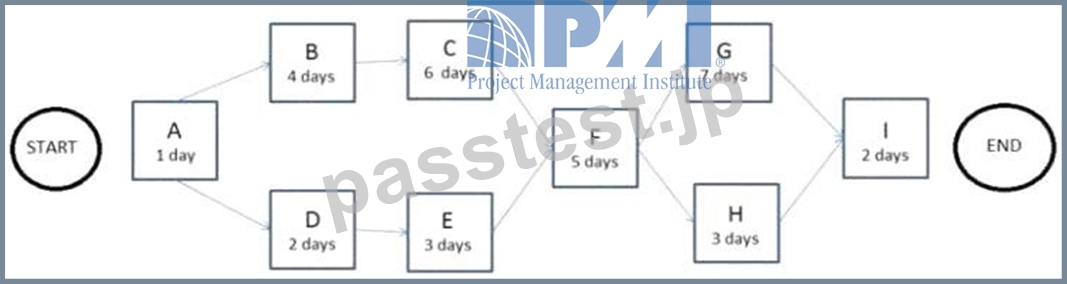
The free float for Activity H is how many days?
- A. 0
- B. 1
- C. 2
- D. 3
正解:D
質問 # 397
A project manager can choose from several techniques to resolve conflicts between team members.
Which technique can result in a win-win situation?
- A. Withdraw/Avoid
- B. Collaborate/Problem Solve
- C. Smooth/Accommodate
- D. Compromise/Reconcile
正解:B
解説:
Explanation/Reference:
Reference: https://4squareviews.com/2013/06/26/5th-edition-pmbok-guide-chapter-9-conflict-resolution/
質問 # 398
The Plan Stakeholder Management process belongs to which Process Group?
- A. Monitoring and Controlling
- B. Planning
- C. Initiating
- D. Executing
正解:B
解説:
Section: Volume A
Explanation:
Planning Process Group
4.2 Develop Project Management Plan
5.1 Plan Scope Management
5.2 Collect Requirements
5.3 Define Scope
5.4 Create WBS
6.1 Plan Schedule Management
6.2 Define Activities
6.3 Sequence Activities
6.4 Estimate Activity Resources
6.5 Estimate Activity Durations
6.6 Develop Schedule
7.1 Plan Cost Management
7.2 Estimate Costs
7.3 Determine Budget
8.1 Plan Quality Management
9.1 Plan Human Resource Management
10.1 Plan Communications Management
11.1 Plan Risk Management
11.2 Identify Risks
11.3 Perform Qualitative Risk Analysis
11.4 Perform Quantitative Risk Analysis
11.5 Plan Risk Responses
12.1 Plan Procurement Management
13.2 Plan Stakeholder Management
質問 # 399
The Monitoring and Controlling Process Group includes processes that:
- A. Define a new project or a new phase of an existing project.
- B. Complete the work defined in the project management plan.
- C. Track, review, and regulate the progress and performance of a project.
- D. Establish the scope, objectives, and course of action of a project.
正解:C
解説:
Section: Volume A
質問 # 400
In the Plan Procurement Management process, which source selection criteria analyzes if the seller's proposed technical methodologies, techniques, solutions, and services meet the procurement documents requirements?
- A. Technical approach
- B. Business size and type
- C. Technical capability
- D. Production capacity and interest
正解:A
質問 # 401
Which input to Collect Requirements is used to identify stakeholders who can provide information on requirements?
- A. Project charter
- B. Stakeholder register
- C. Stakeholder management plan
- D. Scope management plan
正解:B
解説:
Section: Volume A
Explanation:
5.2.1.5 Stakeholder Register
Described in Section 13.1.3.1. The stakeholder register is used to identify stakeholders who can provide information on the requirements. The stakeholder register also captures major requirements and main expectations stakeholders may have for the project.
13.1.3.1 Stakeholder Register
The main output of the Identify Stakeholders process is the stakeholder register. This contains all details related to the identified stakeholders including, but not limited to:
Identification information. Name, organizational position, location, role in the project, contact information;
Assessment information. Major requirements, main expectations, potential influence in the project, phase
in the life cycle with the most interest; and
Stakeholder classification. Internal/external, supporter/neutral/resistor, etc.
The stakeholder register should be consulted and updated on a regular basis, as stakeholders may change- or new ones identified-throughout the life cycle of the project.
Process: 5.2 Collect Requirements
Definition: The process of determining, documenting, and managing stakeholder needs and requirements to meet project objectives.
Key Benefit: The key benefit of this process is that it provides the basis for defining and managing the project scope including product scope.
Inputs
1. Scope management plan
2. Requirements management plan
3. Stakeholder management plan
4. Project charter
5. Stakeholder register
Tools & Techniques
1. Interviews
2. Focus groups
3. Facilitated workshops
4. Group creativity techniques
5. Group decision-making techniques
6. Questionnaires and surveys
7. Observations
8. Prototypes
9. Benchmarking
10.Context diagrams
11.Document analysis
Outputs
1. Requirements documentation
2. Requirements traceability matrix
質問 # 402
......
材料 From:
- 2025年最新の CAPM試験問題集で(PDFとテストエンジン)無料提供:https://www.passtest.jp/PMI/CAPM-shiken.html
- 2025年最新のCAPMのPDF試験問題集で無料提供:https://drive.google.com/open?id=16-sBpVOCtyXT53fd82BowORVGyA8xqW0
無料材料を提供しております!お客様の全試験合格を助けます!