

最新 [2025年02月28日] 100%合格率を保証します素晴らしいOGEA-103試験問題PDF
OGEA-103認定有効な試験問題集解答で学習ガイド!(最新の110問題)
オープングループは、エンタープライズテクノロジーアーキテクチャの基準、認定、およびベストプラクティスの開発に焦点を当てたグローバルコンソーシアムです。最も人気のある認定の1つは、TOGAFエンタープライズアーキテクチャ(EA)認定です。 TOGAF EA認定は、パート1とパート2の2つの部分に分割されます。ただし、1つの試験で両方のパートを取得したい人の場合、オープングループはOGEA-103(TOGAFエンタープライズアーキテクチャパート1とパート2を組み合わせて)を提供します。 。
TOGAFエンタープライズアーキテクチャフレームワークは、エンタープライズアーキテクチャにとって広く認識されている基準です。組織がエンタープライズアーキテクチャの開発と管理に使用するための共通の言語と方法論を提供します。フレームワークは、適応可能になるように設計されており、組織の特定のニーズを満たすためにカスタマイズできます。 TOGAFフレームワークで認定を達成することにより、専門家はこの広く使用されている基準の専門知識を実証できます。
質問 # 27
Exhibit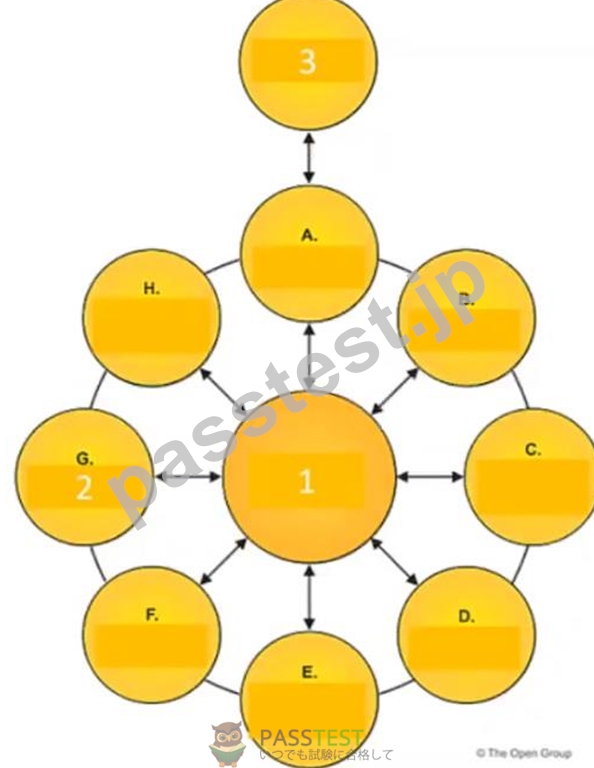
Consider the illustration showing an architecture development cycle Which description matches the phase of the ADM labeled as item 1?
- A. Operates the process of managing architecture requirements
- B. Establishes procedures for managing change to the new architecture
- C. Provides architectural oversight for the implementation
- D. Conducts implementation planning for the architecture defined in previous phases
正解:D
解説:
Explanation
The phase of the ADM labeled as item 1 is Phase F: Migration Planning. This phase conducts implementation planning for the architecture defined in previous phases by creating an Architecture Roadmap and a detailed Implementation and Migration Plan. This phase also identifies and groups major work packages, transition architectures, projects, and dependencies. References:
https://pubs.opengroup.org/architecture/togaf9-doc/arch/chap19.html
質問 # 28
Complete the sentence When considering agile development Architecture to Support Project will identify what products the Enterprise needs the boundary of the products and what constraints a product owner has. this defines the Enterprise's___________.
- A. backlog
- B. operations
- C. lifecycle economics
- D. workflow management
正解:A
解説:
When considering agile development, Architecture to Support Project will identify what products the enterprise needs, the boundary of the products, and what constraints a product owner has. This defines the enterprise's backlog. A backlog is a list of features or tasks that need to be done to deliver a product or service. It is prioritized by the product owner based on the value and urgency of each item. Reference: The TOGAF Standard | The Open Group Website, Section 3.3.5 Architecture to Support Project.
質問 # 29
In which phase of the ADM cycle do building blocks become implementation-specific?
- A. Phase D
- B. Phase B
- C. Phase E
- D. Phase C
正解:C
解説:
Explanation
Building blocks are reusable components of business, IT, or architectural capability that can be combined to deliver architectures and solutions. Building blocks can be defined at various levels of detail, depending on the stage of architecture development. In the earlier phases of the ADM cycle (A to D), building blocks are defined in generic terms, such as logical or physical, to provide a high-level view of the architecture. In Phase E: Opportunities and Solutions, building blocks become implementation-specific, meaning that they are linked to specific products, standards, technologies, and vendors that are available in the market. This phase also identifies the delivery vehicles, such as projects, programs, or portfolios, that will realize the building blocks12 References: 1: The TOGAF Standard, Version 9.2, Part II: Architecture Development Method (ADM), Chapter 23: Phase E: Opportunities and Solutions 2: The TOGAF Standard, Version 9.2, Part IV:
Architecture Content Framework, Chapter 36: Building Blocks
質問 # 30
In which phase(s) of the ADM would you deal with the actions resulting from a transformation readiness assessment?
- A. Phase E and F
- B. Phase G
- C. Phase A
- D. Phase F
正解:A
解説:
According to the TOGAF Standard, 10th Edition, a transformation readiness assessment is a technique that evaluates the preparedness of the organization to undergo a change, and identifies the actions needed to increase the likelihood of a successful outcome. A transformation readiness assessment can be conducted in Phase E: Opportunities and Solutions, and the actions resulting from it can be dealt with in Phase F: Migration Planning 1. In Phase E, the transformation readiness assessment can help to identify the major implementation challenges and risks, and to define the critical success factors and key performance indicators for the architecture project. In Phase F, the actions resulting from the transformation readiness assessment can help to develop a detailed and realistic migration plan, and to address the gaps, issues, and dependencies that may affect the transition to the target architecture 1. References: 1: TOGAF Standard, 10th Edition, Part III: ADM Guidelines and Techniques, Chapter 29: Business Transformation Readiness Assessment.
質問 # 31
Consider the following ADM phases objectives.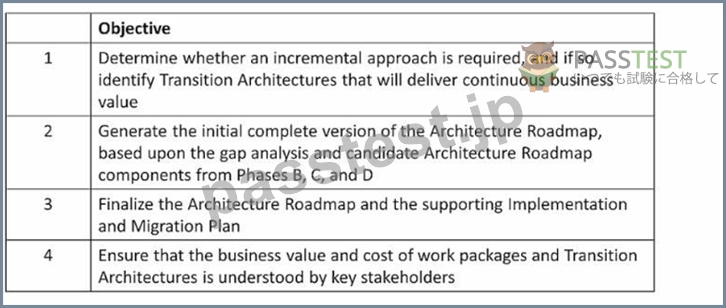
Which phase does each objective match?
- A. 1G-2E-3F-4F
- B. 1E-2F-3E-4F
- C. 1F-2E-3F-4G
- D. 1E-2E-3F-4F
正解:A
質問 # 32
Which statement about Requirements Management is most correct?
- A. The purpose of Requirements Management is to process change requests
- B. Requirements Management and stakeholder engagement are placed at the center of architecture development
- C. Requirements Management is a step of all ADM Phases
- D. Stakeholder requirements are captured once in Phase A and managed throughout the ADM cycle
正解:B
解説:
This statement about Requirements Management is most correct because it reflects the central role of Requirements Management and stakeholder engagement in the ADM cycle. Requirements Management is not a step of all ADM Phases, but rather an ongoing process that ensures that all relevant requirements are elicited, analyzed, prioritized, and addressed throughout the architecture development and transition. Stakeholder engagement is also a continuous activity that involves identifying, communicating, and managing stakeholder expectations and concerns. Reference: The TOGAF Standard | The Open Group Website, Section 3.1 Introduction to the ADM.
質問 # 33 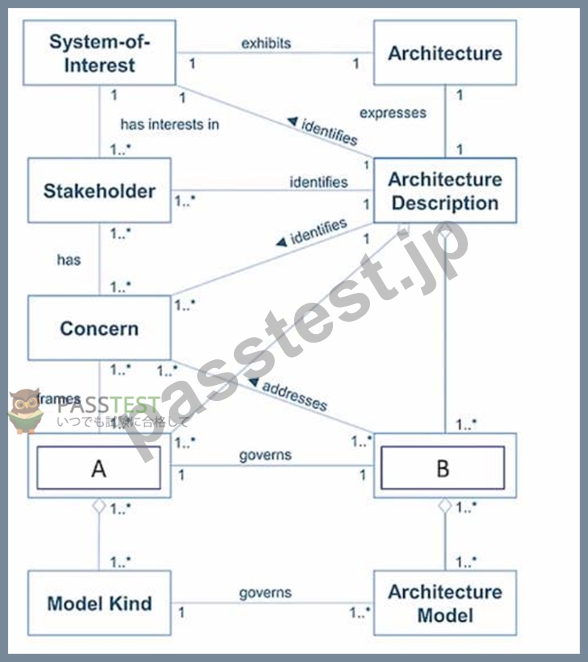
Consider the image showing basic architectural concepts.
What are items A and B?
- A. A-Architecture Board, B-Architecture Capability
- B. A-Architecture Viewpoint, B-Architecture View
- C. A-Requirement. B-Candidate Architecture
- D. A-Candidate Architecture, B-Trade-off
正解:D
解説:
Explanation
The image shows basic architectural concepts based on the ISO/IEC/IEEE 42010 standard, which defines an architecture description as a work product used to express an architecture1 According to this standard, an architecture description consists of one or more architecture views, which are representations of the system of interest from the perspective of one or more stakeholders and their concerns2 An architecture view conforms to an architecture viewpoint, which establishes the conventions for constructing, interpreting, and analyzing the view to address the concerns of the stakeholders3 An architecture viewpoint may also define model kinds, which are kinds of models used to express the view.
In the context of the TOGAF standard, a candidate architecture is a possible architecture that addresses some or all of the requirements and concerns of the stakeholders. A trade-off is a decision outcome that balances and reconciles multiple, often conflicting, factors, such as costs, benefits, risks, and opportunities. In the process of developing an architecture, the architect may have to evaluate and compare different candidate architectures and make trade-offs among them to select the most suitable one.
Therefore, the items A and B in the image are candidate architecture and trade-off, respectively, as they represent the concepts of possible solutions and decision outcomes that are relevant to the architecture development process.
References: 1: ISO/IEC/IEEE 42010:2011, Systems and software engineering - Architecture description, Clause 3.4 2: ISO/IEC/IEEE 42010:2011, Systems and software engineering - Architecture description, Clause 3.5 3: ISO/IEC/IEEE 42010:2011, Systems and software engineering - Architecture description, Clause 3.6 : ISO/IEC/IEEE 42010:2011, Systems and software engineering - Architecture description, Clause 3.8 : The TOGAF Standard, Version 9.2, Part III: ADM Guidelines and Techniques, Chapter 28:
Architecture Content Framework : The TOGAF Standard, Version 9.2, Part III: ADM Guidelines and Techniques, Chapter 30: Trade-Off Analysis
質問 # 34
Which of the following describes how the Enterprise Continuum is used when developing an enterprise architecture?
- A. To coordinate with the other management frameworks in use
- B. To classify architecture and solution assets
- C. To identify and understand business requirements
- D. To describe how an architecture addresses stakeholder concerns
正解:B
質問 # 35
Complete the sentence The Architecture Landscape is divided into levels known as__________________________.
- A. Segment Strategic and Capability Architectures
- B. Baseline. Transition and To Be Architectures
- C. Gaps Plateaus, and Target Architectures
- D. Transitional Complete and incremental Architectures
正解:A
解説:
The Architecture Landscape is divided into levels known as Segment Strategic and Capability Architectures.
These levels correspond to different scopes and purposes of architectures within an enterprise. Segment Architectures are architectures that address specific business units, functions, or processes within an enterprise. Strategic Architectures are architectures that provide a high-level view of the enterprise's vision, goals, and direction. Capability Architectures are architectures that address specific business capabilities or services that span multiple segments or domains. Reference: The TOGAF Standard | The Open Group Website, Section 2.4 Architecture Repository.
質問 # 36
Which of the following best describes the need for the ADM process to be governed?
- A. To enable development of reference architectures
- B. To verify that the method is being applied correctly
- C. To enable a fast response to market changes
- D. To permit the architecture domains to be integrated
正解:B
解説:
According to the TOGAF standard, the need for the ADM process to be governed is to ensure that the architecture development and implementation activities are conducted in a consistent, coherent, and compliant manner1. Governance provides the means to verify that the method is being applied correctly and effectively, and that the architecture deliverables and artifacts meet the quality and standards criteria1. Governance also enables the management of risks, issues, changes, and dependencies that may arise during the ADM process1.
Some of the benefits of governing the ADM process are2:
* Improved alignment of the architecture with the business strategy and objectives
* Enhanced stakeholder engagement and communication
* Increased reuse and integration of architecture assets and resources
* Reduced complexity and duplication of architecture efforts
* Increased agility and adaptability of the architecture to changing needs and requirements
* Improved compliance and auditability of the architecture outcomes and outputs
質問 # 37
Consider the following ADM phases objectives.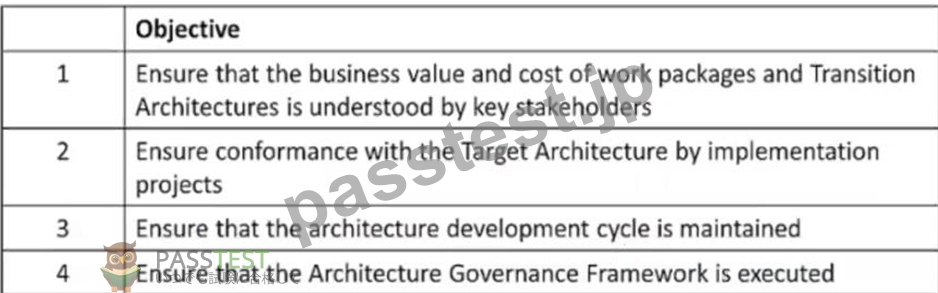
Which phase does each objective match?
- A. 1F-2G-3H-4H
- B. 1G-2H-3H-4F
- C. 1F-2G-3G-4H
- D. 1H-2F-3F-4G
正解:C
解説:
1F: To define an Implementation and Migration Strategy that will achieve an orderly transition from the Baseline to Target Architectures 2G: To perform appropriate governance functions while the solution is being implemented 3G: To ensure conformance with the Target Architecture by implementation projects 4H: To establish procedures for continual monitoring and assessment of the performance of the solution in operation
質問 # 38
You are working as an Enterprise Architect at a large company. The company runs many retail stores as well as an online marketplace that allows hundreds of brands to partner with the company. The company has a mature Enterprise Architecture (EA) practice and uses the TOGAF standard for its architecture development method. The EA practice is involved in all aspects of the business, with oversight provided by an Architecture Board with representatives from different parts of the business. The EA program is sponsored by the Chief Information Officer (CIO).
Many of the stores remain open all day and night. Each store uses a standard method to track sales and inventory, which involves sending accurate, timely sales data to a central AI-based inventory management system that can predict demand, adjust stock levels, and automate reordering. The central inventory management system is housed at the company's central data center.
The company has acquired a major rival. The Chief Executive Officer (CEO) believes that the merger will enable growth through combined offerings and cost savings. The decision has been made to fully integrate the two organizations, including merging retail operations and systems. Duplicated systems will be replaced with one standard retail management system. The CIO expects significant savings from these changes across the newly merged company.
The rival company has successfully implemented the use of hand-held devices within stores for both customers and staff, which has increased satisfaction due to time savings. The CIO has approved the rollout of these devices to all stores but has stated that training should be brief, as there are many part-time employees.
You have been asked to confirm the most relevant architecture principles for this transformation. Based on the TOGAF Standard, which of the following is the best answer?
- A. Common Vocabulary and Data Definitions, Compliance with the Law, Requirements Based Change, Responsive Change Management, Data Security
- B. Common Use Applications, Data is an Asset, Data is Accessible, Ease of Use, Business Continuity
- C. Maximize Benefit to the Enterprise, Common Use Applications, Data is an Asset, Responsive Change Management, Technology Independence
- D. Control Technical Diversity, Interoperability, Data is an Asset, Data is Shared, Business Continuity
正解:C
解説:
In this scenario, the enterprise is undergoing significant transformation due to a merger and the adoption of new technology (hand-held devices). Several key principles from TOGAF's ADM Techniques-particularly those focused on promoting enterprise-wide standardization, adaptability, and data utilization-are pertinent here:
Maximize Benefit to the Enterprise:
This principle emphasizes that all architectural decisions should deliver maximum business value. Given that the company is integrating systems to cut costs and improve offerings, maximizing the benefit is crucial. Ensuring that the EA efforts align with enterprise-wide benefits supports the goal of optimizing costs and enhancing offerings, which aligns with the CEO's vision for the merger.
Common Use Applications:
Standardizing applications across the merged entity will be essential to achieve cost savings and to simplify operations. The goal of reducing the number of applications fits with this principle, ensuring that reusable and widely adopted applications support business functions across the organization. Adopting this principle will also aid in harmonizing the systems from both organizations and avoiding unnecessary diversity.
Data is an Asset:
Data plays a central role in the company's operations, especially with the use of AI-driven inventory management and the integration of systems. Treating data as an asset is essential for reliable and accurate decision-making. This principle ensures that data is viewed as a critical enterprise resource and is managed with care, maintaining integrity, accuracy, and value.
Responsive Change Management:
The organization's ability to adapt quickly and effectively to changes, such as integrating new handheld devices and merging systems, is essential. This principle will facilitate the smooth transition required for integrating the new handheld devices and the merger-related system updates while minimizing disruption to store operations.
Technology Independence:
Since the enterprise will likely encounter varied technologies from the merger, it is crucial to maintain flexibility. This principle advocates for using technology solutions that are adaptable and not bound to a single vendor or specific technology. This ensures that the enterprise can integrate various technological components from both organizations and evolve with minimal constraints.
These principles align well with TOGAF's broader recommendations for guiding architectural changes, as found in Section 2.6 of the TOGAF ADM Techniques. They ensure that the EA practice is aligned with business objectives while maintaining flexibility, data integrity, and a focus on enterprise-wide benefits. These guiding principles are critical for the successful execution of the integration and adoption of new technologies while achieving cost efficiencies and improving service delivery.
For reference, TOGAF's ADM Techniques highlight the importance of architectural principles in guiding transformational initiatives, ensuring that decisions are made consistently across the enterprise. Each principle supports organizational agility, system integration, and the efficient use of technology resources, all of which are vital for the enterprise's stated objectives.
質問 # 39
What is defined as the effect of uncertainty on objectives?
- A. Threat
- B. Vulnerability
- C. Continuity
- D. Risk
正解:D
解説:
Risk is defined as the effect of uncertainty on objectives, according to the ISO 31000 standard, which provides principles and guidelines for risk management1 Risk can be positive or negative, depending on whether the uncertainty affects the achievement or the failure of the objectives. Risk can also be expressed in terms of likelihood and impact, which indicate the probability and the consequence of the risk occurrence.
Risk management is the coordinated activities to direct and control an organization with regard to risk. Risk management is an integral part of the TOGAF standard, as it helps to identify, assess, and treat the risks that may affect the architecture development and implementation2 References: 1: ISO 31000:2018, Risk management - Guidelines, Clause 3.1 2: The TOGAF Standard, Version 9.2, Part III: ADM Guidelines and Techniques, Chapter 32: Risk Management
質問 # 40
Consider the following statement.
According to the TOGAF standard, a governed approach of a particular deliverable will ensure adherence to the principles, standards, and requirements of the existing or developing architectures.
Which deliverable does this refer to?
- A. An Architecture Contract
- B. The Architecture Definition Document
- C. The Architecture Vision
- D. The Statement of Architecture Work
正解:A
解説:
According to the TOGAF Standard, 10th Edition, an architecture contract is "a formal agreement between a service provider and a service consumer that defines the mutual commitments and expectations for the delivery of an architecture" 1. An architecture contract is a governed approach of a particular deliverable that will ensure adherence to the principles, standards, and requirements of the existing or developing architectures, as it specifies the roles, responsibilities, deliverables, quality criteria, and acceptance criteria for the architecture work 1. The other options are not correct, as they are not governed approaches of a particular deliverable, but rather different types of deliverables within the architecture development process. An architecture vision is "a high-level, aspirational view of the target architecture" 1. A statement of architecture work is "a document that defines the scope and approach that will be used to complete an architecture project" 1. An architecture definition document is "a document that describes the baseline and target architectures for one or more domains" 1. Reference: 1: TOGAF Standard, 10th Edition, Part I: Introduction, Chapter 3: Definitions.
質問 # 41
Please read this scenario prior to answering the question
Your role is that of a consultant to the Lead Enterprise Architect to an international supplier of engineering services and automated manufacturing systems. It has three manufacturing plants where it assembles both standard and customized products for industrial production automation. Each of these plants has been operating its own planning and production scheduling systems, as well as applications and control systems that drive the automated production line.
The Enterprise Architecture department has been operating for several years and has mature, well-developed architecture governance and development processes that are based on the TOGAF Standard. The CIO sponsors the Enterprise Architecture.
During a recent management meeting, a senior Vice-President highlighted an interview where a competitor company's CIO is reported as saying that their production efficiency had been improved by replacing multiple planning and scheduling systems with a common Enterprise Resource Planning (ERP) system located in a central data center. Some discussion followed, with the CIO responding that the situations are not comparable, and the current architecture is already optimized.
In response, the Architecture Board approved a Request for Architecture Work covering the investigations to determine if such an architecture transformation would lead to improvements in efficiency. You have been assigned to support the architecture team working on this project.
A well-known concern of the plant managers is about the security and reliability of driving their planning and production scheduling from a remote centralized system. Any chosen system would also need to support the current supply chain network consisting of local partners at each of the plants.
Refer to the scenario
You have been asked to explain how you will initiate the architecture project.
Based on the TOGAF Standard, which of the following is the best answer?
- A. You would research vendor literature and conduct a series of briefings with vendors that are on the current approved supplier list. Based on the findings from the research, you would define a preliminary Architecture Vision including summary views, high-level requirements, and high-level definitions of the baseline and target environments from a business, information systems, and technology perspective. You would then use that to build consensus among the key stakeholders.
- B. You would conduct a pilot project that will enable vendors to demonstrate potential off-the-shelf solutions that address the concerns of the stakeholders. Running a pilot project will save time and money later in the process. Based on the findings of that pilot project, a complete set of requirements can then be developed that will drive the evolution of the architecture. Once the requirements are completed, a formal stakeholder review should be held, and permission sought to proceed to develop the target architecture.
- C. You would develop baseline and target Architectures for each of the manufacturing plants, ensuring that the views corresponding to selected viewpoints address key concerns of the stakeholders. A business case, together with performance metrics and measures should be defined to ensure the architecture meets the business needs. A consolidated gap analysis between the architectures will then validate the approach and determine the capability increments needed to achieve the target state.
- D. You would hold a series of interviews at each of the manufacturing plants using the business scenarios technique. This will allow you to understand the systems and integrations with local partners. You would use stakeholder analysis to identify key players in the engagement, and to understand their concerns. You will then identify and document the key high-level stakeholder requirements for the architecture. You will then generate high level definitions of the baseline and target architectures.
正解:D
解説:
The best answer is C. You would hold a series of interviews at each of the manufacturing plants using the business scenarios technique. This will allow you to understand the systems and integrations with local partners. You would use stakeholder analysis to identify key players in the engagement, and to understand their concerns. You will then identify and document the key high-level stakeholder requirements for the architecture. You will then generate high level definitions of the baseline and target architectures.
This answer is based on the TOGAF standard, which recommends the following steps to initiate the architecture project1:
* Establish the architecture project
* Identify stakeholders, concerns, and business requirements
* Confirm and elaborate business goals, business drivers, and constraints
* Evaluate business capabilities
* Assess readiness for business transformation
* Define scope
* Confirm and elaborate Architecture Principles, including business principles
* Develop Architecture Vision
* Define the Target Architecture value propositions and KPIs
* Identify the business transformation risks and mitigation activities
* Secure stakeholder and sponsor approval
The answer C covers most of these steps, by using the business scenarios technique to elicit and validate the business requirements, goals, drivers, and constraints, as well as the current and future states of the architecture2. The answer C also uses stakeholder analysis to identify and engage the key stakeholders, and to address their concerns and expectations3. The answer C also generates high level definitions of the baseline and target architectures, which can be used to develop the Architecture Vision and the value propositions4.
The other answers are not the best approach for architecture development, because:
* Answer A focuses on researching vendor literature and conducting briefings with vendors, which is not the best way to understand the business needs and the current situation of the enterprise. Answer A also defines a preliminary Architecture Vision without involving the stakeholders or validating the requirements, which may lead to misalignment and lack of consensus.
* Answer B conducts a pilot project that will enable vendors to demonstrate potential solutions, which is premature and costly at this stage of the architecture project. Answer B also does not address the stakeholder concerns or the current systems and integrations, which may result in gaps and risks.
Answer B also develops the requirements after the pilot project, which may not reflect the actual business needs and goals.
* Answer D develops baseline and target architectures for each of the manufacturing plants, which may not consider the enterprise-wide perspective and the potential benefits of a common ERP system.
Answer D also does not involve the stakeholders or address their concerns, which may result in resistance and conflict. Answer D also does not define the business case or the performance metrics, which are essential for demonstrating the value and feasibility of the architecture.
References: 1: The TOGAF Standard, Version 9.2 - Architecture Vision 2: The TOGAF Standard, Version
9.2 - Business Scenarios 3: [The TOGAF Standard, Version 9.2 - Stakeholder Management] 4: [The TOGAF Standard, Version 9.2 - Architecture Definition Document]
質問 # 42
......
Open Group OGEA-103は、TOGAFエンタープライズアーキテクチャフレームワークに焦点を当てた包括的な認定試験です。この試験は、エンタープライズアーキテクチャの分野で働く専門家の知識とスキルをテストするように設計されています。この試験では、TOGAF認定プログラムのパート1とパート2の両方を組み合わせて、候補者がフレームワークとその実装を完全に理解できるようにします。
OGEA-103時間限定!無料アクセス:https://www.passtest.jp/TheOpenGroup/OGEA-103-shiken.html
OGEA-103問題集で2025年最新のThe Open Group OGEA-103試験問題はここ:https://drive.google.com/open?id=17LWxNRwxsY12fIOgMhQ4hOC2U4B5Pwm9