

[2025年04月]更新のThe Open Group OGEA-103試験練習テスト問題
更新された認定試験OGEA-103問題集で練習テスト問題
オープングループOGEA-103(TOGAFエンタープライズアーキテクチャパート1とパート2の組み合わせ)認証試験は、エンタープライズアーキテクトのグローバルに認められた認定です。認定試験では、TOGAFエンタープライズアーキテクチャフレームワークのパート1と2の両方を組み合わせています。 TOGAFフレームワークは、エンタープライズアーキテクチャの開発と管理に広く使用されているアプローチです。エンタープライズアーキテクチャの開発と管理のための共通言語、方法論、およびツールを提供します。
OGEA-103試験は、TOGAFフレームワークで知識と専門知識を実証したい個人向けに設計されています。これは、エンタープライズアーキテクチャに関連する基礎概念と高度なトピックの両方をカバーしています。この試験は、複数選択の質問で構成されており、TOGAFフレームワーク、そのコンポーネント、およびその関係に関する候補者の理解をテストするように設計されています。 OGEA-103試験に合格すると、候補者がTOGAFフレームワークを完全に理解しており、実際の状況に適用できることが示されています。この認定は、エンタープライズアーキテクトとしてのキャリアの進歩と信頼性の向上の機会を開くことができます。
質問 # 22
What is present in all phases within the ADM and should be identified, classified and mitigated before starting a transformation effort?
- A. Information gaps
- B. Budgetary constraints
- C. Risk
- D. Schedule constraints
正解:C
解説:
According to the TOGAF Standard, 10th Edition, risk is present in all phases within the Architecture Development Method (ADM), and it should be identified, classified, and mitigated before starting a transformation effort 1. Risk is defined as "the effect of uncertainty on objectives" 2, and it can have positive or negative impacts on the architecture project. Risk management is a technique that helps to assess and address the potential risks that may affect the achievement of the architecture objectives, and to balance the trade-offs between opportunities and threats. Risk management is applied throughout the ADM cycle, from the Preliminary Phase to the Requirements Management Phase, and it is integrated with other techniques, such as stakeholder management, business transformation readiness assessment, gap analysis, and migration planning 1. The other options are not correct, as they are not present in all phases within the ADM, and they are not necessarily identified, classified, and mitigated before starting a transformation effort. Budgetary constraints are the limitations on the financial resources available for the architecture project, and they are usually considered in Phase E: Opportunities and Solutions, and Phase F: Migration Planning 3. Schedule constraints are the limitations on the time available for the architecture project, and they are also usually considered in Phase E and F 3. Information gaps are the missing or incomplete data or knowledge that may affect the architecture project, and they are usually identified in Phase B: Business Architecture, Phase C: Information Systems Architecture, and Phase D: Technology Architecture . Reference: 1: TOGAF Standard, 10th Edition, Part III: ADM Guidelines and Techniques, Chapter 32: Risk Management. 2: TOGAF Standard, 10th Edition, Part I: Introduction, Chapter 3: Definitions. 3: TOGAF Standard, 10th Edition, Part II: Architecture Development Method, Chapter 16: Phase E: Opportunities and Solutions, and Chapter 17: Phase F: Migration Planning. : TOGAF Standard, 10th Edition, Part II: Architecture Development Method, Chapter 13: Phase B: Business Architecture, Chapter 14: Phase C: Information Systems Architecture, and Chapter 15: Phase D: Technology Architecture.
質問 # 23
Complete the sentence When considering agile development Architecture to Support Project will identify what products the Enterprise needs the boundary of the products and what constraints a product owner has. this defines the Enterprise's___________.
- A. lifecycle economics
- B. backlog
- C. operations
- D. workflow management
正解:B
解説:
Explanation
When considering agile development, Architecture to Support Project will identify what products the enterprise needs, the boundary of the products, and what constraints a product owner has. This defines the enterprise's backlog. A backlog is a list of features or tasks that need to be done to deliver a product or service.
It is prioritized by the product owner based on the value and urgency of each item. Reference: The TOGAF Standard | The Open Group Website, Section 3.3.5 Architecture to Support Project.
質問 # 24
Which phase of the ADM has the purpose to develop an Enterprise Architecture Capability?
- A. Phase A
- B. Preliminary Phase
- C. Phase B
- D. Phase G
正解:B
解説:
According to the TOGAF Standard, 10th Edition, the Preliminary Phase of the Architecture Development Method (ADM) has the purpose to develop an Enterprise Architecture Capability 1. An Enterprise Architecture Capability is the ability of the organization to perform the activities and tasks related to Enterprise Architecture, such as defining the scope, principles, vision, governance, and stakeholders of the architecture. The Preliminary Phase also establishes the architecture framework, the architecture repository, the architecture tools, and the architecture team 1. The other options are not correct, as they have different purposes in the ADM. Phase G: Implementation Governance has the purpose to ensure that the implementation projects conform to the target architecture 2. Phase A: Architecture Vision has the purpose to define the scope, stakeholders, business drivers, and objectives of the architecture project 3. Phase B: Business Architecture has the purpose to describe the baseline and target business architecture, and to identify the gaps between them . References: 1: TOGAF Standard, 10th Edition, Part II: Architecture Development Method, Chapter 6: Preliminary Phase. 2: TOGAF Standard, 10th Edition, Part II: Architecture Development Method, Chapter 18: Phase G: Implementation Governance. 3: TOGAF Standard, 10th Edition, Part II: Architecture Development Method, Chapter 12: Phase A: Architecture Vision. : TOGAF Standard, 10th Edition, Part II:
Architecture Development Method, Chapter 13: Phase B: Business Architecture.
質問 # 25
Consider the following ADM phases objectives.
Objective
1- Determine whether an incremental approach is required, and if so identify Transition Architectures that will deliver continuous business value
2- Generate the initial complete version of the Architecture Roadmap, based upon the gap analysis and candidate Architecture Roadmap components from Phases B, C, and D
3- Finalize the Architecture Roadmap and the supporting Implementation and Migration Plan
4- Ensure that the business value and cost of work packages and Transition Architectures is understood by key stakeholders Which phase does each objective match?
- A. 1F-2E-3F-4G
- B. 1E-2E-3F-4F
- C. 1G-2E-3F-4F
- D. 1E-2F-3E-4F
正解:C
解説:
According to the TOGAF standard, the objectives of each ADM phase are as follows1:
* Phase E: Opportunities and Solutions
o Determine whether an incremental approach is required, and if so identify Transition Architectures that will deliver continuous business value o Identify and group major work packages within the Architecture Roadmap o Identify and group major implementation projects to realize the Architecture Roadmap o Identify dependencies between increments and projects o Estimate cost, benefit, and risk at a high level for each increment and project o Conduct initial prioritization and sequencing of the Architecture Roadmap and projects
* Phase F: Migration Planning
o Generate the initial complete version of the Architecture Roadmap, based upon the gap analysis and candidate Architecture Roadmap components from Phases B, C, and D o Confirm the Transition Architectures with relevant stakeholders o Create the Implementation and Migration Plan, including Transition Architectures, work packages, projects, and other activities o Confirm and agree the Architecture Roadmap and Implementation and Migration Plan with relevant stakeholders
* Phase G: Implementation Governance
o Finalize the Architecture Roadmap and the supporting Implementation and Migration Plan o Ensure conformance with the Target Architecture by implementation projects o Perform appropriate Architecture Governance functions for the solution and any implementation-driven architecture Change Requests o Ensure that the architecture lifecycle is maintained o Ensure that the Architecture Governance Framework is executed
* Phase H: Architecture Change Management
o Ensure that the business value and cost of work packages and Transition Architectures is understood by key stakeholders o Manage risks and issues related to the Architecture Roadmap and Implementation and Migration Plan o Monitor the implementation projects and Transition Architectures o Manage changes to the architecture baseline o Manage changes to the Architecture Capability Therefore, the correct matching of the objectives and the phases is:
* 1G: Determine whether an incremental approach is required, and if so identify Transition Architectures that will deliver continuous business value
* 2E: Generate the initial complete version of the Architecture Roadmap, based upon the gap analysis and candidate Architecture Roadmap components from Phases B, C, and D
* 3F: Finalize the Architecture Roadmap and the supporting Implementation and Migration Plan
* 4F: Ensure that the business value and cost of work packages and Transition Architectures is understood by key stakeholders
質問 # 26
Complete the sentence. Actions arising from the Business Transformation Readiness Assessment technique should be incorporated in the
- A. Implementation Governance Model
- B. Implementation and Migration Plan
- C. Architecture Roadmap
- D. Architecture Requirements Specification
正解:B
解説:
The Business Transformation Readiness Assessment technique is used to evaluate the readiness of the organization to undergo change and to identify the actions needed to increase the likelihood of a successful business transformation. These actions should be incorporated in the Implementation and Migration Plan, which is the detailed plan to transition from the Baseline Architecture to the Target Architecture. The Implementation and Migration Plan also includes the Transition Architectures, the Architecture Building Blocks, the Work Packages, the Implementation Governance Model, and the Architecture Contract12 Reference: 1: The TOGAF Standard, Version 9.2, Part III: ADM Guidelines and Techniques, Chapter 27: Business Transformation Readiness Assessment 2: The TOGAF Standard, Version 9.2, Part II: Architecture Development Method (ADM), Chapter 21: Phase F: Migration Planning
質問 # 27
Which of the following statements about architecture partitioning is correct?
- A. Partitions are used to simplify the management of the Enterprise Architecture.
- B. Partitions are equivalent to architecture levels.
- C. Partitions are defined and assigned to agile Enterprise Architecture teams.
- D. Partitions reflect the organization's structure.
正解:A
解説:
Based on the web search results, architecture partitioning is a technique that divides the Enterprise Architecture into smaller and manageable segments or groups, based on various classification criteria, such as subject matter, time, maturity, volatility, etc.12 Architecture partitioning is used to simplify the development and management of the Enterprise Architecture, by reducing complexity, improving governance, enhancing reusability, and increasing alignment and agility12. Therefore, the statement that partitions are used to simplify the management of the Enterprise Architecture is correct.
The other statements are incorrect because:
*Partitions are not equivalent to architecture levels. Architecture levels are different layers of abstraction that describe the Enterprise Architecture from different perspectives, such as strategic, segment, and capability3.
Partitions are subsets of architectures that are defined within or across the levels, based on specific criteria1.
*Partitions do not necessarily reflect the organization's structure. The organization's structure is one possible criterion for partitioning the architecture, but it is not the only one. Other criteria, such as business function, product, service, geography, etc., can also be used to partition the architecture12.
*Partitions are not defined and assigned to agile Enterprise Architecture teams. Agile Enterprise Architecture is an approach that applies agile principles and practices to the architecture work, such as iterative development, frequent feedback, adaptive planning, and continuous delivery4. Partitions are not a specific feature of agile Enterprise Architecture, but a general technique that can be applied to any architecture method or framework, including TOGAF12.
References: 1: The TOGAF Standard, Version 9.2 - Architecture Partitioning 2: TOGAF Standard - Introduction - Architecture Partitioning 3: [The TOGAF Standard, Version 9.2 - Applying the ADM Across the Architecture Landscape] 4: TOGAF Standard - Introduction - Definitions - The Open Group
質問 # 28
Which of the following best describes the purpose of the Gap Analysis technique?
- A. To allocate resources for architecture projects
- B. To identify items omitted from the Target Architecture
- C. To govern the architecture throughout its implementation process
- D. To develop a set of general rules and guidelines for the architecture
正解:B
解説:
The purpose of the Gap Analysis technique is similar to the previous question, but with a focus on the Target Architecture. The technique helps to identify the items that are not included or specified in the Target Architecture, such as capabilities, services, components, standards, or technologies. These items may be essential for achieving the vision and goals of the enterprise, or for addressing the stakeholder concerns and requirements. By identifying the items omitted from the Target Architecture, the technique helps to ensure that the architecture is comprehensive, feasible, and realistic.
質問 # 29
Which statement best describes iteration and the ADM?
- A. The ADM is sequential Iteration is applied within phases
- B. The ADM is iterative within the first cycle and then between phases
- C. The level of detail is defined once and applies to all iterations
- D. The ADM is iterative, over the whole process between phases and within phases
正解:D
解説:
Explanation
This statement best describes iteration and the ADM. The ADM is iterative over the whole process between phases and within phases because it allows for feedback loops and refinements at any point in the architecture development and transition process. Iteration enables architects to address changing requirements, assumptions, constraints, and environments; to validate and improve architectures; to manage risks and issues; and to ensure stakeholder satisfaction and value realization. Reference: The TOGAF Standard | The Open Group Website, Section 3.1 Introduction to the ADM.
質問 # 30
Exhibit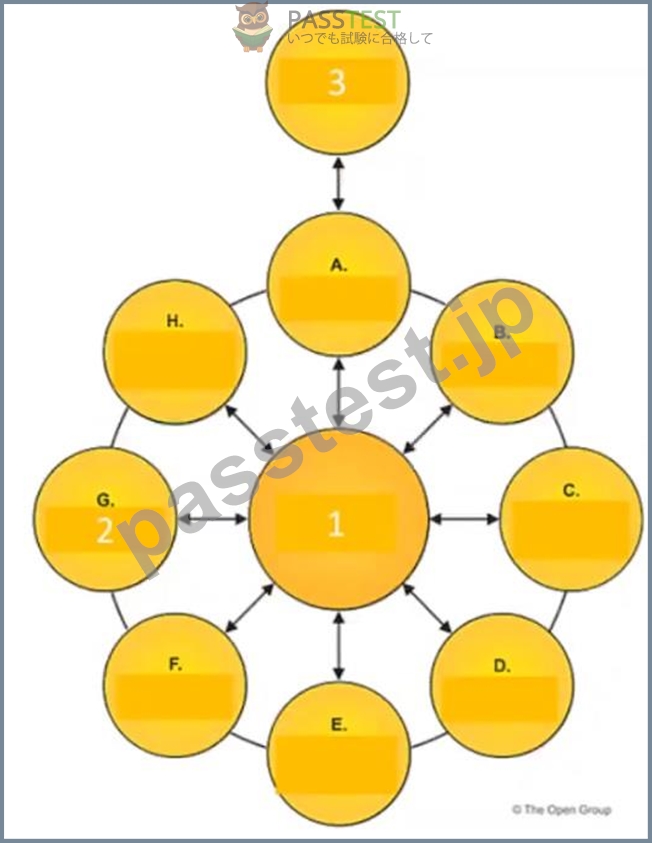
Consider the illustration showing an architecture development cycle Which description matches the phase of the ADM labeled as item 1?
- A. Establishes procedures for managing change to the new architecture
- B. Operates the process of managing architecture requirements
- C. Conducts implementation planning for the architecture defined in previous phases
- D. Provides architectural oversight for the implementation
正解:C
解説:
The phase of the ADM labeled as item 1 is Phase F: Migration Planning. This phase conducts implementation planning for the architecture defined in previous phases by creating an Architecture Roadmap and a detailed Implementation and Migration Plan. This phase also identifies and groups major work packages, transition architectures, projects, and dependencies. Reference: https://pubs.opengroup.org/architecture/togaf9-doc/arch/chap19.html
質問 # 31
Consider the following statement.
Projects may cycle between ADM phases, in planned cycles covering multiple phases.
What does it illustrate?
- A. Requirements management
- B. Enterprise Architecture
- C. Implementation governance
- D. Iteration
正解:D
解説:
The statement "Projects may cycle between ADM phases, in planned cycles covering multiple phases" illustrates the concept of iteration, which is the process of repeating the ADM phases or steps within a phase to refine the architecture outputs and address the changing requirements and stakeholder concerns. Iteration can occur at different levels of granularity and scope, such as within a single phase, across multiple phases, or across the entire ADM cycle. Iteration can also be applied to different architecture domains, such as business, data, application, and technology. Iteration is a key feature of the ADM that enables the development of architectures that are fit for purpose, adaptable, and responsive to change. Reference: : The TOGAF Standard, Version 9.2, Part III: ADM Guidelines and Techniques, Chapter 24: Applying Iteration to the ADM
質問 # 32
Which of the following best describes purpose of the Business Scenarios?
- A. To guide decision making throughout the enterprise
- B. To identify risk when implementing an architecture project
- C. To catch errors in a project architecture early
- D. To identify and understand requirements
正解:D
解説:
Explanation
Business scenarios are a technique for capturing, clarifying, and communicating the functional and non-functional requirements of a system. Business scenarios describe the business environment, the actors involved, the desired outcomes, and the processes or rules that govern the behavior of the system. Business scenarios are useful for ensuring that the architecture addresses the real needs and concerns of the stakeholders, and for validating and testing the architecture against expected situations. Business scenarios are developed in Phase A: Architecture Vision of the ADM cycle, and refined and updated throughout the other phases3 References: 3: The TOGAF Standard, Version 9.2, Part III: ADM Guidelines and Techniques, Chapter 26: Business Scenarios : The TOGAF Standard, Version 9.2, Part II: Architecture Development Method (ADM), Chapter 18: Phase A: Architecture Vision
質問 # 33
Which of the following describes the practice by which the enterprise architecture is managed and controlled at an enterprise-wide level?
- A. IT governance
- B. Corporate governance
- C. Technology governance
- D. Architecture governance
正解:D
解説:
According to the TOGAF Standard, 10th Edition, architecture governance is "the practice by which enterprise architectures and other architectures are managed and controlled at an enterprise-wide level" 1. Architecture governance ensures that the architecture development and implementation are aligned with the strategic objectives, principles, standards, and requirements of the enterprise, and that they deliver the expected value and outcomes. Architecture governance also involves establishing and maintaining the architecture framework, repository, board, contracts, and compliance reviews 1. The other options are not correct, as they are not the term used by the TOGAF Standard to describe the practice by which the enterprise architecture is managed and controlled at an enterprise-wide level. Corporate governance is "the system by which an organization is directed and controlled" 2, and it covers aspects such as leadership, strategy, performance, accountability, and ethics. IT governance is "the system by which the current and future use of IT is directed and controlled" 2, and it covers aspects such as IT strategy, policies, standards, and services. Technology governance is "the system by which the technology decisions and investments are directed and controlled" 3, and it covers aspects such as technology selection, acquisition, deployment, and maintenance. Reference: 1: TOGAF Standard, 10th Edition, Part VI: Architecture Governance, Chapter 44: Introduction. 2: TOGAF Standard, 10th Edition, Part I: Introduction, Chapter 3: Definitions. 3: TOGAF Series Guide: Using the TOGAF Framework to Define and Govern Service-Oriented Architectures, Part II: Using the TOGAF Framework to Define and Govern Service-Oriented Architectures, Chapter 5: Technology Governance.
質問 # 34
Which ADM phase focuses on defining the problem to be solved, identifying the stakeholders, their concerns, and requirements?
- A. Phase A
- B. Preliminary Phase
- C. Phase
- D. Phase
正解:A
解説:
Phase A: Architecture Vision is the first phase of the Architecture Development Method (ADM) cycle, which is the core of the TOGAF standard. The main purpose of this phase is to define the scope and approach of the architecture development, and to create the Architecture Vision, which is a high-level description of the desired outcomes and benefits of the proposed architecture. To achieve this purpose, this phase focuses on defining the problem to be solved, identifying the stakeholders, their concerns, and requirements, and establishing the business goals and drivers that motivate the architecture work. This phase also involves obtaining the approval and commitment of the sponsors and other key stakeholders, and initiating the Architecture Governance process.
References: : The TOGAF Standard, Version 9.2, Part II: Architecture Development Method (ADM), Chapter 5: Introduction to the ADM : The TOGAF Standard, Version 9.2, Part II: Architecture Development Method (ADM), Chapter 18: Phase A: Architecture Vision : The TOGAF Standard, Version 9.2, Part II:
Architecture Development Method (ADM), Chapter 18.3: Inputs : The TOGAF Standard, Version 9.2, Part II:
Architecture Development Method (ADM), Chapter 18.4: Steps
質問 # 35
Complete the following sentence. In the ADM documents which are under development and have not undergone any formal review and approval process are_______________.
- A. Known as ''Version 0.1''
- B. Invalid
- C. In between phases
- D. Called ''draft''
正解:D
解説:
In the ADM documents which are under development and have not undergone any formal review and approval process are called "draft". This indicates that they are subject to change and refinement as the architecture development progresses. Reference: The TOGAF Standard | The Open Group Website, Section 4.2.5 Architecture Deliverables.
質問 # 36
When considering the scope of an architecture, what dimension considers to what level of detail the architecting effort should go?
- A. Architecture Domains
- B. Breadth
- C. Depth
- D. Project
正解:C
解説:
The scope of an architecture is the extent and level of detail of the architecture work. The scope of an architecture can be defined along four dimensions: project, breadth, depth, and architecture domains. The project dimension considers the boundaries and objectives of the architecture project, such as the time frame, budget, resources, and deliverables. The breadth dimension considers the coverage and completeness of the architecture across the enterprise, such as the organizational units, business functions, processes, and locations.
The depth dimension considers the level of detail and specificity of the architecture, such as the granularity, abstraction, and precision of the architectural elements and relationships. The architecture domains dimension considers the aspects or segments of the architecture, such as the business, data, application, and technology domains.
Therefore, the depth dimension is the one that considers to what level of detail the architecting effort should go.
References: : The TOGAF Standard, Version 9.2, Part III: ADM Guidelines and Techniques, Chapter 25:
Architecture Scope : The TOGAF Standard, Version 9.2, Part III: ADM Guidelines and Techniques, Chapter
25.2: Scope Dimensions : The TOGAF Standard, Version 9.2, Part III: ADM Guidelines and Techniques, Chapter 25.2.1: Project, Breadth, Depth, and Architecture Domains
質問 # 37
What are the four architecture domains that the TOGAF standard deals with?
- A. Baseline, Candidate, Transition, Target
- B. Business, Data, Application, Technology
- C. Application, Data, Information, Knowledge
- D. Capability, Segment, Enterprise, Federated
正解:B
解説:
The TOGAF standard divides Enterprise Architecture into four primary architecture domains: business, data, application, and technology. These domains represent different aspects of an enterprise and how they relate to each other. The business domain defines the business strategy, governance, organization, and key business processes. The data domain describes the structure of the logical and physical data assets and data management resources. The application domain provides a blueprint for the individual applications to be deployed, their interactions, and their relationships to the core business processes. The technology domain describes the logical software and hardware capabilities that are required to support the deployment of business, data, and application services. Other domains, such as motivation, security, or governance, may span across these four primary domains. References:
* The TOGAF Standard, Version 9.2 - Core Concepts
* Domains - The Open Group
* TOGAF Standard - Introduction - Definitions - The Open Group
* The TOGAF Standard, Version 9.2 - Definitions - The Open Group
* TOGAF and the history of enterprise architecture | Enable Architect
質問 # 38
What is present in all phases within the ADM and should be identified, classified and mitigated before starting a transformation effort?
- A. Information gaps
- B. Budgetary constraints
- C. Risk
- D. Schedule constraints
正解:C
解説:
According to the TOGAF Standard, 10th Edition, risk is present in all phases within the Architecture Development Method (ADM), and it should be identified, classified, and mitigated before starting a transformation effort 1. Risk is defined as "the effect of uncertainty on objectives" 2, and it can have positive or negative impacts on the architecture project. Risk management is a technique that helps to assess and address the potential risks that may affect the achievement of the architecture objectives, and to balance the trade-offs between opportunities and threats. Risk management is applied throughout the ADM cycle, from the Preliminary Phase to the Requirements Management Phase, and it is integrated with other techniques, such as stakeholder management, business transformation readiness assessment, gap analysis, and migration planning 1. The other options are not correct, as they are not present in all phases within the ADM, and they are not necessarily identified, classified, and mitigated before starting a transformation effort. Budgetary constraints are the limitations on the financial resources available for the architecture project, and they are usually considered in Phase E: Opportunities and Solutions, and Phase F: Migration Planning 3. Schedule constraints are the limitations on the time available for the architecture project, and they are also usually considered in Phase E and F 3. Information gaps are the missing or incomplete data or knowledge that may affect the architecture project, and they are usually identified in Phase B: Business Architecture, Phase C:
Information Systems Architecture, and Phase D: Technology Architecture . References: 1: TOGAF Standard,
10th Edition, Part III: ADM Guidelines and Techniques, Chapter 32: Risk Management. 2: TOGAF Standard,
10th Edition, Part I: Introduction, Chapter 3: Definitions. 3: TOGAF Standard, 10th Edition, Part II:
Architecture Development Method, Chapter 16: Phase E: Opportunities and Solutions, and Chapter 17: Phase F: Migration Planning. : TOGAF Standard, 10th Edition, Part II: Architecture Development Method, Chapter
13: Phase B: Business Architecture, Chapter 14: Phase C: Information Systems Architecture, and Chapter 15:
Phase D: Technology Architecture.
質問 # 39
Consider the following ADM phases objectives.
Objective:
1.Develop the Target Data Architecture that enables the Business Architecture and the Architecture Vision
2.Develop the Target Business Architecture that describes how the enterprise needs to operate to achieve the business goals
3.Develop a high-level aspirational vision of the capabilities and business value to be delivered as a result of the proposed Enterprise Architecture
4.Identify candidate Architecture Roadmap components based upon gaps between the Baseline and Target Technology Architectures Which phase does each objective match?
- A. 1B-2D-3A-4C
- B. 1C-2D-3B-4A
- C. 1A-2B-3C-4D
- D. 1C-2B-3A-4D
正解:D
解説:
*Phase A: Architecture Vision
oDevelop a high-level aspirational vision of the capabilities and business value to be delivered as a result of the proposed Enterprise Architecture oDefine the scope and boundaries of the architecture engagement oIdentify the key stakeholders and their concerns and expectations oDefine the Architecture Vision statement and the Architecture Definition Document oObtain approval and commitment from the sponsors and stakeholders
*Phase B: Business Architecture
oDevelop the Target Business Architecture that describes how the enterprise needs to operate to achieve the business goals oDefine the Baseline Business Architecture, if not available oPerform a gap analysis between the Baseline and Target Business Architectures oDefine candidate roadmap components for the Business Architecture oResolve impacts across the Architecture Landscape
*Phase C: Information Systems Architecture
oDevelop the Target Data Architecture that enables the Business Architecture and the Architecture Vision oDevelop the Target Application Architecture that supports the Business Architecture and the Architecture Vision oDefine the Baseline Data and Application Architectures, if not available oPerform a gap analysis between the Baseline and Target Data and Application Architectures oDefine candidate roadmap components for the Information Systems Architecture oResolve impacts across the Architecture Landscape
*Phase D: Technology Architecture
oDevelop the Target Technology Architecture that enables the Information Systems Architecture and the Architecture Vision oDefine the Baseline Technology Architecture, if not available oPerform a gap analysis between the Baseline and Target Technology Architectures oIdentify candidate Architecture Roadmap components based upon gaps between the Baseline and Target Technology Architectures oResolve impacts across the Architecture Landscape Therefore, the correct matching of the objectives and the phases is:
*1C: Develop the Target Data Architecture that enables the Business Architecture and the Architecture Vision
*2B: Develop the Target Business Architecture that describes how the enterprise needs to operate to achieve the business goals
*3A: Develop a high-level aspirational vision of the capabilities and business value to be delivered as a result of the proposed Enterprise Architecture
*4D: Identify candidate Architecture Roadmap components based upon gaps between the Baseline and Target Technology Architectures References: 1: The TOGAF Architecture Development Method
質問 # 40
Consider the following descriptions of deliverables consumed and produced across the TOGAF ADM cycle.
General rules and guidelines, intended to be enduring and seldom
amended, that inform and support the way in which an organization sets
about fulfilling its mission
The joint agreements between development partners and sponsors on the
deliverables, quality, and fitness-for-purpose of an architecture.
A document that is sent from the sponsoring organization to the
architecture organization to trigger the start of an architecture
development cycle
A set of quantitative statements that outline what an implementation
project must do in order to comply with the architecture.
Which deliverables match these descriptions?
- A. Architecture Principles -2 Architecture Contracts - 3 Request for Architecture Work - 4 Architecture Requirements Specification
- B. Architecture Principles -2 Architecture Contracts - 3 Architecture Requirements Specification-4 Request for Architecture Work Explanation According to the TOGAF standard, the deliverables that match the descriptions are as follows:
- C. Architecture Contracts - 2 Architecture Requirements Specification - 3 Architecture Vision - 4 Architecture Principles
- D. Architecture Requirements Specification -2 Architecture Principles - 3 Architecture Vision - 4 Architecture Contracts
正解:C
解説:
1 Architecture Principles: These are general rules and guidelines, intended to be enduring and seldom amended, that inform and support the way in which an organization sets about fulfilling its mission1. They reflect a level of consensus among the various elements of the enterprise, and form the basis for making future IT decisions1.
2 Architecture Contracts: These are the joint agreements between development partners and sponsors on the deliverables, quality, and fitness-for-purpose of an architecture2. They are used to ensure that the architecture is implemented and governed according to the agreed-upon specifications and standards2.
3 Request for Architecture Work: This is a document that is sent from the sponsoring organization to the architecture organization to trigger the start of an architecture development cycle3. It defines the scope, schedule, budget, deliverables, and stakeholders of the architecture project3.
4 Architecture Requirements Specification: This is a set of quantitative statements that outline what an implementation project must do in order to comply with the architecture4. It defines the requirements for each architecture domain, as well as the relationships and dependencies among them4.
References: 1: Architecture Principles 2: Architecture Contracts 3: Request for Architecture Work 4: Architecture Requirements Specification
質問 # 41
Which phase of the ADM has the purpose to develop an Enterprise Architecture Capability?
- A. Phase A
- B. Preliminary Phase
- C. Phase B
- D. Phase G
正解:B
解説:
According to the TOGAF Standard, 10th Edition, the Preliminary Phase of the Architecture Development Method (ADM) has the purpose to develop an Enterprise Architecture Capability 1. An Enterprise Architecture Capability is the ability of the organization to perform the activities and tasks related to Enterprise Architecture, such as defining the scope, principles, vision, governance, and stakeholders of the architecture. The Preliminary Phase also establishes the architecture framework, the architecture repository, the architecture tools, and the architecture team 1. The other options are not correct, as they have different purposes in the ADM. Phase G: Implementation Governance has the purpose to ensure that the implementation projects conform to the target architecture 2. Phase A: Architecture Vision has the purpose to define the scope, stakeholders, business drivers, and objectives of the architecture project 3. Phase B:
Business Architecture has the purpose to describe the baseline and target business architecture, and to identify the gaps between them . References: 1: TOGAF Standard, 10th Edition, Part II: Architecture Development Method, Chapter 6: Preliminary Phase. 2: TOGAF Standard, 10th Edition, Part II: Architecture Development Method, Chapter 18: Phase G: Implementation Governance. 3: TOGAF Standard, 10th Edition, Part II:
Architecture Development Method, Chapter 12: Phase A: Architecture Vision. : TOGAF Standard, 10th Edition, Part II: Architecture Development Method, Chapter 13: Phase B: Business Architecture.
質問 # 42
......
更新された検証済みのOGEA-103問題集と解答で合格保証もしくは全額返金:https://www.passtest.jp/TheOpenGroup/OGEA-103-shiken.html
OGEA-103のPDF問題とテストエンジンには110問があります:https://drive.google.com/open?id=1nzp7MprNHRSCpkCkpLe8djkcn0HUSkP6