

2024年最新のの問題Enterprise ArchitectureとOGEA-103リアル試験問をマスターせよ!
突破受験者のシミュレーションされたOGEA-103試験PDF問題を試そう
質問 # 21
Which of the following are the four purposes that typically frame the planning horizon, depth and breadth of an Architecture Project, and the contents of the EA Repository-?
- A. General Foundational Subordinate and Superior Architecture
- B. Strategy Portfolio Project Solution Delivery
- C. Avant-Garde Big-Bang, Discreet and Cohesive
- D. Segment, Capability. Enterprise and End-to-end Target Architecture
正解:B
解説:
Strategy Portfolio Project Solution Delivery are the four purposes that typically frame the planning horizon, depth and breadth of an Architecture Project, and the contents of the EA Repository. They correspond to different levels of abstraction and granularity in the architecture development process. Reference: The TOGAF Standard, Version 9.2 - The Open Group, Section 2.4 Architecture Repository.
質問 # 22
Complete the sentence A business scenario describes______________
- A. shortfalls between the Baseline and Target Architectures
- B. business and technology environment in which those problems occur
- C. business domain gaps such as cross-training requirements
- D. general rules and guidelines tor the architecture being developed
正解:B
解説:
A business scenario describes business and technology environment in which those problems occur. It provides a realistic context for identifying and addressing business problems and opportunities, as well as their impact on the enterprise's architecture. Reference: The TOGAF Standard | The Open Group Website, Section 3.3.1 Business Scenarios.
質問 # 23
Which of the following best describes the purpose of the Architecture Roadmap?
- A. It provides for effective communication of the end architecture project to the stakeholders
- B. It forms the basis of a contractual agreement between the sponsor and the architecture organization
- C. It is sent from the sponsor and triggers the start of an architecture development cycle
- D. It lists work packages on a timeline showing progress towards the Target Architecture
正解:D
解説:
The purpose of the Architecture Roadmap is to provide a high-level view of how the Baseline Architecture will transition to the Target Architecture over time. It lists work packages on a timeline showing progress towards the Target Architecture, as well as dependencies, risks, and benefits. The Architecture Roadmap forms part of the Implementation and Migration Plan and guides the execution of the architecture projects. Reference: https://pubs.opengroup.org/architecture/togaf9-doc/arch/chap20.html
質問 # 24
Complete the sentence The purpose of the Preliminary Phase is to_____________.
- A. define the enterprise strategy
- B. describe the target architecture
- C. identify the stakeholders and their requirements
- D. architect an Enterprise Architecture Capability
正解:D
解説:
The purpose of the Preliminary Phase is to architect an Enterprise Architecture Capability that meets the needs and expectations of the enterprise's stakeholders and supports and enables subsequent phases of architecture development and transition. This phase involves defining the scope, principles, framework, and governance for the Enterprise Architecture Capability. Reference: The TOGAF Standard | The Open Group Website, Section 3.2 Preliminary Phase.
質問 # 25
Consider the following ADM phases objectives.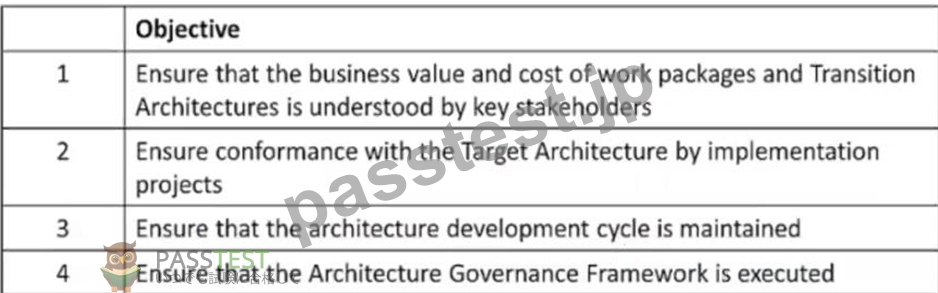
Which phase does each objective match?
- A. 1G-2H-3H-4F
- B. 1H-2F-3F-4G
- C. 1F-2G-3H-4H
- D. 1F-2G-3G-4H
正解:D
解説:
1F: To define an Implementation and Migration Strategy that will achieve an orderly transition from the Baseline to Target Architectures 2G: To perform appropriate governance functions while the solution is being implemented 3G: To ensure conformance with the Target Architecture by implementation projects 4H: To establish procedures for continual monitoring and assessment of the performance of the solution in operation
質問 # 26
Complete the sentence The Enterprise Continuum provides methods for classifying architecture artifacts as they evolve from________________________.
- A. generic architectures to Organization-Specific Architectures
- B. generic architectures to reusable Solution Building Blocks
- C. Solutions Architectures to Solution Building Blocks
- D. Foundation Architectures to re-usable architecture assets
正解:A
解説:
The Enterprise Continuum provides methods for classifying architecture artifacts as they evolve from generic architectures to Organization-Specific Architectures. Generic architectures are architectures that have been developed for use across a wide range of enterprises with similar characteristics. They provide common models, functions, and services that can be reused and adapted for specific purposes. Organization-Specific Architectures are architectures that have been tailored to meet the needs and requirements of a particular enterprise or a major organizational unit within an enterprise. They reflect the unique vision, goals, culture, structure, processes, systems, and technologies of that enterprise or unit. Reference: The TOGAF Standard | The Open Group Website, Section 2.3 Enterprise Continuum.
質問 # 27
Which of the following is included as part of Architecture Governance1?
- A. Interacting with the CxO level on Enterprise Architecture
- B. Ensuring compliance with internal and external standards and regulatory obligations
- C. Managing Stakeholders and their requirements
- D. Creating and maintaining the Statement of Architecture Work though out the ADM cycle
正解:B
解説:
Ensuring compliance with internal and external standards and regulatory obligations is one of the activities included as part of Architecture Governance. Architecture Governance is the practice and orientation by which enterprise architectures and other architectures are managed and controlled at an enterprise-wide level. It involves establishing processes, roles, responsibilities, policies, and standards to ensure that architectures are aligned with the enterprise's strategy and objectives, and meet the quality and performance requirements. Reference: The TOGAF Standard | The Open Group Website, Section 3.3.6 Architecture Governance.
質問 # 28
Consider the following statements
1 A whole corporation or a division of a corporation
2 A government agency or a single government department
3 Partnerships and alliances of businesses working together such as a consortium or supply chain What are those examples of according to the TOGAF Standard?
- A. Organizations
- B. Business Units
- C. Architectures Scopes
- D. Enterprises
正解:D
解説:
Enterprises are examples of the scope of an architecture according to the TOGAF Standard. An enterprise is defined as any collection of organizations that has a common set of goals and/or a single bottom line. Enterprises can be whole corporations or divisions of a corporation, government agencies or single government departments, partnerships and alliances of businesses working together, etc. Reference: The TOGAF Standard | The Open Group Website, Section 2.1 Core Concepts.
質問 # 29
Complete the sentence The TOGAF standard covers the development of four architecture domains. Business. Data, Technology and__________________.
- A. Application
- B. Segment
- C. Capability
- D. Transition
正解:A
解説:
The TOGAF standard covers the development of four architecture domains: Business, Data, Technology and Application. These domains represent different aspects of an enterprise's architecture and provide a consistent way of describing, analyzing, and designing them. Reference: The TOGAF Standard | The Open Group Website, Section 2.2 Architecture Development Method (ADM).
質問 # 30
Consider the following statement:
According to the TOGAF Standard a governed approach of a particular deliverable will ensure a system of continuous monitoring to check integrity changes decision-making and audit of all architecture-related activities Which deliverable is being referred to?
- A. The Architecture Definition Document
- B. The Architecture Vision
- C. The Statement of Architecture Work
- D. An Architecture Contract
正解:D
解説:
An Architecture Contract is a deliverable that specifies the responsibilities and obligations of the parties involved in the implementation and governance of an architecture. It ensures a system of continuous monitoring to check integrity changes decision-making and audit of all architecture-related activities. Reference: The TOGAF Standard | The Open Group Website, Section 3.3.4 Architecture Contracts.
質問 # 31
Exhibit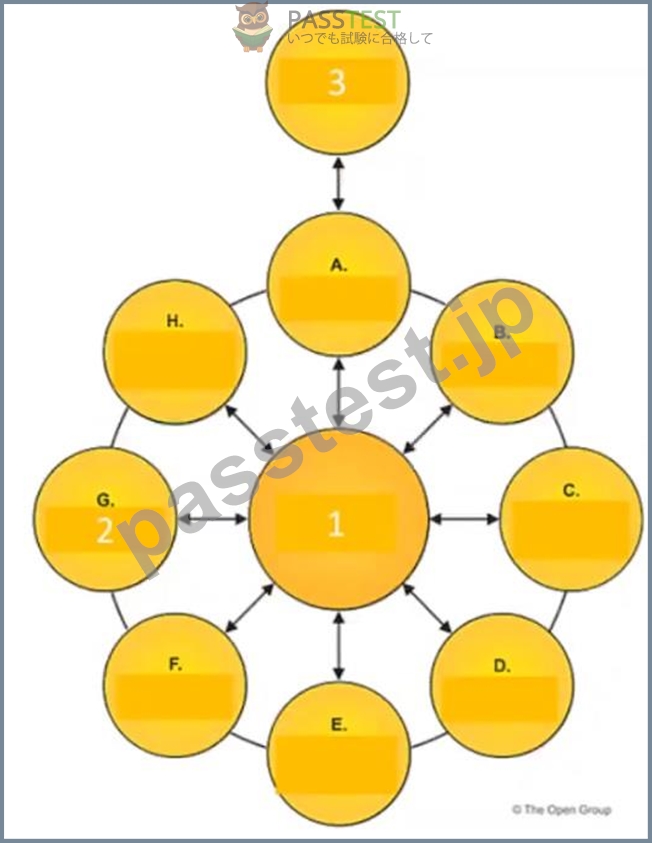
Consider the illustration showing an architecture development cycle Which description matches the phase of the ADM labeled as item 1?
- A. Conducts implementation planning for the architecture defined in previous phases
- B. Provides architectural oversight for the implementation
- C. Operates the process of managing architecture requirements
- D. Establishes procedures for managing change to the new architecture
正解:A
解説:
The phase of the ADM labeled as item 1 is Phase F: Migration Planning. This phase conducts implementation planning for the architecture defined in previous phases by creating an Architecture Roadmap and a detailed Implementation and Migration Plan. This phase also identifies and groups major work packages, transition architectures, projects, and dependencies. Reference: https://pubs.opengroup.org/architecture/togaf9-doc/arch/chap19.html
質問 # 32
Which section of the TOGAF template for Architecture Principles should describe the relationship to other principles?
- A. Implications
- B. Rationale
- C. Name
- D. Statement
正解:A
解説:
The implications section of the TOGAF template for Architecture Principles should describe the relationship to other principles. Implications are statements that describe how a principle will impact other principles, as well as other aspects of the enterprise such as business processes, organizational structures, roles and responsibilities, standards, etc. Implications help to identify potential conflicts or synergies among principles and to assess their feasibility and applicability. Reference: The TOGAF Standard | The Open Group Website, Section 3.3.7 Architecture Principles.
質問 # 33
Complete the sentence When considering agile development Architecture to Support Project will identify what products the Enterprise needs the boundary of the products and what constraints a product owner has. this defines the Enterprise's___________.
- A. lifecycle economics
- B. workflow management
- C. backlog
- D. operations
正解:C
解説:
When considering agile development, Architecture to Support Project will identify what products the enterprise needs, the boundary of the products, and what constraints a product owner has. This defines the enterprise's backlog. A backlog is a list of features or tasks that need to be done to deliver a product or service. It is prioritized by the product owner based on the value and urgency of each item. Reference: The TOGAF Standard | The Open Group Website, Section 3.3.5 Architecture to Support Project.
質問 # 34
Which of the following best describes a purpose of the Gap Analysis technique?
- A. To validate non-functional requirements
- B. To determine service levels for the architecture
- C. To identify missing functions
- D. To establish quality metrics for the architecture
正解:C
解説:
Gap analysis is a technique that is used to validate an architecture by highlighting the shortfall between the Baseline Architecture and the Target Architecture. One of the purposes of gap analysis is to identify missing functions that are either deliberately omitted, accidentally left out, or not yet defined in the Target Architecture. Missing functions are marked as gaps that need to be filled by developing or procuring the building blocks.
質問 # 35
What are the following activities part or?
* Initial risk assessment
* Risk mitigation and residual risk assessment
* Risk monitoring
- A. Risk Management
- B. Security Architecture
- C. Phase A
- D. Phase C
正解:A
解説:
The following activities are part of Risk Management:
Initial risk assessment
Risk mitigation and residual risk assessment
Risk monitoring
Risk Management is the process of identifying, assessing, and responding to risks that may affect the achievement of the enterprise's objectives. Risk Management involves balancing positive and negative outcomes resulting from the realization of either opportunities or threats. Reference: The TOGAF Standard | The Open Group Website, Section 3.3.3 Risk Management.
質問 # 36
Which of the following is a responsibility of an Architecture Board?
- A. Conducting assessments of the maturity level of architecture discipline within the organization
- B. Allocating resources for architecture projects
- C. Establishing targets for re-use of components
- D. Creating the Statement of Architecture Work
正解:A
解説:
The Architecture Board is a governance body that oversees and supports the implementation of architectures within an organization. One of its responsibilities is to conduct assessments of the maturity level of architecture discipline within the organization using frameworks such as CMMI or ACMM. This helps to identify areas for improvement and monitor progress towards achieving higher levels of maturity. Reference: https://pubs.opengroup.org/architecture/togaf9-doc/arch/chap44.html
質問 # 37
What provides context for architecture work, by describing the needs and ways of working employed by the enterprise?
- A. Architecture Contracts
- B. Business principles business goals, and business drivers
- C. Strategy and vision
- D. Stakeholder needs
正解:B
解説:
Business principles business goals, and business drivers provide context for architecture work, by describing the needs and ways of working employed by the enterprise. They define what the enterprise wants to achieve, how it wants to operate, and what factors influence its decisions and actions. Reference: The TOGAF Standard | The Open Group Website, Section 3.2 Preliminary Phase.
質問 # 38
......
突破受験者のシミュレーションされたOGEA-103問題集:https://www.passtest.jp/TheOpenGroup/OGEA-103-shiken.html
売上ナンバーワン試験参照問題:https://drive.google.com/open?id=1GPKXQ_ZTRofj7Tf6cAqZ2UBonjus1Ibq