

OGEA-103試験問題でリアルに更新された問題PDF
合格させる無料保証付きクイズ2024年最新の実際に出ると確認されたThe Open Group
質問 # 34
Please read this scenario prior to answering the question
Your role is consultant to the Lead Architect within a multinational company that manufactures electronic components. The company has several manufacturing divisions located worldwide and a complex supply chain. After a recent study, senior management have stated a concern about business efficiency considering the company's multiple data centers and duplication of applications.
The company has a mature Enterprise Architecture (EA) practice and uses the TOGAF architecture development method in its EA practice. In addition to the EA program, the company has severalmanagement frameworks in use, including business planning, project/portfolio management, and operations management.
The EA program is sponsored by the CIO.
A strategic architecture has been defined to improve the ability to meet customer demand and improve management of the supply chain. The strategic architecture includes the consolidation of multiple Enterprise Resource Planning (ERP) applications that have been operating independently in the divisions' production facilities.
Each division has completed the Architecture Definition documentation to meet its own specific manufacturing requirements. The enterprise architects have defined a set of work packages that address the gaps identified. They have identified the value produced, effort required, and dependencies between work packages to reach a farget architecture that would integrate a new ERP environment into the company.
Because of the risks posed by change from the current environment, the architects have recommended that a phased approach occurs to implement the target architecture with several transition states. The overall implementation process is estimated to take several years.
Refer to the scenario
You have been asked what the next steps are for the migration planning.
Based on the TOGAF standard which of the following is the best answer?
- A. You place the Architecture Definition Document under configuration control. This will ensure that the architecture remains relevant and responsive to the needs of the enterprise. You would identify the development resources to undertake the projects. You would then produce an Implementation Governance Model to manage the lessons learned prior to finalizing the plan. You recommend that lessons learned be applied as changes to the architecture without review.
- B. You conduct a series of Compliance Assessments to ensure that the architecture is being implemented according to the contract. The Compliance Assessment should verify that the implementation team is using the proper development methodology. It should include deployment of monitoring tools and ensure that performance targets are being met. If they are not met, then you would identify changes to performance requirements and update those in the Implementation and Migration Plan.
- C. You estimate the business value for each project by applying the Business Value Assessment Technique to prioritize the implementation projects and project increments. The assessment should focus on return on investment and performance evaluation criteria that can be used to monitor the progress of the architecture transformation. You would confirm and plan a series of Transition Architecture phases using an Architecture Definition Increments Table that lists the projects.
- D. You assess how the Implementation and Migration plan impacts the other frameworks in use in the organization. Minimally, you ensure that the plan is coordinated with the business planning, project/portfolio management and operations management frameworks. You would then assign a business value to each work package, considering available resources and strategic fit. You then use the work packages to identify projects that will be in the Implementation and Migration Plan
正解:C
解説:
The Business Value Assessment Technique is a technique that can be used to estimate and compare the business value of the projects and project increments that implement the architecture work packages, which are the sets of actions or tasks that are required to implement a specific part of the architecture. The business value is the measure of the benefits or advantages that the project or project increment delivers to the business, such as increased revenue, reduced costs, improved quality, or enhanced customer satisfaction1 The steps for applying the Business Value Assessment Technique are:
Identify the criteria and factors that are relevant to the business value assessment, such as costs, benefits, risks, and opportunities. The criteria and factors should be aligned with the business goals and drivers that motivate the architecture work, and the stakeholder requirements and concerns that influence the architecture work.
Assign weights and scores to the criteria and factors, using various methods, such as expert judgment, historical data, or analytical models. The weights and scores should reflect the importance and performance of the criteria and factors, and the trade-offs and preferences of the stakeholders.
Calculate the business value for each project or project increment, using various techniques, such as net present value, return on investment, or balanced scorecard. The business value should indicate the expected or actual outcomes and impacts of the project or project increment on the business.
Prioritize the implementation projects and project increments, based on the business value and other considerations, such as dependencies, resources, or risks. The prioritization should determine the order or sequence of the projects and project increments, and the allocation and utilization of the resources.
Therefore, the best answer is C, because it describes the next steps for the migration planning, which are the activities that support the transition from the Baseline Architecture to the Target Architecture. The answer covers the Business Value Assessment Technique, which is relevant to the scenario.
References: 1: The TOGAF Standard, Version 9.2, Part III: ADM Guidelines and Techniques, Chapter 28:
Business Value Assessment Technique : The TOGAF Standard, Version 9.2, Part II: Architecture Development Method (ADM), Chapter 18: Phase A: Architecture Vision : The TOGAF Standard, Version 9.2, Part II: Architecture Development Method (ADM), Chapter 21: Phase F: Migration Planning : The TOGAF Standard, Version 9.2, Part IV: Architecture Content Framework, Chapter 36: Building Blocks
質問 # 35
What provides context for architecture work, by describing the needs and ways of working employed by the enterprise?
- A. Business principles business goals, and business drivers
- B. Strategy and vision
- C. Stakeholder needs
- D. Architecture Contracts
正解:A
解説:
Business principles business goals, and business drivers provide context for architecture work, by describing the needs and ways of working employed by the enterprise. They define what the enterprise wants to achieve, how it wants to operate, and what factors influence its decisions and actions. Reference: The TOGAF Standard | The Open Group Website, Section 3.2 Preliminary Phase.
質問 # 36
What is used to structure architectural information in an orderly way so that it can be processed to meet stakeholder needs?
- A. An Architecture Framework
- B. An EA Library
- C. Content Metamodel
- D. A Stakeholder Map
正解:C
解説:
Explanation
A content metamodel is a formal structure that defines the types of entities and relationships that are used to capture, store, filter, query, and represent architectural information in a way that supports consistency, completeness, and traceability12.
A stakeholder map is a tool that identifies and analyzes the key stakeholders and their interests, influence, and expectations in relation to the architecture3. It is not used to structure architectural information, but rather to understand the stakeholder needs and concerns.
An architecture framework is a set of principles, guidelines, standards, and tools that provide a common structure and methodology for developing architectures4. It is not used to structure architectural information, but rather to guide the architecture development process and ensure alignment with the business strategy and objectives.
An EA library is a repository that stores and manages the architecture artifacts, deliverables, and other relevant information produced and consumed during the architecture development and governance. It is not used to structure architectural information, but rather to provide access, security, and version control for the architecture content.
References: 1: The TOGAF Standard, Version 9.2 - Content Metamodel 2: TOGAF 9.2 Content Metamodel Framework - A Quick Guide - KnowledgeHut 3: The TOGAF Standard, Version 9.2 - Stakeholder Management 4: The TOGAF Standard, Version 9.2 - Architecture Framework : The TOGAF Standard, Version 9.2 - Architecture Repository
質問 # 37
Please read this scenario prior to answering the question
You are serving as the Lead Architect for an Enterprise Architecture team within a leading multinational biotechnology company. The company works in three major industries, including healthcare, crop production, and agriculture. Your team works within the healthcare division.
The healthcare division is developing a new vaccine, and has to demonstrate its effectiveness and safety in a set of clinical trials that satisfy the regulatory requirements of the relevant health authorities. The clinical trials are undertaken by its research laboratories at multiple facilities worldwide. In addition to internal research and development activities, the healthcare division is also involved in publicly funded collaborative research projects with industrial and academic partners.
The Enterprise Architecture team has been engaged in an architecture project to develop a secure system that will allow the healthcare researchers to share information more easily about their clinical trials, and work more collaboratively across the organization and also with its partners. This system will also connect with external partners.
The Enterprise Architecture team uses the TOGAF ADM with extensions required to support healthcare manufacturing practices and laboratory practices. Due to the highly sensitive nature of the information that is managed, special care has been taken to ensure that each architecture domain considers the security and privacy issues that are relevant.
The Vice President for Worldwide Clinical Research is the sponsor of the Enterprise Architecture activity. She has stated that disruptions must be minimized for the clinical trials, and that the rollout must be undertaken incrementally.
Refer to the scenario
You have been asked to recommend the approach to identify the work packages for an incremental rollout meeting the requirements.
Based on the TOGAF standard which of the following is the best answer?
- A. You recommend that the Solution Building Blocks from a Consolidated Gaps, Solutions and Dependencies Matrix be grouped into a set of work packages. Using the matrix as a planning tool, regroup the work packages to account for dependencies. Sequence the work packages into the Capability Increments needed to achieve the Target Architecture, so that the implementation team can schedule the rollout one region at a time to minimize disruption. Document the work packages for the Enterprise Architecture using a Transition Architecture State Evolution Table.
- B. You recommend that a Consolidated Gaps. Solutions and Dependencies Matrix is used as a planning tool for creating work packages. For each gap classify whether the solution is either a new development, purchased solution, or based on an existing product. Group the similar solutions together to define the work packages. Regroup the work packages into a set of Capability Increments to transition to the Target Architecture considering the schedule for clinical trials, and document in an Architecture Definition Increments Table.
- C. You recommend that the set of required Solution Building Blocks be determined by identifying those which need to be developed and which need to be procured. Eliminate any duplicates. Group the remaining Solution Building Blocks together to create the work packages using a CRUD (create, read, update, delete) matrix. Rank the work packages and select the most cost-effective options for inclusion in a series of Transition Architectures. Schedule the roll out of the work packages to be sequential across the geographic regions.
- D. You recommend that an Implementation Factor Catalog is drawn up to indicate actions and constraints.
A Consolidated Gaps. Solutions and Dependencies Matrix should also be created. For each gap. identify a proposed solution and classify it as new development, purchased solution, or based on an existing product. Group similar activities together to form work packages. Identify dependencies between work packages factoring in the clinical trial schedules. Regroup the work packages into a set of Capability Increments scheduled into a series of Transition Architectures.
正解:B
解説:
Explanation
A Consolidated Gaps, Solutions and Dependencies Matrix is a technique that can be used to create work packages for an incremental rollout of the architecture. A work package is a set of actions or tasks that are required to implement a specific part of the architecture. A work package can be associated with one or more Architecture Building Blocks (ABBs) or Solution Building Blocks (SBBs), which are reusable components of business, IT, or architectural capability. A work package can also be associated with one or more Capability Increments, which are defined, discrete portions of the overall capability that deliver business value. A Capability Increment can be realized by one or more Transition Architectures, which are intermediate states of the architecture that enable the transition from the Baseline Architecture to the Target Architecture123 The steps for creating work packages using this technique are:
For each gap between the Baseline Architecture and the Target Architecture, identify a proposed solution and classify it as new development, purchased solution, or based on an existing product. A gap is a difference or deficiency in the current state of the architecture that needs to be addressed by the future state of the architecture. A solution is a way of resolving a gap by implementing one or more ABBs or SBBs.
Group similar solutions together to define the work packages. Similar solutions are those that have common characteristics, such as functionality, technology, vendor, or location.
Identify dependencies between work packages, such as logical, temporal, or resource dependencies.
Dependencies indicate the order or priority of the work packages, and the constraints or risks that may affect their implementation.
Regroup the work packages into a set of Capability Increments to transition to the Target Architecture.
Capability Increments should be defined based on the business value, effort, and risk associated with each work package, and the schedule and objectives of the clinical trials. Capability Increments should also be aligned with the Architecture Vision and the Architecture Principles.
Document the work packages and the Capability Increments in an Architecture Definition Increments Table, which shows the mapping between the work packages, the ABBs, the SBBs, and the Capability Increments. The table also shows the dependencies, assumptions, and issues related to each work package and Capability Increment.
Therefore, the best answer is B, because it describes the approach to identify the work packages for an incremental rollout meeting the requirements, using the Consolidated Gaps, Solutions and Dependencies Matrix as a planning tool.
References: 1: The TOGAF Standard, Version 9.2, Part III: ADM Guidelines and Techniques, Chapter 30:
Gap Analysis 2: The TOGAF Standard, Version 9.2, Part IV: Architecture Content Framework, Chapter 36:
Building Blocks 3: The TOGAF Standard, Version 9.2, Part III: ADM Guidelines and Techniques, Chapter 31:
Architecture Change Management : The TOGAF Standard, Version 9.2, Part II: Architecture Development Method (ADM), Chapter 23: Phase E: Opportunities and Solutions : The TOGAF Standard, Version 9.2, Part II: Architecture Development Method (ADM), Chapter 21: Phase F: Migration Planning : The TOGAF Standard, Version 9.2, Part II: Architecture Development Method (ADM), Chapter 18: Phase A: Architecture Vision : The TOGAF Standard, Version 9.2, Part III: ADM Guidelines and Techniques, Chapter 23:
Architecture Principles
質問 # 38
Which section of the TOGAF template for Architecture Principles should describe the relationship to other principles?
- A. Name
- B. Rationale
- C. Statement
- D. Implications
正解:D
解説:
Explanation
The implications section of the TOGAF template for Architecture Principles should describe the relationship to other principles. Implications are statements that describe how a principle will impact other principles, as well as other aspects of the enterprise such as business processes, organizational structures, roles and responsibilities, standards, etc. Implications help to identify potential conflicts or synergies among principles and to assess their feasibility and applicability. Reference: The TOGAF Standard | The Open Group Website, Section 3.3.7 Architecture Principles.
質問 # 39
Which of the following are the four purposes that typically frame the planning horizon, depth and breadth of an Architecture Project, and the contents of the EA Repository-?
- A. Avant-Garde Big-Bang, Discreet and Cohesive
- B. Strategy Portfolio Project Solution Delivery
- C. General Foundational Subordinate and Superior Architecture
- D. Segment, Capability. Enterprise and End-to-end Target Architecture
正解:B
解説:
Explanation
Strategy Portfolio Project Solution Delivery are the four purposes that typically frame the planning horizon, depth and breadth of an Architecture Project, and the contents of the EA Repository. They correspond to different levels of abstraction and granularity in the architecture development process. Reference: The TOGAF Standard, Version 9.2 - The Open Group, Section 2.4 Architecture Repository.
質問 # 40
Complete the following sentence:
Presenting different_________and_________to stakeholders helps architects to extract hidden agendas principles and requirements that could impact the final Target Architecture
- A. Solutions Applications
- B. Business Scenarios Business Models
- C. Alternatives Trade-offs
- D. Architecture Views Architecture Viewpoints
正解:C
解説:
Explanation
Presenting different alternatives and trade-offs to stakeholders helps architects to extract hidden agendas principles and requirements that could impact the final Target Architecture. Alternatives are different ways of achieving a desired outcome, while trade-offs are compromises or sacrifices that must be made to choose one alternative over another. Reference: The TOGAF Standard | The Open Group Website, Section 3.3.1 Business Scenarios.
質問 # 41
Exhibit: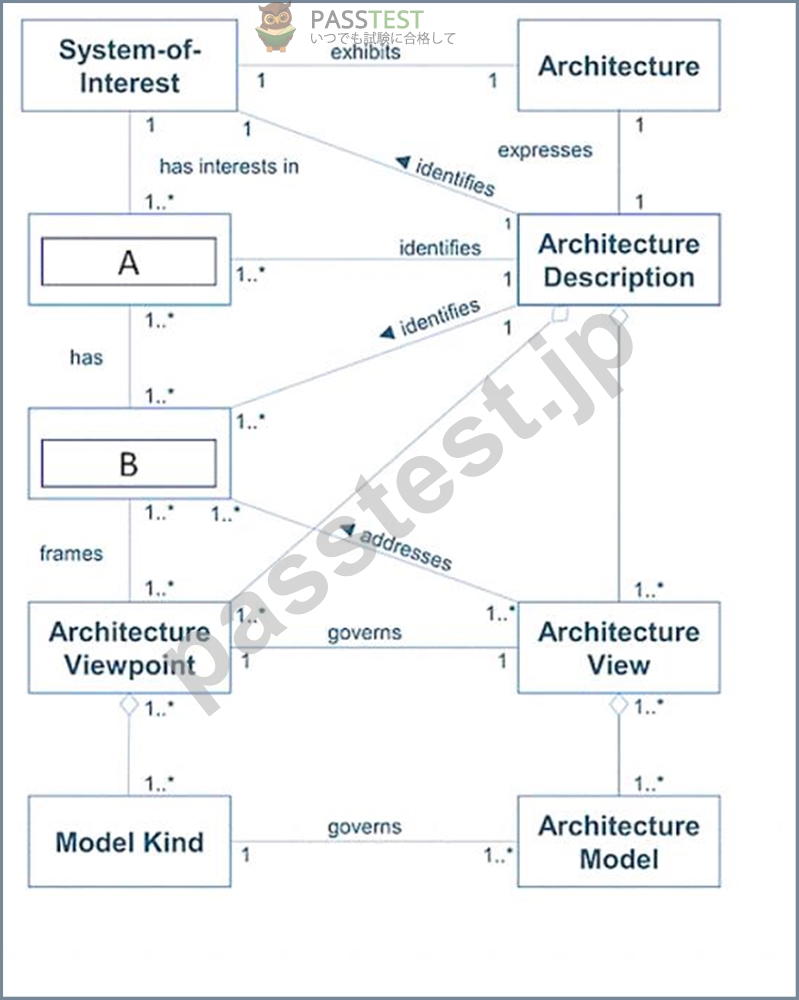
Consider the image showing basic architectural concepts.
What are items A and B?
- A. A-Base Architecture, B-Target Architecture
- B. A-Stakeholder, B-Concern
- C. A-User, B-Requirement
- D. A-Candidate Architecture, B-Trade-off
正解:B
解説:
Explanation
In the context of TOGAF, a stakeholder is any individual, team, or organization who has interests in, or concerns relative to, the outcome of the architecture. Concerns are those interests which pertain to any aspect of the system's functioning, development or operation, including considerations such as performance, reliability, and security1. References:
*The TOGAF Standard, Version 9.2 - Definitions - The Open Group
質問 # 42
When considering the scope of an architecture, what dimension considers to what level of detail the architecting effort should go?
- A. Breadth
- B. Architecture Domains
- C. Depth
- D. Project
正解:C
解説:
The scope of an architecture is the extent and level of detail of the architecture work. The scope of an architecture can be defined along four dimensions: project, breadth, depth, and architecture domains. The project dimension considers the boundaries and objectives of the architecture project, such as the time frame, budget, resources, and deliverables. The breadth dimension considers the coverage and completeness of the architecture across the enterprise, such as the organizational units, business functions, processes, and locations. The depth dimension considers the level of detail and specificity of the architecture, such as the granularity, abstraction, and precision of the architectural elements and relationships. The architecture domains dimension considers the aspects or segments of the architecture, such as the business, data, application, and technology domains.
Therefore, the depth dimension is the one that considers to what level of detail the architecting effort should go.
質問 # 43
Consider the image showing basic architectural concepts.
What are items A and B?
- A. A-Requirement. B-Candidate Architecture
- B. A-Architecture Viewpoint, B-Architecture View
- C. A-Candidate Architecture, B-Trade-off
- D. A-Architecture Board, B-Architecture Capability
正解:C
解説:
The image shows basic architectural concepts based on the ISO/IEC/IEEE 42010 standard, which defines an architecture description as a work product used to express an architecture1 According to this standard, an architecture description consists of one or more architecture views, which are representations of the system of interest from the perspective of one or more stakeholders and their concerns2 An architecture view conforms to an architecture viewpoint, which establishes the conventions for constructing, interpreting, and analyzing the view to address the concerns of the stakeholders3 An architecture viewpoint may also define model kinds, which are kinds of models used to express the view.
In the context of the TOGAF standard, a candidate architecture is a possible architecture that addresses some or all of the requirements and concerns of the stakeholders. A trade-off is a decision outcome that balances and reconciles multiple, often conflicting, factors, such as costs, benefits, risks, and opportunities. In the process of developing an architecture, the architect may have to evaluate and compare different candidate architectures and make trade-offs among them to select the most suitable one.
Therefore, the items A and B in the image are candidate architecture and trade-off, respectively, as they represent the concepts of possible solutions and decision outcomes that are relevant to the architecture development process.
質問 # 44
Consider the following descriptions of deliverables consumed and produced across the TOGAF ADM cycle.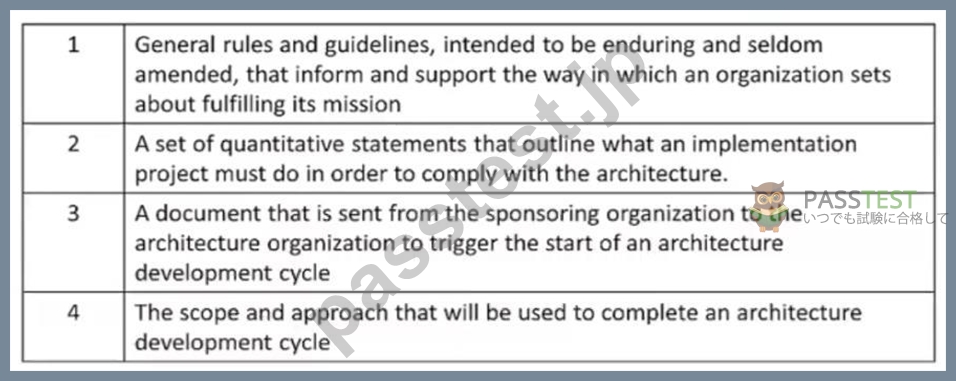
Which deliverables match these descriptions?
- A. 1 Request for Architecture Work - 2 Statement of Architecture Work - 3 Architecture Principles - 4 Architecture Requirements Specification
- B. 1 Architecture Requirements Specification - 2 Request for Architecture Work - 3 Statement of Architecture Work - 4 Architecture Principles
- C. 1 Statement of Architecture Work - 2 Architecture Principles - 3 Architecture Requirements Specification - 4 Request for Architecture Work
- D. 1 Architecture Principles - 2 Architecture Requirements Specification - 3 Request for Architecture Work
- 4 Statement of Architecture Work
正解:A
解説:
The Request for Architecture Work is a deliverable that is sent from the sponsor and triggers the start of an architecture development cycle. It defines the scope, budget, schedule, and deliverables for a specific architecture project. The Statement of Architecture Work is a deliverable that is produced by the architect and defines the approach and resources needed to complete an architecture project. It forms the basis of a contractual agreement between the sponsor and the architecture organization. The Architecture Principles are a deliverable that is produced by the architect and defines the general rules and guidelines for the architecture work. They reflect the business principles, business goals, and business drivers of the organization. The Architecture Requirements Specification is a deliverable that is produced by the architect and defines the requirements that govern the architecture work. It covers both functional and non-functional requirements as well as constraints and assumptions.
質問 # 45
Exhibit: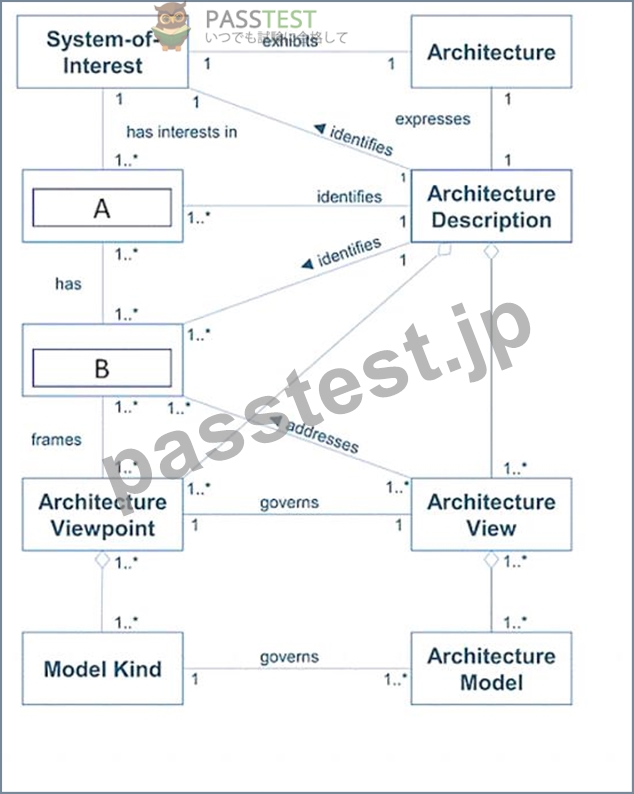
Consider the image showing basic architectural concepts.
What are items A and B?
- A. A-Base Architecture, B-Target Architecture
- B. A-Stakeholder, B-Concern
- C. A-User, B-Requirement
- D. A-Candidate Architecture, B-Trade-off
正解:B
解説:
In the context of TOGAF, a stakeholder is any individual, team, or organization who has interests in, or concerns relative to, the outcome of the architecture. Concerns are those interests which pertain to any aspect of the system's functioning, development or operation, including considerations such as performance, reliability, and security1. References:
*The TOGAF Standard, Version 9.2 - Definitions - The Open Group
質問 # 46
Please read this scenario prior to answering the question
You are working as Chief Enterprise Architect at a large Internet company. The company has many divisions, ranging from cloud to logistics. The company has grown rapidly, expanding from initially selling physical books and media to a range of services including an online marketplace, live-streaming. eBooks. and cloud services.
Overall management of the numerous divisions has become challenging. Recent high-profile projects have overrun on budget and under delivered, damaging the company's reputation, and adversely impacting its share price. There is a widely held view within the executive management that the organization structure has played a major role in these project failures.
The company has an established Enterprise Architecture program based on the TOGAF standard, sponsored jointly by the Chief Executive Officer (CEO) and Chief Information Officer (CIO). The CEO has decided that the company needs to reorganize its divisions around artificial intelligence and machine learning with a focus on automation. The CEO has worked with the Enterprise Architects to create a strategic architecture for the reorganization, including an Architecture Vision, together with definitions for the four domain architectures. This sets out an ambitious vision of the future of the company over a three-year period. This includes a set of work packages and includes three distinct transformations.
The CIO has made it clear that prior to the approval of the detailed Implementation and Migration plan, the EAteam will need to assess the risks associated with the proposed architecture. He has received concerns from key stakeholders across the company that the proposed reorganization may be too ambitious and there is doubt whether it can produce sufficient value to warrant the risks.
Refer to the scenario
You have been asked to recommend an approach to satisfy these concerns. Based on the TOGAF Standard, which of the following is the best answer?
- A. The Enterprise Architects should evaluate the organization's readiness to undergo change. This will allow the risks associated with the transformations to be identified, classified, and mitigated for. This should include identifying dependencies between the set of changes, including gaps and work packages. It will also identify improvement actions to be worked into the Implementation and Migration Plan. The business value, effort, and risk associated for each transformation should be determined.
- B. Establishing interoperability in alignment with the corporate operating model will ensure risks are minimized. The Enterprise Architects should apply an interoperability analysis to evaluate any potential issues across the architecture. This should include the development of a matrix showing the interoperability requirements. These can then be included within the transformation strategy embedded in the target transition architectures. The Enterprise Architects should then finalize the Architecture Roadmap and the Implementation and Migration Plan.
- C. The Enterprise Architects should bring together information about potential approaches and produce several alternative target transition architectures. They should then investigate the different architecture alternatives and discuss these with stakeholders using the Architecture Alternatives and Trade-offs technique. Once the target architecture has been selected, it should be analyzed using a state evolution table to determine the Transition Architectures. A value realization process should then be established to ensure that the concerns raised are addressed.
- D. Before preparing the detailed Implementation and Migration plan, the Enterprise
正解:A
解説:
Architects should review and consolidate the gap analysis results from Phases B to This will identify the transformations required to achieve the proposed Target Architecture. The Enterprise Architects should then assess the readiness of the organization to undergo change and determine an overall direction to address and mitigate risks identified. The Transition Architecture should then be planned to use a state evolution table.
Explanation:
The Business Transformation Readiness Assessment is a technique that can be used to evaluate the readiness of the organization to undergo change and to identify the actions needed to increase the likelihood of a successful business transformation. This technique can help to address the concerns of the key stakeholders about the risks and value of the proposed reorganization. The technique involves assessing the following aspects of the organization: vision, commitment, capacity, capability, culture, and communication. Based on the assessment, the risks associated with the transformations can be identified, classified, and mitigated for. The technique also helps to identify the dependencies between the set of changes, including gaps and work packages, and the improvement actions to be worked into the Implementation and Migration Plan. The technique also supports the determination of the business value, effort, and risk associated for each transformation, which can be used to prioritize and sequence the work packages and the Transition Architectures1 Reference: 1: The TOGAF Standard, Version 9.2, Part III: ADM Guidelines and Techniques, Chapter 27: Business Transformation Readiness Assessment
質問 # 47
Consider the following ADM phases objectives.
Objective
1- Determine whether an incremental approach is required, and if so identify Transition Architectures that will deliver continuous business value
2- Generate the initial complete version of the Architecture Roadmap, based upon the gap analysis and candidate Architecture Roadmap components from Phases B, C, and D
3- Finalize the Architecture Roadmap and the supporting Implementation and Migration Plan
4- Ensure that the business value and cost of work packages and Transition Architectures is understood by key stakeholders Which phase does each objective match?
- A. 1E-2E-3F-4F
- B. 1F-2E-3F-4G
- C. 1G-2E-3F-4F
- D. 1E-2F-3E-4F
正解:C
解説:
According to the TOGAF standard, the objectives of each ADM phase are as follows1:
* Phase E: Opportunities and Solutions
o Determine whether an incremental approach is required, and if so identify Transition Architectures that will deliver continuous business value o Identify and group major work packages within the Architecture Roadmap o Identify and group major implementation projects to realize the Architecture Roadmap o Identify dependencies between increments and projects o Estimate cost, benefit, and risk at a high level for each increment and project o Conduct initial prioritization and sequencing of the Architecture Roadmap and projects
* Phase F: Migration Planning
o Generate the initial complete version of the Architecture Roadmap, based upon the gap analysis and candidate Architecture Roadmap components from Phases B, C, and D o Confirm the Transition Architectures with relevant stakeholders o Create the Implementation and Migration Plan, including Transition Architectures, work packages, projects, and other activities o Confirm and agree the Architecture Roadmap and Implementation and Migration Plan with relevant stakeholders
* Phase G: Implementation Governance
o Finalize the Architecture Roadmap and the supporting Implementation and Migration Plan o Ensure conformance with the Target Architecture by implementation projects o Perform appropriate Architecture Governance functions for the solution and any implementation-driven architecture Change Requests o Ensure that the architecture lifecycle is maintained o Ensure that the Architecture Governance Framework is executed
* Phase H: Architecture Change Management
o Ensure that the business value and cost of work packages and Transition Architectures is understood by key stakeholders o Manage risks and issues related to the Architecture Roadmap and Implementation and Migration Plan o Monitor the implementation projects and Transition Architectures o Manage changes to the architecture baseline o Manage changes to the Architecture Capability Therefore, the correct matching of the objectives and the phases is:
* 1G: Determine whether an incremental approach is required, and if so identify Transition Architectures that will deliver continuous business value
* 2E: Generate the initial complete version of the Architecture Roadmap, based upon the gap analysis and candidate Architecture Roadmap components from Phases B, C, and D
* 3F: Finalize the Architecture Roadmap and the supporting Implementation and Migration Plan
* 4F: Ensure that the business value and cost of work packages and Transition Architectures is understood by key stakeholders
質問 # 48
What does the TOGAF ADM recommend for use in developing an Architecture Vision document?
- A. Architecture Principles
- B. Gap Analysis
- C. Business Scenarios
- D. Requirements Management
正解:C
解説:
Business scenarios are a technique recommended by the TOGAF ADM for use in developing an Architecture Vision document12. Business scenarios are a means of capturing the business requirements and drivers, the processes and actors involved, and the desired outcomes and measures of success34. Business scenarios help to create a common vision and understanding among the stakeholders, and to identify and validate the architecture requirements . Business scenarios also provide a basis for analyzing the impact and value of the proposed architecture. References:
*The TOGAF Standard, Version 9.2 - Phase A: Architecture Vision - The Open Group
*TOGAF Standard - Introduction - Phase A: Architecture Vision
*The TOGAF Standard, Version 9.2 - Definitions - The Open Group
*Business Scenarios - The Open Group
*[The TOGAF Standard, Version 9.2 - Architecture Requirements Specification - The Open Group]
*[The TOGAF Standard, Version 9.2 - Architecture Vision - The Open Group]
*[The TOGAF Standard, Version 9.2 - Business Transformation Readiness Assessment - The Open Group]
質問 # 49
Consider the following chart: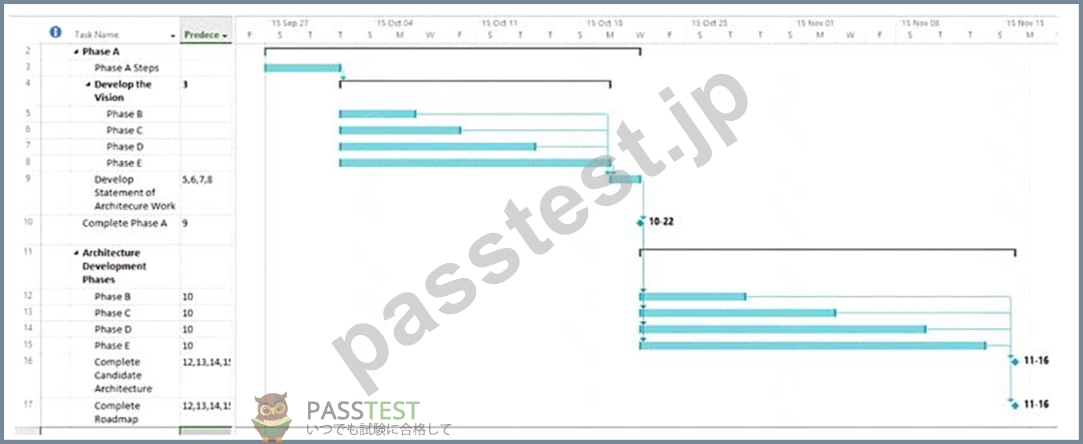
Which important concept for Enterprise Architecture Practitioners does it illustrate?
- A. An Enterprise Architecture must be developed in phases with a limited fixed duration.
- B. ADM phases must be run simultaneously until the relevant information has been produced.
- C. ADM phases must be run in a sequenced approach to produce the Architecture.
- D. Enterprise Architects must use Gantt charts to communicate with Stakeholders.
正解:C
解説:
The chart shown is a Gantt chart, which is commonly used for project management to illustrate a project schedule. In the context of TOGAF (The Open Group ArchitectureFramework), which is a framework for enterprise architecture, this Gantt chart is demonstrating the sequenced approach to the Architecture Development Method (ADM). The ADM is the core process of TOGAF which provides a tested and repeatable process for developing architectures. The ADM is described as being iterative, over the whole process, between phases, and within phases. For each iteration of the ADM, a fresh decision must be taken about each of the parameters (scope, granularity, time period, and architecture assets).
The ADM consists of a number of phases that have to be followed in sequence:
Preliminary Phase: Framework and principles
Phase A: Architecture Vision
Phase B: Business Architecture
Phase C: Information Systems Architectures, including Data and Application Architectures Phase D: Technology Architecture Phase E: Opportunities and Solutions Phase F: Migration Planning Phase G: Implementation Governance Phase H: Architecture Change Management Requirements Management Each phase is dependent on the outputs of the previous phase and the Requirements Management phase runs throughout. The Gantt chart clearly shows the dependency and sequence in which these phases occur, implying that a structured approach is followed to produce the enterprise architecture.
References:
The TOGAF Standard, Version 9.2, a standard of The Open Group
The TOGAF documentation available at https://publications.opengroup.org/standards/architecture andhttps://publications.opengroup.org/guides/architecture
質問 # 50
Which section of the TOGAF template for Architecture Principles should highlight the requirements for carrying out the principle?
- A. Name
- B. Rationale
- C. Statement
- D. Implications
正解:D
解説:
The Implications section describes the impact of adhering to the principle on the organization, the processes, the information systems, and the technology23. It also identifies the changes, costs, and risks that may result from applying the principle23. The Implications section helps to communicate the benefits and consequences of the principle to the stakeholders and to guide the implementation and governance of the architecture23.
The other sections of the TOGAF template for Architecture Principles are1:
* Name: This section provides a short and memorable name for the principle that represents its essence and purpose23. The name should not mention any specific technology or solution23.
* Statement: This section provides a concise and formal definition of the principle that expresses the fundamental rule or constraint that the principle imposes23. The statement should be clear, unambiguous, and testable23.
* Rationale: This section provides the reasoning and justification for the principle, explaining why it is important and how it supports the business goals and drivers23. The rationale should also link the principle to the higher-level enterprise or IT principles that it elaborates on23.
質問 # 51
......
トップクラスのOGEA-103練習試験問題:https://www.passtest.jp/TheOpenGroup/OGEA-103-shiken.html
無料Enterprise Architecture OGEA-103究極の学習ガイド:https://drive.google.com/open?id=1Gfj2rvg3FKnIRgkP3hsLN1eHB6jboQO6