

完全版NCP-MCI-6.5練習テスト180特別な問題と解答が待ってます!
Nutanix Certified Professional問題集でNCP-MCI-6.5試験完全版問題で試験学習ガイド
質問 # 38
An Administrator has been asked to deploy VMs using a specific image. The image has been configured with settings and applications that will be used by engineering to develop a new product by the company.
The image is not available on the desired cluster, but it is available in other cluster associated with Prism Central.
Why isno't the image available?
- A. The image placement policy was configured with enforcement.
- B. The cluster should be removed from all categories.
- C. The image bandwidth policy has prevented the image upload.
- D. The cluster has not been added to the correct category
正解:D
質問 # 39
An administrator recently added new SSDs to a Nutanix cluster and knows the firmware will be out of date, Due to security constraints, the cluster does not have access to the Internet.
Which two steps must be completed to update the firmware? (Choose two.)
- A. Download a darksite bundle and deploy an internal webserver,
- B. update the LCM Source and URL to access the firmware bundle.
- C. Select Upgrade Software, then upload the firmware bundle.
- D. Download the disk firmware from the OEM's website.
正解:A、C
解説:
Download a dark site bundle and deploy an internal web server123.
Select Upgrade Software, then upload the firmware bundle using the Direct Upload option in LCM1.
質問 # 40
Where should an administrator unregister Prism Element from Prism Central?
- A. From a CVM SSH session
- B. From a Host SSH session
- C. From the Prism Element web console
- D. From the Prism Central web console
正解:A
質問 # 41
What requires iSCSI initiator configuration in the guest OS to use Volumes?
- A. Microsoft Windows Failover Cluster
- B. SQL Server Always On Availability Group
- C. Oracle RAC
- D. Exchange DAG
正解:A
解説:
The only option that requires iSCSI initiator configuration in the guest OS to use Volumes is Microsoft Windows Failover Cluster. Volumes is an enterprise-class, software-defined block storage solution that exposesstorage resources directly to virtualized guest operating systems or physical hosts using the iSCSI protocol7. To use Volumes, customers need toconfigure iSCSI initiators on their hosts or guest OSes.
However, some applications or services can use native storage adapters instead of iSCSI initiators when running on AHV VMs. These include:
* SQL Server Always On Availability Group: This is a high availability and disaster recovery solution for SQL Server databases that uses Windows Server Failover Clustering (WSFC) and Availability Groups (AGs) as its core components. When running on AHV VMs, SQL Server Always On Availability Group can use native storage adapters instead of iSCSI initiators.
* Oracle RAC: This is a clustered database system that provides high availability and scalability for Oracle databases. When running on AHV VMs, Oracle RAC can use native storage adapters instead of iSCSI initiators.
* Exchange DAG: This is a group of up to 16 mailbox servers that hosts a set of databases and provides automatic database-level recovery from failures that affect individual servers or databases. When running on AHV VMs, Exchange DAG can use native storage adapters instead of iSCSI initiators.
質問 # 42
A user running a Computer Aided Design (CAD) application is complaining about slow response time within the VM, particular when moving windows or rendering images.
Which VM metric will guide the administrator toward diagnosing the problem?
- A. Hypervisor Memory Usage (%)
- B. GPU Usage
- C. Storage Controller Latency
- D. Swap in Rate
正解:B
解説:
A GPU (graphics processing unit) is a specialized hardware device that can accelerate graphics rendering and computation for applications that use APIs such as DirectX, OpenGL, CUDA, and OpenCL. A GPU can also offload the CPU from encoding and decoding tasks for remote display protocols such as Frame Remote Desktop Protocol (FRP). A VM can use a GPU either by directly accessing a physical GPU (pGPU) on the host or by using a virtual GPU (vGPU) that shares a pGPU with other VMs. A user running a computer aided design (CAD) application may benefit from using a GPU or a vGPU to improve the performance and responsiveness of the application, especially when moving windows or rendering images. However, if the GPU or vGPU is not properly configured or provisioned, the user may experience slow response time within the VM. Therefore, to diagnose the problem, the administrator should monitor the GPU Usage metric for the VM. The GPU Usage metric shows the percentage of GPU resources that are consumed by the VM over time3. The administrator can use Prism Central to view the GPU Usage metric for each VM in a chart or a widget4. The administrator can also use Prism Central to view other metrics related to GPU performance, such as GPU Memory Usage, GPU Encoder Usage, and GPU Decoder Usage3. By analyzing these metrics, the administrator can determine if the VM is using the GPU efficiently and optimally, or if it needs more or less GPU resources.
質問 # 43
Refer to the exhibit.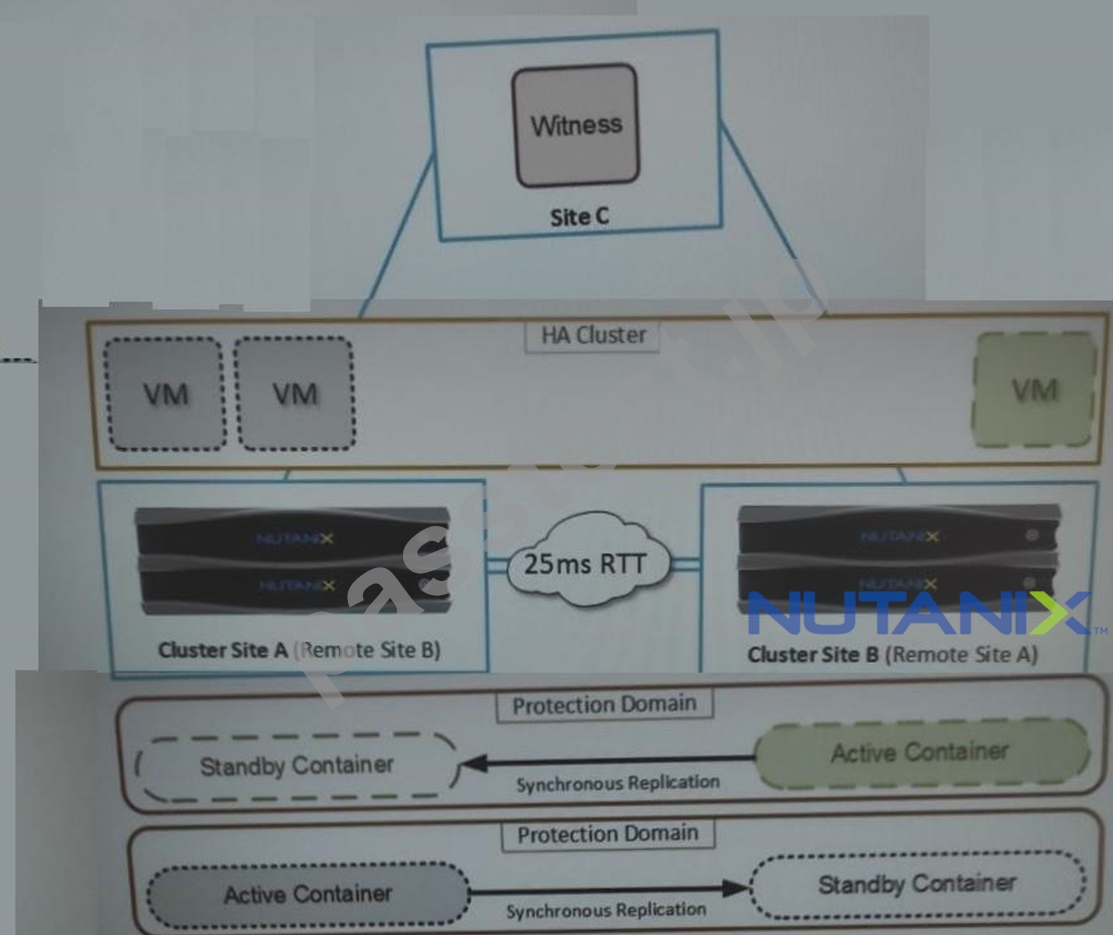
An administrator is trying to implement the solution that is shown in the exhibit, but has been unsuccessful.
Based on the diagram, what is causing the issue?
- A. Unsupported hypervisor
- B. Active containers in both sites
- C. A remote Witness VM
- D. Network latency
正解:D
質問 # 44
An administrator wants to expand the Failure Domain level of a cluster.
What two options are available? (Choose two.)
- A. Node
- B. Block
- C. Rack
- D. Data Center
正解:B、C
解説:
Nutanix clusters are resilient to a drive, node, block, and rack failures because they use redundancy factor 2 by default, allowing Nutanix clusters to self-heal2. Failure scenarios can be thought of in terms of fault domains, which are the physical or logical parts of a computing environment or location that are adversely affected when a device or service experiences an issue or outage3. There are four fault domains in a Nutanix cluster: Disk, Node, Block, and Rack4. Block and Rack are two options that are available for expanding the failure domain level of a cluster. Block fault tolerance is enabled by default and ensures that data is replicated across different blocks in a cluster5. Rack fault tolerance has to be configured manually and ensures that data is replicated across different racks in a cluster4.
質問 # 45
How many SSL certificates are used by Prism Element on a Nutanix cluster?
- A. 0
- B. 1
- C. 2
- D. 3
正解:D
質問 # 46
Refer to Exhibit:
Which statement is true?
- A. A critical alert will be triggered when there is an anomaly above 4000 MB.
- B. A warning alert will be triggered if I/O working set size goes over the blue band.
- C. A warning alert will be triggered after 3 anomalies have been catch.
- D. A critical alert will be triggered if I/O working set size goes over 6000 MB.
正解:A
解説:
A). This statement is incorrect because there is no static threshold set to trigger a critical alert at 6000 MB. The graph shows a peak that goes above 6000 MB, but the alert configuration below does not specify a static threshold at this value.
B). This is the correct statement. The configuration under "Behavioral Anomaly" is set to alert every time there is an anomaly, with a critical level alert set to trigger when the I/O working set size is between 0 MB and 4000 MB. The graph illustrates that the anomalies (highlighted in pink) occur when the working set size exceeds the normal range (blue band). Therefore, any anomaly detected above 4000 MB would trigger a critical alert.
C). This statement is incorrect because there is no indication that a warning alert is configured to trigger after 3 anomalies. The exhibit does not show any configuration that specifies an alert based on the number of anomalies.
D). This statement is incorrect as there's no indication that a warning alert will be triggered based on the I/O working set size exceeding the blue band. The alert settings are configured to ignore anomalies below 4000 MB and to trigger a critical alert for anomalies above this threshold.
The settings displayed in the exhibit are typically part of Nutanix's Prism infrastructure management platform, which can set various thresholds for performance metrics and trigger alerts based on those thresholds. The behavior is defined in the Prism documentation where the alert configuration is outlined.
質問 # 47
A node with Erasure Coding fails.
What is the impact?
- A. Potentially increased amount of data stored in the SSD tier.
- B. Increased Controller VM CPU Load.
- C. The node stops utilizing Erasure Coding.
- D. AQS unable to do deduplication during the Erasure Coding failure.
正解:B
質問 # 48
What Nutanix feature provides effective caching optimization In VDI environments?
- A. Remote Protection Group
- B. Shadow Clones
- C. Snap Clones
- D. Local Protection Group
正解:B
解説:
Shadow Clones is a Nutanix feature that provides effective caching optimization in VDI environments. VDI stands for Virtual Desktop Infrastructure, which is a technology that allows users to access virtual desktops hosted on a centralized server. VDI environments typically have a high degree of similarity among desktop images, which means that many VMs access the same data blocks from the storage layer. Shadow Clones leverages this similarity by creating read-only copies of frequently accessed data blocks on each node's SSD tier, reducing network traffic and improving performance. Shadow Clones works automatically and transparently without any configuration or intervention from the administrator.
質問 # 49
Which component can be associated with a storage policy?
- A. Catalog
- B. Subnet
- C. Vm
- D. Category
正解:C
解説:
A storage policy can be associated with a VM. A storage policy is a set of rules that define how data objects are stored and protected. It specifies the characteristics of storage, data protection, and data placement for virtual disks that are assigned to a VM. Subnets, catalogs, and categories are not associated with storage policies.https://portal.nutanix.com/page/documents/details?targetId=Prism-Central-Guide-vpc_2022_6:mul-clust
質問 # 50
An administrator needs to configure a new subnet on an AHV cluster and want to ensure that VMs will automatically be assigned an IP address at creation time.
Which type of network does the administrator need to create?
- A. Dynamic Network
- B. DHCP Network
- C. Managed Network
- D. Unmanaged Network
正解:C
解説:
A managed network is a type of network that can be created on an AHV cluster and allows VMs to automatically be assigned an IP address at creation time. A managed network uses the Nutanix IP Address Management (IPAM) service, which provides DHCP and DNS functionality for the VMs on the network. A managed network can be configured with a subnet range, a default gateway, and DNS servers. The IPAM service will allocate IP addresses from the subnet range to the VMs and register their hostnames in the DNS servers. The IPAM service will also release the IP addresses when the VMs are deleted or moved to another network1.
To create a managed network on an AHV cluster, the administrator can use Prism Element or Prism Central. The steps are as follows2:
In Prism Element, go to the Network Configuration page and click Create Network.
In Prism Central, go to the Networks page and click Create.
Enter a name and description for the network.
Select Managed as the network type.
Enter the subnet range, default gateway, and DNS servers for the network.
Optionally, enable VLAN tagging and enter a VLAN ID for the network.
Click Save.
質問 # 51
An administrator manages a cluster and notices several failed components shown in the exhibit.
What two options does the administrator have to run all NCC checks manually? (Choose two.)
- A. Running noc health_checks run_all on the PC VM
- B. Using the action action drop-down menu in the Health dashboard of Prism Central
- C. Running ncc health_checks run-alll on the CVM
- D. Using the Actions drop-down menu in the Health dashboard of Prism Element.
正解:C、D
質問 # 52
Which two private key types are supported by the Nutanix SSL certificate implementation? (Choose two.)
- A. RSA
- B. ECDSA
- C. ECDH
- D. ED25519
正解:A、B
質問 # 53
A cluster has RF2. The cluster loses two drives on different nodes in the same storage tier.
What is the effect on the replicas of the VMs?
- A. Some VMs may reboot and gain access to data
- B. Some VM data may be lost
- C. No VMs lose data because of RF2
- D. No VMs lose data if the node has two or more SSDs
正解:B
質問 # 54
An administrator wants to create a trunked interface on a VM on AOS 5.15x.
Which two steps should the administrator take first to achieve this? (Choose two)
- A. Update VM dialog.
- B. Log in over PE web UI.
- C. SSH to CVM.
- D. Use acli
正解:C、D
解説:
Explanation/Reference:
Reference:
#sthash.3uIAHeXZ.dpbs
質問 # 55
A user is complaining about slowness of a mission-critical MSSQL Server. The administrator logs into Prism Element to investigate the VM performance and observes what is shown in the diagram.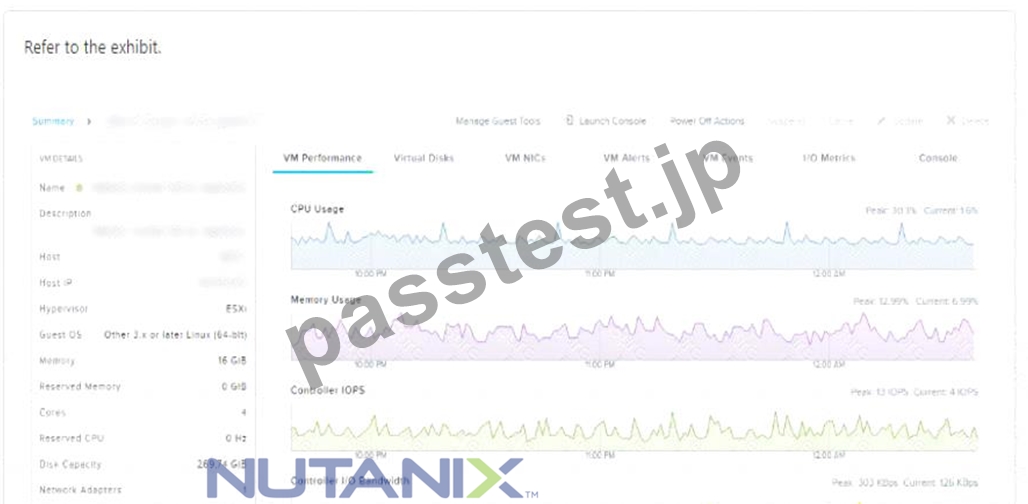
Which action would best improve VM performance?
- A. Add additional RAM to the host on which the VM is running.
- B. Disable hyperthreading in the BIOS.
- C. Ensure the host's CPUs ere not excessively overcommitted.
- D. Add additional RAM to the user VM.
正解:D
解説:
Prism Element is a graphical user interface that allows you to manage Nutanix clusters1. You can use Prism Element charts to understand Nutanix cluster workloads and troubleshoot performance related issues2.
memory optimized virtual machine sizes offer the best performance for SQL Server workloads on Azure VMs.
Adding more RAM to the user VM can help reduce paging and improve query execution times.
SQL Server performance can be affected by disk latency and throughput. By creating separate virtual disks for data and logs, you can spread activity across multiple spindles and reduce disk contention.
https://next.nutanix.com/how-it-works-22/differences-between-prism-element-prism-central-and-prism-pro-3713
質問 # 56
Which change can be made on a cluster with software-based Data-at-Rest Encryption enabled?
- A. Change Native KMS to External KMS
- B. Enable encryption for a VM
- C. Disable encryption on the cluster
- D. Deploy an additional Native KMS Server
正解:A
質問 # 57
What Nutanix feature provides effective caching optimization In VDI environments?
- A. Remote Protection Group
- B. Shadow Clones
- C. Snap Clones
- D. Local Protection Group
正解:B
解説:
Shadow Clones is a Nutanix feature that provides effective caching optimization in VDI environments. VDI stands for Virtual Desktop Infrastructure, which is a technology that allows users to access virtual desktops hosted on a centralized server. VDI environments typically have a high degree of similarity among desktop images, which means that many VMs access the same data blocks from the storage layer. Shadow Clones leverages this similarity by creating read-only copies of frequently accessed data blocks on each node's SSD tier, reducing network traffic and improving performance. Shadow Clones works automatically and transparently without any configuration or intervention from the administrator.
References: : [Fault Tolerance - Nutanix Bible] : [Block Awareness - Nutanix Bible] : [Block Awareness - Nutanix Support & Insights] : [Shadow Clones - Nutanix Bible] : [Shadow Clones - Nutanix Support & Insights] : [Shadow Clones - Nutanix Community]
質問 # 58
......
NCP-MCI-6.5正真正銘のベスト資料、オンライン練習試験:https://www.passtest.jp/Nutanix/NCP-MCI-6.5-shiken.html
優れもの良質なNCP-MCI-6.5問題集が待ってます:https://drive.google.com/open?id=1QRUD_Iva6axoYYhzXZDygWBAEXqJoSaV