

[2024年10月]更新のNutanix NCP-MCI-6.5試験一発合格保証!
完全版NCP-MCI-6.5練習テスト180独特な解答と解釈が待ってます!今すぐ取得せよ!
質問 # 65
Refer to exhibit:
Why has an anomaly been triggered?
- A. Controller reached 2500 IOPS.
- B. Normal Controller behavior has increased.
- C. Observed values do not match predicted values.
- D. Observed IOPS exceed normal values.
正解:C
解説:
Nutanix anomaly detection is a feature that monitors seasonal trends for time-series data (e.g. CPU usage, memory usage, latency, etc.) and establishes a "band" of expected values based on historical data12. Only values that hit outside the "band" will trigger an event / alert1.
Nutanix leverages a method for determining the bands called 'Generalized Extreme Studentized Deviate Test'. A simple way to think about this is similar to a confidence interval where the values are between the lower and upper limits established by the algorithm.
Another web source3 shows an example of how anomaly detection works in Nutanix Prism Central. In the video, you can see that when the observed value of a metric deviates significantly from the predicted value based on historical data, an anomaly event is triggered and displayed on a chart.
Therefore, by comparing the observed values with the predicted values based on historical data, Nutanix anomaly detection can identify abnormal behavior and alert you accordingly.
質問 # 66
A two-node ROBO cluster is configured with a witness VM.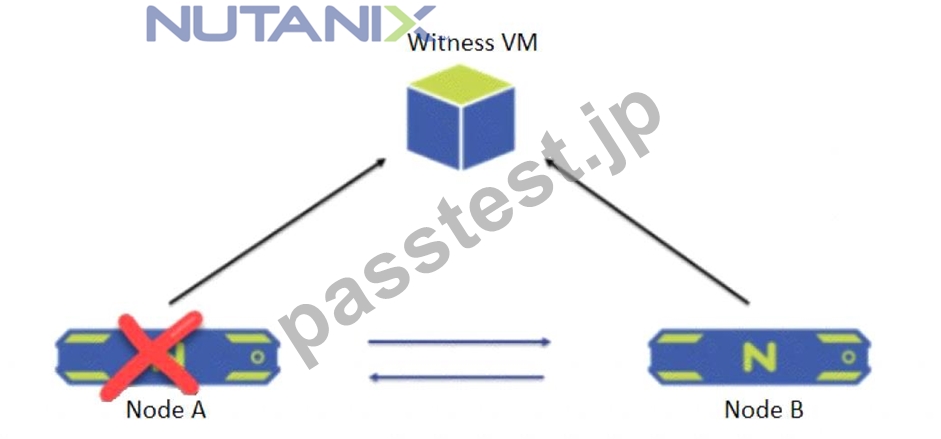
What happens when Node A goes down?
- A. Node B sends a leadership request to the Witness VM and goes into single-node mode.
- B. The cluster is unaffected and no administrator intervention is required.
- C. The- cluster becomes unavailable and goes into read-only mode.
- D. All operations and services on the Node B are shut down and go into a waiting state.
正解:A
質問 # 67
An administrator is implementing a VDI solution. The workload will be a series of persistent desktops in a dedicated storage container within a four-node cluster Storage optimizations should be set on the dedicated storage container to give optimal performance including during a node failure event Which storage optimizations should the administrator set to meet the requirements?
- A. Compressoion and Deduplication
- B. Deduplication and Erasure Coding
- C. Compression Deduplication and Erasure Coding
- D. Compression only
正解:C
解説:
According to the web search results, three storage optimizations that should be set on a dedicated storage container for a VDI solution with persistent desktops are compression, deduplication and erasure coding.
Compression is a technique that reduces the size of data by removing redundant information. Deduplication is a technique that eliminates duplicate copies of data blocks and stores only unique blocks. Erasure coding is a technique that increases usable capacity by reducing the replication factor of data blocks and using parity information instead7. These three optimizations can improve performance and save storage space for VDI workloads, especially during a node failure event when data needs to be rebuilt from parity information8. The administrator can enable these optimizations by using Prism Element web console or ncli command-line interface9.
質問 # 68
Refer to the exhibit.
The Linux Admin role has been created to manage only Linux VMs in the environment. However, the Admin1 user does not have access to all Linux VMs.
What step should be taken to grant the proper access?
- A. Add the proper category to each Linux VM.
- B. Add the role to the Linux images.
- C. Add the hosts to the entities KM for the role.
- D. Grant the admin1 user the viewer role (or the cluster.
正解:A
解説:
According to the Nutanix Prism Central Guide, role-based access control (RBAC) in Prism Central allows you to create custom roles and assign them to users or groups based on the categories of the entities they need to manage1. Categories are key-value pairs that you can assign to entities such as VMs, hosts, clusters, images, etc. to group them logically2. For example, you can create a category key called "OS" and assign values such as "Linux" or "Windows" to different VMs based on their operating system.
In the exhibit, the Linux Admin role has been created with the following settings:
* The role has the "VM Admin" permission, which allows the user to perform all actions on VMs3.
* The role has been assigned to the admin1 user.
* The role has been scoped to the entities that have the category key "OS" and the value "Linux".
However, the admin1 user does not have access to all Linux VMs in the environment. This means that some of the Linux VMs do not have the proper category assigned to them. To grant the proper access, the administrator should add the category key "OS" and the value "Linux" to each Linux VM that needs to be managed by the Linux Admin role. This can be done either individually or in bulk through Prism Central4. Once the categories are added, the admin1 user will be able to see and manage all Linux VMs in the environment.
質問 # 69
An administrator adds a node with older generation processors to an existing AHV cluster with newer generation processors. What is the effect on live migration?
- A. Live migration is prevented until the administrator enables the legacy migration option.
- B. Live migration of VMs is prevented between newer and older processors.
- C. Live migration is prevented until the administrator manually changes the newer processor level.
- D. Live migration continues to function as expected and VMs can move to any AHV host.
正解:B
解説:
According to the Migration to a different processor web search result2, live migration of VMs depends on the source and destination hosts having the same CPU functions (CPU flags). Live migration requires the source and destination hosts to have CPUs from the same manufacturer, and only CPU functions which both hosts support are provided (same CPU generation, or by using VMware Enhanced vMotion Compatibility (EVC)).
If the administrator adds a node with older generation processors to an existing AHV cluster with newer generation processors, then live migration of VMs is prevented between newer and older processors, unless EVC is enabled.
質問 # 70
Refer to the exhibit.
The Linux Admin role has been created to manage only Linux VMs in the environment. However, the Admin1 user does not have access to all Linux VMs.
What step should be taken to grant the proper access?
- A. Add the hosts to the entities KM for the role.
- B. Add the role to the Linux images.
- C. Grant the admin1 user the viewer role (or the cluster.
- D. Add the proper category to each Linux VM.
正解:A
質問 # 71
A user running a Computer Aided Design (CAD) application is complaining about slow response time within the VM, particular when moving windows or rendering images.
Which VM metric will guide the administrator toward diagnosing the problem?
- A. Storage Controller Latency
- B. Swap in Rate
- C. Hypervisor Memory Usage (%)
- D. GPU Usage
正解:D
解説:
A GPU (graphics processing unit) is a specialized hardware device that can accelerate graphics rendering and computation for applications that use APIs such as DirectX, OpenGL, CUDA, and OpenCL. A GPU can also offload the CPU from encoding and decoding tasks for remote display protocols such as Frame Remote Desktop Protocol (FRP). A VM can use a GPU either by directly accessing a physical GPU (pGPU) on the host or by using a virtual GPU (vGPU) that shares a pGPU with other VMs. A user running a computer aided design (CAD) application may benefit from using a GPU or a vGPU to improve the performance and responsiveness of the application, especially when moving windows or rendering images. However, if the GPU or vGPU is not properly configured or provisioned, the user may experience slow response time within the VM. Therefore, to diagnose the problem, the administrator should monitor the GPU Usage metric for the VM. The GPU Usage metric shows the percentage of GPU resources that are consumed by the VM over time3. The administrator can use Prism Central to view the GPU Usage metric for each VM in a chart or a widget4. The administrator can also use Prism Central to view other metrics related to GPU performance, such as GPU Memory Usage, GPU Encoder Usage, and GPU Decoder Usage3. By analyzing these metrics, the administrator can determine if the VM is using the GPU efficiently and optimally, or if it needs more or less GPU resources.
質問 # 72
Which data savings technique utilizes stripes and parity calculation in a Nutanix cluster?
- A. Erasure coding
- B. Parity strip
- C. Deduplication
- D. Compression
正解:A
解説:
According to the Nutanix Support & Insights web search result1, erasure coding is a data savings technique that utilizes stripes and parity calculation in a Nutanix cluster. Erasure coding increases the usable capacity on a cluster by reducing the replication factor of data blocks. Instead of replicating data, erasure coding uses parity information to rebuild data in the event of a disk or node failure. Erasure coding can save up to 50% of storage space compared to replication factor 2, and up to 75% compared to replication factor 32.
質問 # 73
An administrator would like to leverage the Reliable Event Logging Protocol (RELP) with their Remote Syslog Server. After completing the configuration, it is observed that RELP logging is not working as expected.
What is the likely cause of this issue?
- A. The remote server does not have rsyslog-relp installed.
- B. The Remote Syslog Server was configure using TCP as the protocol.
- C. The cluster does not have RELP installed.
- D. The GENESIS was the only one chosen to forward log information.
正解:A
質問 # 74
An administrator is configuring cross-hypervisor DR from an ESXi cluster to a new AHV cluster. When the administrator migrates a protection domain to the AHV cluster, the VMs fail to boot.
What should the administrator do to correct this problem?
- A. Uninstall VMware Tools from the VMs.
- B. Increase the snapshot frequency to more than 6 hours.
- C. Add all VMs into a single consistency group.
- D. Install Nutanix Guest Tools in the protected VMs.
正解:D
解説:
According to the web search results, one of the requirements for cross-hypervisor disaster recovery (CHDR) is to install and configure Nutanix Guest Tools (NGT) on all the VMs2. NGT configures the VM with all the required drivers for VM portability. Without NGT, the VMs may fail to boot after being migrated to a different hypervisor type.
質問 # 75
How should an administrator enable secure access to Volumes using a password?
- A. iSER
- B. CHAP
- C. LDAP
- D. SAML
正解:B
解説:
https://portal.nutanix.com/page/documents/details/?targetId=Web-Console-Guide-Prism-v50:wc-block-services-enabling-t.html Provision storage on the Nutanix cluster by creating a volume group. Create a client whitelist to enable access to the volume group by using the IP addresses or client initiator IQNs in a whitelist (as part of the volume group configuration). Create a secret for the volume group if you are using CHAP authentication.
質問 # 76
Which capability refers to the storage of VM data on the node where the VM is running and ensure that the read I/O does not have to traverse the network?
- A. Intelligent Locally
- B. Intelligent Tiering
- C. Data Locality
- D. Data Tiering
正解:C
質問 # 77
An administrator notices that most of the VMs in the cluster are on one host. Users report that an application seems to respond slowly. The application server VM has significantly more memory assigned to it than other VMs.
How should the administrator fix this issue?
- A. Add more memory to the VM.
- B. Reduce the amount of memory assigned to the VM.
- C. Migrate the VM to a different host.
- D. Increase the memory on the CVM.
正解:C
質問 # 78
An administrator needs to bring down a host in a Nutanix Cluster for maintenance reasons. The administratorputs the host in maintenance mode.
What should the administrator do to perform an orderly shutdown of the CVM?
- A. Execute the cvm_shutdown -P now command from the host.
- B. Execute the cvm_shutdown -P new command from the CVM.
- C. Enter Fever off Server - immediate from the IPMI console.
- D. Enter Fewer off Server-orderly Shutdown from the IPMI console.
正解:B
解説:
According to the How to use the cvm_shutdown script web search result3, the cvm_shutdown script signals HA when shutting down the CVM (Controller VM) to forward the storage traffic to another healthy CVM.
Instead of using sudo shutdown or sudo reboot commands, this script should be used to minimize I/O hits in user VMs running on the present hypervisor host. The cvm_shutdown -P now command will initiate the shutdown process on the CVM immediately. Therefore, if the administrator needs to perform an orderly shutdown of the CVM, they should execute this command from the CVM.
質問 # 79
Which two access protocols are supported by Files? (Choose two.)
- A. ISCSI
- B. FCOE
- C. SMB
- D. NFS
正解:C、D
質問 # 80
......
あなたの合格を助けるNutanix認証と最新のPassTest NCP-MCI-6.5試験問題集解答:https://drive.google.com/open?id=1_IaqD2vqej9pNvzk7T-Elj0g8r07Q5hf
最新NCP-MCI-6.5問題集試験解答はここにある:https://www.passtest.jp/Nutanix/NCP-MCI-6.5-shiken.html