

PassTest Professional-Machine-Learning-Engineer問題集でリアル試験問題でテストエンジン問題集でトレーニング
Google Professional-Machine-Learning-Engineerテスト問題集とオンライン試験エンジン
質問 # 38
Your company manages a video sharing website where users can watch and upload videos. You need to create an ML model to predict which newly uploaded videos will be the most popular so that those videos can be prioritized on your company's website. Which result should you use to determine whether the model is successful?
- A. The Pearson correlation coefficient between the log-transformed number of views after 7 days and 30 days after publication is equal to 0.
- B. The model predicts videos as popular if the user who uploads them has over 10,000 likes.
- C. The model predicts 97.5% of the most popular clickbait videos measured by number of clicks.
- D. The model predicts 95% of the most popular videos measured by watch time within 30 days of being uploaded.
正解:D
解説:
https://developers.google.com/machine-learning/problem-framing/framing#quantify-it
質問 # 39
You are going to train a DNN regression model with Keras APIs using this code: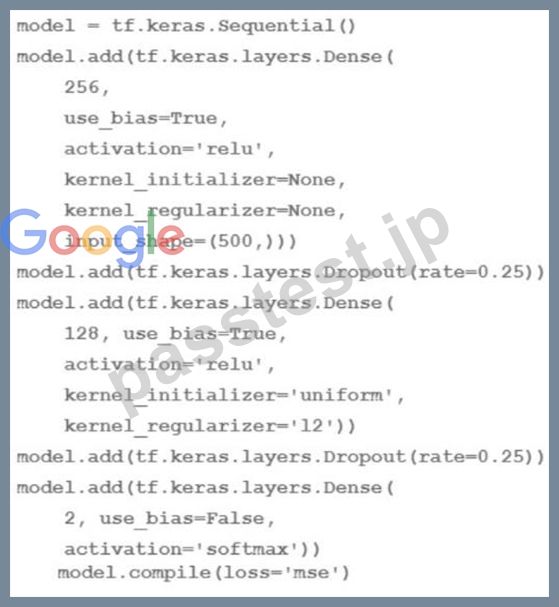
How many trainable weights does your model have? (The arithmetic below is correct.)
- A. 501*256+257*128+128*2=161408
- B. 500*256*0 25+256*128*0 25+128*2 = 40448
- C. 501*256+257*128+2 = 161154
- D. 500*256+256*128+128*2 = 161024
正解:B
質問 # 40
You work for a large technology company that wants to modernize their contact center. You have been asked to develop a solution to classify incoming calls by product so that requests can be more quickly routed to the correct support team. You have already transcribed the calls using the Speech-to-Text API. You want to minimize data preprocessing and development time. How should you build the model?
- A. Build a custom model to identify the product keywords from the transcribed calls, and then run the keywords through a classification algorithm
- B. Use AutoML Natural Language to extract custom entities for classification
- C. Use the Cloud Natural Language API to extract custom entities for classification
- D. Use the Al Platform Training built-in algorithms to create a custom model
正解:B
質問 # 41
You are training a TensorFlow model on a structured data set with 100 billion records stored in several CSV files. You need to improve the input/output execution performance. What should you do?
- A. Convert the CSV files into shards of TFRecords, and store the data in Cloud Storage
- B. Convert the CSV files into shards of TFRecords, and store the data in the Hadoop Distributed File System (HDFS)
- C. Load the data into Cloud Bigtable, and read the data from Bigtable
- D. Load the data into BigQuery and read the data from BigQuery.
正解:A
質問 # 42
You recently joined a machine learning team that will soon release a new project. As a lead on the project, you are asked to determine the production readiness of the ML components. The team has already tested features and data, model development, and infrastructure. Which additional readiness check should you recommend to the team?
- A. Ensure that feature expectations are captured in the schema
- B. Ensure that training is reproducible
- C. Ensure that all hyperparameters are tuned
- D. Ensure that model performance is monitored
正解:B
質問 # 43
You are an ML engineer on an agricultural research team working on a crop disease detection tool to detect leaf rust spots in images of crops to determine the presence of a disease. These spots, which can vary in shape and size, are correlated to the severity of the disease. You want to develop a solution that predicts the presence and severity of the disease with high accuracy. What should you do?
- A. Create an object detection model that can localize the rust spots.
- B. Develop an image classification ML model to predict the presence of the disease.
- C. Develop a template matching algorithm using traditional computer vision libraries.
- D. Develop an image segmentation ML model to locate the boundaries of the rust spots.
正解:D
質問 # 44
You manage a team of data scientists who use a cloud-based backend system to submit training jobs. This system has become very difficult to administer, and you want to use a managed service instead. The data scientists you work with use many different frameworks, including Keras, PyTorch, theano. Scikit-team, and custom libraries. What should you do?
- A. Create a library of VM images on Compute Engine; and publish these images on a centralized repository
- B. Configure Kubeflow to run on Google Kubernetes Engine and receive training jobs through TFJob
- C. Set up Slurm workload manager to receive jobs that can be scheduled to run on your cloud infrastructure.
- D. Use the Al Platform custom containers feature to receive training jobs using any framework
正解:C
質問 # 45
Your data science team needs to rapidly experiment with various features, model architectures, and hyperparameters. They need to track the accuracy metrics for various experiments and use an API to query the metrics over time. What should they use to track and report their experiments while minimizing manual effort?
- A. Use Kubeflow Pipelines to execute the experiments Export the metrics file, and query the results using the Kubeflow Pipelines API.
- B. Use Al Platform Training to execute the experiments Write the accuracy metrics to Cloud Monitoring, and query the results using the Monitoring API.
- C. Use Al Platform Notebooks to execute the experiments. Collect the results in a shared Google Sheets file, and query the results using the Google Sheets API
- D. Use Al Platform Training to execute the experiments Write the accuracy metrics to BigQuery, and query the results using the BigQueryAPI.
正解:D
質問 # 46
You lead a data science team at a large international corporation. Most of the models your team trains are large-scale models using high-level TensorFlow APIs on AI Platform with GPUs. Your team usually takes a few weeks or months to iterate on a new version of a model. You were recently asked to review your team's spending. How should you reduce your Google Cloud compute costs without impacting the model's performance?
- A. Use AI Platform to run distributed training jobs with checkpoints.
- B. Migrate to training with Kuberflow on Google Kubernetes Engine, and use preemptible VMs with checkpoints.
- C. Migrate to training with Kuberflow on Google Kubernetes Engine, and use preemptible VMs without checkpoints.
- D. Use AI Platform to run distributed training jobs without checkpoints.
正解:C
質問 # 47
A real estate company wants to create a machine learning model for predicting housing prices based on a historical dataset. The dataset contains 32 features.
Which model will meet the business requirement?
- A. K-means
- B. Logistic regression
- C. Linear regression
- D. Principal component analysis (PCA)
正解:C
質問 # 48
You are training a deep learning model for semantic image segmentation with reduced training time. While using a Deep Learning VM Image, you receive the following error: The resource 'projects/deeplearning-platforn/zones/europe-west4-c/acceleratorTypes/nvidia-tesla-k80' was not found. What should you do?
- A. Ensure that you have preemptible GPU quota in the selected region.
- B. Ensure that the required GPU is available in the selected region.
- C. Ensure that you have GPU quota in the selected region.
- D. Ensure that the selected GPU has enough GPU memory for the workload.
正解:C
質問 # 49
A credit card company wants to build a credit scoring model to help predict whether a new credit card applicant will default on a credit card payment. The company has collected data from a large number of sources with thousands of raw attributes. Early experiments to train a classification model revealed that many attributes are highly correlated, the large number of features slows down the training speed significantly, and that there are some overfitting issues.
The Data Scientist on this project would like to speed up the model training time without losing a lot of information from the original dataset.
Which feature engineering technique should the Data Scientist use to meet the objectives?
- A. Run self-correlation on all features and remove highly correlated features
- B. Use an autoencoder or principal component analysis (PCA) to replace original features with new features
- C. Normalize all numerical values to be between 0 and 1
- D. Cluster raw data using k-means and use sample data from each cluster to build a new dataset
正解:C
質問 # 50
You have been asked to develop an input pipeline for an ML training model that processes images from disparate sources at a low latency. You discover that your input data does not fit in memory. How should you create a dataset following Google-recommended best practices?
- A. Create a tf.data.Dataset.prefetch transformation
- B. Convert the images Into TFRecords, store the images in Cloud Storage, and then use the tf. data API to read the images for training
- C. Convert the images to tf .Tensor Objects, and then run tf. data. Dataset. from_tensors ().
- D. Convert the images to tf .Tensor Objects, and then run Dataset. from_tensor_slices{).
正解:B
解説:
Cite from Google Pag: to construct a Dataset from data in memory, use tf.data.Dataset.from_tensors() or tf.data.Dataset.from_tensor_slices(). When input data is stored in a file (not in memory), the recommended TFRecord format, you can use tf.data.TFRecordDataset(). tf.data.Dataset is for data in memory. tf.data.TFRecordDataset is for data in non-memory storage.
https://cloud.google.com/architecture/ml-on-gcp-best-practices#store-image-video-audio-and-unstructured-data-on-cloud-storage
" Store image, video, audio and unstructured data on Cloud Storage Store these data in large container formats on Cloud Storage. This applies to sharded TFRecord files if you're using TensorFlow, or Avro files if you're using any other framework. Combine many individual images, videos, or audio clips into large files, as this will improve your read and write throughput to Cloud Storage. Aim for files of at least 100mb, and between 100 and 10,000 shards. To enable data management, use Cloud Storage buckets and directories to group the shards. "
質問 # 51
You are training an LSTM-based model on Al Platform to summarize text using the following job submission script: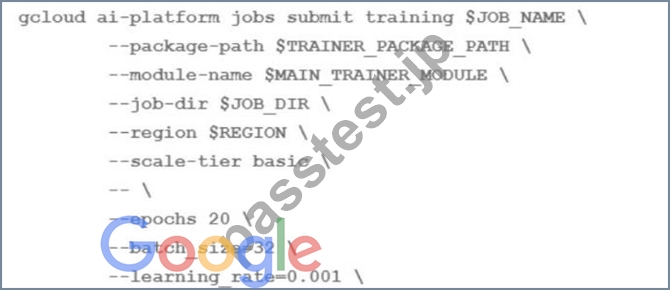
You want to ensure that training time is minimized without significantly compromising the accuracy of your model. What should you do?
- A. Modify the 'scale-tier' parameter
- B. Modify the 'epochs' parameter
- C. Modify the batch size' parameter
- D. Modify the 'learning rate' parameter
正解:C
質問 # 52
Your data science team has requested a system that supports scheduled model retraining, Docker containers, and a service that supports autoscaling and monitoring for online prediction requests. Which platform components should you choose for this system?
- A. Vertex AI Pipelines, Vertex AI Prediction, and Vertex AI Model Monitoring
- B. Vertex AI Pipelines and App Engine
- C. Cloud Composer, BigQuery ML, and Vertex AI Prediction
- D. Cloud Composer, Vertex AI Training with custom containers, and App Engine
正解:B
質問 # 53
Your team has been tasked with creating an ML solution in Google Cloud to classify support requests for one of your platforms. You analyzed the requirements and decided to use TensorFlow to build the classifier so that you have full control of the model's code, serving, and deployment. You will use Kubeflow pipelines for the ML platform. To save time, you want to build on existing resources and use managed services instead of building a completely new model. How should you build the classifier?
- A. Use AutoML Natural Language to build the support requests classifier
- B. Use the Natural Language API to classify support requests
- C. Use an established text classification model on Al Platform as-is to classify support requests
- D. Use an established text classification model on Al Platform to perform transfer learning
正解:D
解説:
the model cannot work as-is as the classes to predict will likely not be the same; we need to use transfer learning to retrain the last layer and adapt it to the classes we need
質問 # 54
You are designing an ML recommendation model for shoppers on your company's ecommerce website. You will use Recommendations Al to build, test, and deploy your system. How should you develop recommendations that increase revenue while following best practices?
- A. Because it will take time to collect and record product data, use placeholder values for the product catalog to test the viability of the model.
- B. Use the "Other Products You May Like" recommendation type to increase the click-through rate
- C. Use the "Frequently Bought Together' recommendation type to increase the shopping cart size for each order.
- D. Import your user events and then your product catalog to make sure you have the highest quality event stream
正解:C
解説:
Frequently bought together' recommendations aim to up-sell and cross-sell customers by providing product.
質問 # 55
You built and manage a production system that is responsible for predicting sales numbers. Model accuracy is crucial, because the production model is required to keep up with market changes. Since being deployed to production, the model hasn't changed; however the accuracy of the model has steadily deteriorated. What issue is most likely causing the steady decline in model accuracy?
- A. Poor data quality
- B. Lack of model retraining
- C. Too few layers in the model for capturing information
- D. Incorrect data split ratio during model training, evaluation, validation, and test
正解:D
質問 # 56
You developed an ML model with Al Platform, and you want to move it to production. You serve a few thousand queries per second and are experiencing latency issues. Incoming requests are served by a load balancer that distributes them across multiple Kubeflow CPU-only pods running on Google Kubernetes Engine (GKE). Your goal is to improve the serving latency without changing the underlying infrastructure. What should you do?
- A. Switch to the tensorflow-model-server-universal version of TensorFlow Serving
- B. Significantly increase the max_batch_size TensorFlow Serving parameter
- C. Recompile TensorFlow Serving using the source to support CPU-specific optimizations Instruct GKE to choose an appropriate baseline minimum CPU platform for serving nodes
- D. Significantly increase the max_enqueued_batches TensorFlow Serving parameter
正解:B
質問 # 57
You are building an ML model to detect anomalies in real-time sensor dat a. You will use Pub/Sub to handle incoming requests. You want to store the results for analytics and visualization. How should you configure the pipeline?
- A. 1 = BigQuery, 2 = Al Platform, 3 = Cloud Storage
- B. 1 = DataProc, 2 = AutoML, 3 = Cloud Bigtable
- C. 1 = BigQuery, 2 = AutoML, 3 = Cloud Functions
- D. 1 = Dataflow, 2 - Al Platform, 3 = BigQuery
正解:C
質問 # 58
You are working on a classification problem with time series data and achieved an area under the receiver operating characteristic curve (AUC ROC) value of 99% for training data after just a few experiments. You haven't explored using any sophisticated algorithms or spent any time on hyperparameter tuning. What should your next step be to identify and fix the problem?
- A. Address the model overfitting by tuning the hyperparameters to reduce the AUC ROC value.
- B. Address data leakage by applying nested cross-validation during model training.
- C. Address data leakage by removing features highly correlated with the target value.
- D. Address the model overfitting by using a less complex algorithm.
正解:B
解説:
https://towardsdatascience.com/time-series-nested-cross-validation-76adba623eb9
質問 # 59
You have trained a text classification model in TensorFlow using Al Platform. You want to use the trained model for batch predictions on text data stored in BigQuery while minimizing computational overhead. What should you do?
- A. Use Dataflow with the SavedModel to read the data from BigQuery
- B. Export the model to BigQuery ML.
- C. Submit a batch prediction job on Al Platform that points to the model location in Cloud Storage.
- D. Deploy and version the model on Al Platform.
正解:B
解説:
https://cloud.google.com/bigquery-ml/docs/making-predictions-with-imported-tensorflow-models
https://cloud.google.com/bigquery-ml/docs/making-predictions-with-imported-tensorflow-models#importing_models
https://cloud.google.com/bigquery-ml/docs/making-predictions-with-imported-tensorflow-models#bq CREATE OR REPLACE MODEL example_dataset.imported_tf_model OPTIONS (MODEL_TYPE='TENSORFLOW', MODEL_PATH='gs://cloud-training-demos/txtclass/export/exporter/1549825580/*')
質問 # 60
......
Google Professional Machine Learning Engineer試験は、機械学習の分野で働く個人のスキルと知識を検証するGoogle Cloudによって提供される認定です。この試験は、Google Cloudテクノロジーを使用して、スケーラブルに機械学習モデルを設計、構築、展開できる能力をテストするために設計されています。この試験は、本番環境で機械学習アルゴリズムを扱い、実装する専門家である経験豊富な機械学習エンジニアを対象としています。
Google Professional Machine Learning Engineer認定試験は、機械学習エンジニアリング分野の知識とスキルを評価する包括的な評価です。この認定試験は、プログラミング、統計学、データ分析に強いバックグラウンドを持ち、人工知能と機械学習の分野でキャリアを進めたいと考えている個人を対象としています。
Google Professional-Machine-Learning-Engineer問題を提供していますGoogle Cloud Certified問題集と完璧な解答付き:https://www.passtest.jp/Google/Professional-Machine-Learning-Engineer-shiken.html
信頼され続けるProfessional-Machine-Learning-Engineer試験のコツとPDF試験材料:https://drive.google.com/open?id=1ix2Xgee9pbkGa9P-ZOyoMmzAZKa84RI5