

PDFを無料でダウンロードにはProfessional-Machine-Learning-Engineer有効な練習テスト問題があります
Professional-Machine-Learning-Engineerテストエンジンお試しセット、Professional-Machine-Learning-Engineer問題集PDF
Google Professional Machine Learning Engineer 認定試験に合格するためには、ソフトウェアエンジニアリング、データモデリング、統計学に関する強力なバックグラウンドが必要です。また、TensorFlowやPyTorchなどの機械学習フレームワークでの実務経験が必要であり、Google Cloud Platformなどのクラウドコンピューティングプラットフォームにも精通している必要があります。
Googleのプロフェッショナル機械学習エンジニア試験は、多肢選択問題とシナリオベースの問題の組み合わせになっています。この試験は、データ準備、モデルトレーニングと評価、最適化技術、展開戦略など、幅広いトピックをカバーしています。候補者は、TensorFlow、Keras、Scikit-learnをはじめとするさまざまなツールやフレームワークを使用して機械学習モデルを設計、構築、展開する能力を証明する必要があります。この試験に合格するには、機械学習の概念を徹底的に理解し、機械学習ソリューションを設計、実装する実務経験が必要です。
Google Professional Machine Learning Engineer認定試験は、Googleクラウドプラットフォームでスケーラブルで効率的な機械学習モデルの設計、構築、展開に習熟したいと考えている機械学習エンジニア、データサイエンティスト、ソフトウェアエンジニアにとって貴重な資格です。認定試験に合格することにより、候補者は仲間と区別し、機械学習の分野での専門知識を実証することができます。
質問 # 72
You work for an international manufacturing organization that ships scientific products all over the world Instruction manuals for these products need to be translated to 15 different languages Your organization's leadership team wants to start using machine learning to reduce the cost of manual human translations and increase translation speed. You need to implement a scalable solution that maximizes accuracy and minimizes operational overhead. You also want to include a process to evaluate and fix incorrect translations. What should you do?
- A. Create a Vertex Al pipeline that processes the documents1 launches an AutoML Translation training job evaluates the translations, and deploys the model to a Vertex Al endpoint with autoscaling and model monitoring When there is a predetermined skew between training and live data re-trigger the pipeline with the latest data.
- B. Create a workflow using Cloud Function Triggers Configure a Cloud Function that is triggered when documents are uploaded to an input Cloud Storage bucket Configure another Cloud Function that translates the documents using the Cloud Translation API and saves the translations to an output Cloud Storage bucket Use human reviewers to evaluate the incorrect translations.
- C. Use AutoML Translation to tram a model Configure a Translation Hub project and use the trained model to translate the documents Use human reviewers to evaluate the incorrect translations
- D. Use Vertex Al custom training jobs to fine-tune a state-of-the-art open source pretrained model with your data Deploy the model to a Vertex Al endpoint with autoscaling and model monitoring When there is a predetermined skew between the training and live data, configure a trigger to run another training job with the latest data.
正解:C
解説:
AutoML Translation is a service that allows you to create and train custom ML models for translating text between different languages. You can use AutoML Translation to train a model that can translate instruction manuals for scientific products to 15 different languages. You can also use Translation Hub to configure a project and use the trained model to translate the documents. Translation Hub is a service that allows you to manage and automate your translation workflows on Google Cloud. You can use Translation Hub to upload the documents to a Cloud Storage bucket, select the source and target languages, and apply the trained model to translate the documents. You can also use Translation Hub to download the translated documents or save them to another Cloud Storage bucket. You can also use human reviewers to evaluate the incorrect translations. Human reviewers are peoplewho can review and correct the translations produced by the ML model. You can use human reviewers to improve the quality and accuracy of the translations, and provide feedback to the ML model. You can use Translation Hub to integrate with third-party human review services, such as Google Translate Community or Appen. By using AutoML Translation, Translation Hub, and human reviewers, you can implement a scalable solution that maximizes accuracy and minimizes operational overhead. You can also include a process to evaluate and fix incorrect translations. References:
* [AutoML Translation documentation]
* [Translation Hub documentation]
* [Preparing for Google Cloud Certification: Machine Learning Engineer Professional Certificate]
質問 # 73
You want to migrate a scikrt-learn classifier model to TensorFlow. You plan to train the TensorFlow classifier model using the same training set that was used to train the scikit-learn model and then compare the performances using a common test set. You want to use the Vertex Al Python SDK to manually log the evaluation metrics of each model and compare them based on their F1 scores and confusion matrices. How should you log the metrics?
- A.

- B.

- C.

- D.

正解:C
解説:
To log the metrics of a machine learning model in TensorFlow using the Vertex AI Python SDK, you should utilize the aiplatform.log_metrics function to log the F1 score and aiplatform.log_classification_metrics function to log the confusion matrix. These functions allow users to manually record and store evaluation metrics for each model, facilitating an efficient comparison based on specific performance indicators like F1 scores and confusion matrices. References: The answer can be verified from official Google Cloud documentation and resources related to Vertex AI and TensorFlow.
* Vertex AI Python SDK reference | Google Cloud
* Logging custom metrics | Vertex AI
* Migrating from scikit-learn to TensorFlow | TensorFlow
質問 # 74
You developed a Transformer model in TensorFlow to translate text Your training data includes millions of documents in a Cloud Storage bucket. You plan to use distributed training to reduce training time. You need to configure the training job while minimizing the effort required to modify code and to manage the clusters configuration. What should you do?
- A. Create a Vertex Al custom training job with GPU accelerators for the second worker pool Use tf
.distribute.MultiWorkerMirroredStrategy for distribution. - B. Create a Vertex Al custom distributed training job with Reduction Server Use N1 high-memory machine type instances for the first and second pools, and use N1 high-CPU machine type instances for the third worker pool.
- C. Create a training job that uses Cloud TPU VMs Use tf.distribute.TPUStrategy for distribution.
- D. Create a Vertex Al custom training job with a single worker pool of A2 GPU machine type instances Use tf .distribute.MirroredStraregy for distribution.
正解:C
解説:
According to the official exam guide1, one of the skills assessed in the exam is to "configure and optimize model training jobs". Cloud TPU VMs2 are a new way to access Cloud TPUs directly on the TPU host machines, offering a simpler and more flexible user experience. Cloud TPU VMs are optimized for ML model training and can reduce training time and cost. You can use Cloud TPU VMs to train Transformer models in TensorFlow by using the tf.distribute.TPUStrategy3, which handles the distribution of computations across the TPU cores. The other options are not relevant or optimal for this scenario. References:
* Professional ML Engineer Exam Guide
* Cloud TPU VMs
* Distributed training with TPUStrategy
* Google Professional Machine Learning Certification Exam 2023
* Latest Google Professional Machine Learning Engineer Actual Free Exam Questions
質問 # 75
You work for a magazine publisher and have been tasked with predicting whether customers will cancel their annual subscription. In your exploratory data analysis, you find that 90% of individuals renew their subscription every year, and only 10% of individuals cancel their subscription. After training a NN Classifier, your model predicts those who cancel their subscription with 99% accuracy and predicts those who renew their subscription with 82% accuracy. How should you interpret these results?
- A. This is not a good result because the model should have a higher accuracy for those who renew their subscription than for those who cancel their subscription.
- B. This is a good result because the accuracy across both groups is greater than 80%.
- C. This is not a good result because the model is performing worse than predicting that people will always renew their subscription.
- D. This is a good result because predicting those who cancel their subscription is more difficult, since there is less data for this group.
正解:C
解説:
This is not a good result because the model is performing worse than predicting that people will always renew their subscription. This option has the following reasons:
* It indicates that the model is not learning from the data, but rather memorizing the majority class. Since
90% of the individuals renew their subscription every year, the model can achieve a 90% accuracy by simply predicting that everyone will renew their subscription, without considering the features or the patterns in the data. However, the model's accuracy for predicting those who renew their subscription is only 82%, which is lower than the baseline accuracy of 90%. This suggests that the model is overfitting to the minority class (those who cancel their subscription), and underfitting to the majority class (those who renew their subscription).
* It implies that the model is not useful for the business problem, as it cannot identify the customers who are at risk of churning. The goal of predicting whether customers will cancel their annual subscription is to prevent customer churn and increase customer retention. However, the model's accuracy for predicting those who cancel their subscription is 99%, which is too high and unrealistic, as it means that the model can almost perfectly identify the customers who will churn, without any false positives or false negatives. This may indicate that the model is cheating or exploiting some leakage in the data, such as a feature that reveals the outcome of the prediction. Moreover, the model's accuracy for predicting those who renew their subscription is 82%, which is too low and unreliable, as it means that the model can miss many customers who will churn, and falsely label them as renewing customers. This can lead to losing customers and revenue, and failing to take proactive actions to retain them.
References:
* How to Evaluate Machine Learning Models: Classification Metrics | Machine Learning Mastery
* Imbalanced Classification: Predicting Subscription Churn | Machine Learning Mastery
質問 # 76
You work for a gaming company that has millions of customers around the world. All games offer a chat feature that allows players to communicate with each other in real time. Messages can be typed in more than 20 languages and are translated in real time using the Cloud Translation API. You have been asked to build an ML system to moderate the chat in real time while assuring that the performance is uniform across the various languages and without changing the serving infrastructure.
You trained your first model using an in-house word2vec model for embedding the chat messages translated by the Cloud Translation API. However, the model has significant differences in performance across the different languages. How should you improve it?
- A. Remove moderation for languages for which the false positive rate is too high.
- B. Add a regularization term such as the Min-Diff algorithm to the loss function.
- C. Train a classifier using the chat messages in their original language.
- D. Replace the in-house word2vec with GPT-3 or T5.
正解:A
質問 # 77
You work for a large retailer and you need to build a model to predict customer churn. The company has a dataset of historical customer data, including customer demographics, purchase history, and website activity.
You need to create the model in BigQuery ML and thoroughly evaluate its performance. What should you do?
- A. Create a linear regression model in BigQuery ML Use the ml. evaluate function to evaluate the model performance.
- B. Create a linear regression model in BigQuery ML and register the model in Vertex Al Model Registry Evaluate the model performance in Vertex Al.
- C. Create a logistic regression model in BigQuery ML and register the model in Vertex Al Model Registry.
Evaluate the model performance in Vertex Al. - D. Create a logistic regression model in BigQuery ML Use the ml.confusion_matrix function to evaluate the model performance.
正解:C
解説:
Customer churn is a binary classification problem, where the target variable is whether a customer has churned or not. Therefore, a logistic regression model is more suitable than a linear regression model, which is used for regression problems. A logistic regression model can output the probability of a customer churning, which can be used to rank the customers by their churn risk and take appropriate actions1.
BigQuery ML is a service that allows you to create and execute machine learning models in BigQuery using standard SQL queries2. You can use BigQuery ML to create a logistic regression model for customer churn prediction by using the CREATE MODEL statement and specifying the LOGISTIC_REG model type3. You can use the historical customer data as the input table for the model, and specify the features and the label columns3.
Vertex AI Model Registry is a central repository where you can manage the lifecycle of your ML models4. You can import models from various sources, such as BigQuery ML, AutoML, or custom models, and assign them to different versions and aliases4. You can also deploy models to endpoints, which are resources that provide a service URL for online prediction.
By registering the BigQuery ML model in Vertex AI Model Registry, you can leverage the Vertex AI features to evaluate and monitor the model performance4. You can use Vertex AI Experiments to track and compare the metrics of different model versions, such as accuracy, precision, recall, and AUC. You can also use Vertex AI Explainable AI to generate feature attributions that show how much each input feature contributed to the model's prediction.
The other options are not suitable for your scenario, because they either use the wrong model type, such as linear regression, or they do not use Vertex AI to evaluate the model performance, which would limit the insights and actions you can take based on the model results.
References:
* Logistic Regression for Machine Learning
* Introduction to BigQuery ML | Google Cloud
* Creating a logistic regression model | BigQuery ML | Google Cloud
* Introduction to Vertex AI Model Registry | Google Cloud
* [Deploy a model to an endpoint | Vertex AI | Google Cloud]
* [Vertex AI Experiments | Google Cloud]
質問 # 78
As the lead ML Engineer for your company, you are responsible for building ML models to digitize scanned customer forms. You have developed a TensorFlow model that converts the scanned images into text and stores them in Cloud Storage. You need to use your ML model on the aggregated data collected at the end of each day with minimal manual intervention. What should you do?
- A. Use the batch prediction functionality of Al Platform
- B. Create a serving pipeline in Compute Engine for prediction
- C. Deploy the model on Al Platform and create a version of it for online inference.
- D. Use Cloud Functions for prediction each time a new data point is ingested
正解:A
解説:
https://cloud.google.com/ai-platform/prediction/docs/batch-predict
質問 # 79
A Data Scientist is developing a machine learning model to predict future patient outcomes based on information collected about each patient and their treatment plans. The model should output a continuous value as its prediction. The data available includes labeled outcomes for a set of 4,000 patients. The study was conducted on a group of individuals over the age of 65 who have a particular disease that is known to worsen with age.
Initial models have performed poorly. While reviewing the underlying data, the Data Scientist notices that, out of 4,000 patient observations, there are 450 where the patient age has been input as 0. The other features for these observations appear normal compared to the rest of the sample population How should the Data Scientist correct this issue?
- A. Replace the age field value for records with a value of 0 with the mean or median value from the dataset
- B. Drop all records from the dataset where age has been set to 0.
- C. Drop the age feature from the dataset and train the model using the rest of the features.
- D. Use k-means clustering to handle missing features
正解:B
解説:
Explanation
質問 # 80
A Data Scientist is working on an application that performs sentiment analysis. The validation accuracy is poor, and the Data Scientist thinks that the cause may be a rich vocabulary and a low average frequency of words in the dataset.
Which tool should be used to improve the validation accuracy?
- A. Amazon Comprehend syntax analysis and entity detection
- B. Natural Language Toolkit (NLTK) stemming and stop word removal
- C. Amazon SageMaker BlazingText cbowmode
- D. Scikit-leam term frequency-inverse document frequency (TF-IDF) vectorizer
正解:D
解説:
Explanation/Reference: https://monkeylearn.com/sentiment-analysis/
質問 # 81
Your team trained and tested a DNN regression model with good results. Six months after deployment, the model is performing poorly due to a change in the distribution of the input dat a. How should you address the input differences in production?
- A. Create alerts to monitor for skew, and retrain the model.
- B. Perform feature selection on the model, and retrain the model with fewer features
- C. Perform feature selection on the model, and retrain the model on a monthly basis with fewer features
- D. Retrain the model, and select an L2 regularization parameter with a hyperparameter tuning service
正解:D
質問 # 82
Your company manages an application that aggregates news articles from many different online sources and sends them to users. You need to build a recommendation model that will suggest articles to readers that are similar to the articles they are currently reading. Which approach should you use?
- A. Manually label a few hundred articles, and then train an SVM classifier based on the manually classified articles that categorizes additional articles into their respective categories.
- B. Encode all articles into vectors using word2vec, and build a model that returns articles based on vector similarity.
- C. Build a logistic regression model for each user that predicts whether an article should be recommended to a user.
- D. Create a collaborative filtering system that recommends articles to a user based on the user's past behavior.
正解:B
解説:
* Option A is incorrect because creating a collaborative filtering system that recommends articles to a user based on the user's past behavior is not the best approach to suggest articles that are similar to the articles they are currently reading. Collaborative filtering is a method of recommendation that uses the ratings or preferences of other users to predict the preferences of a target user1. However, this method does not consider the content or features of the articles, and may not be able to find articles that are similar in terms of topic, style, or sentiment.
* Option B is correct because encoding all articles into vectors using word2vec, and building a model that returns articles based on vector similarity is a suitable approach to suggest articles that are similar to the
* articles they are currently reading. Word2vec is a technique that learns low-dimensional and dense representations of words from a large corpus of text, such that words that are semantically similar have similar vectors2. By applying word2vec to the articles, we can obtain vector representations of the articles that capture their meaning and usage. Then, we can use a similarity measure, such as cosine similarity, to find articles that have similar vectors to the current article3.
* Option C is incorrect because building a logistic regression model for each user that predicts whether an article should be recommended to a user is not a feasible approach to suggest articles that are similar to the articles they are currently reading. Logistic regression is a supervised learning method that models the probability of a binary outcome (such as recommend or not) based on some input features (such as user profile or article content)4. However, this method requires a large amount of labeled data for each user, which may not be available or scalable. Moreover, this method does not directly measure the similarity between articles, but rather the likelihood of a user's preference.
* Option D is incorrect because manually labeling a few hundred articles, and then training an SVM classifier based on the manually classified articles that categorizes additional articles into their respective categories is not an effective approach to suggest articles that are similar to the articles they are currently reading. SVM (support vector machine) is a supervised learning method that finds a hyperplane that separates the data into different classes (such as news categories) with the maximum margin5. However, this method also requires a large amount of labeled data, which may be costly and time-consuming to obtain. Moreover, this method does not account for the fine-grained similarity between articles within the same category, or the cross-category similarity between articles from different categories.
References:
* Collaborative filtering
* Word2vec
* Cosine similarity
* Logistic regression
* SVM
質問 # 83
A monitoring service generates 1 TB of scale metrics record data every minute. A Research team performs queries on this data using Amazon Athena. The queries run slowly due to the large volume of data, and the team requires better performance.
How should the records be stored in Amazon S3 to improve query performance?
- A. Parquet files
- B. CSV files
- C. RecordIO
- D. Compressed JSON
正解:A
質問 # 84
You received a training-serving skew alert from a Vertex Al Model Monitoring job running in production.
You retrained the model with more recent training data, and deployed it back to the Vertex Al endpoint but you are still receiving the same alert. What should you do?
- A. Temporarily disable the alert Enable the alert again after a sufficient amount of new production traffic has passed through the Vertex Al endpoint.
- B. Update the model monitoring job to use a lower sampling rate.
- C. Temporarily disable the alert until the model can be retrained again on newer training data Retrain the model again after a sufficient amount of new production traffic has passed through the Vertex Al endpoint
- D. Update the model monitoring job to use the more recent training data that was used to retrain the model.
正解:D
解説:
The best option for resolving the training-serving skew alert is to update the model monitoring job to use the more recent training data that was used to retrain the model. This option can help align the baseline distribution of the model monitoring job with the current distribution of the production data, and eliminate the false positive alerts. Model Monitoring is a service that can track and compare the results of multiple machine learning runs. Model Monitoring can monitor the model's prediction input data for feature skew and drift.
Training-serving skew occurs when the feature data distribution in production deviates from the feature data distribution used to train the model. If the original training data is available, you can enable skew detection to monitor your models for training-serving skew. Model Monitoring uses TensorFlow Data Validation (TFDV) to calculate the distributions and distance scores for each feature, and compares them with a baseline distribution. The baseline distribution is the statistical distribution of the feature's values in the training data. If the distance score for a feature exceeds an alerting threshold that you set, Model Monitoring sends you an email alert. However, if you retrain the model with more recent training data, and deploy it back to the Vertex AI endpoint, the baseline distribution of the model monitoring job may become outdated and inconsistent with the current distribution of the production data. This can cause the model monitoring job to generate false positive alerts, even if the model performance is not deteriorated. To avoid this problem, you need to update the model monitoring job to use the more recent training data that was used to retrain the model. This can help the model monitoring job to recalculate the baseline distribution and the distance scores, and compare them with the current distribution of the production data. This can also help the model monitoring job to detect any true positive alerts, such as a sudden change in the production data that causes the model performance to degrade1.
The other options are not as good as option B, for the following reasons:
* Option A: Updating the model monitoring job to use a lower sampling rate would not resolve the training-serving skew alert, and could reduce the accuracy and reliability of the model monitoring job.
The sampling rate is a parameter that determines the percentage of prediction requests that are logged and analyzed by the model monitoring job. Using a lower sampling rate can reduce the storage and computation costs of the model monitoring job, but also the quality and validity of the data. Using a lower sampling rate can introduce sampling bias and noise into the data, and make the model monitoring job miss some important features or patterns of the data. Moreover, using a lower sampling rate would not address the root cause of the training-serving skew alert, which is the mismatch between the baseline distribution and the current distribution of the production data2.
* Option C: Temporarily disabling the alert, and enabling the alert again after a sufficient amount of new production traffic has passed through the Vertex AI endpoint, would not resolve the training-serving skew alert, and could expose the model to potential risks and errors. Disabling the alert would stop the model monitoring job from sending email notifications when the distance score for a feature exceeds the alerting threshold, but it would not stop the model monitoring job from calculating and comparing the distributions and distance scores. Therefore, disabling the alert would not address the root cause of the training-serving skew alert, which is the mismatch between the baseline distribution and the current distribution of the production data. Moreover, disabling the alert would prevent the model monitoring job from detecting any true positive alerts, such as a sudden change in the production data that causes the model performance to degrade. This can expose the model to potential risks and errors, and affect the user satisfaction and trust1.
* Option D: Temporarily disabling the alert until the model can be retrained again on newer training data, and retraining the model again after a sufficient amount of new production traffic has passed through the Vertex AI endpoint, would not resolve the training-serving skew alert, and could cause unnecessary costs and efforts. Disabling the alert would stop the model monitoring job from sending email notifications when the distance score for a feature exceeds the alerting threshold, but it would not stop the model monitoring job from calculating and comparing the distributions and distance scores.
Therefore, disabling the alert would not address the root cause of the training-serving skew alert, which is the mismatch between the baseline distribution and the current distribution of the production data.
Moreover, disabling the alert would prevent the model monitoring job from detecting any true positive alerts, such as a sudden change in the production data that causes the model performance to degrade.
This can expose the model to potential risks and errors, and affect the user satisfaction and trust.
Retraining the model again on newer training data would create a new model version, but it would not
* update the model monitoring job to use the newer training data as the baseline distribution. Therefore, retraining the model again on newer training data would not resolve the training-serving skew alert, and could cause unnecessary costs and efforts1.
References:
* Preparing for Google Cloud Certification: Machine Learning Engineer, Course 3: Production ML Systems, Week 4: Evaluation
* Google Cloud Professional Machine Learning Engineer Exam Guide, Section 3: Scaling ML models in production, 3.3 Monitoring ML models in production
* Official Google Cloud Certified Professional Machine Learning Engineer Study Guide, Chapter 6:
Production ML Systems, Section 6.3: Monitoring ML Models
* Using Model Monitoring
* Understanding the score threshold slider
* Sampling rate
質問 # 85
A large company has developed a BI application that generates reports and dashboards using data collected from various operational metrics. The company wants to provide executives with an enhanced experience so they can use natural language to get data from the reports. The company wants the executives to be able ask questions using written and spoken interfaces.
Which combination of services can be used to build this conversational interface? (Choose three.)
- A. Amazon Comprehend
- B. Amazon Polly
- C. Alexa for Business
- D. Amazon Transcribe
- E. Amazon Connect
- F. Amazon Lex
正解:A、D、E
質問 # 86
You need to build classification workflows over several structured datasets currently stored in BigQuery. Because you will be performing the classification several times, you want to complete the following steps without writing code: exploratory data analysis, feature selection, model building, training, and hyperparameter tuning and serving. What should you do?
- A. Configure AutoML Tables to perform the classification task
- B. Use Al Platform to run the classification model job configured for hyperparameter tuning
- C. Use Al Platform Notebooks to run the classification model with pandas library
- D. Run a BigQuery ML task to perform logistic regression for the classification
正解:D
解説:
BigQuery ML supports supervised learning with the logistic regression model type.
質問 # 87
You work for a magazine publisher and have been tasked with predicting whether customers will cancel their annual subscription. In your exploratory data analysis, you find that 90% of individuals renew their subscription every year, and only 10% of individuals cancel their subscription. After training a NN Classifier, your model predicts those who cancel their subscription with 99% accuracy and predicts those who renew their subscription with 82% accuracy. How should you interpret these results?
- A. This is not a good result because the model should have a higher accuracy for those who renew their subscription than for those who cancel their subscription.
- B. This is a good result because the accuracy across both groups is greater than 80%.
- C. This is not a good result because the model is performing worse than predicting that people will always renew their subscription.
- D. This is a good result because predicting those who cancel their subscription is more difficult, since there is less data for this group.
正解:C
解説:
In this case, the model has a high accuracy of 99% for identifying customers who cancel their subscriptions, but a lower accuracy of 82% for identifying customers who renew their subscriptions. However, this does not necessarily mean that the model is performing well, because 90% of the customers renew their subscription, so if the model always predicts that customers will renew, it will be correct 90% of the time. Therefore, the model's performance is worse than the baseline of always predicting that customers will renew their subscription.
https://en.wikipedia.org/wiki/Imbalanced_data
https://machinelearningmastery.com/baseline-performance-machine-learning-algorithms/
質問 # 88
You work for an online publisher that delivers news articles to over 50 million readers. You have built an AI model that recommends content for the company's weekly newsletter. A recommendation is considered successful if the article is opened within two days of the newsletter's published date and the user remains on the page for at least one minute.
All the information needed to compute the success metric is available in BigQuery and is updated hourly. The model is trained on eight weeks of data, on average its performance degrades below the acceptable baseline after five weeks, and training time is 12 hours. You want to ensure that the model's performance is above the acceptable baseline while minimizing cost. How should you monitor the model to determine when retraining is necessary?
- A. Schedule a weekly query in BigQuery to compute the success metric.
- B. Schedule a daily Dataflow job in Cloud Composer to compute the success metric.
- C. Schedule a cron job in Cloud Tasks to retrain the model every week before the newsletter is created.
- D. Use Vertex AI Model Monitoring to detect skew of the input features with a sample rate of 100% and a monitoring frequency of two days.
正解:B
質問 # 89
You are training an object detection model using a Cloud TPU v2. Training time is taking longer than expected. Based on this simplified trace obtained with a Cloud TPU profile, what action should you take to decrease training time in a cost-efficient way?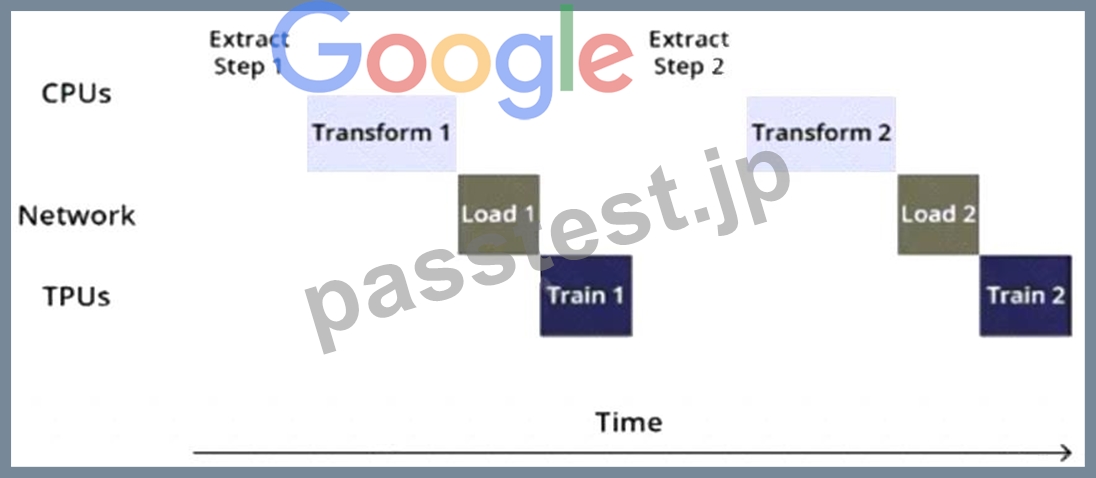
- A. Rewrite your input function to resize and reshape the input images.
- B. Rewrite your input function using parallel reads, parallel processing, and prefetch.
- C. Move from Cloud TPU v2 to 8 NVIDIA V100 GPUs and increase batch size.
- D. Move from Cloud TPU v2 to Cloud TPU v3 and increase batch size.
正解:B
解説:
The trace in the question shows that the training time is taking longer than expected. This is likely due to the input function not being optimized. To decrease training time in a cost-efficient way, the best option is to rewrite the input function using parallel reads, parallel processing, and prefetch. This will allow the model to process the data more efficiently and decrease training time. References:
* [Cloud TPU Performance Guide]
* [Data input pipeline performance guide]
質問 # 90
......
あなたを合格させるGoogle Cloud Certified Professional-Machine-Learning-Engineer試験問題集で2024年11月03日には273問あります:https://www.passtest.jp/Google/Professional-Machine-Learning-Engineer-shiken.html
最新のGoogle Professional-Machine-Learning-EngineerのPDFと問題集で(2024)無料試験問題解答:https://drive.google.com/open?id=1OjS1nnSOVaR3UNC5bd7mkrCBJw00AZE8